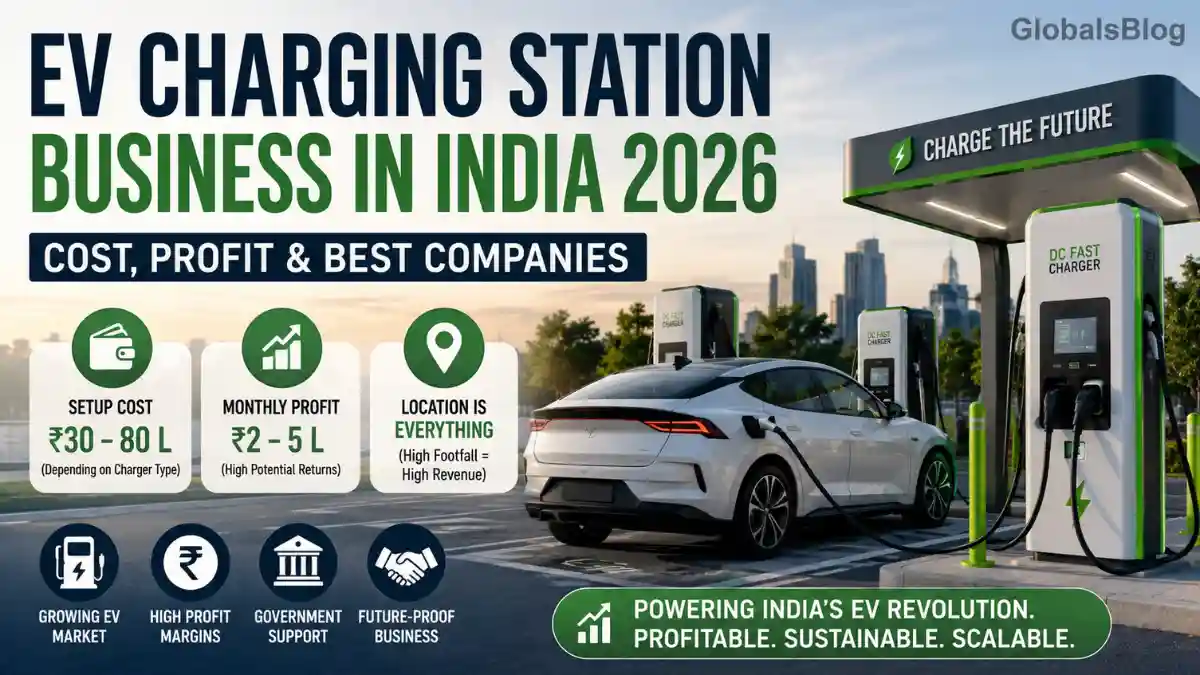
Setup: ₹30–80 L. Monthly profit: ₹2–5 L. But location, logistics, and operator skill determine if you make money or burn cash. Here is the complete financial breakdown for 2026.
Can You Actually Make Money Running EV Chargers?
- Yes, but with caveats. A DC fast charger in a premium location (highway, metro city) can generate ₹2–5 L monthly profit. An AC charger in a mediocre location barely breaks even.
- Capital requirement is brutal. DC fast charger: ₹50–80 L setup (charger + civils + land lease). AC charger: ₹10–25 L setup. You're betting ₹50 L+ on location success with 3–4 year payback periods.
- Utilization is the killer variable. A DC charger at highway rest stop: 40–60 sessions/day (profitable). A DC charger in a medium city: 8–12 sessions/day (break-even). Poor location decisions destroy margins.
- Government subsidies are real but shrinking. FAME subsidy up to 30% of capex, but declining year-over-year as deployment accelerates. Count on 20% subsidy by 2026, not 30%.
- Competition is intensifying. Tata Charging, Shell Recharge, Croma Now, Chargepoint—these established players have density, brand, and APIs that kill margins for independent operators. New entrants need a differentiation angle (highway-specific, apartment-focused, etc).
2026 Market Reality: Average DC charger utilization: 18 sessions/day (vs 40+ needed for profitability). 35,000 public charging points deployed (vs 10,000 just two years ago). Charging rates declining 8–12% annually as competition increases. Payback period: 42–54 months for most new installations. The gold rush is over; the infrastructure play is beginning.
Complete Cost Breakdown: Setting Up an EV Charging Station
Note: Costs vary significantly by region, grid infrastructure availability, and local permit complexity. Highway locations typically require more civils (higher cost). Urban metro locations face higher land costs but better utilization.
Profit Analysis: What Actually Happens Month-to-Month
Scenario 1: DC Fast Charger (50 kW) — Highway Premium Location
Reality check: This assumes 45 sessions/day (ambitious for most locations). Actual highway chargers average 18–25 sessions/day, bringing profit down to ₹2–4 L/month. Payback period: 18–24 months at these rates.
Scenario 2: DC Fast Charger (50 kW) — Medium City Location
Reality check: At 12 sessions/day, your ₹40–50 L investment takes 65+ months to break even. After accounting for depreciation (₹30–40K/month), you're barely profitable. This is why independent operators struggle.
Scenario 3: AC Charger Network (4-charger residential setup)
Reality check: AC chargers are boring but reliable. Lower upfront cost (₹13–22 L), slower payback (48–60 months), but steady margin if utilization is reasonable. This is the "boring money" play.
The Margin Breakdown: Where Money Gets Eaten
| Cost Component | % of Revenue | Impact on Margins |
|---|---|---|
| Electricity Cost | 45–55% | Your single biggest variable cost. Grid rates vary ₹5–8/kWh by region. Higher rates kill margins instantly. |
| Fixed Operating Costs (Staff, Rent, Maintenance) | 20–30% | Chargers need 24/7 monitoring for safety, liability. Can't cut this without risking downtime. |
| App/Platform Fees (Tata, Shell, Croma) | 10–15% | You must integrate with 3–4 major networks for visibility. Each takes 8–12% of transaction value. |
| Depreciation & Capital Servicing | 10–12% | Equipment lasts 5–7 years. You're carrying ₹40–50 L debt at 10% interest. This compound strangles cash flow. |
| Margin (If Everything Goes Right) | 5–8% | That's why the business is hard. A 1–2% cost increase wipes out profit. Location/utilization determines everything. |
"The EV charging business is a venture play, not a utility play. You're not building for current returns—you're betting on margin compression reversing, volume scaling, or behavioral data monetization. Anyone entering this purely for 5-year ROI is delusional." — Industry analyst, major EV charging infrastructure fund, 2026
Who's Actually Winning: The Major Players in 2026
Insight: Winner-take-most dynamics are obvious. Tata Charging's density gives them cost advantage on platform fees (negotiating power). Shell's premium pricing works because they own the brand. Independent operators are getting crushed by scale disadvantage. If you're thinking about starting a charging business as an independent operator in 2026, you're already late.
Regulatory & Subsidy Reality 2026
- FAME II Subsidy declining: 30% in 2024 → 20% in 2026 → 10% estimated 2027. Plan for decreasing subsidy support.
- Electricity rate caps (proposed): Some states are capping DC charger rates at ₹55–60/kWh (vs ₹70+ current). Regulatory pressure will compress margins 10–15% over next 18 months.
- Grid infrastructure standards tightening: New chargers must meet stricter grid compatibility requirements (₹2–4 L extra cost in some regions).
- Safety liability increasing: Fire incidents in one charger network can trigger industry-wide safety mandates, raising compliance costs.
- Land acquisition complexity: Government land for chargers is becoming restricted. Private land leases getting expensive (₹50K–2 L/month for highway premium spots).
Should You Actually Start an EV Charging Business?
Green Light ✅ If You Have:
- Capital for a dense network (10+ chargers), not just 1–2 spots. Density gives you negotiating power on platform fees (8% vs 12%) and operator efficiency.
- Location advantage: Highway concession, tier-1 city land lease, or retail partnership (Croma, fuel station).
- Operational expertise: You understand electricity procurement, utility negotiation, and 24/7 operations.
- 5+ year payback patience. This isn't quick money. You're playing a 10-year infrastructure game.
- Differentiation angle: Not just "another charger," but fleet management, apartment integration, workplace charging, etc.
Red Light ❌ If You're Planning To:
- Set up a single DC charger and expect ₹5 L/month profit. Location utilization is 50/50. Most fail.
- Build independently without integrating into major networks. No one will use a standalone app. You need Tata + Shell + Croma + ChargePoint integration, but each takes 10–12% margin.
- Depend on government subsidies for profitability. Subsidies are declining. Your unit economics must work without them.
- Avoid understanding electrical grid dynamics. Electricity costs and grid upgrades can swing your margins 20–30%. This isn't optional knowledge.
Related:
The Truth About EV Charging in 2026
EV charging is a critical infrastructure business, not a quick-money business. The winners (Tata Charging, Shell, Reliance, Croma) are treating this as a 10-year play to build density, capture data, and own customer relationships. Margins are tight. Competition is crushing. Location determines 70% of success.
If you're disciplined about location, patient about payback, and willing to operate 24/7, there's money to be made. But this is operational excellence, not entrepreneurial shortcut. You're competing against better-capitalized, faster-scaling enterprises. Your only advantage is local obsession and superior execution.
The gold rush is over. The actual mining is just beginning.
Leave a comment
Share a quick thought about this story.
Thanks for sharing your view. It is ready for review.
Please try again in a moment.