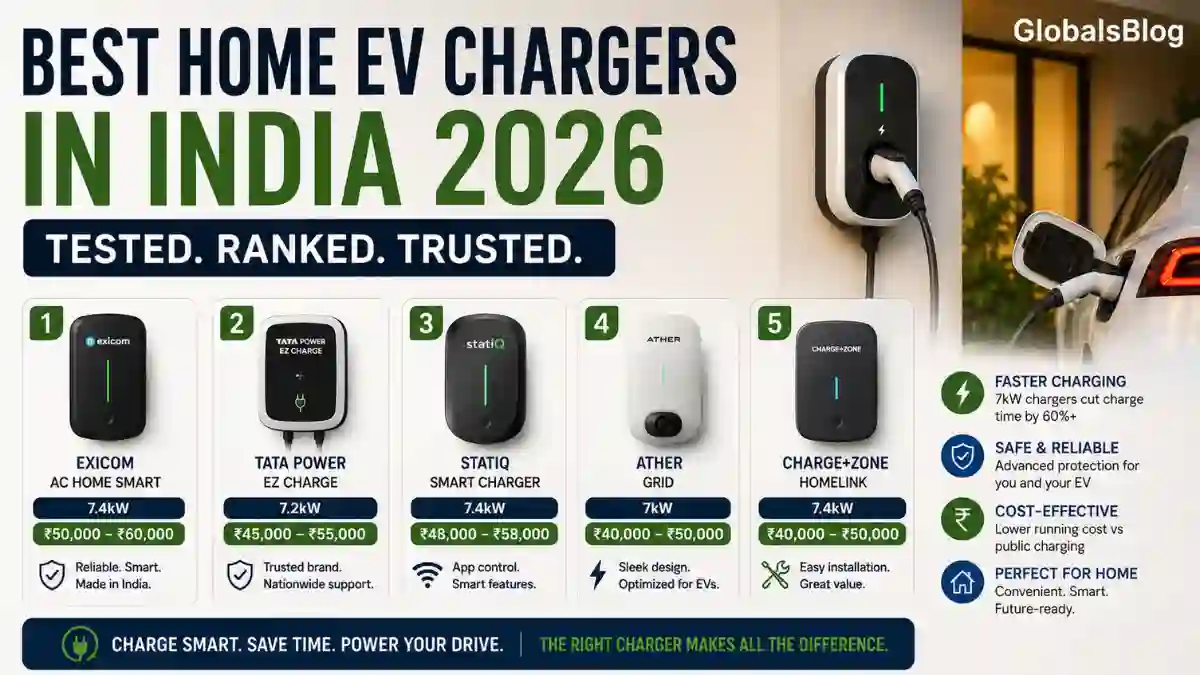
Your dealership is bundled cable takes 14 hours. The right 7kW wallbox takes 5. Here are the best home EV chargers available in India right now — with honest prices, specs, and what they're actually like to live with.
Also Searched As
- I Installed 3 Different Home EV Chargers in India — Here's What Nobody Tells You First
- Why That Free Charger from Your Dealership Is Actually Costing You More in 2026
- Best 7kW Home EV Charger India 2026: Exicom, Tata Power, Delta — Which One Actually Wins?
India crossed 1.5 million EV sales last year — and a quiet crisis followed almost every single one home. The bundled 3.3kW portable charger that came in the box looks fine in a brochure. In practice, it draws near-continuous high load on a standard 15-amp socket, takes 12–14 hours to fully charge a mid-range 40kWh battery, and is genuinely dangerous over time if your home wiring is anything less than pristine.
The best home EV chargers in India aren't just faster. They are fundamentally different devices — wall-mounted, dedicated-circuit units that protect your battery, communicate with your car's onboard management system, and give you a full charge every morning without a second thought. This guide ranks the top five, explains what to look for, and tells you exactly what the total cost of getting set up looks like in 2026.
Quick Answer
Best overall: Tata Power EZ Charge 7.4kW Wallbox — best service network, OEM integration, app experience. ₹15,000–₹22,000 for hardware; total installed cost ₹25,000–₹45,000.
Best for reliability: Exicom CPD 7.2kW — IP67 rating, surge-protected for Indian grid fluctuations, trusted by MG, Hyundai, and Audi home delivery programmes.
Best premium pick: ABB Terra AC Wallbox 7.4kW — European engineering, tri-phase 22kW option, ideal if you're considering commercial expansion or V2G readiness.
Minimum recommended spec: 7kW AC wallbox, Type 2 / CCS2 compatible, IP55+ weather rating, app connectivity, dedicated 32A circuit. Do not install below this threshold if you have a 40kWh+ battery vehicle.
Level 1 vs Level 2 vs DC Fast: What You Actually Need at Home
Before comparing products, it's worth understanding what the three levels of EV charging mean in practical Indian terms — because most buyer confusion starts here.
3.3kW Portable
- Standard 15A socket
- 12–16 hrs for full charge
- Risks socket overheating
- Comes bundled with car
- No smart features
7–22kW Wallbox
- Dedicated 32A circuit
- 5–8 hrs for full charge
- App, scheduling, safety
- Ideal for daily home use
- ₹15K–₹75K installed
50kW+ DC Charger
- 30–60 min to 80%
- Very high infrastructure cost
- Accelerates battery wear daily
- For public / commercial use
- Not practical for residential
The verdict for Indian homes is clear: a 7.4kW or 11kW AC Level 2 wallbox is the right target. It charges fast enough for overnight use, gentle enough to preserve long-term battery health, and affordable enough to justify against the time and risk savings. DC fast charging daily at home would degrade your battery faster — and the infrastructure cost is absurd for residential use anyway.
The Indian Grid Reality Most Guides Ignore
Indian household voltage fluctuates between 190V and 250V in most cities — wider swings than European standards. A good home EV charger must have active surge protection, an automatic voltage monitoring circuit, and ideally an IP67 weatherproof rating. Cheap uncertified chargers from aggregator websites may lack all three. A single voltage spike can damage both the charger and your car's onboard converter. Always buy BEE-certified equipment from a brand with service centres in your city.
What Does a Home EV Charging Station Actually Cost in India?
Full breakdown of hardware prices, installation labour, DISCOM load upgrade fees, and state subsidies — everything you need to budget accurately before buying.
Tata Power EZ Charge Home Wallbox
7.4kW AC · Type 2 · India's most widely installed home charger
Tata Power has installed over 1.4 lakh home chargers across India — a scale no competitor comes close to matching. For most buyers, that number alone settles the debate. When you buy a Tata Nexon EV, Punch EV, or Tiago EV, your dealership will offer to arrange a Tata Power home installation as part of delivery. The process is genuinely smooth: an app-based booking, a site visit, and a certified installation team — all coordinated through the EZ Charge platform.
The charger itself is compact, wall-mounted, and compatible with all Type 2 connector EVs — which includes virtually every four-wheeler sold in India. The EZ Charge app handles scheduling, usage monitoring, and remote start/stop. The IP55 rating handles monsoon conditions. It is not the most feature-rich charger in this list, but it is the most supported — with service centres in 100+ cities and a helpline that actually answers.
One important note: the hardware price of ₹15,000–₹22,000 is just the charger unit. Total installed cost including 6mm copper wiring, MCB/RCCB switchgear, conduit, and potentially a DISCOM sanctioned load upgrade will range from ₹25,000 to ₹45,000 depending on your city and the distance from your main electrical panel.
Strengths
- India's largest home charger service network
- Seamless Tata EV delivery integration
- Best app experience for Indian users
- Most affordable branded option
Limitations
- IP55 (not IP67 like Exicom)
- No 11kW or 22kW home variant
- Best suited for Tata EV ecosystem
Best EV Charging Apps in India 2026 — Ranked & Reviewed
The EZ Charge app is great for home charging. But when you're on the road, you need the right app for public networks. Here's the complete guide to India's best EV charging apps in 2026.
Exicom CPD 7.2kW Home Charger
7.2kW AC · Type 2 · IP67 · India's grid-hardened specialist
Exicom is the name that keeps coming up among EV technicians, fleet operators, and OEM delivery programmes — not the name that comes up in flashy ads. Gurugram-based Exicom supplies chargers to MG Motors, Hyundai, and Audi's India home charging programmes, and has deployed over 20,000 AC and DC chargers across the country. That pedigree matters when you're talking about a device that will draw 32 amps from your home circuit every single night for five years.
The standout spec is the IP67 weatherproof rating — full dust protection and immersion resistance. Most competing home chargers in India are IP54 or IP55. In a country with monsoon flooding, coastal humidity, and construction dust, IP67 is not overkill. The built-in surge suppression and active voltage monitoring circuits are specifically tuned for Indian grid conditions — voltage fluctuations that would cause cheaper chargers to fault out are managed gracefully here.
Exicom also offers 11kW and 22kW variants for homes with three-phase supply — genuinely useful if you have multiple EVs or plan to eventually use Vehicle-to-Grid (V2G) bidirectional charging, which Exicom is already piloting. The downside is price: hardware alone runs ₹40,000–₹55,000, making it the most expensive wallbox in this list.
Strengths
- IP67 — best weather protection in category
- Purpose-built for Indian grid conditions
- 11kW/22kW options for future-proofing
- V2G bidirectional charging ready
Limitations
- Most expensive home charger here
- Service centres thinner outside Tier 1 cities
- App less polished than Tata Power
Delta AC Mini Plus 7.4kW
7.4kW AC · Type 2 · App + OTA + Solar-ready
Delta Electronics is a global leader in power electronics — their technology is inside a significant portion of India's public charging network, including Tata Power and ChargeZone installations. The AC Mini Plus brings that industrial pedigree into a compact, apartment-friendly home package. At roughly 200mm × 130mm wall footprint, it's one of the most discreet wallboxes available in India.
The smart features are where Delta earns its price premium. Over-the-air firmware updates mean your charger gains new capabilities without a service visit. Real-time energy monitoring lets you track per-session costs accurately. The solar integration API is a standout for anyone who has or is planning a rooftop solar system — the charger can be configured to prioritise excess solar generation before drawing from the grid, a feature that can meaningfully reduce running costs over a five-year horizon.
Delta also scores highly on compatibility: it works with every major four-wheeler EV sold in India today and supports OCPP (Open Charge Point Protocol), meaning it can integrate with third-party energy management systems if your home setup demands it.
Strengths
- Best smart features & OTA updates
- Solar PV integration — reduce grid draw
- OCPP-compatible for smart home setups
- Compact, apartment-friendly design
Limitations
- Higher price than Tata Power
- Service requires calling Delta directly
- Smart features add setup complexity
Step-by-Step: How the Home EV Charger Installation Process Actually Works
From DISCOM load upgrade application to MCB sizing to final Form-4 Test Report — here's exactly what happens between buying a charger and your first overnight charge.
ABB Terra AC Wallbox 7.4kW
7.4kW / 22kW (3-phase) · Type 2 · Wi-Fi + RFID + Ethernet
ABB is one of the world's most respected names in electrical infrastructure, and the Terra AC Wallbox is the product of that heritage. For Indian buyers, it occupies a specific niche: the premium villa or bungalow owner who wants the best hardware available, may have three-phase power supply, and is considering a charger that could eventually serve two or three vehicles or double as a commercial charger for guests.
The 22kW three-phase variant is the most powerful home charger legally usable in India on a domestic connection (subject to your DISCOM's sanctioned load limits). It can charge a vehicle with a compatible 22kW onboard charger from 20% to 80% in under two hours — useful for households where charging windows are constrained. The RFID access control is handy for apartment complexes or shared garages where you want to prevent unauthorised use.
The honest caveat: most Indian homes run single-phase supply, which means you'd be using the 7.4kW mode regardless. If single-phase is your reality, the ABB's price premium over Exicom or Delta is hard to justify purely on home performance grounds. It earns its place for buyers actively thinking about future commercial use or resale premium.
Strengths
- 22kW option — India's fastest home charger
- RFID access control for shared spaces
- Globally certified, premium build quality
- Wi-Fi + Ethernet + OCPP 1.6
Limitations
- Most expensive option on this list
- 22kW useless without 3-phase supply
- IP54 — lower weather rating than Exicom
Okaya EV Home Wallbox 7.4kW
7.4kW AC · Type 2 · Government-approved · DISCOM partnerships
Okaya is India's largest battery manufacturer repurposing deep electrical expertise into EV charging hardware. The home wallbox benefits from that heritage: solid thermal management, BEE-certified components, and a government-approved product that qualifies for DISCOM subsidy programmes in Delhi, Maharashtra, and select other states. If you are in a state that offers a ₹6,000–₹10,000 home charger subsidy, Okaya's approvals make subsidy processing straightforward in ways that some imported chargers complicate.
The app functionality covers the basics — charging schedules, energy monitoring, session history — without the advanced solar integration or dynamic load management of Delta. For a buyer who wants a reliable, Made-in-India 7.4kW unit at a mid-range price point with government recognition, Okaya delivers genuine value. It's also the best option for buyers in smaller cities where ABB or Delta's service reach is thin.
Strengths
- Government-approved, qualifies for subsidies
- Strong value — lowest price for 7.4kW
- Made in India, deep electrical supply chain
- Good Tier 2/3 city support
Limitations
- App less polished than Tata Power/Delta
- No 11kW/22kW variant
- Brand recognition lower than peers
All 5 Home EV Chargers: Side-by-Side Comparison
| Charger | Output | IP Rating | HW Price | Best For |
|---|---|---|---|---|
| Tata Power EZ Charge | 7.4 kW | IP55 | ₹15K–₹22K | Tata EV owners |
| Exicom CPD 7.2kW | 7.2–22 kW | IP67 | ₹40K–₹55K | Max reliability |
| Delta AC Mini Plus | 7.4 kW | IP55 | ₹35K–₹50K | Solar + smart home |
| ABB Terra AC | 7.4–22 kW | IP54 | ₹55K–₹75K | Premium / 3-phase |
| Okaya Wallbox | 7.4 kW | IP55 | ₹18K–₹28K | Subsidy + value |
Total installed cost — hardware + certified electrician + copper wiring + MCB/RCCB + conduit + potential DISCOM load upgrade — adds ₹15,000–₹30,000 on top of hardware prices for most setups. Budget ₹35,000–₹75,000 in total depending on your city, the distance from your main panel, and whether your sanctioned load needs upgrading.
Thinking Beyond Home? EV Charging Station Business Cost & Profit in India
If you're considering installing a charger in your apartment complex, office, or as a commercial venture — here's the full cost-profit breakdown for EV charging station businesses in India 2026.
5 Things to Check Before You Buy Any Home EV Charger
The charger brand matters less than getting these five things right first. Every service engineer who installs home EV chargers in India regularly sees avoidable problems that stem from skipping this checklist.
Check Your Sanctioned Load Limit
Most Indian homes have a sanctioned load of 3–5 kW from their DISCOM. A 7.4kW charger running alongside an AC, refrigerator, and water heater will trip your main breaker repeatedly unless you upgrade. Apply for a load upgrade before the charger is even purchased — the paperwork in many DISCOMs takes 2–4 weeks.
Insist on 6mm² ISI-Marked Copper Cable
The cable run from your main panel to the charger must be 6mm² copper — not aluminium, not 4mm², and not the wire your local electrician "has in stock." Aluminium cables expand and contract differently under sustained 32A load and are a genuine fire risk. Always verify the cable specification before work begins.
Verify BEE Certification and IEC 61851-1 Compliance
In 2026, home insurance policies in India are increasingly including clauses that void fire coverage if an uncertified EV charger is involved. Always buy BEE-rated hardware and ensure your installer provides the mandatory Form-4 test report for your DISCOM load upgrade application.
Apartment Owners: Get the RWA NOC in Writing First
Many Resident Welfare Associations attempt to block private EV charger installations — often unlawfully. Under current Ministry of Housing guidelines, RWAs cannot legally prevent individual flat owners from installing personal EV chargers if safety norms are followed. That said, get a written NOC before spending money on installation to avoid disputes mid-work.
Apply for an EV-Specific Meter (Where Available)
Delhi, Haryana, Maharashtra, and Tamil Nadu offer EV-specific electricity meters with subsidised per-unit rates — typically ₹0.50–₹1.50/kWh lower than standard domestic tariff. Over five years of daily charging, this saves ₹15,000–₹35,000. The application is straightforward and entirely worth the one-time effort.
⚡ Best Home EV Charger India: Quick Buyer Checklist (Featured Snippet)
- Minimum spec: 7kW AC wallbox, Type 2 connector, IP55+ rating, dedicated 32A circuit, BEE-certified hardware.
- Budget the total installed cost — not just hardware. Factor in wiring, MCB, conduit, and DISCOM load upgrade: ₹35,000–₹75,000 total depending on setup.
- Charge between 1 AM and 5 AM to catch the most stable grid voltage and, where applicable, the lowest off-peak electricity tariff.
- Set your car to charge to 80% daily, reserving 100% for weekend trips — it extends long-term battery health meaningfully.
- IP67 (Exicom) is worth paying for if your parking is exposed to monsoon rain, coastal humidity, or open-air conditions.
- If you have solar panels or plan to install them, choose Delta AC Mini Plus for its solar-first charging mode.
- Always use a licensed C-Certificate electrician for the installation — uncertified work voids warranty and may void home insurance.
"A 7.4kW wallbox means you plug in after dinner and wake up to 100%. The bundled cable forces you to plan your entire weekend around your battery percentage. It's not the same category of device." — International Brand Equity, March 2026
The Contrarian Truth: The "Best" Charger Depends on What You're Plugging It Into
Here's something most buying guides gloss over: the charger's output is always capped by your car's onboard AC charger (OBC), not the wallbox spec. A Tata Nexon EV Max accepts a maximum of 7.2kW AC input. A Hyundai IONIQ 5 accepts 11kW. An MG ZS EV accepts 7.4kW. Buying a 22kW ABB wallbox for your Nexon EV is paying for capability your car will never use at home.
Match your wallbox to your vehicle's OBC rating, then add one step of headroom for your next car. A 7.4kW wallbox is correct for every mass-market Indian EV sold today. Only spend up to 11kW or 22kW if you already own — or are actively planning to buy — a vehicle with a matching OBC. This distinction alone can save you ₹20,000–₹40,000 in hardware costs.
The Future-Proofing Case for Exicom's Bidirectional Charger
Exicom is piloting Vehicle-to-Grid (V2G) bidirectional home chargers in India — devices that let your EV battery send power back to your home during a grid outage or peak-tariff period. If this technology reaches mass availability in 2027–28 as expected, owners with Exicom hardware will have a software-update upgrade path. Buyers thinking 7–10 years ahead may find the premium worth it purely for V2G optionality.
Your Best Home EV Charger Is the One That Fits Your Setup — Not the One with the Most Stars
The best home EV charger in India in 2026 is whichever device matches your vehicle's OBC, fits your parking setup, and is backed by a service network you can actually call. For most buyers — Tata EV owners, first-time charger purchasers, or anyone who wants a simple install-and-forget experience — the Tata Power EZ Charge wins on value and support. For buyers who want maximum hardware resilience, Exicom's IP67 unit is the professional's choice. For solar home owners, Delta AC Mini Plus. For premium three-phase setups, ABB Terra. For subsidy-eligible buyers in Tier 2 cities, Okaya.
Before you finalise any charger, read the full breakdown of home EV charging station costs in India — the total installed figure often surprises first-time buyers who budget only for hardware. And once you've sorted the home setup, bookmark India's best EV charging apps for everything that happens outside your garage. If you're thinking bigger and considering a commercial or society-level installation, the EV charging station business cost and profit guide covers the commercial side comprehensively. Finally, for the step-by-step installation walkthrough, head to the home EV charger installation process guide.
Get the right charger installed correctly once, and every morning starts the same way: full battery, zero anxiety.
Leave a comment
Share a quick thought about this story.
Thanks for sharing your view. It is ready for review.
Please try again in a moment.