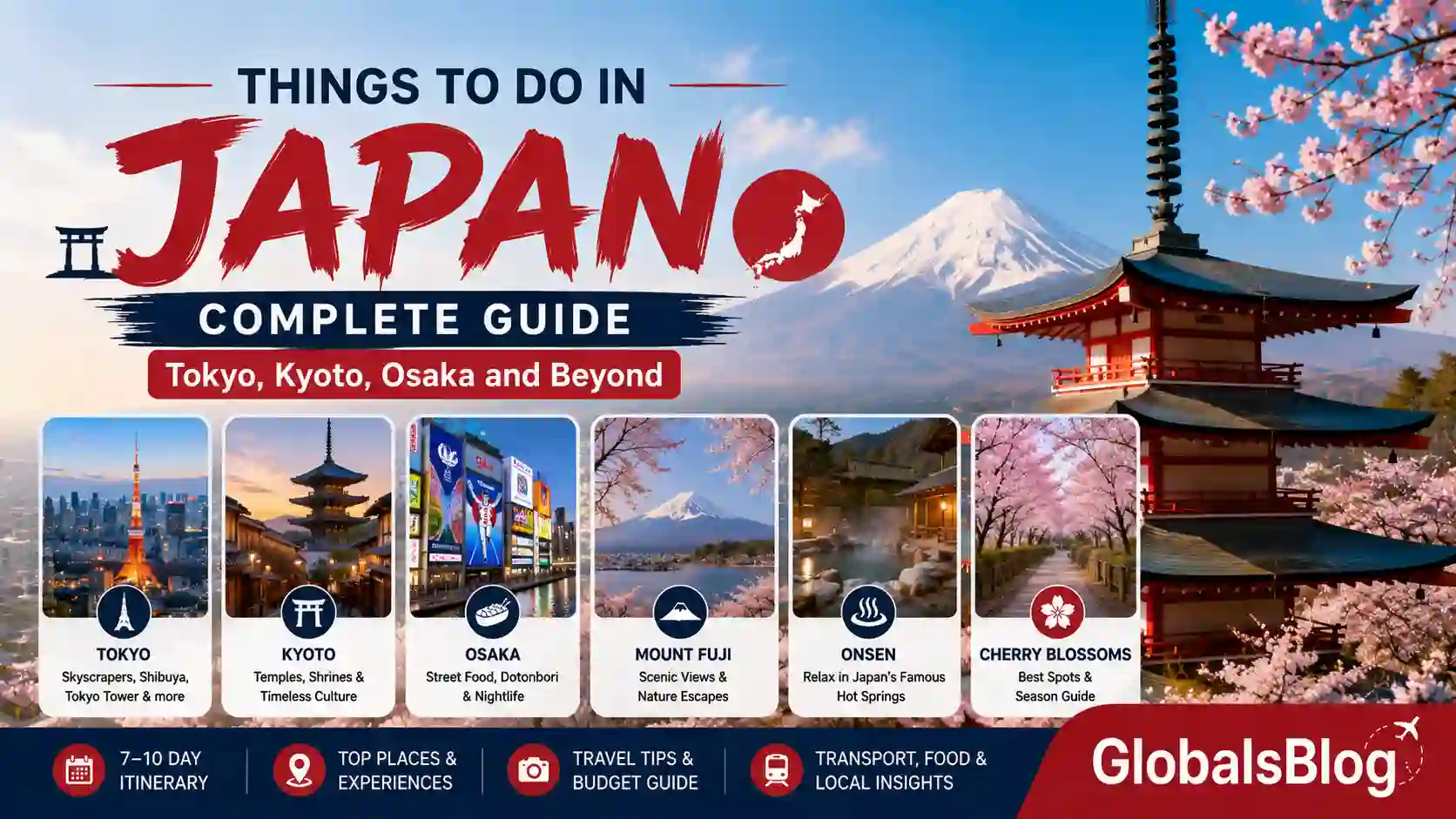
Japan is the rare destination where first-time visitors return immediately planning their second trip. The food, the efficiency, the culture, and the sheer range of experience in one country makes it unlike anywhere else.
A reader from Mumbai spent ten days in Japan and came back describing it as the best trip of her life — not for a single spectacular moment, but for the accumulation of small ones. The vending machine coffee at a train station in rural Kyoto. The quiet of Fushimi Inari Shrine at 6am before the tour groups arrived. A bowl of ramen at a counter restaurant where nobody spoke English and the experience was entirely communicated through pointing and gratitude. Japan rewards travellers who show up curious rather than those who show up with the longest to-do list. This guide gives you the framework for both: the unmissable landmarks and the slower discoveries that define why people return.
The best things to do in Japan are: experience Shibuya Crossing and Senso-ji Temple in Tokyo, visit the Fushimi Inari Shrine at dawn in Kyoto, walk the Arashiyama Bamboo Grove, eat your way through Dotonbori in Osaka, take a day trip to see Mount Fuji from Hakone, feed the deer at Nara Park, soak in an onsen in a traditional ryokan, ride the Shinkansen bullet train between cities, and witness cherry blossoms in spring or autumn foliage in November. The classic first-timer route is Tokyo (3–4 nights) → Kyoto (2–3 nights) → Osaka (1–2 nights), with day trips to Nara, Hakone, and Hiroshima. The JR Pass makes this circuit affordable and seamless.
Japan by City — Choose Your Base Before Choosing Activities
Japan''s main tourist cities each have a completely different character. Planning around which city you are staying in — rather than trying to do everything from one base — produces a far more rewarding experience.
| City | Character | Best For | Days Needed |
|---|---|---|---|
| Tokyo | Futuristic, vast, electric | Food, technology, pop culture, neighbourhood exploration | 3–5 nights minimum |
| Kyoto | Historic, spiritual, traditional | Temples, shrines, geisha districts, bamboo groves | 2–3 nights |
| Osaka | Lively, food-obsessed, social | Street food, nightlife, Universal Studios Japan | 1–2 nights |
| Nara | Calm, ancient, deer | Day trip from Kyoto or Osaka — Nara Park, Todai-ji | Half to full day |
| Hiroshima | Profound, peaceful, important | Peace Memorial Museum, Miyajima Island floating torii | Full day or overnight |
| Hakone | Nature, onsen, Mount Fuji views | Ryokan stay, onsen, best accessible Mount Fuji viewpoint | 1–2 nights |
Best Things to Do in Japan — City by City
Tokyo is the largest city in the world, with a population of 37 million — with 50% more people than all of Australia. It is a true metropolis, with a dizzying array of things to see, do, and eat, from futuristic Shibuya to historic Yanaka, to trendy Harajuku and luxurious Ginza. The most iconic Tokyo experience is Shibuya Crossing — the world''s busiest pedestrian intersection, best experienced from the Shibuya Sky observation deck above for the bird''s eye view, and from ground level at rush hour. Senso-ji Temple in Asakusa is Tokyo''s oldest temple — arrive before 8am to experience the vermillion gate (Kaminarimon) and the Nakamise shopping street without crowds. Tsukiji Outer Market for breakfast sushi and seafood. Harajuku and Takeshita Street for street fashion and crepes. The teamLab Planets immersive digital art experience in Toyosu. In 2026, PokéPark Kanto opened inside Yomiuriland Amusement Park — the world''s first permanent outdoor Pokémon park — and the Edo-Tokyo Museum has reopened after renovation.
Kyoto was the Imperial capital of Japan for more than 1,000 years, creating a legacy of incredible art, architecture, culture and cuisine. Kyoto was spared from WWII bombing which flattened many other Japanese cities, making it one of the few Japanese cities with well-preserved historic buildings and streetscapes. The single most important Kyoto experience is Fushimi Inari Shrine — one of Kyoto''s shrine-and-temple highlights with its famous red torii gates — visited at 6am before tour groups arrive, when the thousands of vermillion gates ascending the mountain belong almost entirely to you. Kinkaku-ji (Golden Pavilion) and Ginkaku-ji (Silver Pavilion), the Higashiyama historic districts, and the Arashiyama bamboo grove are the other essential Kyoto experiences. The Gion district in the evening, where geisha (geiko) and apprentice geisha (maiko) move between teahouse engagements, is the most atmospheric evening walk in Japan. In 2026, Kyoto welcomed the Imperial Hotel Kyoto — a ¥12.4 billion ($78.4 million) restoration of the historic 1936 Yasaka Kaikan building near the Gion district, now operating as a luxury hotel. The Nintendo Museum in Kyoto is now open — interactive exhibits, iconic games and rare collections for visitors of all ages.
Osaka is known for being very down to earth, a little bit rowdy, and totally food-obsessed. Osaka is only a 15-minute bullet train from Kyoto but has a totally different energy. It has a lively evening atmosphere and Osaka Castle as its heritage anchor. Dotonbori is the heart of Osaka''s food and entertainment district — a canal-side street of illuminated restaurant signs, street food stalls, and the famous mechanical Kani Doraku crab. Standout dishes to try when exploring Japanese street food include the iconic takoyaki octopus balls and sweet taiyaki fish-shaped cakes. Osaka Castle surrounded by its moat and park is one of Japan''s most photogenic heritage landmarks. Universal Studios Japan (USJ) is a major draw for families — the Super Mario World area, Minions, Harry Potter, and seasonal attractions. USJ is a 30-minute train ride from Osaka Station. The Kuromon Market (Osaka''s kitchen) for morning browsing and fresh seafood on sticks is one of the finest food market experiences in Asia.
Hakone is the best accessible location for Mount Fuji views — Mount Fuji is only about 2.5 hours away by bus from popular cities such as Tokyo, Osaka, and Kyoto. As one of Japan''s most iconic landmarks, Mount Fuji attracts worldwide tourists to see this awe-inspiring beauty. Hakone also has excellent onsen hotels with Mount Fuji views and the famous open-air sculpture museum. Nara is a half-day from Kyoto or Osaka — feeding the deer at Nara Park is a great option and the Todai-ji temple housing Japan''s largest bronze Buddha is one of Japan''s most impressive single buildings. Hiroshima is a full-day trip from Osaka or Kyoto by Shinkansen — the Peace Memorial Museum is one of the most important and emotionally affecting museum experiences available anywhere in the world, and Miyajima Island''s floating torii gate (Itsukushima Shrine) is one of Japan''s three most iconic views. Allow a full day minimum for Hiroshima and Miyajima combined.
Top Japan Experiences — The Unmissable List
| Experience | Where | Best Time | Cost (approx) | Verdict |
|---|---|---|---|---|
| Fushimi Inari at dawn | Kyoto | 6–7am any day | Free | Most Iconic Experience |
| Shinkansen bullet train | Between cities | Any time | JR Pass (buy in advance) | Most Unique Transport |
| Onsen at a ryokan | Hakone / anywhere | Evening soak | From ¥15,000/night | Most Relaxing |
| Arashiyama Bamboo Grove | Kyoto | Early morning | Free | Most Photographed |
| Dotonbori food walk | Osaka | Evening | ¥2,000–5,000 food budget | Best Food Experience |
| Tea ceremony | Kyoto | Morning | ¥2,000–5,000 | Best Cultural Immersion |
| Sumo tournament (live) | Tokyo / Osaka | Jan, May, Sep (Tokyo); Mar (Osaka) | ¥2,200–¥14,800 | Most Unique Sport |
| Cherry blossoms (hanami) | Nationwide | Late Mar–early Apr | Free to watch | Most Seasonal |
Japan 7-Day and 10-Day Itinerary
7-Day Japan Itinerary — First Timer
Days 1–3: Tokyo. Day 1 — Shinjuku, Harajuku, Meiji Shrine, Shibuya Crossing at night. Day 2 — Asakusa (Senso-ji at 7am), Tsukiji breakfast, teamLab Planets, Tokyo Skytree. Day 3 — Day trip to Kamakura (Great Buddha, coastal temples) or Nikko (ornate shrines in the mountains).
Days 4–5: Kyoto. Day 4 — Fushimi Inari at 6am, Nishiki Market, Gion evening walk. Day 5 — Arashiyama Bamboo Grove and Tenryu-ji Garden, Kinkaku-ji, tea ceremony.
Day 6: Nara day trip. Morning Nara Park (deer + Todai-ji), return to Kyoto or continue to Osaka by afternoon.
Day 7: Osaka. Dotonbori street food, Osaka Castle, Kuromon Market, evening flights or overnight stay.
10-Day Japan Itinerary — Extended Circuit
Add to the 7-day base: Day 4 (between Tokyo and Kyoto) — Hakone. One night at a ryokan with onsen and Mount Fuji views, Hakone Open-Air Museum. Day 9 — Hiroshima and Miyajima. Full day: Peace Memorial Museum in the morning, ferry to Miyajima Island for the floating torii and Itsukushima Shrine in the afternoon. Day 10 — Osaka to Kyoto return with additional Kyoto temple exploration (Philosopher''s Path in autumn, Nijo Castle, Daitoku-ji).
Japan Trip from India — Practical Guide
Visa: India requires a visa for Japan. Japan''s tourist visa process is straightforward — submit through a Japan Embassy or authorised travel agent. Processing takes 5–7 working days. Single-entry tourist visa valid for 90 days. No visa on arrival for Indian passport holders — plan applications 3–4 weeks ahead.
Flights: Direct flights from Mumbai and Delhi to Tokyo (Narita or Haneda) on Air India, Japan Airlines, and ANA. Flight time approximately 8–9 hours. Connecting flights via Singapore, Bangkok, or Kuala Lumpur are often significantly cheaper. Check current fares 2–3 months ahead for the best prices.
JR Pass: The Japan Rail Pass covers most Shinkansen (bullet train) services and local JR trains across the country. The 7-day pass (approximately ¥50,000 / ₹28,000) pays for itself with just two round trips between Tokyo and Kyoto. Must be purchased outside Japan — order online before departure from the official JR Pass website or authorised resellers.
Budget: Japan is more affordable than its reputation suggests, especially with a weak yen. Mid-range budget: ¥15,000–25,000 per day (approximately ₹8,500–14,000) covering accommodation, food, local transport, and entry fees. Budget travellers can manage ¥8,000–12,000 per day staying in capsule hotels and eating at convenience stores and ramen counters. See our best time to visit Japan guide for seasonal cost variations.
Japan Travel Tips
- Arrive at famous attractions as early as possible — Fushimi Inari, Arashiyama Bamboo Grove, and Senso-ji are completely different experiences at 6am versus 10am. The crowds that arrive after 9am transform these places entirely
- Get a Suica or IC card at the airport on arrival — a rechargeable contactless card that works on all trains, buses, and vending machines across Japan. Much simpler than buying individual tickets for every journey
- Learn two phrases before arriving: "Sumimasen" (excuse me / sorry) and "Arigatou gozaimasu" (thank you very much). Both will be used constantly and received warmly
- Cash is still important in Japan — many smaller restaurants, temples, and rural attractions do not accept cards. Carry ¥10,000–20,000 in cash at all times
- 7-Eleven, Lawson, and FamilyMart convenience stores are genuinely excellent for meals — onigiri, hot foods, quality sandwiches, and cold drinks at reasonable prices. Eating convenience store meals in Japan is not a compromise; it is an experience
- Book popular restaurants in advance — Tokyo and Kyoto''s most sought-after restaurants require reservations weeks or months ahead. Use Tableall or Pocket Concierge for English-language high-end restaurant reservations
Japan Tourist Mistakes to Avoid
- Visiting Fushimi Inari, Arashiyama, or Senso-ji at midday in peak season — these are genuinely transformative at dawn and overwhelmingly crowded by 10am. The difference between the same place at 6am and 11am is the difference between a travel highlight and a disappointment
- Trying to see too many cities in too few days — the Shinkansen makes it tempting to cover Tokyo, Kyoto, Osaka, Hiroshima, Nara, and Hakone in 7 days. Each city rewards slower exploration. Choose fewer cities and spend more time in each
- Not booking the JR Pass before arriving in Japan — the pass must be purchased outside Japan. Buying tickets individually for Shinkansen travel without the pass is significantly more expensive
- Visiting in Golden Week (late April to early May) without booking everything well in advance — Japan''s domestic travel peak season sends accommodation prices to their annual high and crowds to maximum at all major attractions
- Missing the onsen experience because it "sounds uncomfortable" — bathing in a traditional Japanese hot spring, whether at a ryokan or a public sento, is one of the most genuinely restorative experiences the country offers. The unfamiliarity is much smaller in practice than it sounds in description
Tokyo for Energy. Kyoto for Soul. Osaka for Food. Hakone for Fuji. Hiroshima for Perspective.
Japan rewards every type of traveller — the food obsessive, the temple walker, the technology enthusiast, the nature seeker, and the person who simply wants to sit at a counter restaurant and eat the best ramen of their life. Fushimi Inari at dawn. The bullet train between cities. One night in a ryokan with an outdoor onsen. Cherry blossoms in April or autumn foliage in November. The deer of Nara walking up to take a cracker from your hand. Japan is not a destination you see and cross off a list. It is a destination you experience and immediately start planning to return to.
The best things to do in Japan are visiting Fushimi Inari Shrine at dawn in Kyoto (thousands of red torii gates ascending a forested mountain, free entry), experiencing Shibuya Crossing in Tokyo, walking the Arashiyama Bamboo Grove at 6am, eating your way through Dotonbori in Osaka, taking the Shinkansen bullet train between cities, soaking in an onsen at a traditional ryokan, visiting the Peace Memorial Museum in Hiroshima, seeing Mount Fuji from Hakone, and feeding the deer at Nara Park. The classic first-timer circuit covers Tokyo (3–4 nights), Kyoto (2–3 nights), and Osaka (1–2 nights) with day trips to Nara and Hiroshima.
A minimum of 7 days is recommended for a first Japan trip covering the essential Tokyo-Kyoto-Osaka circuit. 10 days allows the addition of Hakone (for Mount Fuji and onsen), Hiroshima and Miyajima Island, and a slower pace in each city. 14 days enables a deeper exploration including Nara, a night on Koyasan, and potentially Hiroshima plus a northern addition like Kanazawa. Most first-time visitors find 7 days leaves them wanting at least 5 more — Japan is a country that expands the more time you give it.
The two best times to visit Japan are late March to early April (cherry blossom season — sakura transforms parks and temples into pink canopies, the most photographed Japan experience) and November (autumn foliage season — red and gold maple leaves at Kyoto''s temples is Japan at its most visually spectacular). Both periods are peak season with higher prices and crowds — book accommodation 2–3 months ahead. March to May and September to November offer the best overall weather. Avoid Golden Week (late April to early May) and O-Bon (mid-August) for domestic travel peaks. See our complete Japan timing guide for month-by-month breakdown.
Japan is more affordable than its reputation suggests, particularly with a weak yen making it significantly cheaper for Indian rupee holders than it was 5 years ago. A mid-range Japan trip budget from India works out to approximately ₹8,500–14,000 per day including accommodation, food, local transport, and entry fees. Flights from Mumbai or Delhi cost approximately ₹35,000–65,000 return. The JR Pass (approximately ₹28,000 for 7 days) covers Shinkansen and JR train travel between cities and pays for itself quickly. Budget travellers can manage on ₹5,000–8,000 per day by staying in capsule hotels and eating at convenience stores and ramen counters.
Yes — Indian passport holders require a visa to visit Japan. There is no visa on arrival. The tourist visa application is submitted at the Japan Embassy in India or through an authorised travel agent. Processing takes approximately 5–7 working days. A single-entry tourist visa allows stays of up to 30 days (extendable to 90 days in some cases). Apply 3–4 weeks before your travel date to allow sufficient processing time. Required documents typically include passport, recent photographs, flight and hotel bookings, bank statements, and employment/income proof.
Reader Experiences