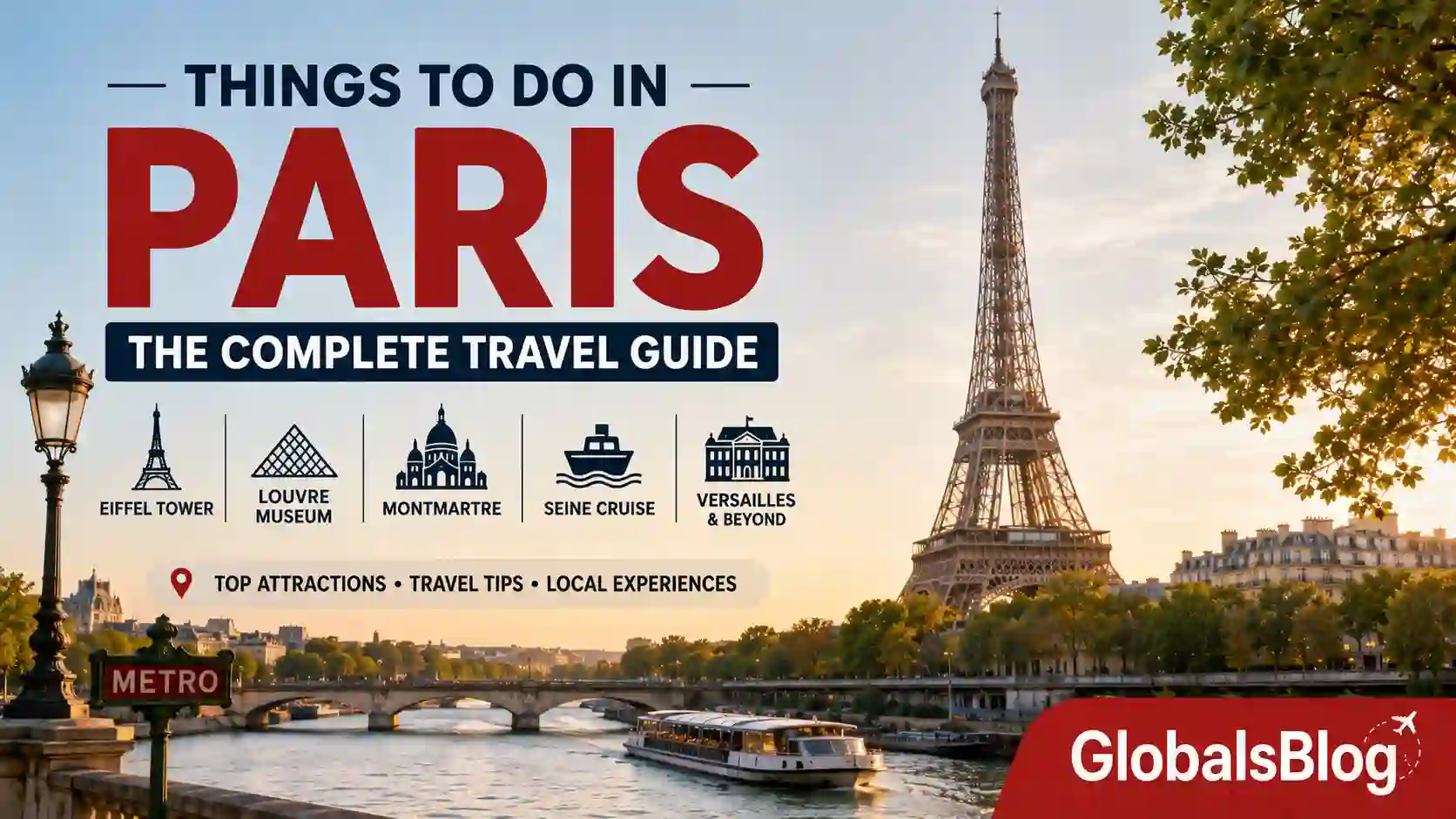
Paris rewards the traveller who looks beyond the obvious. The Eiffel Tower is magnificent. So is the croissant at the corner boulangerie and the view from Montmartre at dawn.
Most first-time visitors to Paris spend three days ticking off the same five landmarks in the same order and leave feeling they have "done" Paris. They have not. Paris is a city that reveals itself slowly — through a neighbourhood explored on foot, a meal at an unremarkable-looking bistro that turns out to be extraordinary, a museum visited at the right time of day when the crowds have thinned. This guide gives you the landmarks you should absolutely see, the neighbourhoods that show you what Paris actually feels like, and the practical knowledge that makes the difference between a frustrating trip and an effortless one.
The best things to do in Paris are: visit the Eiffel Tower at night when it sparkles with 20,000 lights, spend a morning at the Louvre before crowds arrive (Friday evenings after 6pm are the hidden gem), walk Montmartre at dawn when the neighbourhood belongs to locals, take a Seine River cruise at sunset, visit Musée d''Orsay for the world''s finest Impressionist collection, and spend a full day at the Palace of Versailles (closed Mondays). Beyond the landmarks: explore Le Marais for the best food and neighbourhood atmosphere, do a Paris food tour, and walk the Champs-Élysées to the Arc de Triomphe for the finest Paris panorama from above.
Best Things to Do in Paris — The Essential List
The Eiffel Tower is the obvious first entry and deserves its position. On a clear day the views are fantastic — and at night when it shimmers with 20,000 lights, it genuinely earns its reputation. The decision most visitors get wrong is when to go. Midday on a weekend produces hour-long queue times even with pre-booked tickets. The best times are early morning (opening, around 9:30am) for the clearest light and shortest queues, or evening when the illuminations begin. Eiffel Tower tickets are available online 60 days before your visit and tend to sell out fast — book at the official site toureiffel.paris as early as possible. If you want the view without the Eiffel Tower price, the Place du Trocadéro gives one of the best photo spots in Paris and the rooftop bar Ombres at Musée du Quai Branly has spectacular views of the tower.
The Louvre is the world''s most visited museum and contains over 35,000 works across 60,000 square metres — you cannot see it all, so the strategy of "walking in and seeing what happens" produces a frustrating experience for most visitors. Choose two or three specific things you want to see: the Mona Lisa (in the Denon Wing, room 711 — always crowded), the Venus de Milo (Sully Wing), the Winged Victory of Samothrace (Denon Wing, foot of the main stairs). For the Louvre without a wall of people between you and a masterpiece, come Friday nights after 6pm — extended hours mean significantly lower crowd density than daytime visits. Tickets can be bought from the official site louvre.fr — booking in advance is strongly recommended, especially in summer.
Montmartre is not a single attraction — it is a state of mind. This hilltop neighbourhood in the 18th arrondissement is where Picasso, Toulouse-Lautrec, and Modigliani lived, where the can-can was invented, where the Sacré-Cœur Basilica watches over the whole city. The neighbourhood transforms completely depending on when you visit. Arrive before 9am and the steep streets are quiet, the bakeries are just opening, and the views from the steps of Sacré-Cœur take in the whole of Paris in morning light. By 11am, tour groups arrive and the atmosphere changes. Sacré-Cœur entry is free (donations welcome) and the surrounding streets — Place du Tertre, Rue Lepic, the hidden vineyard — reward slow exploration. Notre-Dame Cathedral, having reopened after the 2019 fire, now allows visitors to climb the towers again — a significant addition to Paris in 2026.
The Musée d''Orsay is frequently the more rewarding museum visit for most travellers — it houses the world''s greatest collection of Impressionist and Post-Impressionist art in a converted Beaux-Arts railway station whose architecture is itself remarkable. Monet, Renoir, Degas, Van Gogh, Cézanne, Seurat — the works here are among the most reproduced images in art history, and seeing them in person in a building of this scale is genuinely affecting. The museum is significantly less crowded than the Louvre, allowing you to stand in front of a Van Gogh self-portrait without a wall of phones between you and the canvas. The Musée d''Orsay sits along the scenic banks of the Seine — combine the visit with a walk along the river. Book tickets at musee-orsay.fr.
The Palace of Versailles is one of the most extraordinary buildings on earth — the absolute expression of royal ambition in 17th-century France, where Louis XIV''s court of 20,000 people operated from a palace of 2,300 rooms surrounded by 800 hectares of formal gardens. Getting the context of Louis XIV''s megalomania makes the experience far more interesting, and organised tours handle transport and skip-the-line entry. It is a full-day commitment and worth every minute. The gardens alone justify the trip — the garden fountain shows run on select weekends — check chateauversailles.fr for current 2026 dates. Tuesday through Thursday are the best days to visit — closed Mondays, and weekends are extremely crowded. Take the RER C train from central Paris (approximately 40 minutes).
At the heart of Place Charles de Gaulle, the Arc de Triomphe is one of Paris''s most iconic landmarks — built to honour French troops from the Napoleonic Wars and World Wars, this grand triumphal arch marks the western end of the Champs-Élysées, where twelve avenues meet at Place de l''Étoile. The Tomb of the Unknown Soldier with its eternal flame is inside. Climb to the top for the most spectacular 360-degree view of Paris — twelve avenues radiating outward with the Eiffel Tower in the distance. Entry is via an underground tunnel beneath the roundabout (do not try to cross the traffic). Walk the full length of the Champs-Élysées from the Arc to Place de la Concorde — roughly 1.9 km — to understand Paris''s grand urban design at its most ambitious scale.
Best Neighbourhoods in Paris — Beyond the Landmarks
Le Marais (4th arrondissement) is consistently the neighbourhood most visitors wish they had spent more time in. It holds the Place des Vosges (Paris''s oldest planned square, built 1612), the Musée Picasso, excellent falafel at L''As du Fallafel on Rue des Rosiers, the Marché des Enfants Rouges (Paris''s oldest covered market, dating to 1615), and a concentration of independent boutiques, art galleries, and bistros unmatched in the city. A Paris food tour in Le Marais — walking the neighbourhood, stopping at bakeries, fromageries, wine bars, and market stalls — is one of the most enjoyable ways to spend a morning in Paris. The neighbourhood is also the centre of Paris''s LGBTQ+ community and has an inclusive, diverse street energy that feels genuinely contemporary alongside its medieval architecture.
Saint-Germain-des-Prés (6th arrondissement) is the Paris of literary mythology — Café de Flore and Les Deux Magots were where Hemingway, Sartre, Simone de Beauvoir, and James Baldwin wrote and argued and drank. Both cafés are now tourist landmarks themselves, expensive but worth one coffee for the atmosphere. The Luxembourg Gardens immediately to the south are the most beautiful formal park in Paris — the manicured paths, the octagonal pond, and the palace backdrop make an hour here feel genuinely restorative. The Rue de Buci market area and surrounding streets have excellent fromage and wine shops for assembling a picnic.
Belleville may not be the most famous neighbourhood in Paris — but it might be the coolest. The 20th arrondissement neighbourhood is where Paris''s artistic community has migrated as rents in Montmartre and Le Marais have risen — street art, independent galleries, and a food scene that mixes North African, Chinese, and contemporary French cuisines without any self-consciousness. The Parc de Belleville has the second-finest free view of Paris in the city (after Montmartre) and is almost entirely tourist-free. In summer, Parc de la Villette on the eastern edge of the city hosts an annual open-air cinema festival running July 22 to August 16, 2026, with English-language films shown in original language with French subtitles — and it is completely free to visit.
The Seine is Paris''s spine — and walking its banks from Notre-Dame (now reopened and accepting visitors after the 2019 fire restoration) westward past the Musée d''Orsay to the Eiffel Tower covers an extraordinary concentration of Paris''s finest sights in a single 5km walk. The Latin Quarter on the south bank — anchored by the Panthéon, the Sorbonne, and the Rue Mouffetard market — has the densest concentration of affordable restaurants in Paris and an intellectual atmosphere that the university''s presence maintains. A Seine River cruise at sunset is the single most efficient Paris sightseeing experience — you see the Eiffel Tower, Notre-Dame, the bridges, and the city''s Haussmanian silhouette all in 90 minutes from the water.
Paris Practical Guide
| Topic | What You Need to Know |
|---|---|
| Best time to visit | April–June and September–October — mild weather, before/after peak summer crowds. July–August is peak season and very crowded. Winter (Nov–Feb) is cold but atmospheric and much cheaper. |
| Getting around | Paris Métro is excellent — 16 lines covering the entire city. Buy a Navigo Easy card (tap-and-go) or carnet of 10 tickets. Most major attractions are walkable between each other in central arrondissements. |
| Museum closures | Most national museums close Tuesdays (Louvre, Centre Pompidou). Most municipal museums close Mondays (Musée d''Orsay, Versailles). Always check before visiting. |
| Paris Museum Pass | Covers entry to 50+ museums including the Louvre, Musée d''Orsay, Versailles, Arc de Triomphe — but does not cover the Eiffel Tower summit or most guided tours. Worth buying if you visit 3+ major museums in consecutive days. |
| Budget | Mid-range: €100–€150/day including accommodation, food, and one major attraction. Budget possible at €60–80/day using free attractions and markets. Luxury unlimited. |
| Language | French — but most tourist areas have good English. Starting with "Bonjour, parlez-vous anglais?" (Hello, do you speak English?) opens most interactions significantly better than going straight to English. |
Things to Do in Paris with Kids
Paris is more family-friendly than its reputation suggests. The best activities for children: Disney Adventure World at Disneyland Paris opened in spring 2026 with a new World of Frozen land — a full-day excursion from Paris by RER A (40 minutes). The Cité des Sciences et de l''Industrie at Parc de la Villette is France''s largest science museum with excellent interactive exhibits for all ages. The Jardin d''Acclimatation in the Bois de Boulogne is a traditional amusement park with rides, puppet theatre, and a boating lake. The Eiffel Tower is genuinely thrilling for children — the glass floor section on the first level is particularly impressive. The Musée du Quai Branly''s garden has an excellent outdoor children''s area.
Paris Travel Tips
- Book all major attractions online before you travel — the Eiffel Tower, Louvre, Versailles, and Musée d''Orsay all sell out in peak season and walk-up queues can be 2+ hours
- Paris restaurants typically close between 3pm and 7pm — do not plan a sit-down lunch after 2pm or dinner before 7:30pm, or you will find most kitchens closed
- The best bread in Paris is at the neighbourhood boulangerie — buy a baguette tradition (not just a baguette) in the morning and eat it on a park bench. This is one of the genuine pleasures of Paris that costs under €2
- Walk more than you metro — Paris''s central arrondissements are best understood at street level and most major sights are closer to each other than the metro map suggests
- Avoid eating on the Champs-Élysées — the most overpriced and least authentic dining strip in the city. Walk one street back in any direction for significantly better food at half the price
- The Paris Visite transport pass is generally worse value than a Navigo Easy card unless you are doing airport transfers — do the math for your specific trip
Paris Tourist Mistakes to Avoid
- Trying to see too much in too few days — Paris seen slowly is infinitely more rewarding than Paris ticked off rapidly. Two or three things a day, with time to sit in a café and watch the city, beats six landmarks rushed through
- Visiting the Louvre without a plan — 35,000 works across 15km of galleries. Decide what you specifically want to see before entering, or you will spend three hours wandering and seeing nothing properly
- Going to Versailles on a Monday (closed) or a weekend (extremely crowded) — Tuesday through Thursday in the morning gives the best Versailles experience
- Eating only in tourist-facing restaurants near major attractions — the best Paris food is in neighbourhood bistros away from the landmarks, usually unremarkable looking from outside
- Skipping the less-famous museums — the Musée de l''Orangerie (Monet''s Water Lilies in a purpose-built oval room), Sainte-Chapelle (the finest Gothic stained glass in existence), and the Musée Rodin (Rodin''s sculptures in his own garden) are among Paris''s finest experiences and far less crowded than the Louvre
Paris Does Not Need a Checklist. It Needs Time.
The Eiffel Tower at night. The Louvre on a Friday evening. Montmartre at dawn. The Musée d''Orsay with no one between you and a Van Gogh. A morning in Le Marais with a croissant and nowhere particular to be. Versailles on a Wednesday. A sunset Seine cruise. Paris is not a city you see — it is a city you spend time in. The traveller who takes three days to see ten things returns wanting more. The traveller who spends three days on three things returns understanding why this city has held the world''s imagination for three centuries.
The best things to do in Paris are visiting the Eiffel Tower (especially at night for the light show), exploring the Louvre Museum (Friday evenings for fewer crowds), walking Montmartre and Sacré-Cœur at dawn, visiting the Musée d''Orsay for the world''s finest Impressionist collection, taking a Seine River cruise at sunset, spending a full day at the Palace of Versailles (Tuesday–Thursday, closed Monday), exploring Le Marais neighbourhood for food and atmosphere, and climbing the Arc de Triomphe for Paris''s best panoramic view. Beyond landmarks, a Paris food tour and an evening at a neighbourhood bistro are among the most memorable experiences the city offers.
A minimum of 4–5 days is recommended to experience Paris properly. Three days covers the main landmarks (Eiffel Tower, Louvre, Montmartre, Musée d''Orsay) but leaves no time for neighbourhood exploration or Versailles. Five days allows one day for Versailles, one for Le Marais and the Latin Quarter, and three for the major landmarks and museums at a comfortable pace. A week or more rewards you with the Paris of neighbourhood markets, side-street bistros, and the unhurried exploration that reveals why the city inspires such devotion in repeat visitors.
The best times to visit Paris are April to June (spring — mild weather, blooming parks, pre-peak crowds) and September to October (autumn — the light is exceptional, summer tourists have left, cultural season opens). July and August are the busiest and most expensive months — the city is very crowded but the weather is good and outdoor Paris (parks, cafés, river) is at its best. November to March is the cheapest period with few crowds but cold weather and shorter days. December has exceptional Christmas market atmosphere.
The Paris Museum Pass is worth buying if you plan to visit three or more major museums in consecutive days. It covers 50+ sites including the Louvre, Musée d''Orsay, Versailles, Sainte-Chapelle, and the Arc de Triomphe. It does not cover the Eiffel Tower summit or most guided tours. The pass cannot be paused — calculate whether you will realistically visit enough sites in the days it covers before purchasing. For a 3-day Paris visit focused on museums, it typically offers good value.
The best free things to do in Paris include walking Montmartre and visiting Sacré-Cœur (free entry), strolling the Luxembourg Gardens and Tuileries Gardens, walking the Seine riverbanks and crossing Paris''s historic bridges, exploring Le Marais neighbourhood and Place des Vosges, visiting Parc de Belleville for a free panoramic Paris view without tourist crowds, and attending the open-air cinema at Parc de la Villette in summer (July–August, free entry). Many Paris museums are free on the first Sunday of each month — the Louvre, Musée d''Orsay, and Centre Pompidou all participate.
Reader Experiences