Japan rewards travellers who time their visit well — and punishes those who don''t with crowds, heat, or grey skies.
A reader from Chennai visited Japan in August after years of saving for the trip. She had avoided cherry blossom season thinking it would be too crowded. August in Japan delivered 35°C heat and 90% humidity — genuinely oppressive conditions that made outdoor sightseeing in Kyoto and Tokyo exhausting rather than joyful. She got most of what she wanted to see, but later told us the timing had genuinely diminished what should have been the trip of a lifetime. Japan timing is not optional — it is half the experience.
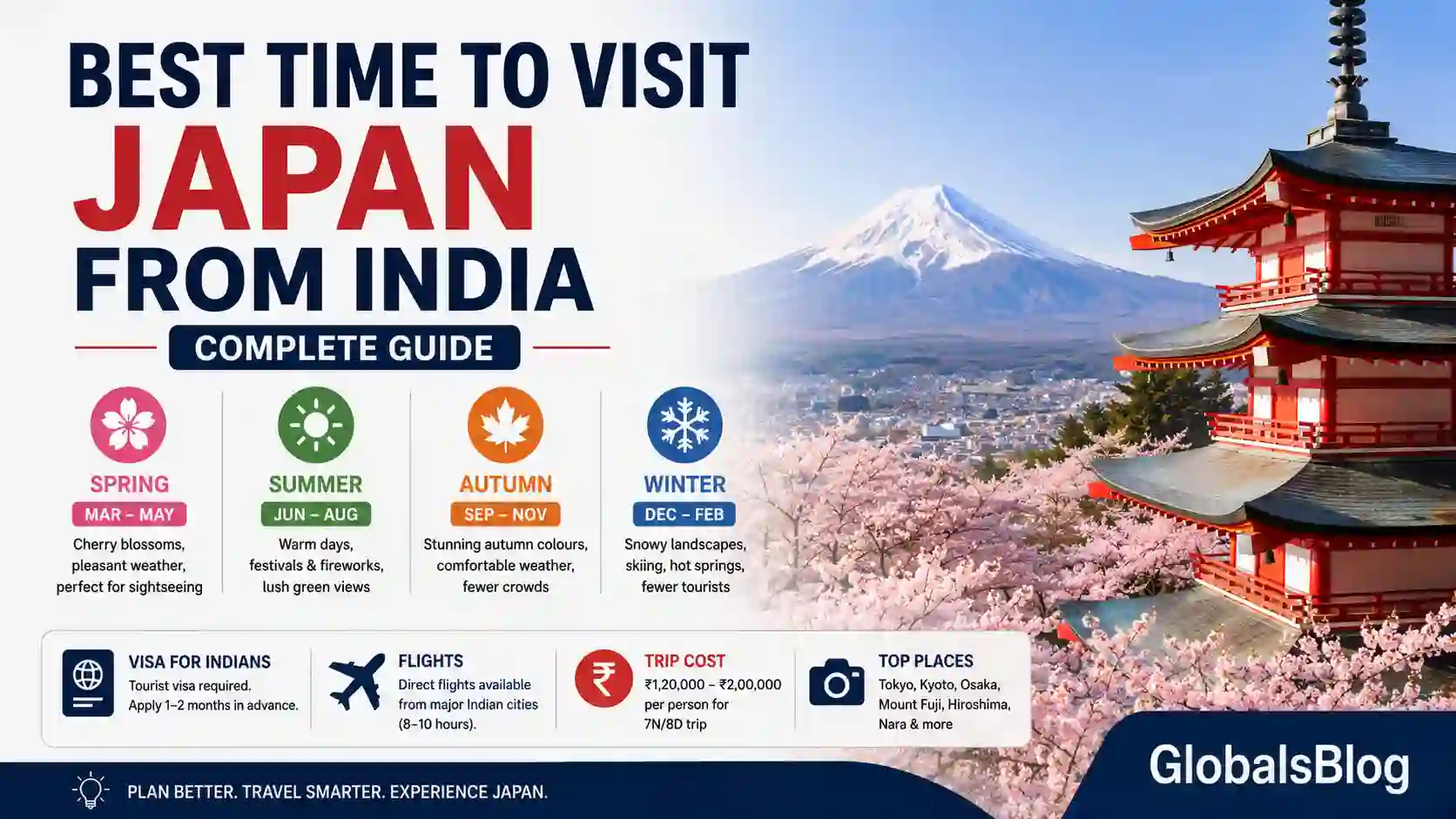
The best times to visit Japan from India are March to May for cherry blossoms and mild spring weather, and September to November for autumn foliage and comfortable temperatures. March-April specifically for cherry blossoms is Japan's most iconic season but its most crowded — book 3-4 months ahead. September-November is our top recommendation for most Indian travellers — beautiful autumn colours, comfortable weather, lower crowds than spring, and better value. Avoid July-August (extreme heat and humidity) and December-February (cold, though excellent for snow experiences in Hokkaido).
Why Japan Timing Matters More Than Almost Any Other Destination
Most destinations have a "good season" and a "bad season." Japan has four genuinely distinct seasons, each offering a completely different travel experience — and two of them (summer heat-humidity and cherry blossom peak crowds) require specific knowledge to navigate correctly.
Japanese culture has a deep relationship with seasonal nature — hanami (cherry blossom viewing), koyo (autumn leaf viewing), and yukimi (snow viewing) are not tourist marketing concepts but genuine cultural practices that transform how the entire country looks and feels. Visiting Japan in the right season is not about chasing good weather — it is about experiencing the country the way Japanese people experience it themselves.
For Indian travellers specifically, Japan's summer (July-August) is the season to avoid most carefully. Indian visitors accustomed to heat are often surprised by Japan's summer humidity — not the temperature alone (35°C) but the 85-90% humidity that makes outdoor activity genuinely uncomfortable for most of the day.
Best Months to Visit Japan from India — Season by Season
Spring is Japan's most photographed and most anticipated season — cherry blossoms (sakura) bloom across the country in a wave that moves northward from late March in Tokyo to mid-April in Kyoto and late April in Hokkaido. The bloom lasts only 1-2 weeks per location, and forecasting the exact peak requires checking annual cherry blossom prediction maps published by Japanese meteorological services closer to the date. March-April weather is genuinely pleasant — 12-20°C, minimal rain, ideal for walking between temples, parks, and sakura-lined rivers. The honest trade-off is crowds and prices at their annual peak — popular destinations like Maruyama Park in Kyoto and Ueno Park in Tokyo are extremely busy during peak bloom weekends. Book accommodation in Kyoto 3-4 months ahead for March-April.
Japan's summer is our honest "avoid if possible" recommendation for most Indian travellers — not because nothing is happening but because the combination of 34-36°C heat and 80-90% humidity makes outdoor sightseeing genuinely exhausting in a way that Indian dry heat does not prepare you for. Kyoto's temple gardens and Tokyo's street culture are significantly less enjoyable when you are drenched in sweat by 10am. June brings Japan's tsuyu (rainy season) with several weeks of grey skies and frequent rain. July and August are school holiday months for Indian families — if you must travel in summer, July is better than August with slightly lower humidity. Budget accommodation prices are lower in summer than spring and autumn, which partially compensates.
Autumn is our top recommendation for most Indian travellers visiting Japan — comfortable temperatures (15-25°C), spectacular foliage colours as maple and ginkgo trees turn red, orange, and gold from late October through November, and lower crowd levels than cherry blossom spring season. September transitions out of summer heat with occasional typhoons but manageable weather. October is the sweet spot — comfortable temperatures, no typhoon risk, and the early autumn colour in northern Japan and mountain regions. November delivers peak autumn foliage in Kyoto and Tokyo, rivalling cherry blossom season in visual impact without the March-April peak prices. This is also when Diwali typically falls — an excellent international Japan trip timing for Indian festival-season travellers.
Winter Japan is the most underrated season for Indian travellers who do not mind cold — temperatures range from 2-10°C in Tokyo and Kyoto, with Hokkaido delivering genuine ski resort conditions from December through February. The Sapporo Snow Festival in February is one of Japan's most spectacular events — enormous ice sculptures across the entire city. Tokyo and Kyoto in winter are significantly less crowded than spring or autumn, with excellent accommodation availability and lower prices. For Indian families with children who have never seen snow, a Hokkaido ski trip in January-February offers that experience in Japan's most spectacular snow context. Carry proper winter clothing — Japanese winters are genuinely cold by Indian standards.
Japan Season Comparison for Indian Travellers
| Season | Months | Weather | Highlight | Verdict |
|---|---|---|---|---|
| Spring | Mar–May | 12–20°C, mild | Cherry blossoms | Best Experience |
| Summer | Jun–Aug | 33–36°C, humid | Festivals, fireworks | Avoid if Possible |
| Autumn | Sep–Nov | 15–25°C, clear | Autumn foliage | Best Overall Pick |
| Winter | Dec–Feb | 2–10°C, cold | Snow, fewer crowds | Good for Snow Seekers |
Japan Visa for Indian Passport Holders — 2026
Indian passport holders require a Japan tourist visa — there is no visa on arrival for Indians. The visa application requires submission at the Japanese Embassy or Consulate in India (Delhi, Mumbai, Chennai, Kolkata, Bengaluru, Osaka consulates), or through a registered visa facilitation agency. Processing typically takes 5-7 business days. Apply at least 4-6 weeks before travel to allow buffer time.
Required documents include passport, visa application form, recent photographs, confirmed flight bookings, hotel bookings, bank statements (typically showing ₹2-3 lakh balance), and sometimes an itinerary. Japan visa for India has a high approval rate for properly documented applications — rejection is relatively uncommon for Indian applicants with genuine tourism intent and financial documentation.
Getting to Japan from India
Direct flights from Delhi to Tokyo (Narita or Haneda) run on Air India and All Nippon Airways, with flight times of approximately 8-9 hours. Mumbai to Tokyo direct runs about 9-10 hours. Connecting flights through Singapore, Kuala Lumpur, or Bangkok add 2-3 hours but are often significantly cheaper. Book flights 2-3 months ahead for spring cherry blossom season — flights fill fast and prices surge for late March to early April dates.
Realistic Japan Trip Cost from India
Japan is not as expensive as its reputation suggests if you know what to expect. A 7-night trip costs ₹1,20,000-₹1,80,000 per person including return flights (₹45,000-₹70,000), accommodation (₹4,000-₹8,000/night for a clean mid-range hotel or ryokan), and daily expenses (₹4,000-₹6,000/day for food, transport, and activities). The Japan Rail Pass — if your itinerary covers multiple cities — adds ₹15,000-₹25,000 per person but saves significant individual ticket costs. Use our Trip Cost Calculator to build your specific Japan itinerary budget.
Japan Travel Tips for Indian Tourists
- Apply for Japan visa at least 4-6 weeks before travel — standard processing is 5-7 days but buffer time prevents stress
- Buy a Japan Rail Pass before leaving India — significantly cheaper purchased outside Japan through authorised Indian agents
- Carry Japanese Yen cash — Japan remains a largely cash-based society outside major tourist hotels and department stores
- Book Kyoto accommodation 3-4 months ahead for March-April cherry blossom season — the city has limited hotel inventory relative to demand
- Use our Trip Cost Calculator to build a realistic Japan budget including the Japan Rail Pass cost
- Download Google Maps offline for Japan before departure — reliable navigation without constant data usage
Japan Planning Mistakes Indian Travellers Make
- Visiting in August to avoid cherry blossom crowds and discovering the heat — The Chennai reader's experience is common among Indian travellers who assume Japan's summer is manageable because they are accustomed to Indian heat. Japanese summer humidity is a genuinely different and more oppressive experience than dry Indian heat at similar temperatures.
- Not applying for visa early enough — Japan visa takes 5-7 days minimum and last-minute applications risk cutting it too close
- Not buying Japan Rail Pass before leaving India — the pass is significantly more expensive purchased in Japan and requires advance purchase through authorised agents in India
- Trying to cover Tokyo, Kyoto, Osaka, Hiroshima, and Hakone in 7 days — each deserves more time than a rushed single day allows
- Not carrying sufficient Japanese Yen cash — Japan's cash culture catches many Indian travellers off guard who rely primarily on cards
⚠️ Disclaimer: Visa requirements, flight schedules, and Japan Rail Pass pricing change regularly — always verify current Japan visa requirements through the official Japanese Embassy website and confirm Japan Rail Pass terms through authorised agents before purchase.
Autumn for Most, Spring for Cherry Blossoms, Never August
September-November is Japan's best window for most Indian travellers — comfortable temperatures, stunning autumn foliage, reasonable prices. March-April delivers the iconic cherry blossom experience at peak crowds and prices. Winter works beautifully for snow seekers. Just avoid July-August unless school holiday timing forces the issue — the heat and humidity will define your memories more than any temple or garden you visit.
September to November is the best overall time to visit Japan from India — comfortable temperatures of 15-25°C, spectacular autumn foliage, and lower crowds than spring cherry blossom season. March to May is the best time for cherry blossoms specifically, though accommodation must be booked 3-4 months ahead for Kyoto. Avoid July-August due to extreme heat and humidity (33-36°C, 80-90% humidity) which makes outdoor sightseeing genuinely uncomfortable.
Yes — Indian passport holders require a Japan tourist visa. Applications are submitted at the Japanese Embassy or Consulate in India (Delhi, Mumbai, Chennai, Kolkata, Bengaluru) or through a registered visa facilitation agency. Processing takes 5-7 business days and approval rates are high for properly documented applications. Apply at least 4-6 weeks before travel. Required documents include passport, flight and hotel bookings, bank statements, and a travel itinerary.
A 7-night Japan trip from India typically costs ₹1,20,000-₹1,80,000 per person, including return flights (₹45,000-₹70,000), accommodation (₹4,000-₹8,000/night), and daily expenses including food, transport, and activities (₹4,000-₹6,000/day). A Japan Rail Pass adds ₹15,000-₹25,000 per person but saves significantly on individual train tickets for multi-city itineraries. Cherry blossom season (March-April) costs 15-20% more than autumn season for the same itinerary.
Cherry blossom season in Japan typically runs late March to late April, moving northward as temperatures rise. Tokyo and Osaka bloom around late March to early April. Kyoto peaks in early to mid-April. Northern Honshu and Hokkaido bloom in late April to early May. The exact peak shifts by 1-2 weeks year to year based on winter temperatures — check annual sakura forecast maps published from January onward for precise timing closer to your travel date.
Yes, for the right type of traveller. Winter Japan (December-February) is significantly less crowded than spring or autumn, with lower accommodation prices and excellent availability. Hokkaido delivers world-class ski resort experiences and the spectacular Sapporo Snow Festival in February. Tokyo and Kyoto in winter are cold (2-10°C) but very functional with excellent temple and museum visits. Indian families wanting to show children real snow in a comfortable, safe setting often choose Hokkaido ski trips as their Japan experience.
Reader Experiences