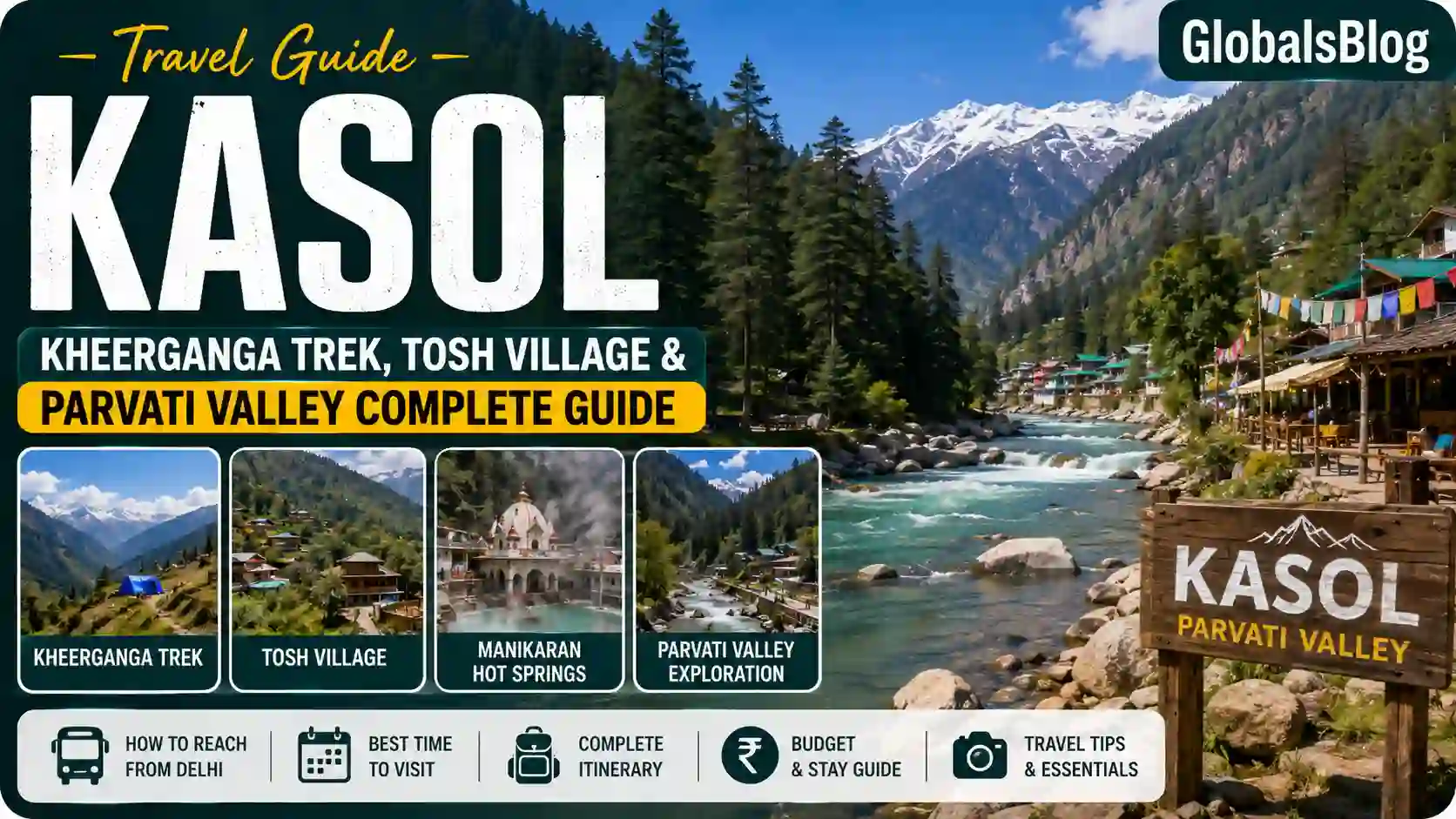
Kasol is a small village on the banks of the Parvati River in Himachal Pradesh — and one of the most visited destinations for young Indian travellers who want their first Himalayan experience without the infrastructure of a formal hill station. The river, the Israeli café culture, the treks into Parvati Valley, and the altitude are the reasons people come. The altitude and the river are free.
A reader from Hyderabad had her first Himalayan experience in Kasol at 24 — two college friends, a shared taxi from Delhi, a guesthouse room for ₹500/night with a Parvati River view, and four days of walking, sitting by the river, eating Israeli food she had never encountered before, and looking at the mountains. She described it years later as "the trip that made me understand why people go to the mountains" — not for any monument or attraction but for the specific quality of being in a high valley with cold river water and pine forests and the Himalayan skyline. Kasol offers this at a price and accessibility that makes it the first serious mountain trip for hundreds of thousands of young Indian travellers every year. The village itself is small — a single road, guesthouses and cafés on both sides, the Parvati River audible from everywhere — but the surrounding Parvati Valley contains some of the most beautiful Himalayan trekking in Himachal Pradesh. This guide covers both the village and the valley.
Kasol location: Parvati Valley, Kullu district, Himachal Pradesh — 42km from Bhuntar, 490km from Delhi, 1,580m altitude. How to reach: Bus from Delhi ISBT to Bhuntar (10–12 hours overnight, ₹700–1,200) then taxi to Kasol (₹500), or direct HRTC bus. Best time: March–June (spring, clear views) and September–November (post-monsoon, fewer crowds). Things to do: riverside sitting and walks, Kheerganga trek (13km, hot springs, 2 days), Malana Village trek, Tosh Village (8km beyond Kasol), Rasol trek, Chalal village walk (2km from Kasol). Stay: guesthouses ₹500–2,000/night. Food: Israeli and Himachali cafés — Moon Dance, Freedom Café, Evergreen. Note: No ATMs beyond Kasol — carry cash. Heavy snowfall closes roads December–February.
What to Do in Kasol
Kheerganga is the most popular Himalayan day trek for first-time trekkers in India — a 13km trail through the Parvati Valley from Barshaini to the meadow and hot spring pool at 2,950m altitude. The trail passes through pine forests, rocky river gorges, two small villages (Nakthan and Rudra Nag waterfall), and arrives at the broad open meadow of Kheerganga where the natural hot sulphur spring pool is the primary destination. Soaking in the hot spring while looking at the surrounding snow peaks is one of the finest experiences available in accessible Himachal trekking — the contrast between the cold mountain air and the hot spring water, with the Parvati Valley spread below and the high peaks visible above, is what makes Kheerganga the trek that turns first-time trekkers into regular trekkers. The trail is well-marked and modestly steep — suitable for reasonably fit adults without technical trekking experience. Recommended two-day plan: Trek up on Day 1 (starting by 7am from Barshaini), spend the night at Kheerganga in a tent or basic guesthouse, wake to the meadow in morning mist and trek down on Day 2. The two-day option allows the early-morning meadow experience that the same-day descent misses. Barshaini (the trailhead) is reached by shared taxi from Kasol (₹100–150 per person, 40 minutes).
The Parvati River at Kasol is the fundamental reason the village became what it is — a cold, swift glacial river running through a pine-forested valley, its sound constant from anywhere in the village, its clarity remarkable in October–November after the monsoon has cleared. The riverbank accessible from the main village road is rocky and requires care near the waterline (the Parvati is a powerful river and its current is stronger than it appears from the bank), but sitting on the large flat boulders above the water with the pine trees on the opposite bank and the Himalayan ridgeline visible above is exactly the experience that defines Kasol for most visitors. The 2km walk from the main Kasol bridge across to Chalal village on the opposite bank — through a mixed forest of pine and oak, with the river visible through the trees — is the best short walk in Kasol and takes approximately 30 minutes each way. The Kasol main road itself (single road, approximately 500 metres from the bus stop to the far end) concentrates the village's café culture, guesthouse clusters, and the specific Israeli-influenced food scene that has defined Kasol since the 1990s when Israeli travellers post-army service began arriving in large numbers.
Tosh is a small Himachali village 20km from Kasol at 2,400m altitude — accessible by shared jeep from Kasol (approximately 1 hour) or on a full-day trek through the Parvati Valley. Tosh offers the Kasol experience (river, mountains, guesthouse culture, café scene) at quieter crowd levels and higher altitude — the mountain views from Tosh's guesthouse terraces, looking across the Parvati Valley to the snow peaks behind Manikaran, are among the finest in the accessible Parvati region. Several guesthouses in Tosh have rooftop terraces directly facing the high peaks, making sunset and sunrise from the room genuinely spectacular. Tosh is the recommended base for the Sar Pass trek (a 5-day high-altitude trek crossing the Sar Pass at 4,250m, one of the most popular high-altitude treks in Himachal Pradesh). For visitors who want more mountain and less café culture than Kasol's main road: Tosh is the correct base. Electricity is intermittent; phone signal is limited.
Manikaran Sahib is a Sikh gurudwara and Hindu temple complex 4km from Kasol at the confluence of a hot spring with the Parvati River — one of the most significant Sikh pilgrimage sites in Himachal Pradesh and the second most visited hot spring in the Parvati region (after Kheerganga). The gurudwara is built around a natural hot spring that reaches boiling temperature — the kitchen uses the spring water to cook the langar (free community meal) that is available to all visitors without charge or religion prerequisite. The hot spring baths (separate male and female sections within the gurudwara complex) are free to use and provide the hot spring experience without the 13km Kheerganga trek. For travellers who want the hot spring experience at low effort and zero cost: Manikaran is the answer. The gurudwara's interior is beautifully maintained; the langar provides an excellent free meal; and the natural boiling temperature of the spring is a remarkable geological phenomenon — eggs boiled in the spring water take approximately 20 minutes (the spring is that hot). A 4km walk along the river from Kasol to Manikaran and back (2 hours total) is the most natural day walk from the village.
Chalal is a tiny hamlet on the opposite bank of the Parvati River from Kasol, reached by crossing the suspension bridge at the east end of the Kasol main road and following the forest path for approximately 2km. The walk through the pine forest between Kasol and Chalal — with the river audible below and the forested ridge visible above — is the best short walk in the Kasol area and the most commonly cited "favourite thing" by visitors in their second or third day in the village when the initial café-sitting has been completed. Chalal village itself has a few guesthouses and small cafés with river-view terraces that are noticeably quieter than the main Kasol establishments. Some visitors base in Chalal specifically to avoid the Kasol road scene while remaining within walking distance of it. The forest path continues beyond Chalal for those who want to extend the walk toward Grahan village (a further 5km through deeper forest).
Rasol and Grahan are two traditional Himachali villages on the ridgeline above Kasol accessible on day treks that see significantly fewer visitors than the Kheerganga trail. Rasol (8km, 2,500m, 4–5 hours ascent) is a traditional high-altitude Himachali village with basic guesthouses — the trail climbs steeply through deodar cedar forest before emerging on a ridge with views across the Parvati Valley. Grahan village (14km from Kasol via Chalal, 2,350m, 5–6 hours from Kasol) is reachable through the Chalal forest path extended into deeper forest, arriving at a meadow village that receives perhaps 5% of the foot traffic that Kheerganga receives. Both treks offer the Himachali mountain village experience — old wooden houses, traditional agricultural terraces, local architecture — that is distinct from the camping-and-hot-spring experience of Kheerganga. For visitors who want trekking with cultural context beyond the natural landscape: Rasol or Grahan is the recommended addition to the Kasol itinerary.
Kasol Food — The Israeli Café Culture
Kasol has one of the most distinctive food cultures of any small Himalayan village — a combination of traditional Himachali cooking and the Israeli-influenced café culture that developed from the large numbers of young Israeli travellers who began arriving in Kasol in the 1990s after mandatory military service. The Israeli influence is specifically visible in the menus: hummus, shakshuka (eggs poached in spiced tomato sauce), falafel, tahini, pita bread, and Israeli breakfast plates (salad, eggs, labneh) are available at most Kasol cafés alongside the Indian and Himachali options. This is not a kitsch theme — Israeli travellers have genuinely been the primary international visitor demographic in Kasol for 25+ years, and the café owners (many of whom are Himachali locals who learned to cook Israeli food specifically for this market) have developed genuine skill with the cuisine. Recommended cafés:
| Café | Best For | Price Range | Notes |
|---|---|---|---|
| Moon Dance Café | Israeli breakfast, shakshuka, hummus | ₹150–400/dish | Most atmospheric, river-view seating, always crowded in season |
| Freedom Café | Continental + Israeli, best wood-fire pizza | ₹150–400/dish | Popular lunch and dinner spot, excellent pasta |
| Evergreen Café | Budget Israeli + Indian options | ₹80–250/dish | Best value, local crowd, no frills |
| Little Chef | Best Himachali thali in Kasol | ₹120–200/thali | For a break from Israeli food — proper North Indian meal |
| Bhoj Restaurant | Cheapest full meals, dal-roti, local food | ₹60–150/meal | For budget meals — no atmosphere but reliable and inexpensive |
Kasol Itinerary — 3 Days and 4 Days
3-Day Kasol Itinerary:
Day 1: Arrive Kasol (after overnight bus from Delhi or morning from Bhuntar). Check in. Afternoon river walk and village exploration. Moon Dance Café evening. Day 2: Kheerganga Day 1 — shared taxi to Barshaini (7am departure, ₹100–150), begin trek by 8am. Arrive Kheerganga by 2–3pm. Hot spring soak. Sunset at the meadow. Night at Kheerganga tent/guesthouse. Day 3: Kheerganga morning (meadow at dawn), begin descent by 9am. Arrive Barshaini by 1pm. Taxi back to Kasol. Manikaran gurudwara afternoon (4km from Kasol, hot springs, free langar). Departure evening or night bus.
4-Day Kasol Itinerary:
Day 1: Arrive and settle. Village walk, Chalal evening stroll. Day 2: Full day Kheerganga (overnight recommended — see 3-day above, Day 2). Day 3: Return from Kheerganga by noon. Afternoon rest. Manikaran walk. Day 4: Morning — shared jeep to Tosh (₹200–300, 1 hour) for the mountain view. Afternoon in Tosh or walk back toward Kasol. Return to Kasol by evening. Night departure.
How to Reach Kasol
| Mode | From | Duration | Cost | Notes |
|---|---|---|---|---|
| Bus + taxi (recommended budget) | Delhi ISBT Kashmere Gate | 10–12 hrs overnight + 1 hr | ₹700–1,200 bus + ₹500 taxi | HRTC/private overnight buses to Bhuntar, then shared/private taxi to Kasol |
| Direct bus (HRTC) | Delhi / Chandigarh | 12–14 hrs | ₹800–1,500 | Seasonal direct buses to Kasol/Manikaran — check HRTC schedule |
| Flight + taxi | Delhi (IGI) to Bhuntar | 1 hr flight + 1.5 hrs taxi | ₹3,000–7,000 flight + ₹1,200–1,500 taxi | Bhuntar Airport (KUU) has limited flights — IndiGo, Air India seasonal |
| Train + bus/taxi | Delhi to Chandigarh + bus | 3 hrs train + 7 hrs bus | ₹500–1,500 train + ₹400–700 bus | Train to Chandigarh, then Chandigarh to Bhuntar HRTC bus |
The most common route for young Indian travellers: overnight bus from Delhi ISBT Kashmere Gate to Bhuntar (HRTC Volvo or private, ₹700–1,200, departures 7pm–10pm, arrive Bhuntar by 6–8am), then shared taxi from Bhuntar to Kasol (₹60–100 per person in a shared vehicle, 1 hour, 42km). Private taxi Bhuntar to Kasol: ₹500–700. The overnight bus is the standard approach — it saves a hotel night and arrives at Kasol in time for a full first day. Booking: book HRTC buses on himachal.nic.in or private operators through redBus. Booking 2–3 weeks ahead is recommended for May–June and September–October peak seasons when buses fill up.
✓ Kasol Travel Tips
- Carry sufficient cash — ATMs are scarce beyond Kasol: Kasol has one or two ATMs that are frequently out of cash during peak season (May–June, October). Beyond Kasol (Tosh, Kheerganga, Chalal) there are no ATMs and almost no card payment acceptance. Withdraw cash in Bhuntar (better ATM availability) or Chandigarh before reaching Kasol. Budget approximately ₹1,500–2,500 per day in cash for guesthouse + food + transport in and around Kasol
- Acclimatise for at least one day before the Kheerganga trek: Kasol is at 1,580m and Kheerganga is at 2,950m — a 1,370m gain. For visitors arriving directly from Delhi (roughly sea level to 1,580m overnight on a bus), one day of rest and light walking in Kasol before attempting Kheerganga significantly reduces headache and fatigue on the trek. The Chalal walk and river sitting on Day 1 serve both purposes
- September–October is the best Kasol season: May–June is peak season but also extremely crowded (Kheerganga trail can have 500+ people per day in June). September is post-monsoon — the trail is clean, the river is high and beautiful, the meadow at Kheerganga is intensely green, and the crowd level is perhaps 30% of the June peak. October brings clearing skies, colder temperatures (bring a layer for evenings), and the best mountain visibility of the year
- Respect the Parvati River — it is a powerful glacial stream: The Parvati River looks photogenic and accessible but its current is significantly stronger than it appears from the bank. Several drowning incidents occur every year, primarily from visitors wading in sections where the riverbed is unpredictable. Sit on the banks, photograph from the rocks, but do not enter the river in sections where the current is visible and the depth is unknown
- For the Kheerganga trek — leave by 7am from Barshaini: The 13km trail to Kheerganga is best started by 7am to arrive by 2–3pm, giving time for the hot spring soak before dark. Starting at 10am means reaching Kheerganga near dusk, which is both dangerous on the trail and means missing the afternoon soak. Shared taxis from Kasol to Barshaini run from approximately 6am — the early jeep gets the best seats. See our Manali guide for extending the Himachal trip beyond Kasol, and our Shimla guide for the more developed hill station alternative
✗ Kasol Mistakes to Avoid
- Visiting in December–February without verifying road access: Kasol is accessible year-round in mild winters but the Barshaini road and Tosh road are frequently blocked by snow in December–February. More critically, the Kheerganga trail above Rudra Nag becomes icy and dangerous without proper snow equipment in January–February. Budget travellers who arrive in January expecting to trek to Kheerganga without crampons and winter gear consistently have to turn back. Verify current road and trail conditions with guesthouse owners before planning any trek in winter
- Attempting Kheerganga as a same-day return without an early start: The most common Kheerganga mistake — starting from Barshaini at 10am or later, arriving at the hot spring at 5pm, and attempting the 13km descent in the dark. The descent in darkness is genuinely dangerous. Kheerganga requires either: (a) a 6–7am start for a challenging but achievable same-day return arriving in Barshaini by 8pm in good conditions, or (b) an overnight at Kheerganga — which is the strongly recommended option. Never attempt the same-day return starting after 8am
- Assuming Kasol is primarily about a physical attraction: The most common disappointed visitor is someone who arrives expecting sights and is confused by a village with no monuments, no formal attractions, and no structured tourism. Kasol is about the experience of being in a Himalayan valley at a comfortable altitude — the river, the mountains, the pine forest, the café culture, and the treks that leave from it. If your travel preferences require formal attractions, Kasol will be underwhelming. If you can spend a morning sitting by a river and consider that a successful day of travel, Kasol is the perfect destination
- Booking only one night in Kasol: Kasol requires minimum 3 nights to make the journey from Delhi worthwhile — the 10–12 hours of bus travel each way means 1 night in Kasol gives essentially no time in the valley. A minimum 3-night stay allows the Kheerganga trek (2 days), a Manikaran visit, and time to actually sit in the valley. Anyone booking 1–2 nights in Kasol is paying the full transportation cost for a partial experience of the destination
⚠️ Disclaimer: Kasol road conditions, bus availability, and trek access change seasonally and with weather events. The Parvati Valley is prone to landslides during and after heavy monsoon — road access can be interrupted. All prices listed are indicative as of August 2026. Kheerganga hot spring entry fees and camping charges are set by local operators and change frequently. Verify current bus schedules, road conditions, and trek safety before travelling, particularly in winter (December–February) and immediately post-monsoon (August–September).
Day 1: Arrive and River. Day 2: Kheerganga Day 1. Day 3: Kheerganga Return + Manikaran. Day 4: Tosh for Mountain Views. Kasol Gives Back Exactly What You Give It.
The Hyderabad reader who understood mountains for the first time at Kasol was not changed by a monument or an attraction but by four days of sitting by the Parvati River with pine forests on the opposite bank and 4,000-metre peaks at the end of the valley. This is what Kasol offers — and it is not available to visitors who arrive for one night expecting a structured tourism experience. The formula is simple: arrive after the overnight bus, spend one day in the village and by the river, trek to Kheerganga on Day 2 and stay overnight, return on Day 3 and visit Manikaran for the hot spring, consider Tosh on Day 4 for the mountain view. That is the correct Kasol. The river and the mountains are free. The bus is ₹900. The guesthouse is ₹500. The trek is ₹300 for the hot spring. Everything else — the quality of being in a cold Himalayan valley with clean air and a fast river — is already there.
Kasol is famous for its location in the Parvati Valley of Himachal Pradesh (Kullu district) — a small village on the Parvati River at 1,580m altitude that has become one of India's most popular backpacker destinations. Kasol is known for: the Parvati River and its scenic valley setting; the Israeli café culture that developed from large numbers of young Israeli travellers arriving since the 1990s (hummus, shakshuka, falafel, Israeli breakfast available at most cafés); the Kheerganga trek (13km to a natural hot spring at 2,950m, one of the most popular accessible Himalayan day treks in India); Tosh village (8km further up the valley); Manikaran Sahib gurudwara (4km away, significant Sikh pilgrimage site with natural boiling hot spring); budget guesthouse accommodation (₹500–2,000/night); and as a base for multiple Parvati Valley treks (Rasol, Grahan, Sar Pass). Kasol is 490km from Delhi and 42km from Bhuntar airport. Best time to visit: September–November and March–June.
How to reach Kasol from Delhi: Most popular route — overnight bus from Delhi ISBT Kashmere Gate to Bhuntar (HRTC Volvo or private operators, ₹700–1,200, departs 7pm–10pm, arrives Bhuntar 6–8am next day). From Bhuntar, shared taxi to Kasol (₹60–100 per person, 1 hour, 42km) or private taxi (₹500–700). Total cost: approximately ₹800–1,500 per person. Book HRTC buses on himachal.nic.in; private operators through redBus, AbhiBus, or MakeMyTrip. Direct HRTC buses to Kasol/Manikaran also run seasonally from Delhi — check HRTC schedule. Alternative: fly to Bhuntar Airport (KUU) from Delhi (1 hour, ₹3,000–7,000, limited seasonal flights on IndiGo/Air India), then taxi to Kasol (1.5 hours, ₹1,200–1,500). Train option: Delhi to Chandigarh by Shatabdi (3 hours, ₹500–1,500), then HRTC bus Chandigarh to Bhuntar (7 hours, ₹400–700), then taxi to Kasol. Peak season booking: book buses 2–3 weeks ahead for May–June and September–October.
Kheerganga trek details: Distance — 13km one way from Barshaini (end of motor road, 10km from Kasol). Altitude — starts at Barshaini (~1,580m), ends at Kheerganga meadow (2,950m). Total altitude gain: approximately 1,370m. Duration — 5–7 hours ascent for reasonably fit adults, 4–5 hours descent. Difficulty — moderate. No technical equipment needed. Trail is well-marked and popular (guide not required in season). The trail passes through pine forest, river gorges, Nakthan village, Rudra Nag waterfall (approximately 8km from Barshaini — the most photographed point), and arrives at the broad Kheerganga meadow. Destination: natural sulphur hot spring pool with mountain views — entry ₹300–500 per person. Overnight stay option: camping (₹200–400 tent rental) or basic guesthouses (₹300–600). Best approach: 2 days (overnight at Kheerganga) with early 7am departure from Barshaini on Day 1. Trailhead access: shared taxi from Kasol to Barshaini (₹100–150 per person, 40 min) departing from 6am. Same-day return possible only with 6–7am Barshaini start — not recommended for beginners or in poor weather.
Best time to visit Kasol: September–November (recommended) — post-monsoon, river is high and clear, Kheerganga trail is green and clean, mountain views are excellent, temperatures pleasant (10–22°C days, 2–8°C nights). October is considered the single best month — clear skies, best mountain visibility, manageable crowds. March–June — spring season, pleasant temperatures, rhododendrons and wildflowers on higher trails. May–June is peak season (most crowded, Kheerganga trail can be very busy). April is best spring month for fewer crowds. Avoid December–February — Barshaini road and Tosh road are often blocked by snow, Kheerganga trail becomes icy and dangerous without winter gear, many guesthouses and cafés close. July–August — monsoon, trails are slippery, landslides possible on the Parvati Valley road, less ideal but Kasol itself remains accessible. Summary: September–November is best for most visitors; March–early June is good for spring conditions; avoid peak summer (late May–June) if crowd-averse.
Minimum 3 nights (4 days) is recommended for Kasol given the 10–12 hour overnight bus journey from Delhi each way. 3-night plan: Day 1 (arrive from overnight bus) — rest, Kasol village and river. Day 2 — Kheerganga Day 1 (trek up, overnight at meadow). Day 3 — Kheerganga return + Manikaran afternoon. Night bus or Day 4 departure. 4-night plan: add Tosh village (Day 4 morning, jeep ride) or Chalal/Grahan forest trek. 5–7 nights: allows Sar Pass trek (5 days, high-altitude), Rasol village overnight, more relaxed pace. 1–2 nights: insufficient — the 20+ hours of round-trip travel for 1–2 nights is not worthwhile. For Delhi travellers specifically: book minimum 3 nights to justify the journey. For travellers coming from Chandigarh or Manali (shorter distance): 2 nights is the minimum that gives meaningful time in the valley and at least one trek.
Manikaran Sahib is a Sikh gurudwara and Hindu temple complex 4km from Kasol in the Parvati Valley — one of the most important Sikh pilgrimage sites in Himachal Pradesh and a significant Hindu religious site. Built around a natural boiling hot spring (temperature near 100°C), the gurudwara's kitchen uses the spring water to cook the langar (free community meal served to all visitors regardless of religion). The hot spring baths within the gurudwara complex are free to use (separate male and female sections) and provide a Kheerganga-like hot spring experience without the 13km trek — making Manikaran the recommended hot spring option for visitors who cannot do the full Kheerganga trek. Distance from Kasol: 4km — 15-minute taxi (₹100–150) or 1-hour riverside walk. Entry: free. Hot spring: free. Langar: free. Open 24 hours. Note: Manikaran is a religious site — dress respectfully (covered head, removed shoes inside the gurudwara). The boiling spring also has a Hindu Shiva temple on the opposite bank of the river. For Kasol visitors: Manikaran is the recommended afternoon excursion on Day 1 or Day 3 (the hot spring soak before or after the Kheerganga trek).
Leave a comment
Share a quick thought about this story.
Thanks for sharing your view. It is ready for review.
Please try again in a moment.