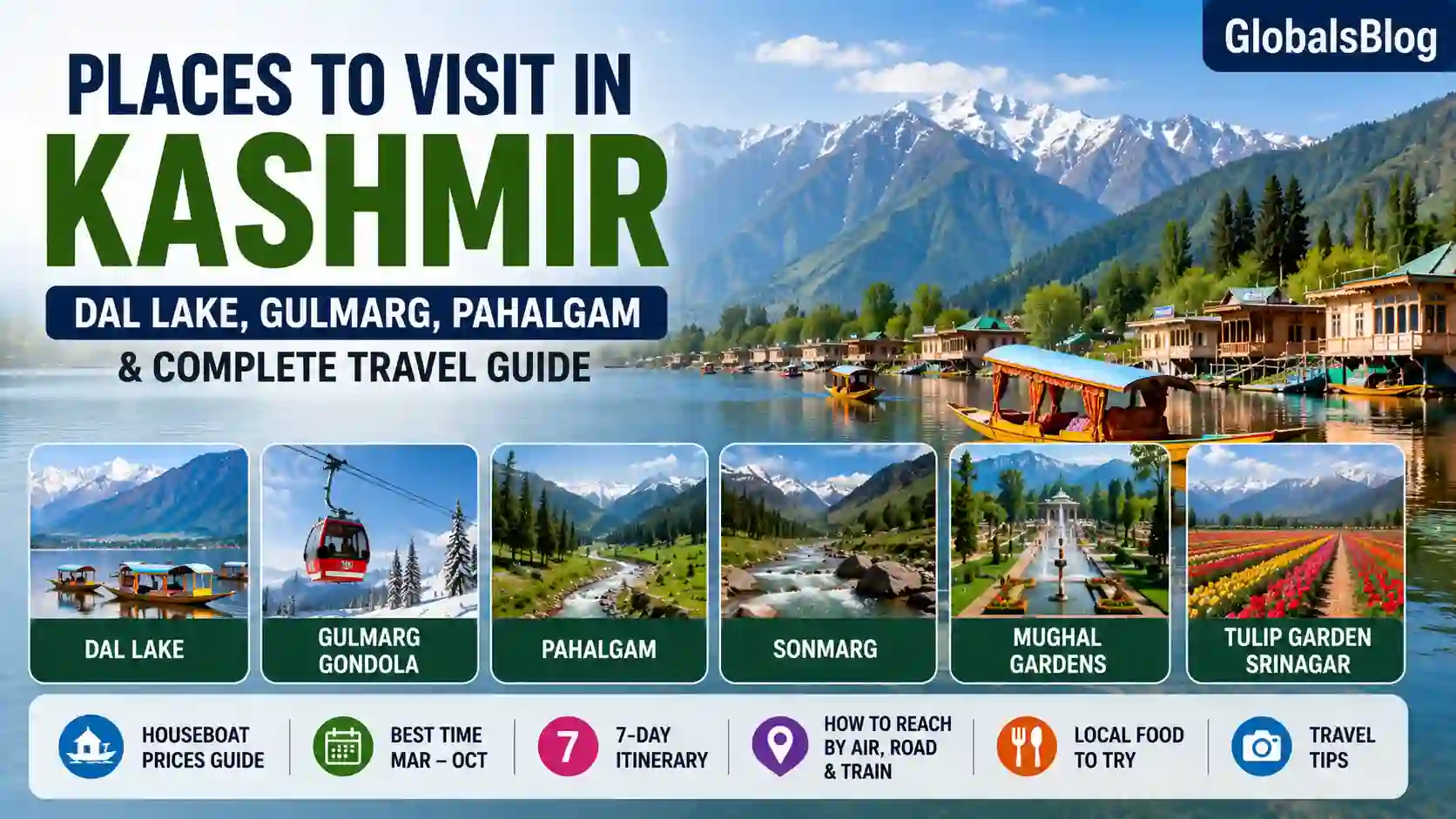
The Dal Lake at dawn — shikaras moving through mist, the Zabarwan Mountains reflected in still water, the smell of wood smoke from houseboats. Gulmarg's Gondola reaching 3,980 metres through cedar forests to Asia's highest ski resort. The saffron fields of Pampore in October bloom. Pahalgam's Lidder River valley with snow peaks at every turn. Kashmir is not one destination — it is four seasons of entirely different experiences in the same valley.
Kashmir Valley — the central valley of the union territory of Jammu & Kashmir — sits at 1,585 metres, enclosed by the Greater Himalayas to the north and east and the Pir Panjal range to the south. The valley is 135km long and 32km wide, with the Jhelum River running through its centre and the Dal and Wular lakes at its heart. For Indian travellers, Kashmir represents the most visually extraordinary domestic destination available — the combination of Mughal garden architecture, high-altitude mountain landscapes, houseboat culture, Sufi shrines, and one of the world's finest saffron crops produces an experience that has no equivalent in the rest of India. Flight connectivity from Delhi (1.5 hours), Bengaluru (3.5 hours), and Mumbai (2.5 hours) has made Kashmir increasingly accessible. The valley's tourism infrastructure has improved significantly — there are now quality hotels and boutique guesthouses across Srinagar, Gulmarg, Pahalgam, and Sonmarg at most budget points. This guide covers every major Kashmir destination with practical details for planning the ideal trip.
Best places to visit in Kashmir: Dal Lake Srinagar (houseboat stay, shikara ride, Mughal gardens — Shalimar Bagh, Nishat Bagh, Chashme Shahi), Gulmarg (Asia's highest gondola at 3,980m, skiing December–March, meadows April–June), Pahalgam (Lidder River valley, Baisaran meadow, Betaab Valley — 97km from Srinagar), Sonmarg (Thajiwas Glacier, 87km from Srinagar — open June–October), Yusmarg (pristine meadow, quieter than Gulmarg, 47km from Srinagar), Naranag (ancient temple ruins, trekking gateway). Best time: April–June (spring, tulips, gardens) and September–November (chinar autumn, clear skies, apple harvest). How to reach: Fly to Srinagar (SXR) from Delhi (1.5 hrs), Mumbai (2.5 hrs), Bengaluru (3.5 hrs).
Best Places to Visit in Kashmir
Dal Lake is the defining image of Kashmir — a 18 sq km lake in the heart of Srinagar surrounded by Mughal gardens, chinars, and the Zabarwan Mountain range. The lake supports a unique floating community: the houseboat owners (Kashmiris of the Hanji community) who have lived on the water for generations, the vegetable and flower farmers who grow produce on floating gardens (the famous floating markets), and the shikara operators who navigate the lake's channels with the painted wooden boats that are Kashmir's most iconic image.
Staying on a houseboat on Dal Lake — the rooms are boat-cabins with carved walnut wood interiors, the meals are served by the host family, and the morning view from the deck is the lake at dawn with snow peaks visible through the mist — is the most distinctive accommodation experience available anywhere in India. Houseboat categories range from Category D (basic, ₹2,000–3,000/night) to Deluxe and Palace categories (₹8,000–15,000/night). Book directly through houseboat owners (avoid travel agent intermediaries who add significant markup). The floating vegetable market on the northeast corner of the lake operates from 5:30am — vendors in shikaras exchange produce before the tourists arrive, and this 90-minute window is the most authentic Dal Lake experience available.
The Mughal gardens of Srinagar are among the finest formal garden complexes in Asia — built by the Mughal emperors Jahangir, Akbar, and Shah Jahan as summer residences around Dal Lake, each garden follows the char bagh (four-garden) Persian design principle with water channels, terraced levels, and symmetrical planting. Shalimar Bagh (built 1619 by Emperor Jahangir) is the largest and most architecturally complete — four terraces descending to the lake, each with a central water channel fed from mountain springs. Nishat Bagh (built 1633 by Asaf Khan, brother of Mumtaz Mahal) has 12 terraces and the finest mountain backdrop — the Zabarwan peaks rise directly behind the garden, framing every photograph. Chashme Shahi is the smallest and most intimate — built around a natural spring whose water was considered so pure it was served to the Mughal court. The three gardens together represent the Mughal aesthetic at its most complete — the combination of running water, geometric planting, and mountain landscape is the specific beauty that made Kashmir the Mughal court's preferred summer retreat.
Gulmarg — "Meadow of Flowers" — is a high-altitude bowl at 2,650m, 51km from Srinagar, that transforms through the seasons: carpeted in wildflowers and green grass from May to October, snow-covered and operating as Asia's highest ski resort from December to March. The Gulmarg Gondola — a two-phase cable car system — is the defining Gulmarg experience regardless of season. Phase 1 rises from Gulmarg (2,650m) to Kongdori (3,099m) through cedar and pine forest with views expanding over the Kashmir Valley and Pir Panjal range. Phase 2 continues from Kongdori to Aparwath (3,980m) — the high-altitude snowfields, the Himalayan peaks at eye level, and on clear days the Pakistan-administered Kashmir territory visible across the ranges. The gondola provides the most accessible high-altitude Himalayan panorama in India — visitors with no trekking fitness or equipment can reach 3,980m in 40 minutes from the Gulmarg meadow.
In winter (December–March), Gulmarg is India's premier ski destination — the only resort in India with Himalayan-scale slopes and consistent snow coverage. Skiing and snowboarding lessons, equipment rental, and lift passes are available. In spring and summer, the Gulmarg meadow itself (covered in wildflowers — iris, buttercup, primrose) is the attraction, with horse riding, golf at Asia's highest golf course (2,650m), and trekking routes into the surrounding forest.
Pahalgam is Kashmir's most scenic river valley destination — a town at 2,130m where the Lidder River (fed by the glaciers of the Kolahoi massif) runs cold and clear through meadows lined with pine and deodar forests. The town itself is the tourist centre; the most rewarding experiences are in the surrounding valleys. Betaab Valley (named after the 1983 Hindi film shot here) is a 15km drive up the Lidder from Pahalgam — a wide, flat valley floor with the Lidder River winding through meadows and snow peaks visible at the valley head. April–June the meadows are green and flower-covered; October–November the deodar and chinar trees turn gold. Baisaran is a meadow at 2,400m accessible only by horse from Pahalgam town — the 45-minute horse ride through deodar forest opens onto a bowl-shaped meadow with panoramic views of the surrounding Pir Panjal peaks that rival Gulmarg for visual drama with none of the crowds. The Lidder River provides some of the best fly fishing in India (trout) in the April–September season — permits from the Fisheries Department in Pahalgam.
Sonmarg — "Meadow of Gold" — is a high-altitude meadow at 2,730m, 87km from Srinagar on the Leh highway. The name refers to the golden wildflowers that carpet the meadow in July, though the summer landscape of green meadows, glacial streams, and snow-capped peaks all around gives it a visual quality that makes it the finest single-day excursion from Srinagar. The Thajiwas Glacier — 3km on foot or by pony from the Sonmarg meadow — is an accessible snowfield that remains snow-covered year-round, providing the classic Kashmir glacier experience (walking on snow with mountain peaks around you) without requiring technical equipment or mountaineering skill. The glacier trek is 2–3 hours round trip at a comfortable pace. Sonmarg is also the last significant settlement before the Zoji La pass (3,528m) on the road to Leh — travellers doing the Kashmir–Ladakh road journey overnight here before the early morning Zoji La crossing. The Sonmarg area also offers trout fishing (Sindh River, permits available locally), pony trekking to Nilagrad and Krishansar lakes, and in late June–early July, some of the finest wildflower meadows in the western Himalayas.
The Indira Gandhi Memorial Tulip Garden is Asia's largest tulip garden — 30 hectares on the slopes of the Zabarwan Hills above Dal Lake, planted with 1.5 million tulips in 64 varieties ranging from deep purple to white, yellow, red, orange, and striped hybrids. The garden blooms for approximately 3–4 weeks in spring (mid-March to mid-April, varying with the year's temperature) and is the visual centrepiece of the annual Kashmir Tulip Festival. The bloom peak — when all 64 varieties are simultaneously open — lasts approximately one week and is the most photogenic single sight in Kashmir. The backdrop of the Zabarwan Mountains and the Dal Lake below the garden, with the tulip field in the foreground, produces the image most associated with Kashmir spring. The garden is worth the specific timing effort — plan a Kashmir trip around the first week of April to catch the tulip bloom. Outside the bloom period (mid-April to March), the garden is closed.
Pampore — 13km from Srinagar — is the centre of Kashmir's saffron cultivation and the source of one of the world's most prized spices. Kashmir saffron (Crocus sativus) has a GI (Geographical Indication) tag and is considered the finest quality saffron in the world — the climate and soil conditions of the Pampore plain produce saffron with higher crocin, picrocrocin, and safranal content than Iranian, Spanish, or Greek saffron. The saffron blooms for 2–3 weeks in October — the fields turn purple-blue with millions of saffron crocus flowers, each flower containing three crimson stigmas that are the saffron spice. The harvest happens in the early morning (the flowers open at dawn and must be harvested before noon) and the Pampore fields in full bloom are one of the most unusual and beautiful agricultural landscapes in India. Walking through the fields with permission from farmers, watching the harvest, and buying saffron directly at the source (₹300–500/gram for pure saffron versus ₹600–1,000+ in Srinagar shops) is the complete Pampore experience — and one that is entirely missed by visitors who do not specifically time their Kashmir trip for October.
Dachigam National Park is a 141 sq km protected area in the Zabarwan Mountains behind Srinagar — the primary and most important habitat of the Hangul (Kashmir Stag, Cervus hanglu hanglu), one of India's most critically endangered large mammals with an estimated population of fewer than 200 individuals surviving exclusively in Dachigam. The Hangul is a large red deer with distinctive spreading antlers — the state animal of Jammu & Kashmir and the subject of intensive conservation efforts since the 1970s when population estimates fell to under 150. Dachigam also harbours snow leopard (at higher elevations), common leopard, Himalayan black bear, brown bear, musk deer, and Himalayan serow. Jeep safaris into the lower Dachigam (accessible zone) take 2–3 hours and provide reasonable Hangul sighting probability in the March–April and October–November periods when the deer are at lower elevations. The park is 22km from Srinagar and is one of the most accessible major wildlife sanctuaries near any Indian city — a morning safari can be combined with a Srinagar afternoon without difficulty.
Kashmir Tourist Places — Quick Reference
| Place | Distance from Srinagar | Season | Best For | Entry |
|---|---|---|---|---|
| Dal Lake / Srinagar | City | Year-round | Houseboat, shikara, Mughal gardens | Free (houseboat separate) |
| Tulip Garden | 3km | Mid-March–Mid-April | Asia's largest tulip display | ₹50 |
| Pampore saffron | 13km | October | Saffron harvest fields | Free |
| Dachigam NP | 22km | March–November | Hangul deer, Himalayan wildlife | ₹200 + safari |
| Yusmarg | 47km | May–October | Quieter meadow alternative to Gulmarg | Free |
| Gulmarg | 51km | Year-round (skiing Dec–Mar) | Gondola, skiing, meadows | Gondola ₹900–1,500 |
| Sonmarg | 87km | June–October | Thajiwas Glacier, Sindh Valley | Free |
| Pahalgam | 97km | April–November | Lidder River, Betaab Valley, Baisaran | ₹50 Betaab Valley |
Kashmir Season Guide — When to Visit and What to Expect
| Season | Months | Temperature | What's Special | Crowds |
|---|---|---|---|---|
| Spring | March–May | 8–22°C | Tulip Garden (April), mustard fields, cherry blossom, Mughal gardens in bloom, Sonmarg opening | High April–May |
| Summer | June–August | 18–30°C | Sonmarg, Pahalgam, all meadows accessible, Amarnath Yatra (July–August) | Peak season |
| Autumn | September–November | 5–20°C | Chinar trees turning gold, saffron harvest (October), apple season, clear skies — the finest Kashmir season | Medium — best value |
| Winter | December–February | -5 to 5°C | Skiing at Gulmarg, snow on Dal Lake houseboats, Srinagar in snow, quiet tourism | Low (except Gulmarg) |
October is the single finest month in Kashmir — the chinar trees (Platanus orientalis, the Kashmir maple equivalent) turn from green to gold, orange, and red across the Mughal gardens, the valley roadsides, and the Dal Lake perimeter. The saffron fields of Pampore bloom simultaneously. The apple harvest is in full swing. The skies are clear and the mountains are fresh-dusted with the first snow. Accommodation prices are 15–20% below the April–June peak. October is the recommendation for any first-time Kashmir visitor.
Kashmir 7-Day Itinerary
Day 1–2 (Srinagar): Arrive Srinagar, check into houseboat on Dal Lake. Day 1: floating vegetable market at 5:30am (shikara), Mughal gardens circuit (Shalimar Bagh, Nishat Bagh, Chashme Shahi), Dal Lake sunset shikara. Day 2: Old Srinagar — Shah-e-Hamdan (Khanqah-e-Moula) mosque, Jamia Masjid, Hari Parbat Fort (panoramic city view), Srinagar market for Kashmiri handicrafts (papier-mâché, walnut wood carving, pashmina, crewel embroidery).
Day 3 (Gulmarg): Day trip or overnight at Gulmarg (51km). Gondola Phase 1 + 2 to 3,980m. Meadow walk/horse riding (summer) or skiing/snowboard (winter). Return or overnight in Gulmarg.
Day 4 (Pahalgam): Drive to Pahalgam (97km, 2.5 hrs). Betaab Valley afternoon. Evening at Lidder River. Overnight Pahalgam.
Day 5 (Pahalgam area): Baisaran meadow morning by horse (45-minute ride). Aru Valley (12km from Pahalgam, jeep) afternoon — meadows, glaciers, trekking gateway.
Day 6 (Sonmarg): Drive Pahalgam–Srinagar–Sonmarg (combined 185km, 4 hours). Thajiwas Glacier trek (3km, 2 hours). Overnight Sonmarg or return to Srinagar.
Day 7 (Srinagar): Pampore saffron fields (if October) or Dachigam National Park morning safari. Dal Lake farewell shikara. Depart.
How to Reach Kashmir
| Mode | From | Duration | Cost | Notes |
|---|---|---|---|---|
| Flight | Delhi (DEL) | 1 hr 30 min | ₹3,000–8,000 | Multiple daily flights IndiGo, Air India, Vistara — book 3–4 weeks ahead for reasonable fares |
| Flight | Mumbai (BOM) | 2 hrs 30 min | ₹4,500–10,000 | Direct flights available — IndiGo, Air India |
| Flight | Bengaluru (BLR) | 3 hrs 30 min | ₹5,000–12,000 | Some direct, some via Delhi — compare before booking |
| Road (Jammu route) | Delhi | 12–14 hrs | ₹1,500–3,000 bus to Jammu + ₹600–800 bus to Srinagar | Jammu to Srinagar 300km via National Highway 44 — 8–10 hrs depending on traffic |
| Train + Road | Delhi | 10–12 hrs total | Train ₹500–2,000 + bus ₹600–800 | Train to Jammu Tawi, then bus/taxi to Srinagar via Jawahar Tunnel |
Flying to Srinagar (SXR) is the overwhelmingly preferred option for most Indian travellers — the 1.5-hour flight from Delhi versus a 12–14 hour road journey makes the flight cost difference rational at any budget. Book Kashmir flights 3–4 weeks in advance; last-minute Kashmir flights are significantly expensive. The Jammu route (by road or train to Jammu, then continuing to Srinagar) is an option for travellers wanting the NH44 mountain driving experience or combining with a Vaishno Devi pilgrimage at Katra (near Jammu). The Jawahar Tunnel (2.85km, on the Jammu–Srinagar highway) connects the Jammu division to the Kashmir Valley through the Banihal Pass — the transition from pine-forested Banihal side to the green Kashmir Valley on the Srinagar side is one of India's most striking geographic transitions.
✓ Kashmir Travel Tips
- Stay on a Dal Lake houseboat at least one night: The houseboat experience — carved walnut interiors, meals served on the deck, shikara taxi on demand, the lake view at dawn and dusk — is available nowhere else in India. Book directly with houseboat owners (not through online intermediaries that add 30–50% markup). Category A and B houseboats (₹4,000–8,000/night) represent the best value — they have proper bathrooms, good food, and the carved wood interiors that make the experience distinctive
- October is the best Kashmir month — book 6–8 weeks ahead: September–October is when chinar trees turn gold, saffron blooms in Pampore, apples are being harvested, and the air is clear. Prices are 15–20% below April peak. Good accommodation books out 6–8 weeks ahead for October — do not wait
- Buy Kashmiri products from government emporia, not street vendors: Kashmir produces some of India's finest handicrafts — genuine pashmina (Cashmere wool from Changthangi goats), hand-knotted silk carpets, crewel embroidery, papier-mâché, and walnut wood carving. The Central Cottage Industries Emporium and J&K Government Arts Emporium in Srinagar have fixed prices and guaranteed authenticity. Street vendors near the Dal Lake frequently sell synthetic pashmina as genuine at genuine prices. The price difference for real pashmina (₹3,000–50,000 for a genuine shawl) versus synthetic (₹500–2,000) reflects the material quality
- The Gulmarg Gondola Phase 2 queue — arrive before 9am: Phase 2 of the Gulmarg Gondola (Kongdori to Aparwath at 3,980m) has limited capacity and queues build from 10am in peak season. Arriving at the Gulmarg gondola base by 8am and taking the first Phase 1 cabin positions you for Phase 2 before the main crowd. In peak season (April–June and December–January), same-day tickets sell out — book online or at the gondola office early morning
- Kashmiri food is one of India's great cuisines: The Wazwan is Kashmir's ceremonial feast — a multi-course meal cooked by traditional Waza (Kashmiri chefs) including Rogan Josh (slow-cooked lamb with Kashmiri chilli and yoghurt), Gushtaba (mutton meatballs in yoghurt gravy), Yakhni (yoghurt-braised lamb), Dum Aloo (whole potatoes in spiced yoghurt sauce), and Kashmiri rice. Most Srinagar houseboats and local restaurants serve Wazwan elements daily. The noon chai (sheer chai, a pink tea made with gunpowder green tea, milk, salt, and bicarbonate of soda) is the signature Kashmir breakfast drink — specific to the valley and unlike anything served elsewhere in India
- See our Leh Ladakh guide for combining Kashmir with Ladakh via Sonmarg–Zoji La–Kargil, and our Manali guide for the alternative Himalayan circuit comparison
✗ Kashmir Mistakes to Avoid
- Booking accommodation through unverified agents at the airport: Srinagar airport has persistent touts offering "good deals" on houseboats and hotels. These intermediaries take significant commissions and frequently deliver accommodation that does not match what was shown in photographs. Book accommodation in advance through verified platforms (Booking.com, MakeMyTrip) or directly through houseboat owner contacts available on Tripadvisor reviews
- Skipping Pahalgam or Sonmarg for an extra day in Srinagar: Dal Lake and the Mughal gardens are essential but do not require more than 2 full days. Pahalgam and Sonmarg are significantly different experiences — the river valley, the glacier, the mountain meadows — and represent the Kashmir that is not visible from the city. A 7-day Kashmir trip that spends 5 days in Srinagar misses the most visually extraordinary destinations in the valley
- Visiting only in summer peak season without considering October: The April–June and July–August peak seasons have the highest prices, the most crowded gondola and sightseeing spots, and good but not exceptional weather. October combines the chinar gold, the saffron bloom, the apple harvest, lower prices, and fewer crowds — it is objectively the finest Kashmir travel experience and is consistently underbooked relative to the summer peak
- Buying "genuine pashmina" from street vendors near the lake: The pashmina fraud is one of Kashmir tourism's most documented problems — synthetic shawls are sold as genuine Cashmere wool at genuine prices with elaborate certification. A genuine pashmina shawl takes 72+ hours to hand-weave; a machine-made synthetic takes 2 hours. The price difference reflects this. Buy only from government emporia or from established shops in the Old Srinagar handicraft area with proper GI certification
⚠️ Disclaimer: Kashmir travel conditions, access routes, and tourism advisories are subject to change based on security situations and weather. Always check the J&K Tourism official website and current travel advisories before planning. Sonmarg is accessible June–October only; winter road closures on the Zoji La pass affect Ladakh connectivity. Entry fees and gondola prices listed are as of August 2026 and subject to revision.
Dal Lake at Dawn. Mughal Gardens in April. Gulmarg Gondola to 3,980m. Pahalgam's Lidder Valley. Sonmarg Glacier. Pampore Saffron in October. Chinar Gold in Autumn. India's Most Beautiful Valley.
Kashmir rewards visitors who plan rather than arrive — the tulip bloom window is 2 weeks in April, the saffron harvest is 2 weeks in October, the Gulmarg gondola queues are manageable before 9am, and the houseboat experience is only as good as the specific boat chosen. A 7-day Kashmir trip planned around October delivers chinar gold, saffron fields, apple season, clear mountain skies, and prices 15–20% below the April peak — the most complete Kashmir experience for the least effort and cost. Fly into Srinagar, sleep on a houseboat your first night, do the Mughal gardens in the morning, drive to Gulmarg on Day 3, Pahalgam on Day 4–5, and Sonmarg on Day 6. Buy saffron in Pampore and pashmina from the government emporium. Watch the chinar trees. The valley that has been called Paradise on Earth since Mughal times has not been overstated.
Best places to visit in Kashmir: Dal Lake Srinagar (houseboat stay, shikara ride, floating vegetable market 5:30am, Mughal gardens circuit — Shalimar Bagh, Nishat Bagh, Chashme Shahi), Gulmarg (51km, gondola to 3,980m Asia's highest cable car, skiing December–March, meadows April–October), Pahalgam (97km, Lidder River valley, Betaab Valley, Baisaran meadow by horse, trekking gateway), Sonmarg (87km, Thajiwas Glacier 3km trek, Sindh Valley, open June–October), Tulip Garden Srinagar (Asia's largest, 1.5 million tulips, mid-March to mid-April only, ₹50 entry), Pampore saffron fields (13km, October bloom only, world's finest saffron), Dachigam National Park (22km, Hangul deer, ₹200 entry), Yusmarg (47km, quieter meadow alternative to Gulmarg). October is the single best Kashmir month — chinar trees gold, saffron in bloom, apple harvest, clear skies.
Best time to visit Kashmir: October (best overall — chinar trees turning gold, saffron bloom in Pampore, apple harvest, clear mountain skies, 15–20% lower prices than peak season). April–May (spring — Tulip Garden bloom, Mughal gardens at peak, mustard and cherry blossom, all roads open; highest prices and most tourists). June–August (summer peak — all destinations accessible including Sonmarg, Pahalgam full season, Amarnath Yatra; crowded and expensive). September (shoulder season — crowds reducing, weather still excellent, good value). December–March (winter — Gulmarg skiing at its best, snow on Dal Lake and houseboats, Srinagar in snow; cold but magical; most other destinations closed). The single best Kashmir month is October: combine it with Pampore saffron, chinar gold in Srinagar and Pahalgam, and the apple harvest for the most complete Kashmir experience.
How to reach Kashmir from Delhi: By air (strongly recommended) — Delhi IGI to Srinagar SXR, 1 hour 30 minutes, IndiGo/Air India/Vistara, ₹3,000–8,000 one way depending on booking advance. Book 3–4 weeks ahead for good fares; last-minute Kashmir flights are expensive. Multiple daily departures. By road — Delhi to Jammu (580km, 9–10 hours by bus or drive on NH44), then Jammu to Srinagar (300km, 8–10 hours via Banihal Pass and Jawahar Tunnel, NH44). Total Delhi–Srinagar by road: 18–20 hours. By train + road — train from Delhi to Jammu Tawi (Delhi Sarai Rohilla, Udhampur Express or Jammu Tawi Express, 7–8 hours, ₹500–2,000 depending on class), then bus or shared taxi from Jammu to Srinagar (₹400–600 bus, ₹600–800 shared taxi, 8–10 hours). The flight is the practical choice for most travellers — the cost difference versus the 18+ hour road journey is easily justified.
Houseboat prices on Dal Lake Srinagar (2026): Category D (basic) — ₹1,500–2,500/night per person; simple rooms, shared bathrooms, basic meals. Category C — ₹2,500–4,000/night per person; private bathrooms, better furnishing. Category B — ₹4,000–6,000/night per person; carved walnut interiors, good meals, dedicated shikara. Category A (Deluxe) — ₹6,000–10,000/night per person; premium carved interiors, multiple rooms, best locations on the lake. Palace category — ₹10,000–15,000+/night per person; heritage houseboats with the finest craftwork. All categories typically include breakfast and dinner. Book directly with houseboat owners (their contact details available on Booking.com, Tripadvisor, and direct phone/WhatsApp) — travel agent intermediaries add 30–50% markup. Category B or A is the recommended minimum for the full houseboat experience — the carved walnut wood interiors, proper bathroom facilities, and quality meals at these levels are what distinguish the genuine Dal Lake experience.
Gulmarg Gondola prices (2026): Phase 1 (Gulmarg 2,650m to Kongdori 3,099m) — ₹900/person return. Phase 2 (Kongdori 3,099m to Aparwath 3,980m) — ₹1,500/person return. Total both phases return — approximately ₹2,400/person. Timings: approximately 9am–5pm daily (varies seasonally — check on day of visit). Phase 2 has limited capacity and queues build significantly from 10am in peak season. Arrive at the Gulmarg gondola base by 8am and take the first available Phase 1 cabin to position for Phase 2 before the main crowd. During winter ski season (December–March), Phase 2 may have additional lift passes for skiers. Book tickets at the gondola office on arrival — online booking may be available through J&K Cable Car Corporation website. Phase 2 is Asia's highest operating cable car and worth the additional ₹1,500 — the views from 3,980m encompass the Kashmir Valley, the Pir Panjal range, the Karakoram range, and Pakistan-administered Kashmir territory on clear days.
Minimum 5 days for a complete Kashmir experience; 7 days is ideal. 5-day plan: Day 1–2 in Srinagar (Dal Lake houseboat, Mughal gardens, Old City, floating market). Day 3 in Gulmarg (51km day trip or overnight — gondola essential). Day 4–5 in Pahalgam (97km — Betaab Valley, Baisaran meadow, Lidder River). A 7-day plan adds Sonmarg (Thajiwas Glacier, Day 6) and Pampore/Dachigam (Day 7 if timing is right for season). 3 days is too short — it covers Srinagar and one excursion (Gulmarg or Pahalgam) without the complete valley experience. 10+ days allows combining Kashmir with Ladakh (via Sonmarg–Zoji La–Kargil–Leh, adding 5–7 more days). For a first Kashmir trip, 7 days covering Srinagar, Gulmarg, Pahalgam, and Sonmarg is the standard well-balanced itinerary.
Leave a comment
Share a quick thought about this story.
Thanks for sharing your view. It is ready for review.
Please try again in a moment.