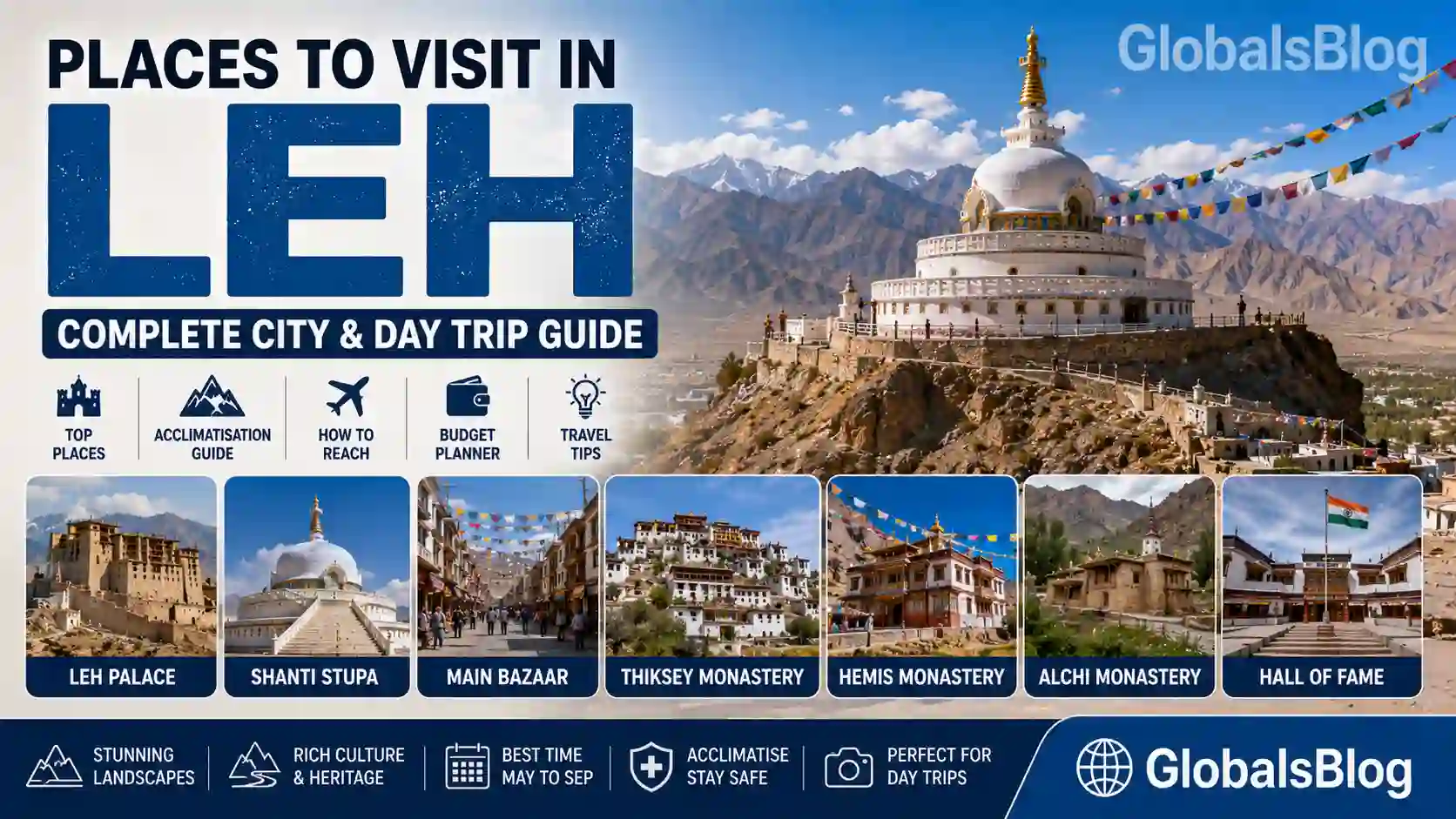
Leh Palace dominates the skyline from a ridge above the city — a 17th-century nine-storey fortress-palace modelled on the Potala in Lhasa. The Main Bazaar sells Pashmina, prayer wheels, dried apricots, and Ladakhi jewellery in a lane unchanged for centuries. And the confluence of the Indus and Zanskar rivers is visible from the NH-1 highway 30km away. Leh is not just the gateway to Ladakh — it is a destination in its own right.
Leh — the capital of the Union Territory of Ladakh — sits at 3,524m in the upper Indus Valley, surrounded by the Ladakh Range to the north and the Zanskar Range to the south. It is the administrative, commercial, cultural, and tourist hub of Ladakh — the point of arrival for all visitors (by air to Kushok Bakula Rimpochee Airport, or by road via the Manali–Leh or Srinagar–Leh highways), the base for all circuit exploration, and a destination of genuine historical and cultural depth in its own right. The city was the capital of the Kingdom of Ladakh from the 15th century to the 19th century, when the Namgyal dynasty ruled from Leh Palace over a trading centre at the crossroads of the Silk Road between India, Tibet, and Central Asia. The cultural mix this produced — Tibetan Buddhist, Kashmiri Muslim, Ladakhi indigenous — is still visible in the city's architecture, cuisine, population, and the distinctive Anglo-Buddhist-Muslim atmosphere of the Main Bazaar. This guide covers every major Leh city attraction, the surrounding monasteries and viewpoints accessible as day trips from Leh, the practical details of acclimatisation, and how to organise the city as a base for the broader Ladakh circuit.
Best places to visit in Leh: Leh Palace (17th century, 9-storey Namgyal dynasty palace, free entry, sunrise views), Shanti Stupa (white Buddhist dome on hilltop, panoramic 360-degree city views), Hall of Fame Museum (Indian Army museum, Kargil War, free for army families), Main Bazaar and Old Town (Silk Road trading lanes, Pashmina, prayer wheels, Ladakhi food), Namgyal Tsemo Monastery (hilltop monastery above Leh Palace, sunset views), Thiksey Monastery day trip (19km, Mini Potala), Hemis Monastery day trip (45km, festival June–July). Best time: June–September. Stay: 24–48 hours mandatory acclimatisation before going to higher areas. Budget: ₹800–2,000/night guesthouses.
Best Places to Visit in Leh City
Leh Palace is the most historically significant building in Ladakh — a nine-storey rammed-earth and timber palace built in the 17th century by King Sengge Namgyal as the seat of the Ladakhi kingdom. The palace is modelled after the Potala Palace in Lhasa, Tibet (though smaller — the Potala was completed around the same time), and stands on a ridge above the old city with commanding views of the Indus Valley, the city below, and the Stok Kangri range across the valley. The palace was abandoned in the 19th century when the Dogra forces of Gulab Singh defeated the Ladakhi kingdom and the royal family moved to Stok Palace — it has been in various states of archaeological restoration since being taken over by the Archaeological Survey of India. The interior: multiple levels of mud-plastered rooms, some with surviving 17th-century murals, the main temple (Lha-Khang Soma) with ancient Buddhist artifacts, and steep narrow staircases between floors. The rooftop (accessible from the upper floors) provides the finest view over Leh city — particularly at sunrise when the light turns the surrounding peaks gold and the city below is still in shadow. Entry is ₹15 (Indian). ASI-managed. Open 7am–6pm. The 15-minute uphill walk from the Main Bazaar to the palace entrance passes through the old city lanes — themselves worth exploring slowly.
Shanti Stupa is a white-domed Buddhist peace pagoda on a hilltop 5km from Leh's Main Bazaar, at 3,600m — offering the most complete 360-degree panoramic view of Leh city and the surrounding Indus Valley available from any single point. The stupa was built in 1991 by the Japanese Buddhist order Nipponzan Myohoji in cooperation with the Ladakh Buddhist Association, and contains relics of the Buddha presented by the Dalai Lama. The architecture is striking — a gleaming white dome with gold-painted sculptures of the Buddha's life on the four sides of the stupa's base, visible from the city far below. The approach: either by a 550-step staircase directly from the main road (25–30 minutes of moderate climbing at 3,600m altitude — take your time), or by vehicle on the road that winds to the summit. The stupa faces west — making it the finest sunset viewpoint in Leh. Sunset visits (5:30–7pm, July–August) reveal the entire Leh Valley turning golden, with Leh Palace silhouetted on its ridge and the Stok Kangri and Zanskar peaks catching the last light to the south. The stupa area is peaceful and well-maintained — a temple with resident monks is adjacent, and the monk's chanting during evening puja adds to the atmosphere. Free entry. Open dawn to dusk.
Leh's Main Bazaar is the commercial spine of the city — a 500-metre-long market street running parallel to the base of Leh Palace's ridge, lined with shops selling Pashmina wool products, Tibetan thangka paintings, prayer wheels and beads, dried apricots and walnuts (Ladakh's most famous food products), traditional Ladakhi jewellery, and the Buddhist religious artifacts that have been traded through this corridor since the Silk Road's active period. The market has been in continuous operation for centuries and retains its character as a genuine trading hub rather than a pure tourist bazaar — Ladakhi families shop here alongside visitors. The lanes behind the Main Bazaar lead into Leh's old town: winding medieval alleys between whitewashed mud-brick buildings, small neighbourhood temples, chortens (Buddhist stupas), and the occasional prayer flag corridor. The old town is best explored without a specific destination — follow any lane uphill from the Main Bazaar and you will reach the Leh Palace ridge or Namgyal Tsemo through genuinely ancient lanes. Local food on the Main Bazaar: Tibetan butter tea (po cha) at the small tea stalls (₹20–40), Ladakhi thukpa (noodle soup) at the dhabas behind the main street, tsampa (roasted barley flour) from the grain shops, and the dried apricots (Ladakhi apricots are smaller and more intensely flavoured than cultivated varieties — the best come from Hunza and Nubra).
Namgyal Tsemo Gonpa is the monastery that sits at the very top of the rocky ridge above Leh Palace — a 15th-century foundation (older than the palace below it) that is reached by a steep 45-minute climb from the palace roof or a shorter track from the Changspa side of the ridge. The monastery is small (a handful of monks maintain it) but the location is extraordinary — from the prayer flag-draped summit at 3,710m, the view encompasses the entire Leh city below, the palace on its ridge, the Indus Valley, and the Stok Kangri (6,153m) across the river. A three-storey tower (Victory Tower) stands at the summit alongside the monastery — originally built to mark the territorial extent of the Ladakhi kingdom. The monastery is at its most atmospheric at sunrise (6–7am) when the monks perform the morning puja with the dawn light breaking over the Stok Range and Leh city still dark below, and at sunset (6–7pm) when the light catches the prayer flags and the palace below turns ochre. The climb from Leh Palace to Namgyal Tsemo at 3,700m takes approximately 45 minutes — take it slowly, stop frequently, and do not attempt it on your first day in Leh before acclimatising.
The Hall of Fame is an Indian Army museum 4km from Leh's Main Bazaar on the Srinagar highway, managed by the Indian Army's Fire and Fury Corps. The museum documents the military history of the Ladakh region from the 1947 war (the first Kashmir conflict) through the 1965 war, the 1971 Bangladesh Liberation War, and most significantly the 1999 Kargil War — the high-altitude conflict between India and Pakistan on the Kargil-Drass peaks that resulted in the reconquest of Pakistani-occupied positions above 5,000m by the Indian Army. The museum is organised into chronological halls covering each conflict, with personal accounts from soldiers, weapons and equipment displays, maps of operations, and a particularly moving section on the officers and soldiers who died in the Kargil conflict — each with a name, photograph, and brief biography. The memorial garden outside has captured Pakistani weapons and a garden dedicated to the fallen. The Hall of Fame is free for army families and retired personnel; ₹30 for civilian visitors. It is undervisited by the tourist majority who focus on the natural and Buddhist attractions of Ladakh — but for any visitor interested in understanding the geopolitical context that makes Ladakh a restricted-access, permit-requiring region, the museum provides essential context.
Leh's food and market scene is one of the most distinctive in India — a mix of Tibetan, Ladakhi, Kashmiri, and continental influences developed to serve both the local population and the increasing tourist flow. Specific Leh food experiences: Thukpa (Tibetan noodle soup with vegetables or meat — the definitive Leh meal, ₹100–180), Skyu (Ladakhi pasta dish with root vegetables in a warming broth — less known than thukpa but more authentic, ₹150–250), Momos (Tibetan dumplings, steamed or fried — available from ₹80 a plate), Butter Tea (po cha — salt and butter tea in the Tibetan tradition, deeply warming at altitude), Chhurpe (dried yak cheese, hard and intense, eaten as a snack), and Ladakhi apricots (fresh in season, dried year-round — the best are from Nubra and Hunza). The Changspa restaurant lane (behind the Main Bazaar toward the Changspa guesthouse area) has the densest concentration of restaurants — Bon Appetit, Tibetan Kitchen, Alchi Kitchen, and The Tibetan Brothers are consistent recommendations. For Pashmina shopping: the Leh Market has dozens of shops — buy from the government-certified shops or directly from weavers in the alleys behind the main market. Authentic Pashmina has a distinctive softness test — it should pass through a ring and feel feather-light against the skin.
Thiksey Monastery is the most visually striking monastery on the Leh–Manali Highway — a 12-storey complex of whitewashed buildings rising from a conical rocky hill 19km from Leh, visible from kilometres away. The monastery is the day trip from Leh that most visitors make on their second or third day — after acclimatising in the city — and it consistently ranks among the finest monastery experiences in Ladakh. The key features: the 15-metre seated Maitreya Buddha (Future Buddha) statue built in 1980 that spans two complete floors of the monastery complex — the largest such statue in Ladakh; the monastery museum with swords, armour, and Thangka paintings; the main assembly hall with original Gelugpa frescoes; and the morning puja ceremony at 6am where monks chant in the prayer hall before dawn with butter lamps lit and incense filling the stone room. The 6am puja is the finest experience at Thiksey — arrive in Leh the previous evening, leave the hotel by 5:15am, and be at Thiksey by 5:45am for the opening of the puja. Most tourists arrive after 9am — the monastery is significantly more peaceful and atmospheric in the two hours before them. Thiksey, Shey Palace (5km closer to Leh), and Hemis Monastery (45km from Leh) can be combined in a single day trip.
Hemis Monastery — 45km from Leh via Karu — is the largest and wealthiest monastery in Ladakh, founded in 1672 under King Sengge Namgyal. The monastery is the site of the annual Hemis Tsechu festival — a two-day masked Cham dance celebration of Guru Padmasambhava's birthday held in June or July (exact dates vary annually with the Tibetan lunar calendar). The festival draws thousands of visitors and features monks in elaborate silk costumes with towering headdresses performing ritual dances in the monastery's courtyard — the most spectacular cultural event in the Ladakh calendar. The monastery museum contains gold and silver religious artifacts, ancient weapons, and the monastery's famous Thangka — the largest Thangka in Ladakh, unrolled only once every 12 years (next due 2028). Hemis is also the entry point for Hemis National Park — India's largest national park and home to the highest concentration of snow leopards in any protected area globally (the park is best for snow leopard sightings in winter, December–February). Entry ₹100 (monastery), ₹200 (museum). The drive from Leh to Hemis passes Shey (former royal summer palace, 15km) and Thiksey (19km) — all three make a natural monastery day circuit, typically done in 5–6 hours from Leh with an early start.
Magnetic Hill is a stretch of road 30km from Leh on the Kargil/Srinagar highway where vehicles placed in neutral appear to roll uphill — a famous optical illusion caused by the surrounding landscape creating a visual perception of an uphill slope where the road actually descends. The yellow box painted on the road marks the spot where the illusion is most effective — park, select neutral, and the vehicle creeps forward against what appears to be gravity. Gurudwara Pathar Sahib is a Sikh shrine 3km before Magnetic Hill, built in 1517 to mark a spot associated with Guru Nanak Dev Ji's legendary journey through Ladakh. The gurudwara is maintained by the Indian Army and offers langar (free community food — typically dal, sabzi, and roti) throughout the day to all visitors regardless of religion. The Sangam viewpoint — where the Indus and Zanskar rivers meet — is visible from the Srinagar Highway approximately 10km before Leh. All three (Sangam viewpoint, Gurudwara Pathar Sahib, Magnetic Hill) are on the same highway and can be combined in a single morning half-day circuit from Leh — leave by 9am, back by 1pm.
Alchi Monastery is the most art-historically significant monastery in Ladakh — founded in the 10th–11th century by the Kashmiri scholar Rinchen Zangpo, it contains the only surviving examples of Indo-Kashmiri Buddhist mural painting from the 10th–12th centuries in existence. The frescos in Alchi's three main temples are considered among the finest early Buddhist art in the world — stylistically distinct from the later Tibetan-influenced art at Hemis and Thiksey, retaining a warmth and naturalism that reflects their Kashmiri artistic origins. The monastery is a working village complex — three resident monks maintain the shrines. Photography inside the temples with murals is not permitted (guards enforce this firmly). Alchi sits at 3,100m — lower than Leh — making it more accessible for altitude-sensitive visitors who want a monastery experience without ascending further. The Alchi–Likir–Basgo monastery circuit (three monasteries within 20km of each other on the Srinagar highway) makes an efficient half-day or full-day trip from Leh. Likir Monastery has a large golden Maitreya Buddha statue in its main courtyard visible from the highway; Basgo Palace is a ruined 15th-century fort on a dramatic hilltop. All three can be done in 5–6 hours from Leh.
Leh Acclimatisation Guide — Critical for All Visitors
| Day | Recommended Activity | Avoid | Altitude |
|---|---|---|---|
| Day 1 (arrival) | Rest completely — short slow walk maximum. No stairs, no uphill, no exertion | Everything strenuous. Alcohol. Sleeping pills | Stay in Leh — 3,524m |
| Day 2 | Gentle city walks — Main Bazaar, Leh Palace (vehicle up, walk inside slowly) | Shanti Stupa steps. Namgyal Tsemo climb. High passes | Stay in Leh — 3,524m |
| Day 3 | Monastery day trip — Thiksey (3,600m) and Hemis (3,600m) are fine | Khardung La (5,359m), Pangong (4,350m), Namgyal Tsemo without prior rest | 3,500–3,700m only |
| Day 4+ | Pangong Tso (4,350m), Nubra (3,048m via Khardung La 5,359m), high passes | — | High altitude now safe |
AMS symptoms to watch for: persistent headache, nausea, loss of appetite, dizziness, difficulty sleeping, and breathlessness at rest. Mild headache on arrival is normal — it typically passes within 24 hours with rest and hydration. Worsening headache, vomiting, chest tightness, or confusion requires immediate descent and medical attention. Diamox (acetazolamide 125mg twice daily) can be prescribed by a doctor before travel to aid acclimatisation — consult your physician before the trip. See our complete Ladakh guide for the full acclimatisation protocol and what to do if AMS occurs.
How to Reach Leh
| Route | Mode | Duration | Cost (approx) | Best For |
|---|---|---|---|---|
| Delhi → Leh | Flight (IndiGo, Air India, SpiceJet) | 1.5 hrs | ₹3,500–9,000 | Fastest, most convenient |
| Mumbai → Leh | Flight (via Delhi, usually) | 2.5–4 hrs | ₹6,000–15,000 | Only viable option from Mumbai |
| Manali → Leh | Road (2 days, 1 night halt Sarchu) | 479km · 2 days | ₹800 bus / ₹3,000 taxi | Road trip enthusiasts, motorcyclists |
| Srinagar → Leh | Road (2 days, 1 night halt Kargil) | 434km · 2 days | ₹600 bus / ₹2,500 taxi | Alternative road approach |
Flying is the preferred option for most visitors — the 1.5-hour Delhi–Leh flight arrives at Kushok Bakula Rimpochee Airport (LEH), 4km from city centre. Taxi from airport to Main Bazaar costs ₹300–400. Book flights 60–90 days ahead for June–August peak season. Morning flights are significantly more reliable than afternoon — afternoon winds at Leh's high-altitude airport cause frequent cancellations without much advance notice. The Manali–Leh road is a magnificent 2-day journey but requires a high-clearance vehicle (Innova, Thar, Bolero) and is only open mid-June through October.
Leh Budget Guide
| Category | Budget | Mid-Range | Premium |
|---|---|---|---|
| Accommodation/night | ₹500–1,200 (guesthouses, Changspa) | ₹2,000–5,000 (hotels) | ₹8,000–20,000 (luxury) |
| Food/day | ₹300–500 (thukpa, momos, dhabas) | ₹700–1,200 | ₹1,500–3,000 |
| Local transport/day | ₹200–400 (shared taxi) | ₹1,500–2,500 (private taxi) | ₹3,000–5,000 (SUV hire) |
| Activities/entry/day | ₹100–300 | ₹300–700 | ₹700–2,000 |
| Total/day (excl. travel) | ₹1,100–2,400 | ₹4,500–9,400 | ₹12,200–30,000 |
Leh City Travel Tips
- Acclimatisation is non-negotiable — plan your first two days around it: Leh at 3,524m requires genuine rest on arrival — not gentle sightseeing, rest. The temptation to immediately start exploring is understandable given the limited trip time most visitors have, but altitude sickness (AMS) that develops from overexertion on day 1 can incapacitate you for 2–3 days, wasting far more time than the acclimatisation rest would have. Day 1: arrive, sleep, drink water. Day 2: gentle Old Town and Main Bazaar walk. Day 3: monasteries. Day 4: high passes and Pangong. This sequence is medically recommended and practically the most efficient
- ATMs in Leh run out in peak season — carry cash from Delhi or Manali: Leh has SBI, PNB, and J&K Bank ATMs but they run empty during July–August when visitor numbers peak. Carry ₹10,000–15,000 per person in cash from your point of departure. Outside Leh city, there are no ATMs at Pangong, Nubra (except Diskit, unreliable), Tso Moriri, or any of the high-altitude villages. Budget your cash carefully for the entire Ladakh circuit before leaving Leh
- Mobile connectivity: Airtel and Jio in Leh city, BSNL outside: Airtel and Jio have reliable connectivity in Leh city and the main roads. Beyond Leh — on the road to Pangong, in Nubra, on the Manali highway — only BSNL has coverage. If you are using Airtel or Jio, download offline Google Maps for Ladakh before your trip. The alternative is a BSNL local SIM — available in Leh Main Bazaar, provides the most reliable coverage throughout the circuit
- Buy ILP permits in Leh before leaving for restricted areas: The Inner Line Permit (ILP) required for Pangong Tso, Nubra Valley, Tso Moriri, and other restricted areas must be obtained from the DC Office (Deputy Commissioner's Office) in Leh before setting out. The DC Office is a 10-minute walk from the Main Bazaar — open weekdays and select weekend mornings. Bring Aadhaar/passport and two photocopies. Most permits take 30–60 minutes to process. Do not plan to pick up permits on your way out of Leh at 5am — get them the previous afternoon
- Leh's morning puja circuit — the best 3 hours in the city: Leave your guesthouse by 5:30am (Day 3 or later, after acclimatisation). Walk to Thiksey via taxi (30 minutes). Attend the 6am puja in the monastery's main prayer hall — monks chanting with butter lamps lit, dawn light on the valley below through the narrow windows. Return by 8am, walk through the Old Town lanes and Main Bazaar as shops are opening. Breakfast at a Changspa café with the morning light on Leh Palace. This 3-hour sequence is the finest morning in Ladakh and costs ₹300–400 total (taxi + entry + breakfast)
- For the complete Ladakh circuit beyond Leh city — Pangong, Nubra, Tso Moriri — see our complete Ladakh travel guide and our best time to visit Ladakh guide for month-by-month timing
Disclaimer: Entry fees, permit requirements, ATM availability, mobile network coverage, and flight schedules in Leh and Ladakh are subject to change. Flight cancellations at Leh airport are common due to weather — always have a buffer day before onward travel. Kargil War Memorial and Hall of Fame visiting conditions may vary based on military schedules. Always verify current permit requirements with the DC Office, Leh before travelling to restricted areas.
Leh Palace for History. Shanti Stupa for Views. Main Bazaar for Culture. Thiksey at Dawn for the Experience. Hall of Fame for Context. Alchi for Art.
Leh city is the most underappreciated part of most Ladakh itineraries — visitors race through it toward Pangong and Nubra, treating it as mere transit. The city rewards those who slow down: the sunrise from Leh Palace rooftop, the 6am puja at Thiksey with no other tourists, the Old Town lanes where the medieval Silk Road trading character survives intact, the Hall of Fame that explains the geopolitical context of this remarkable place, and the butter tea and thukpa at a Changspa café with the morning light on the mountains. Give Leh two full days minimum — three is better. Acclimatise properly. Explore on foot. Then go to Pangong.
The best places to visit in Leh city and surroundings are: Leh Palace (17th-century 9-storey Namgyal dynasty palace, ₹15 entry, sunrise views from rooftop), Shanti Stupa (white Buddhist dome on hilltop, 360-degree panoramic views, best at sunset), Main Bazaar and Old Town (Silk Road trading lanes, Pashmina, prayer wheels, Ladakhi food, medieval alleys), Namgyal Tsemo Monastery (above Leh Palace at 3,710m, 15th century, sunrise and sunset views), Hall of Fame Museum (Indian Army museum, Kargil War documentation, ₹30), Thiksey Monastery day trip (19km, 15m Maitreya Buddha, morning puja 6am), Hemis Monastery day trip (45km, Ladakh's largest, annual Tsechu festival June/July), Magnetic Hill + Gurudwara Pathar Sahib (30km, optical illusion + Sikh shrine, half-day circuit), and Alchi Monastery day trip (70km, oldest surviving 10th-12th century Buddhist murals in India). All beyond-Leh destinations (Pangong, Nubra, Tso Moriri) require ILP permits obtained in Leh.
Spend a minimum of 2 full days in Leh city — 3 days is ideal for a balanced experience. Day 1: complete rest for acclimatisation (no strenuous activity — walk gently in the Main Bazaar only). Day 2: Leh Palace + Old Town walk + Shanti Stupa sunset (all within the city, gentle pace). Day 3: Thiksey Monastery morning puja (6am departure) + Shey Palace + Hemis Monastery day circuit. Day 4 onwards: Nubra Valley, Pangong Tso, and high-altitude destinations beyond Leh. The acclimatisation rest on Day 1 is medically non-negotiable at 3,524m — visitors who skip it to immediately sightsee commonly develop Acute Mountain Sickness that incapacitates them for 2–3 days. Those who rest properly are rewarded with the ability to enjoy high-altitude sites like Khardung La (5,359m) and Pangong (4,350m) comfortably from Day 4.
The best time to visit Leh is June to September. June: roads from Manali open (mid-June), Hemis Festival typically occurs (check exact date), weather pleasant (15–25°C in Leh), fewer crowds than July–August. July–August: peak season — warmest temperatures, all routes and attractions accessible, maximum daylight, but highest tourist volumes and accommodation prices. September: excellent — crowds reduce significantly after mid-September, weather stable until end of September, prices drop, Nubra and Pangong still accessible. October: Manali road begins closing in late October, nights cold (-5°C to -10°C in Leh city), but Pangong and Nubra still accessible via Srinagar route through October. November–May: cold, Manali road closed by snow — for experienced travellers who want fewer tourists and the winter Leh character (Chadar Trek in January–February). July–August is peak season with most visitors; June and September are better for those wanting fewer crowds.
How to reach Leh from Delhi: By air (recommended) — direct flights from Delhi IGI to Leh Kushok Bakula Rimpochee Airport (LEH), 1.5 hours, operated by IndiGo, Air India, SpiceJet. Fares range ₹3,500–9,000 one-way depending on booking lead time. Book 60–90 days in advance for June–August. Morning flights strongly preferred — afternoon flights face higher cancellation rates due to afternoon winds at Leh airport. Airport is 4km from Main Bazaar (taxi ₹300–400). By road — drive or overnight bus to Manali (530km, 12–14 hrs from Delhi), rest 1–2 days in Manali for partial acclimatisation, then drive Manali–Leh highway (479km, 2 days with 1 night halt at Sarchu). Manali–Leh highway open approximately June to October only. Road journey adds 3–4 days each way but the Manali–Leh drive is among India's most spectacular mountain roads.
Budget for a Leh city + Ladakh circuit trip from Delhi (7 days): Budget traveller ₹20,000–30,000 total (flights ₹7,000–10,000 return + local ₹13,000–20,000 for budget guesthouses, shared taxis, local food, and basic activities). Mid-range ₹45,000–65,000 total (flights + comfortable hotels ₹2,000–5,000/night + private taxi for monastery day trips and Pangong/Nubra circuit, eco-camp at Pangong). Premium ₹80,000–1,50,000+ (flights + luxury hotels ₹8,000–20,000/night + private SUV hire for full circuit). Key cost factors: Flights booked 60–90 days ahead are 30–50% cheaper than last-minute. Private taxi for Leh + Pangong + Nubra 7-day circuit: ₹15,000–25,000 for the vehicle. Pangong lake-shore eco-camp: ₹1,500–8,000/night. Carry ₹10,000–15,000 cash from Delhi — Leh ATMs run dry in peak season and there are no ATMs beyond Leh on most routes.
Yes — Leh and Ladakh are among the safest travel destinations in India. Crime against tourists is extremely rare, the local Ladakhi population is welcoming and hospitable, and the Indian Army presence throughout the region ensures security. The primary safety concern is not crime but altitude sickness (AMS) — Leh at 3,524m is high enough that visitors unaccustomed to altitude commonly experience headaches, nausea, and breathlessness on arrival. The 24–48 hour acclimatisation rest on arrival, staying hydrated, avoiding alcohol on day 1, and ascending gradually to higher-altitude destinations are the safety protocols that matter in Leh. Road safety is another consideration — the Manali–Leh and Srinagar–Leh highways are high-altitude mountain roads with steep drop-offs, limited barriers, and occasional rockfall. Travelling with an experienced driver familiar with mountain roads is strongly recommended over self-drive for visitors unfamiliar with Himalayan road conditions. Ladakh is fully accessible to solo female travellers, families, and senior citizens who are medically cleared for high-altitude travel.
Reader Experiences