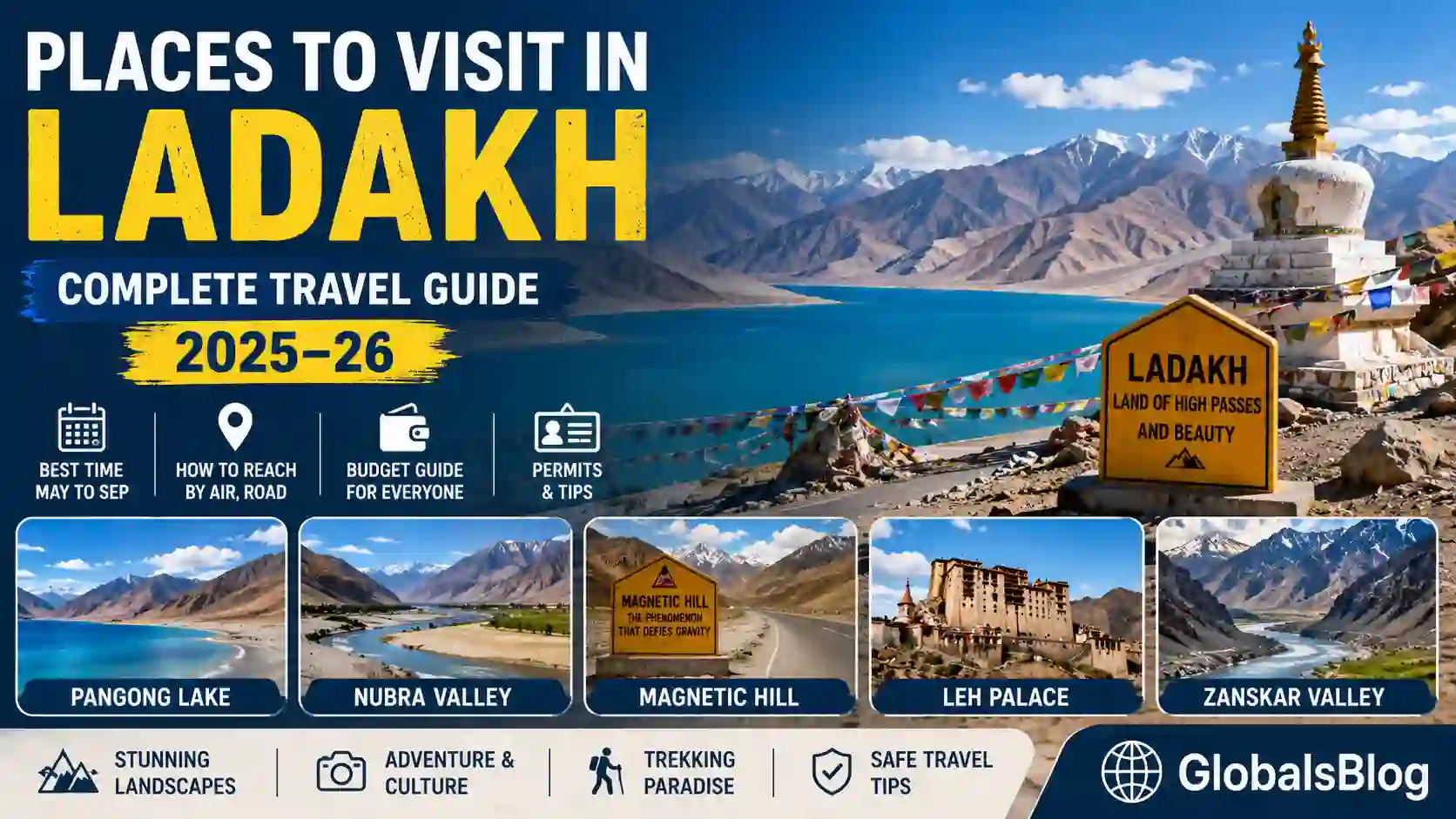
Pangong Lake sits at 4,350m and changes colour from blue to green to red across the day. Nubra Valley's sand dunes host Bactrian camels against Himalayan peaks. Ladakh is India's highest, most remote, and most breathtaking destination — here is everything you need to plan it right.
Ladakh — the Land of High Passes — occupies the northernmost corner of India at an average elevation of 3,500m above sea level. It is a high-altitude cold desert: stark, lunar, and extraordinary. The region spans from the Karakoram Range in the north to the Great Himalayas in the south, covering monasteries perched on cliff faces, lakes that shift colour through the day, valleys where Bactrian camels walk on sand dunes with 6,000m peaks as backdrop, and mountain passes that rank among the highest motorable roads on earth. Ladakh was opened to foreign tourists in 1974 — before that, it was a restricted border zone. Today, it receives approximately 3–4 lakh visitors annually, a number that has grown sharply since the 2019 reorganisation as a Union Territory. Road connectivity from Manali (Manali–Leh Highway) and Srinagar (NH-1), combined with Leh's Kushok Bakula Rimpochee Airport, makes it more accessible than its remoteness suggests — though the altitude and permits require planning that most Indian hill stations do not. This is the most comprehensive Ladakh travel guide for 2025–26: every major destination, route, budget, permit detail, and timing you need.
Best places in Ladakh: Pangong Tso Lake (4,350m — blue-green lake, 134km long, 60% in China), Nubra Valley (sand dunes + Bactrian camels + Diskit Monastery), Magnetic Hill (optical illusion — vehicles appear to roll uphill), Leh Palace (17th century, 9 storeys, views over the city), Khardung La Pass (5,359m — once claimed as world's highest motorable road), Hemis Monastery (June–July festival), Tso Moriri Lake (4,522m — restricted, permit required), Zanskar Valley (remote, winter frozen river trek — Chadar Trek). Best time: June–September. How to reach: fly to Leh (Delhi 1.5 hrs, Mumbai 2.5 hrs) or drive Manali–Leh (2 days, 479km, open May–October). Budget: ₹1,200–2,500/night guesthouses in Leh. Permits: Inner Line Permit (ILP) required for Pangong, Nubra, Tso Moriri.
Best Places to Visit in Ladakh
Pangong Tso (Tso means "lake" in Tibetan) is the defining image of Ladakh — a 134km-long high-altitude lake at 4,350m whose water changes colour from brilliant cobalt blue to turquoise, green, and red-gold across the day depending on the angle of the sun. Roughly 40% of Pangong lies in Indian-administered Ladakh; 60% extends into the Tibetan Autonomous Region of China. The lake is saline and freezes completely in winter — typically November to March — with ice solid enough to walk on. The famous "three idiots" filming location is at the western end near Spangmik village. Colours are most vivid in morning light (8–10am) and late afternoon (4–6pm) — midday light flattens the blues. Camping on the lake shore is the recommended overnight option — eco-camps operate tents from ₹1,500–3,000 per night, and the night sky here at 4,350m with zero light pollution is one of India's finest stargazing experiences.
Nubra Valley is the geographic and visual surprise of Ladakh — a broad, river-carved valley at 3,048m elevation (warmer than Leh) where Bactrian double-humped camels walk across sand dunes with snow-capped 6,000m+ peaks as backdrop. The valley was historically the route of the Silk Road connecting India to Central Asia. Diskit town has the 14th-century Diskit Monastery — Ladakh's oldest and largest Gelugpa monastery — perched dramatically on a hilltop with a 32-metre Maitreya Buddha statue erected in 2010. Hunder village, 10km from Diskit, has the sand dune field where Bactrian camel rides are available (₹500–800 per person). The route from Leh to Nubra via Khardung La (5,359m) is one of the highest motorable roads on earth — the pass itself offers panoramic Himalayan views and the experience of standing above the clouds.
Leh is the capital and gateway city of Ladakh — the base for all major routes in the region. The city sits at 3,524m and first-time visitors must spend 24–48 hours here upon arrival before attempting higher-altitude destinations. Rushing to Pangong or Nubra on arrival day causes Acute Mountain Sickness (AMS) — headache, nausea, breathlessness — which can escalate to life-threatening High Altitude Pulmonary Oedema (HAPE) if ignored. Leh's own attractions: Leh Palace (17th century, 9-storey Namgyal dynasty palace modelled on the Potala in Lhasa); Shanti Stupa (white-domed Buddhist stupa with panoramic city views); the Main Bazaar (Pashmina, dry fruits, Thangka paintings); and Namgyal Tsemo Monastery (best sunset views over the city). The city has Airtel and Jio mobile coverage, good restaurants serving Ladakhi cuisine (Skyu, Thukpa, Butter Tea), and ATMs — carry cash as coverage drops sharply outside the city.
Khardung La at 5,359m is on the route to Nubra Valley and is one of the world's highest motorable mountain passes. A signboard at the pass claims 5,602m — GPS surveys place it at 5,359m — but at either elevation it is an extraordinary experience. The pass is frequently used by motorcyclists — the Leh–Nubra route via Khardung La is one of India's most iconic motorcycle journeys. Temperatures at the summit average -5°C to -15°C even in summer (July–August) — carry a jacket regardless of how warm Leh city feels. Do not spend more than 20–30 minutes at the summit if not fully acclimatised — oxygen at 5,359m is approximately 50% of sea level.
Tso Moriri is arguably more beautiful than Pangong Tso — a 28km-long freshwater lake at 4,522m surrounded by barren golden mountains with no commercial development on the shore. The lake is entirely within Indian territory and is a Ramsar Wetland Site hosting breeding colonies of black-necked cranes (endangered), bar-headed geese, and Brahmaputra cormorants. The sole village, Korzok, has a small monastery and basic guesthouses. Because Tso Moriri requires a full day's drive and is more remote than Pangong, it receives significantly fewer visitors — a deliberate advantage for travellers wanting solitude. The road from Leh via Chumathang (geothermal hot springs) is paved most of the way. Combine with the Changthang Plateau for a 3-day circuit: Leh to Tso Moriri on day 1, Tso Kar on day 2, back to Leh on day 3.
Hemis is the largest and wealthiest monastery in Ladakh — founded in 1672, it houses the Hemis Museum (Thangkas, gold and silver statues, ancient weapons), a library of over 1,000 manuscripts, and the largest Thangka in Ladakh (unrolled once every 12 years, next due 2028). The site of the annual Hemis Festival (Tsechu) — a two-day masked Cham dance celebration of Guru Padmasambhava's birthday, held in June or July. The festival features monks in elaborate silk costumes performing ritual dances in the monastery courtyard and draws thousands of visitors. Hemis is also the entry point for Hemis National Park — India's largest national park and home to the highest density of snow leopards in any protected area globally.
Magnetic Hill is a stretch of road 30km from Leh on the Leh–Kargil Highway where vehicles placed in neutral appear to roll uphill — defying gravity. The effect is an optical illusion: the road slopes downhill but surrounding hills create the visual perception of an uphill gradient. There is no actual magnetic anomaly. Park at the designated yellow box on the road, put the car in neutral, and it will visibly creep forward. Magnetic Hill is en route to Gurudwara Pathar Sahib (Sikh shrine, 3km further) and Sangam — the confluence of the Indus and Zanskar rivers. All three can be combined in a morning half-day trip from Leh, making it an efficient stop regardless of the circuit you are following.
Zanskar is Ladakh's most remote region — accessible by road only for 3–4 months (July–October, when Pensi La pass is open) and famous for the Chadar Trek done in January–February when the Zanskar River freezes into a solid sheet of ice. The Chadar Trek covers 105km over 8–10 days, walking on a frozen river at -15°C to -35°C through a gorge with 300m vertical ice walls — one of India's most extraordinary winter treks. Padum, Zanskar's capital, has the Karsha Monastery (10th century, visible from 10km on a cliff face). The valley has limited accommodation (basic guesthouses ₹800–1,000/night in Padum) and no ATMs — carry all cash from Leh. Zanskar is for experienced Ladakh travellers or those specifically seeking the Chadar Trek.
Thiksey Monastery is the most visually striking monastery in Ladakh — a 12-storey complex of white-painted structures rising from a rocky hilltop 19km from Leh, resembling the Potala Palace in Lhasa. The Gelugpa monastery houses approximately 60 monks and its most important feature is a 15-metre seated statue of Maitreya Buddha built in 1980 — the largest such statue in Ladakh, occupying two full floors. The monastery museum contains swords, armour, Thangka paintings, and Buddhist scriptures. The morning puja (prayer ceremony) at 6am–7am is the most atmospheric visit time — monks chant in the main prayer hall with the sound carrying across the valley. Thiksey, Shey Palace (royal summer palace, 5km), and Hemis Monastery (45km) can all be combined in a single day-trip circuit from Leh.
Alchi is Ladakh's most art-historically significant monastery — founded in the 10th–11th century by Kashmiri scholar Rinchen Zangpo, it contains the only surviving examples of Indo-Kashmiri Buddhist mural painting from the 10th–12th centuries. The frescos in Alchi's three main temples are considered among the finest early Buddhist art in the world — stylistically distinct from the later Tibetan-influenced art at Hemis and Thiksey, retaining a warmth and naturalism reflecting their Kashmiri origins. Three resident monks maintain the complex. Alchi sits at 3,100m — lower than Leh — making it more accessible for altitude-sensitive visitors. The Alchi–Likir–Basgo monastery circuit (three monasteries within 20km) makes an efficient half-day trip from Leh.
How to Reach Ladakh
| Route | Mode | Duration / Cost | Season | Best For |
|---|---|---|---|---|
| Delhi → Leh | Flight (IndiGo, Air India, SpiceJet) | 1.5 hrs · ₹3,500–9,000 | Year-round | Fastest, most reliable |
| Mumbai → Leh | Flight (usually via Delhi) | 2.5–4 hrs · ₹6,000–15,000 | Year-round | Only viable option from Mumbai |
| Manali → Leh | Road (bus or self-drive) | 479km · 2 days (1 night halt Sarchu) | June–October only | Scenic road trip, motorcycle riders |
| Srinagar → Leh | Road (bus or taxi) | 434km · 2 days (1 night Kargil) | May–November | Alternative to Manali route |
Book Leh flights 60–90 days in advance for peak season (June–August) — fares are 30–50% lower when booked early. Morning flights are more reliable; afternoon flights face frequent cancellations due to afternoon winds at Leh's high-altitude airport. The Manali–Leh highway passes Baralacha La (4,890m) and Tanglang La (5,328m) — use a high-clearance vehicle (Innova, Bolero, Thar). See our best time to visit Ladakh guide for month-by-month road conditions and route advice.
Ladakh Permits — Inner Line Permit (ILP)
| Area | Permit Required | Cost (approx) | Where to Get |
|---|---|---|---|
| Pangong Tso Lake | Inner Line Permit (ILP) | ₹400–500/person | DC Office, Leh / online |
| Nubra Valley | ILP (same covers Khardung La) | ₹400–500/person | DC Office, Leh |
| Tso Moriri Lake | ILP (separate from Pangong/Nubra) | ₹400–500/person | DC Office, Leh |
| Leh city, Hemis, Thiksey, Alchi, Magnetic Hill | No permit required | Free | — |
Indian nationals need the ILP; foreign nationals need both ILP and a Protected Area Permit (PAP). Permits obtained at the DC Office in Leh in 30–60 minutes with a valid ID and photocopy. Carry multiple photocopies — checkposts are frequent on restricted area routes. Travel agents in Leh can process permits for a ₹100–200 service fee.
Ladakh 7-Day Itinerary
| Day | Route | Key Stops |
|---|---|---|
| Day 1 | Arrive Leh — REST | Acclimatisation only. Shanti Stupa evening walk at most |
| Day 2 | Leh local sightseeing | Leh Palace, Main Bazaar, Namgyal Tsemo, Hall of Fame |
| Day 3 | Monastery day circuit | Thiksey + Hemis + Shey Palace — return to Leh |
| Day 4 | Leh → Nubra Valley | Khardung La summit, Diskit Monastery, Hunder dunes + camel ride |
| Day 5 | Nubra → Pangong Tso | Via Shyok Valley — arrive Pangong afternoon, overnight eco-camp |
| Day 6 | Pangong → Leh | Sunrise at lake, return via Chang La Pass |
| Day 7 | Leh → Departure | Morning market, book morning flight for reliability |
Ladakh Budget Guide
| Category | Budget | Mid-Range | Premium |
|---|---|---|---|
| Accommodation/night | ₹600–1,200 | ₹2,000–4,000 | ₹8,000–18,000 |
| Food/day | ₹300–500 | ₹600–1,000 | ₹1,500–2,500 |
| Transport/day | ₹200–400 (shared taxi) | ₹1,500–2,500 (private taxi) | ₹3,000–5,000 (SUV hire) |
| Total/day (excl. flights) | ₹1,200–2,400 | ₹4,400–8,300 | ₹13,500–28,500 |
Realistic 7-day trip from Delhi (excluding flights): Budget ₹15,000–20,000 | Mid-range ₹35,000–55,000 | Premium ₹80,000–1,20,000. Flights Delhi–Leh–Delhi add ₹7,000–18,000 depending on booking lead time. See our weekend getaways from Delhi guide for shorter alternatives if budget is constrained.
Ladakh Travel Tips 2025–26
- Acclimatise or suffer — no compromise: AMS affects roughly 25–30% of first-time Ladakh visitors who rush to high-altitude destinations on arrival day. The 24–48 hour acclimatisation rule in Leh before attempting Pangong (4,350m) or Khardung La (5,359m) is non-negotiable. Symptoms: persistent headache, nausea, dizziness. If symptoms worsen, descend immediately and do not ascend until fully recovered
- Carry cash — ATMs run dry in peak season: Leh ATMs (SBI, PNB, J&K Bank) are frequently empty during July–August when visitor numbers overwhelm supply. Carry ₹5,000–10,000 above card-accessible amounts from Manali or Delhi. Outside Leh, most villages and campsites are entirely cash-only
- Book accommodation 60–90 days ahead for July–August: Premium Pangong lake-shore camps and popular Leh hotels book out months in advance. Budget guesthouses have more flexibility but prices spike 50–100% in peak season versus shoulder season (June, September)
- Manali–Leh: not in a hatchback: The highway has river crossings, unpaved sections, and altitude-related vehicle stress beyond a standard hatchback's capability. Rent an Innova Crysta, Bolero, or Thar — a broken-down car between Sarchu and Leh is a dangerous and expensive situation
- Best photography at Pangong: 7–9am and 4–6pm: The lake's colour saturation peaks in low-angle morning and afternoon light. Most tour groups arrive 10am–12pm — arriving before 8am gives best colours and significantly fewer people at viewpoints
- See our best time to visit Ladakh guide for month-by-month weather, road conditions, festival dates, and crowd levels throughout the year
Pangong for the Lake. Nubra for the Camels. Khardung La for the Pass. Hemis for Culture. Zanskar for Solitude. Leh for the Base.
Ladakh is India's most otherworldly destination — a high-altitude cold desert where snow-capped peaks, turquoise lakes, ancient monasteries, and sand dunes co-exist within a day's drive of each other. The standard 7-day circuit covers the highlights efficiently. For deeper exploration: add Tso Moriri for a third lake, Zanskar for remote valley experience, or Alchi for the finest ancient Buddhist art in India. Plan at least 7 days minimum — 10 days is ideal. Book flights 60–90 days in advance, carry cash, acclimatise properly in Leh, and obtain Inner Line Permits before heading to restricted areas. Ladakh rewards preparation with experiences that are impossible to find anywhere else in India.
The best places to visit in Ladakh are: Pangong Tso Lake (4,350m — 134km long, blue-green colour changing through the day, ILP required, 160km from Leh), Nubra Valley (sand dunes, Bactrian camels, Diskit Monastery, 150km via Khardung La, ILP required), Leh city (Leh Palace, Shanti Stupa, Main Bazaar — mandatory acclimatisation base), Khardung La Pass (5,359m — one of world's highest motorable passes), Tso Moriri Lake (4,522m — entirely in India, Ramsar Wetland, far fewer visitors than Pangong), Hemis Monastery (45km — Ladakh's largest, annual Tsechu festival June/July), Thiksey Monastery (19km — 12-storey Mini Potala, 15m Maitreya Buddha), Magnetic Hill (30km — famous optical illusion road), Alchi Monastery (70km — finest 10th–12th century Buddhist murals in India), and Zanskar Valley (most remote — summer road July–October, Chadar Trek January–February on frozen river).
The best time to visit Ladakh is June to September. June: roads open (Manali–Leh highway opens mid-June), fewer crowds, pleasant temperatures 15–25°C in Leh, some snow on high passes. July–August: peak season — all attractions fully accessible, maximum daylight hours, Hemis Festival (exact dates vary), warmest but maximum crowds and highest prices. September: excellent — crowds reduce significantly after mid-September, weather stable, prices drop. October: shoulder — some high-altitude roads begin closing, nights cold (-5°C to -10°C in Leh), but Pangong and Nubra still accessible. Avoid November–May unless specifically doing the Chadar Trek (January–February only).
How to reach Ladakh from Delhi: By air — direct flights Delhi IGI to Leh Kushok Bakula Rimpochee Airport, 1.5 hours, operated by IndiGo/Air India/SpiceJet, ₹3,500–9,000 one-way. Book 60–90 days ahead for June–August. Morning flights most reliable. By road — drive or bus to Manali (530km, 12–14 hours), acclimatise 1–2 days in Manali, then drive Manali–Leh (479km, 2 days with 1 night halt at Sarchu or Jispa). Manali–Leh highway open June–October only. Road journey adds 3–4 days each way but offers spectacular scenery through Rohtang Pass, Baralacha La, and Tanglang La.
Indian nationals need an Inner Line Permit (ILP) to visit restricted areas in Ladakh — specifically Pangong Tso, Nubra Valley, Tso Moriri, and the Dha-Hanu area. Cost is approximately ₹400–500 per person per area. Leh city, Hemis, Thiksey, Alchi, and Magnetic Hill require no permit. Obtain the ILP from the DC Office in Leh within 30–60 minutes with valid ID (Aadhaar, Passport, or Voter ID) and a photocopy. Carry multiple photocopies — checkposts are common on restricted routes. Foreign nationals need both ILP and a Protected Area Permit (PAP) for most restricted zones.
Budget for a 7-day Ladakh trip from Delhi (2025–26): Budget ₹20,000–30,000 total (flights ₹7,000–10,000 + local ₹13,000–20,000) — dorm/budget guesthouses, local dhabas, shared taxis. Mid-range ₹45,000–65,000 total — comfortable hotels, private taxi throughout, Pangong camp stay, all major activities. Premium ₹1,00,000–1,80,000+ — business class flights, luxury hotels and glamping camps, private vehicle. Flights booked 60–90 days ahead are 30–50% cheaper. Private taxi for the 7-day circuit costs ₹15,000–25,000 for the vehicle. Pangong lake-shore camps ₹1,500–8,000/night. All costs are higher than mainland India due to logistics.
Pangong Lake vs Tso Moriri: Pangong Tso (4,350m, 160km from Leh) is more famous, larger, vibrant blue-green colour, well-developed tourist infrastructure with multiple eco-camps, significantly more crowded in July–August. Best for the iconic Ladakh experience and standard 7-day itineraries. Tso Moriri (4,522m, 240km from Leh) is entirely in India, far fewer visitors, Ramsar Wetland with rare wildlife (black-necked cranes, kiang, snow leopard in winter), more pristine and solitary. Better if you prioritise solitude and wildlife. For a 7-day trip: Pangong is the priority. For a 10-day trip: include both on a Changthang Plateau circuit.
Reader Experiences