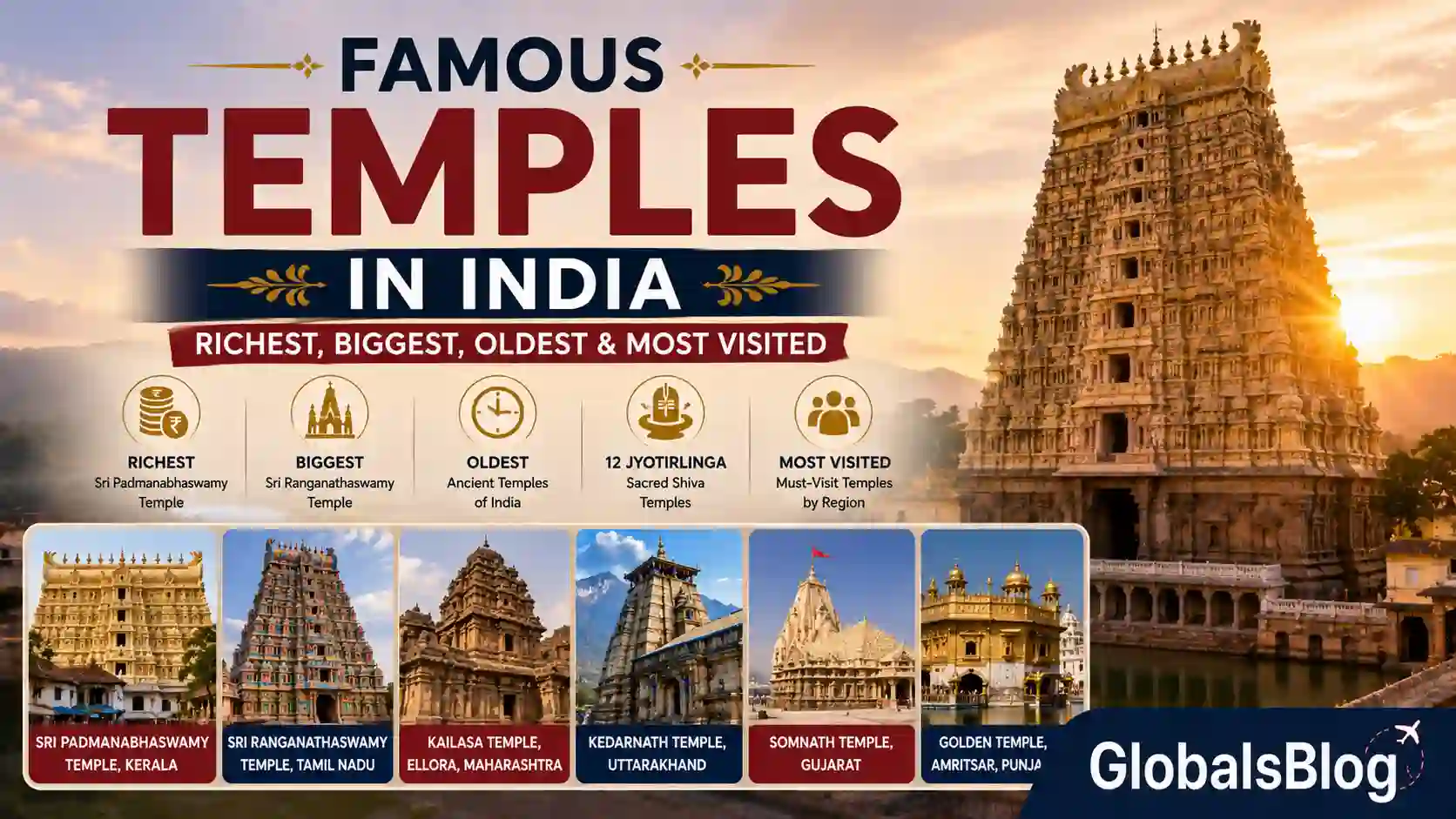
India has more than two million temples. A handful of them are so extraordinary — in wealth, in scale, in antiquity, or in spiritual significance — that they define what temple architecture and devotion can be.
No other country on earth has a temple landscape like India''s. From the world''s richest religious institution (Padmanabhaswamy Temple in Thiruvananthapuram, with an estimated treasure of over ₹1.2 lakh crore) to the world''s largest Hindu temple complex (Ranganathaswamy in Srirangam, larger than the Vatican), to caves carved by hand over 200 years by Buddhist monks (Ajanta), to a temple whose precise founding date is still debated by historians who place it at 8,000 BC (Mundeshwari) — India''s temples are not just religious structures. They are among the most extraordinary achievements of human construction, devotion, and artistry anywhere on earth. This guide ranks and describes the ones that deserve their extraordinary status.
The richest temple in India is Padmanabhaswamy Temple in Thiruvananthapuram, Kerala (estimated treasure ₹1.2 lakh crore+). The biggest temple in India is Ranganathaswamy Temple in Srirangam, Tamil Nadu (156 acres — larger than Vatican City). The oldest temple in India is disputed — Mundeshwari Devi Temple in Bihar has a confirmed inscription dated 636 AD; some historians claim earlier origins. India''s most visited temples are Tirupati Balaji (Andhra Pradesh), Vaishno Devi (Jammu), and Kashi Vishwanath (Varanasi). The 12 Jyotirlinga temples are the most sacred Shiva shrines in India.
Richest Temples in India
Padmanabhaswamy Temple is not only the richest temple in India — it is the richest religious institution on earth by asset value. The temple is dedicated to Lord Vishnu in his reclining Anantashayana posture and is one of the 108 Divya Desams (sacred Vishnu temples). In 2011, a Supreme Court-ordered audit revealed six vaults containing gold ornaments, jewellery, diamonds, and statues of extraordinary antiquity — with estimates of the total treasure varying between ₹1 lakh crore and ₹10 lakh crore depending on the valuation methodology. Vault B, which has never been fully opened, is believed to contain the largest portion. The temple is open only to Hindus; non-Hindus are not permitted entry. The 7th-century structure has elements of both Dravidian and Kerala architectural styles, with a 100-foot eastern tower (gopuram) visible across much of the city. The Travancore royal family continues to serve as the primary trustee under Supreme Court supervision.
Tirupati Balaji — the Venkateswara Temple on Tirumala Hill in Andhra Pradesh — is India''s most visited temple and the richest by annual income. The Tirumala Tirupati Devasthanams (TTD) trust manages an annual revenue that consistently exceeds ₹3,000 crore from offerings, accommodation, and the famous hair-offering ritual (tonsuring). Over 50,000 pilgrims visit daily, with numbers rising to over 100,000 on festival days — making Tirupati the most visited pilgrimage destination on earth after Mecca. The temple is dedicated to Lord Venkateswara (a form of Vishnu) and dates to at least the 9th century AD. The gold-covered vimana (tower) over the sanctum is one of India''s most photographed religious structures. Darshan (viewing of the deity) requires advance booking for most queue categories; the free darshan queue can involve waits of 12–24 hours.
The Siddhi Vinayak Temple in Prabhadevi, Mumbai is the richest Ganesh temple in India and among the top three richest temples overall by annual income. Annual offerings consistently exceed ₹300 crore. The 19th-century temple is the most important Ganesh shrine in Maharashtra and draws a socially diverse crowd of devotees — politicians, film stars, business figures, and ordinary Mumbaikars all make regular visits before significant life events. The temple''s gold-capped shikhara (spire) is visible from several surrounding areas of Prabhadevi. Tuesday is the most auspicious day for Ganesh worship — queues can exceed 6 hours. The trust manages significant charitable and healthcare programmes from the offering income.
Biggest Temples in India
Ranganathaswamy Temple in Srirangam (near Tiruchirappalli) is the largest functioning Hindu temple complex in the world — covering 156 acres with 21 gopurams (gateway towers), 7 concentric enclosures (prakarams), and 50 shrines. To put the scale in context: the Vatican covers 44 hectares (109 acres) — Ranganathaswamy is larger. The outer walls of the complex extend to 3.2 km in circumference. The temple is one of the 108 Divya Desams (sacred Vishnu temples) and the most important of the five Rangakshetra Vishnu temples. The outer enclosures function as a small town — with shops, restaurants, and residences within the temple walls. The innermost sanctum houses Lord Ranganatha (Vishnu) in his reclining form. The 72-metre Rajagopuram (main gateway tower) is one of the tallest temple towers in India. Entry to the innermost sanctum is restricted to Hindus; outer enclosures are open to all.
Akshardham Temple in New Delhi holds the Guinness World Record for the world''s largest comprehensive Hindu temple — the record specifies "comprehensive" (including all its gardens, features, and exhibitions) distinguishing it from Ranganathaswamy which is larger in total complex area. Opened in 2005, Akshardham is a BAPS (Bochasanwasi Akshar Purushottam Sanstha) Swaminarayan temple built by 11,000 artisans over 5 years without steel — using only stone, wood, and copper. The main monument contains 20,000 carved figurines and stands 141 feet tall. The complex includes a musical fountain, IMAX-format film about Swaminarayan''s life, an animatronic show, and boat ride through 10,000 years of Indian cultural history. Photography is not permitted inside. Entry is free; exhibitions have separate charges.
Oldest Temples in India
Dating ancient temples precisely is genuinely difficult — continuous modification, reconstruction, and the oral-tradition nature of early records mean "oldest" claims must be treated carefully. These are the temples with the strongest historical evidence for ancient origins:
Mundeshwari Devi Temple in Kaimur district, Bihar is widely recognised as the oldest functioning Hindu temple in India with confirmed epigraphic evidence — a dated inscription (636 AD, Gupta era) found at the site establishes it as at least 1,400 years old. The octagonal structure dedicated to Goddess Mundeshwari (a form of Parvati) and Lord Shiva is constructed in the Nagara architectural style on a hilltop. Some archaeologists argue for an even earlier date based on structural evidence, potentially placing the original construction in the 4th century AD. The temple functions as an active place of worship to this day. Its remote location in rural Bihar means it receives far fewer visitors than its historical significance warrants — a rare opportunity to visit an ancient temple without the crowds that attend more famous sites.
Most Famous Temples in India — By Region
Kashi Vishwanath Temple in Varanasi is the most sacred Shiva temple in India — one of the 12 Jyotirlingas and the spiritual centre of the Hindu universe in theological geography. The rebuilt and expanded corridor (the Kashi Vishwanath Corridor, inaugurated 2021) now provides direct access between the Ganges Ghat and the temple. Golden Temple (Harmandir Sahib) in Amritsar is the holiest shrine of Sikhism — open to people of all faiths, feeding 100,000 people daily in the world''s largest free kitchen (langar), and architecturally one of the most beautiful structures in India with its gold-plated sanctum reflected in the Amrit Sarovar. Vaishno Devi Temple in Jammu is India''s second most visited pilgrimage site — the shrine cave of Goddess Vaishno Devi requires a 14 km mountain trek (or pony/helicopter for some sections) and receives 8+ million pilgrims annually. Our North India guide covers Varanasi and Amritsar in full context.
Meenakshi Amman Temple in Madurai, Tamil Nadu is the most architecturally spectacular temple in South India — its 14 gopurams covered in thousands of painted stucco sculptures rising up to 52 metres are one of India''s most extraordinary visual experiences. The temple is dedicated to Goddess Meenakshi (a form of Parvati) and Lord Sundareswarar (Shiva) and is an active pilgrimage site receiving 15,000–20,000 visitors daily. Brihadeeswara Temple in Thanjavur (a UNESCO World Heritage Site) is one of India''s finest architectural achievements — the 1,000-year-old Chola-era temple has a 66-metre vimana whose shadow is said never to fall on the ground at noon. Sabarimala Temple in Kerala is one of the world''s largest annual pilgrimage sites — approximately 50 million pilgrims visit during the November-January Mandalam/Makaravilakku season. Our South India guide covers Tamil Nadu temples in full context.
Jagannath Temple in Puri, Odisha is one of the four sacred dhams (pilgrimage sites) of Hinduism and the origin of the famous Rath Yatra chariot festival (July) — the annual procession where enormous wooden chariots carry the deities through the town, attended by millions of devotees, is one of the largest religious gatherings on earth. Entry is restricted to Hindus only. Konark Sun Temple (a UNESCO World Heritage Site) is a 13th-century temple designed as a giant stone chariot — its erotic sculptural programme and the precision of its astronomical design make it India''s most architecturally complex temple even in its partially ruined state. Kamakhya Temple in Guwahati, Assam is one of the most significant Shakti Peeth temples in India — the most important goddess shrine in Northeast India and a major centre of Tantric practice.
Somnath Temple in Gujarat is one of the 12 Jyotirlingas and one of the most historically significant temples in India — it was plundered and rebuilt multiple times by successive rulers, and the current structure (built 1951) stands as a symbol of Hindu cultural resilience. Dwarkadhish Temple in Dwarka is one of the four sacred dhams and the temple associated with Lord Krishna''s city — the 5-storey main tower (shikhara) rises 78 metres and is one of the most distinctive temple silhouettes in India. Dilwara Temples at Mount Abu, Rajasthan are five Jain temples built between the 11th and 13th centuries AD — the marble carving inside, particularly the Vimal Vasahi temple (1031 AD), is considered the finest marble sculpture anywhere in the world. The ceilings, pillars, and walls are carved with such intricate detail that each temple took decades to complete.
The 12 Jyotirlinga Temples — Most Sacred Shiva Shrines
The 12 Jyotirlingas are the most sacred Shiva temples in India — pilgrimage to all 12 is considered one of the highest acts of Hindu devotion. Each temple is believed to house the "Jyotirlingam" — a column of light representing Shiva''s infinite nature. Here are all 12 with locations:
| Jyotirlinga | Temple Name | State |
|---|---|---|
| 1 | Somnath | Gujarat |
| 2 | Mallikarjuna | Andhra Pradesh (Srisailam) |
| 3 | Mahakaleshwar | Madhya Pradesh (Ujjain) |
| 4 | Omkareshwar | Madhya Pradesh |
| 5 | Kedarnath | Uttarakhand |
| 6 | Bhimashankar | Maharashtra |
| 7 | Kashi Vishwanath | Uttar Pradesh (Varanasi) |
| 8 | Trimbakeshwar | Maharashtra (Nashik) |
| 9 | Vaidyanath (Baidyanath) | Jharkhand (Deoghar) |
| 10 | Nageshvara | Gujarat (Dwarka) |
| 11 | Rameshwaram | Tamil Nadu |
| 12 | Grishneshwar | Maharashtra (Aurangabad) |
💡 Quick answers for common questions: Richest temple = Padmanabhaswamy, Kerala. Biggest temple = Ranganathaswamy, Srirangam, Tamil Nadu (156 acres). Most visited = Tirupati Balaji, Andhra Pradesh (50,000+ daily). Oldest temple (confirmed) = Mundeshwari Devi, Bihar (636 AD inscription). Most sacred Shiva temple = Kashi Vishwanath, Varanasi (one of 12 Jyotirlingas). Most sacred Vishnu temple = Tirupati Balaji. Four Hindu dhams = Badrinath (Uttarakhand), Dwarka (Gujarat), Jagannath Puri (Odisha), Rameshwaram (Tamil Nadu).
India Temple Visit Tips
- Book Tirupati darshan tickets at tirupatibalaji.ap.gov.in at least 2–4 weeks in advance — walk-in queues can involve overnight waits
- Dress modestly at all temple sites — most temples require covered shoulders and legs for both men and women. Many provide wraparound cloths at the gate for those who arrive underprepared
- Remove footwear before entering all temples — most major sites have footwear storage facilities (usually free or a small charge)
- Many major temples (Padmanabhaswamy, Jagannath Puri) restrict entry to Hindus — check before planning a visit if you are a non-Hindu
- The best temple photography is usually from outside the main sanctum — most inner sanctums either prohibit photography or the crowd density makes it impossible. Focus on the gopurams and outer structures for the strongest images
- Use our Trip Cost Calculator to plan temple circuit trips across South India — Tamil Nadu''s temples cluster makes a 7-10 day circuit highly efficient
Padmanabhaswamy for Wealth. Ranganathaswamy for Scale. Meenakshi for Beauty. Kashi Vishwanath for Devotion. Golden Temple for Humanity.
India''s temple landscape is one of the most extraordinary collections of religious architecture, living tradition, and concentrated devotion anywhere on earth. The richest religious institution in the world is a temple in Kerala. The largest Hindu complex is larger than Vatican City. The most visited pilgrimage destination outside Mecca is a hill in Andhra Pradesh. And the temple most worth visiting for first-time international visitors — the Golden Temple in Amritsar — charges nothing, feeds 100,000 people free every day, and is open to everyone regardless of faith. India''s temples are not relics. They are alive.
The richest temple in India is Padmanabhaswamy Temple in Thiruvananthapuram, Kerala, with an estimated treasure of over ₹1.2 lakh crore — making it the world''s richest religious institution by asset value. A 2011 Supreme Court-ordered audit revealed six vaults containing gold, jewellery, diamonds, and ancient statues. Vault B has never been fully opened and is believed to hold the largest portion. By annual income, the richest temple is Tirupati Balaji (Venkateswara Temple) in Andhra Pradesh, which generates over ₹3,000 crore per year from offerings and services.
The biggest temple in India by total complex area is Ranganathaswamy Temple in Srirangam, Tamil Nadu, covering 156 acres with 21 gopurams (gateway towers), 7 concentric enclosures, and 50 shrines — making it the world''s largest functioning Hindu temple complex, larger than Vatican City. Akshardham Temple in New Delhi holds the Guinness World Record for the world''s largest "comprehensive" Hindu temple (100+ acres including all exhibitions and gardens). By the height of a single structure, various temples compete — the Rajagopuram of Ranganathaswamy rises 72 metres.
The oldest temple in India with confirmed epigraphic (inscription) evidence is Mundeshwari Devi Temple in Kaimur district, Bihar — a dated inscription from 636 AD establishes it as at least 1,400 years old. It is still an active place of worship. Many temples claim older origins (some as far back as the Mahabharata era), but verifiable dating evidence is limited for most such claims. Structurally, the Bhitargaon temple in Kanpur (5th century AD) is among the oldest surviving brick temple structures in North India. The Mahabodhi Temple in Bodh Gaya has a foundation attributed to Emperor Ashoka (3rd century BC), though the current structure dates to later periods.
The 12 Jyotirlinga temples — India''s most sacred Shiva shrines — are: Somnath (Gujarat), Mallikarjuna (Andhra Pradesh, Srisailam), Mahakaleshwar (Madhya Pradesh, Ujjain), Omkareshwar (Madhya Pradesh), Kedarnath (Uttarakhand), Bhimashankar (Maharashtra), Kashi Vishwanath (Uttar Pradesh, Varanasi), Trimbakeshwar (Maharashtra, Nashik), Vaidyanath/Baidyanath (Jharkhand, Deoghar), Nageshvara (Gujarat, Dwarka), Rameshwaram (Tamil Nadu), and Grishneshwar (Maharashtra, Aurangabad). Pilgrimage to all 12 is called Dwadasha Jyotirlinga Darshan and is considered one of the most meritorious acts of Shiva devotion.
The most visited temple in India is Tirupati Balaji (Venkateswara Temple) in Tirumala, Andhra Pradesh — receiving 50,000 to 100,000+ pilgrims daily and over 25 million annually, making it the most visited pilgrimage destination on earth after Mecca. The second most visited is Vaishno Devi Temple in Jammu (8+ million pilgrims annually). Among temples in metropolitan cities, Siddhi Vinayak in Mumbai and Akshardham in Delhi receive the highest footfall. The Golden Temple in Amritsar (open to all faiths) is India''s most visited temple by non-Hindus and international tourists.
Reader Experiences