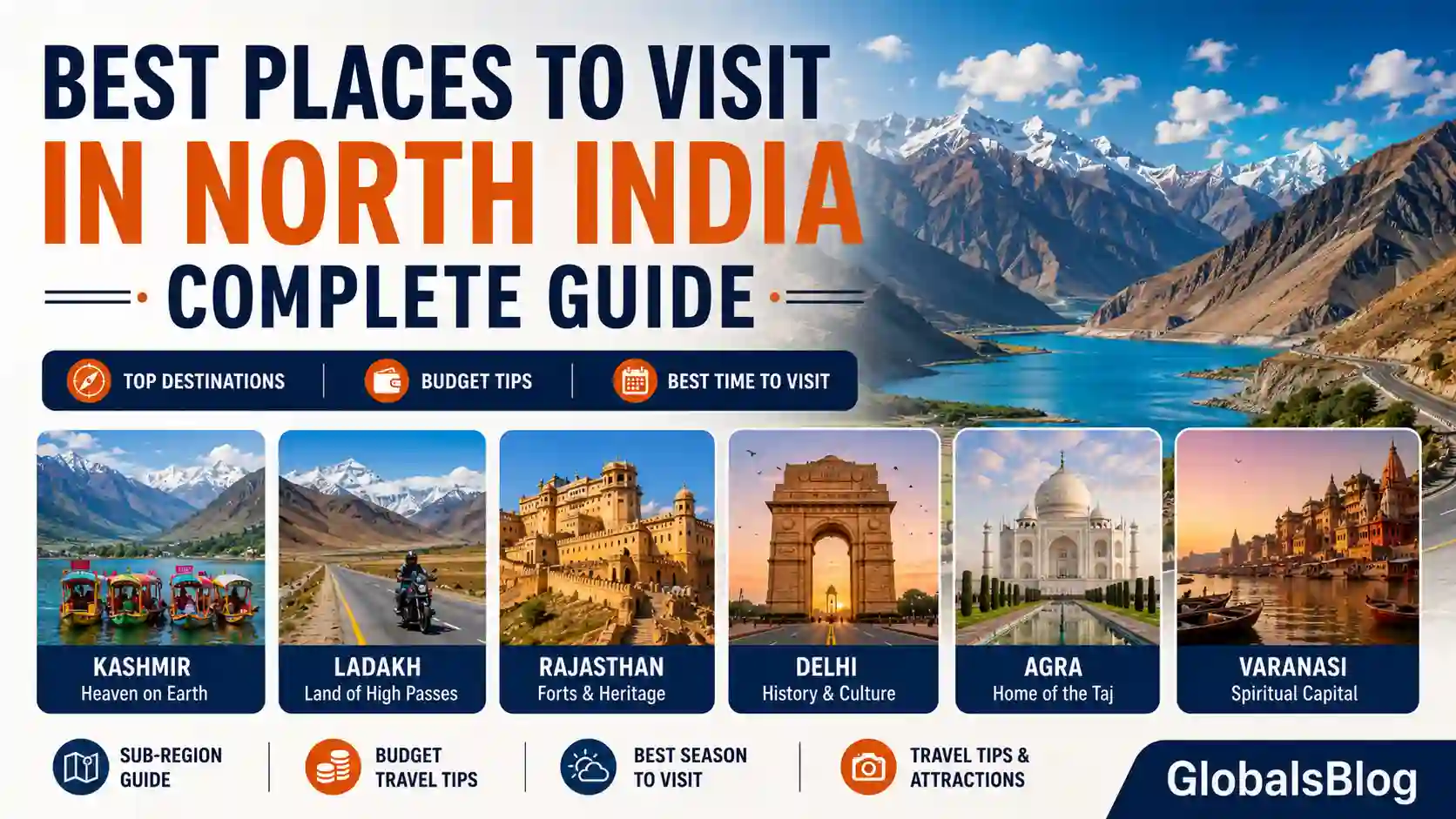
Himalayan peaks, desert forts, spiritual ghats, and the Taj Mahal — North India alone could fill a lifetime of trips.
A reader from Chennai planning her first North India trip asked us a fair question — "Is North India one trip or five trips pretending to be one?" The honest answer is closer to five. Kashmir and Rajasthan share almost nothing in climate, culture, or travel logistics despite both being "North India" on a map. This guide breaks the region into its real sub-regions so you can actually plan something coherent.
The best places to visit in North India include Kashmir and Ladakh for Himalayan landscapes, Rajasthan for desert forts and heritage, Delhi-Agra-Jaipur for the Golden Triangle classic circuit, Varanasi and Rishikesh for spiritual experiences along the Ganges, and Himachal hill stations like Manali and Shimla for accessible mountain escapes. North India is genuinely four or five distinct travel experiences — picking your sub-region matters more than picking a single "best" destination.
North India Is Not One Trip — It Is Five
Most "North India travel guide" content treats the entire region as a single coherent unit. It is not. The climate, culture, language, food, and even the basic logistics of getting around vary so dramatically across North India that planning it as one undifferentiated trip is the single biggest mistake first-time visitors make.
The honest framework is to think of North India as five distinct sub-regions, each deserving its own dedicated trip rather than a rushed combined itinerary. Kashmir and Ladakh belong to the Himalayan high-altitude world. Rajasthan belongs to the desert heritage world. Delhi-Agra-Jaipur form the classic Golden Triangle tourist circuit. Varanasi and Rishikesh anchor the spiritual Ganges circuit. Himachal's Shimla and Manali offer accessible hill station escapes. Treating these as one trip means choosing breadth over depth — usually the wrong trade-off.
How to Pick Your North India Sub-Region
If you want dramatic mountain landscapes and adventure, go Himalayan — Kashmir, Ladakh, Spiti. If you want palaces, forts, and desert culture, go Rajasthan. If this is your first India trip and you want the iconic checklist — Taj Mahal, Red Fort, Hawa Mahal — the Golden Triangle delivers that efficiently. If you want a genuinely transformative cultural and spiritual experience, Varanasi and Rishikesh offer something no other Indian region quite replicates. If you want an easy, accessible mountain escape without extensive travel logistics, Himachal's hill stations are the practical choice.
Best Places to Visit in North India — By Sub-Region
Kashmir delivers North India's most dramatic natural beauty — Dal Lake's houseboats, the Mughal Gardens, and Gulmarg's gondola rides through alpine meadows that turn into a ski resort in winter. Autumn (October) brings spectacular chinar foliage, while spring (April-May) brings tulip fields and fresh snowmelt waterfalls. Summer is peak season for plains-dwelling Indian travellers escaping heat, while winter brings genuine snow sports at Gulmarg. Each season delivers a genuinely different Kashmir experience, making it one of the few North Indian destinations worth visiting more than once across different times of year. Our October travel guide covers Kashmir's autumn colour peak in detail.
Ladakh's stark high-altitude desert landscape, Buddhist monasteries, and the famous Pangong Lake colour shifts make it North India's most genuinely otherworldly destination. The Manali-Leh and Srinagar-Leh highways themselves are bucket-list road trips, while Khardung La and Chang La passes offer some of the highest motorable roads in the world. Ladakh requires more planning than most North Indian destinations — altitude acclimatisation, limited road-open season (June-September primarily), and remote infrastructure. Our September travel guide covers Ladakh's peak accessibility window specifically.
Jaipur, the Pink City, anchors Rajasthan's heritage circuit with Amber Fort's hilltop grandeur, City Palace, and Hawa Mahal's iconic honeycomb facade. As the most accessible Rajasthan city from Delhi, it works as both a standalone trip and the natural starting point for a longer Rajasthan circuit extending to Udaipur and Jaisalmer. The bazaars — particularly Johari Bazaar for jewellery and textiles — offer genuine local shopping beyond the tourist circuit. Winter (November-February) is the only sensible season; Rajasthan summer heat is genuinely punishing and not worth attempting for sightseeing-heavy itineraries.
Udaipur's lake palaces and Jaisalmer's golden desert fort represent Rajasthan's two most photogenic extremes — water-surrounded romantic luxury at one end, stark desert grandeur at the other. Udaipur's Lake Pichola boat rides at sunset and the City Palace complex justify its reputation as one of India's most romantic cities. Jaisalmer's Sam Sand Dunes desert camping under clear winter skies delivers an experience unlike anywhere else in North India. Both require dedicated time rather than rushed day visits — Jaisalmer specifically benefits from at least 2 full days given its remote location and the desert excursion time required.
The Taj Mahal needs no introduction, but the experience genuinely depends on timing — sunrise visits avoid both crowds and harsh midday light, delivering the marble's famous colour-shifting quality at its most dramatic. Beyond the Taj itself, Agra Fort and Fatehpur Sikri (a well-preserved Mughal ghost city 40km away) round out a genuinely rich Mughal heritage circuit that most rushed day-trip visitors from Delhi completely miss. Agra works as an easy day trip from Delhi via the Yamuna Expressway or a more relaxed overnight stay that allows both sunrise and sunset Taj experiences.
Varanasi is North India's most intense and rewarding spiritual destination — the Ganga Aarti ceremony at Dashashwamedh Ghat at sunset, and the pre-dawn boat ride past the ghats as the city wakes, are experiences that genuinely shift how visitors think about India regardless of their own religious background. The old city's narrow lanes, the cremation ghats at Manikarnika, and the genuine spiritual intensity of the place make it unlike anywhere else on this list. It is not always a comfortable trip — crowds, noise, and confronting mortality directly at the cremation ghats challenge many first-time visitors — but it is consistently rated among the most meaningful Indian travel experiences by those who go with the right expectations.
Rishikesh combines spiritual depth with genuine adventure tourism in a way no other North Indian destination matches — yoga ashrams and Ganga Aarti at Triveni Ghat sit alongside river rafting, bungee jumping, and trekking that draws a younger, more adventure-focused crowd than Varanasi's predominantly pilgrimage-driven visitors. The Beatles Ashram, where the band famously studied transcendental meditation, adds a distinctive cultural touchpoint. As the gateway to the Char Dham pilgrimage circuit, Rishikesh also works as a practical base for deeper Himalayan spiritual journeys for travellers wanting to go further.
Shimla and Manali remain North India's most accessible Himalayan hill station escapes — colonial-era charm and the toy train at Shimla, adventure sports and high-altitude pass access at Manali. Both deliver genuine mountain scenery without Kashmir or Ladakh's more demanding logistics, making them the practical choice for travellers with limited time or those uncomfortable with high-altitude or remote travel. Our complete hill stations guide covers both destinations alongside other North Indian hill station alternatives in full detail.
North India Sub-Region Comparison
| Sub-Region | Key Destinations | Best Season | Trip Style | Verdict |
|---|---|---|---|---|
| Himalayan | Kashmir, Ladakh | Apr–Oct | Adventure, landscape | Most Dramatic |
| Desert Heritage | Jaipur, Udaipur, Jaisalmer | Nov–Feb | Heritage, culture | Most Iconic |
| Golden Triangle | Delhi, Agra, Jaipur | Oct–Mar | First-timer checklist | Best for Beginners |
| Spiritual Ganges | Varanasi, Rishikesh | Oct–Apr | Cultural depth, spirituality | Most Intense |
| Hill Stations | Shimla, Manali | Mar–Jun, Sep–Nov | Easy mountain escape | Most Accessible |
Notice that no single season suits all five sub-regions equally — October-November is the closest to a universal sweet spot, overlapping reasonably well with four of the five regions, which is why we consistently recommend that window for first-time North India planning.
How to Plan a North India Trip Without Overreaching
-
Pick one sub-region for trips under 10 days A week in Rajasthan alone, properly explored, beats a rushed week trying to also fit in Delhi, Agra, and a hill station. Depth within one sub-region delivers a better experience than breadth across several.
-
Combine adjacent sub-regions only with 12+ days Delhi-Agra-Jaipur (Golden Triangle) naturally combines well since they sit close together. Adding Udaipur or Jaisalmer extends this into a fuller Rajasthan-plus-Golden-Triangle trip with 12-14 days. Avoid combining geographically distant sub-regions like Kashmir and Rajasthan in a single trip unless you have 3+ weeks.
-
Match your season to your chosen sub-region precisely Rajasthan in May is genuinely dangerous heat. Ladakh in January is closed by snow. Check the specific seasonal window for your chosen sub-region rather than assuming "winter is good for all of North India" — it is not universally true.
-
Calculate realistic travel time between stops North India's distances are larger than they appear on a map, and road quality varies significantly. Use our Road Trip Planner to map realistic travel times before building a multi-stop itinerary.
The Honest Take — Most First North India Trips Are Too Ambitious
We see this constantly: first-time North India travellers building a 10-day itinerary covering Delhi, Agra, Jaipur, Udaipur, and a Himachal hill station, treating each as a 1-2 day stop. This produces an exhausting transit-heavy trip that delivers a checklist of photographs rather than genuine travel experiences.
Our honest recommendation — pick the Golden Triangle (Delhi-Agra-Jaipur) as a genuinely excellent first North India trip at 6-7 days, properly paced. Save Rajasthan's deeper circuit (Udaipur, Jaisalmer) for trip two. Save the Himalayan world (Kashmir, Ladakh) for trip three, since it deserves dedicated focus rather than a rushed add-on. This approach consistently produces better trips than trying to see "all of North India" in one attempt.
Tips for North India Travel
- Book Rajasthan and Golden Triangle trips for November-February — summer heat genuinely makes sightseeing dangerous, not just uncomfortable
- For Ladakh, build in 1-2 acclimatisation days in Leh before attempting high-altitude pass excursions — altitude sickness is a real risk
- Use the Trip Cost Calculator to budget each sub-region separately if combining multiple in one longer trip
- Carry layers even in "warm" North Indian destinations — desert and mountain evenings drop significantly colder than daytime temperatures suggest
- For Varanasi, hire a local guide for the ghats and old city — the experience is significantly richer with proper cultural context than navigating independently
- Book Kashmir houseboats and Jaisalmer desert camps in advance during peak season — these specific accommodation types have limited capacity
North India Trip Planning Mistakes
- Trying to cover Rajasthan, Delhi-Agra, and a hill station in one 10-day trip — A reader from Chennai attempted exactly this combination and described the trip afterward as "checking boxes rather than actually experiencing anything." One sub-region, properly explored, would have served her far better.
- Visiting Rajasthan in peak summer (April-June) — genuinely dangerous heat that makes daytime sightseeing impractical and uncomfortable
- Attempting Ladakh without altitude acclimatisation time built into the itinerary — altitude sickness affects a significant percentage of visitors who rush straight into high-altitude activity
- Underestimating North India's actual distances — a "quick" Delhi to Jaisalmer trip is genuinely an 11-12 hour drive, not a day excursion
⚠️ Disclaimer: This article is for travel inspiration and planning purposes only. Weather patterns, road conditions, and accommodation availability change seasonally and yearly — always verify current information with local tourism boards before booking or travelling, especially for high-altitude Himalayan destinations.
Pick Your North India, Not All of North India
Himalayan landscapes, desert heritage, the Golden Triangle classic, spiritual Ganges, or accessible hill stations — North India is five genuinely different trips wearing one regional label. Choose the one that matches what you actually want from travel, and you will get a far better trip than attempting all five at once.
The best tourist places in North India include Kashmir and Ladakh for Himalayan landscapes, Jaipur and Udaipur in Rajasthan for heritage and forts, Agra for the Taj Mahal, Varanasi for spiritual experiences along the Ganges, and Shimla or Manali for accessible hill station escapes. Each represents a genuinely different travel experience, so picking based on your specific interests matters more than chasing a single "best" list.
The Golden Triangle refers to Delhi, Agra, and Jaipur — three cities forming a geographically close, well-connected circuit that delivers North India's most iconic sights including the Red Fort, Taj Mahal, and Hawa Mahal within a manageable 6-7 day trip. It is widely considered the best first-time circuit for travellers new to North India due to its accessibility and concentration of major attractions.
A focused trip to one sub-region — such as the Golden Triangle or a deeper Rajasthan circuit — works well at 6-9 days. Combining adjacent sub-regions, like Golden Triangle plus deeper Rajasthan, typically needs 12-14 days. Geographically distant combinations like Kashmir plus Rajasthan in one trip require 3+ weeks to avoid excessive transit time eating into the actual travel experience.
October to March is the best overall window for most North India sub-regions including Rajasthan, the Golden Triangle, and the spiritual Ganges circuit. Kashmir and hill stations like Shimla and Manali also work well from April-June. Ladakh has a narrower window of June-September when high-altitude roads are open. Always match your specific sub-region to its ideal season rather than applying one blanket rule across all of North India.
Varanasi offers a more intense, traditional pilgrimage experience centred on the ghats and cremation rituals along the Ganges, suited to travellers seeking deep cultural and spiritual immersion. Rishikesh combines spirituality with adventure tourism — yoga, meditation, and Ganga Aarti alongside river rafting and trekking — making it more accessible for younger travellers or those wanting to balance spirituality with activity. Neither is objectively better; the choice depends on which experience you are seeking.
Reader Experiences