28 states, hundreds of landscapes, and one list that actually helps you choose where to start.
A reader once asked us a deceptively simple question — "Where should I go in India?" We realised we could not answer it in one sentence. India is not one destination. It is forty destinations wearing one passport. So instead of picking one answer, we built this guide to help you pick yours.
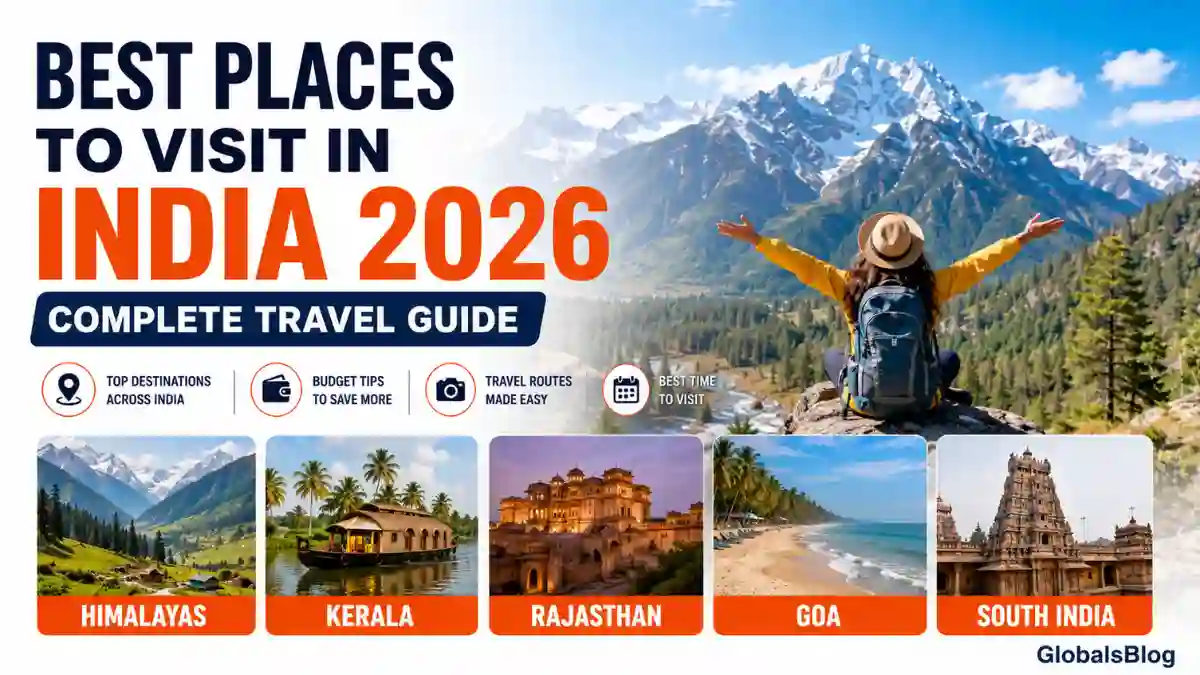
The best places to visit in India in 2026 include Ladakh and Spiti Valley for high-altitude adventure, Kerala backwaters and Munnar for tropical hill and water experiences, Rajasthan's Jaipur and Udaipur for heritage and forts, Goa for beaches, Coorg and Hampi for South India's diversity, and Meghalaya for the Northeast's untouched beauty. Each region suits a different season and travel style — this guide breaks down exactly which one fits your trip.
How to Actually Use This List — Pick a Region, Not a Checklist
Most "best places in India" lists read like a directory. Forty names, zero structure, and a reader left more confused than when they started. We are doing this differently.
India breaks cleanly into five travel zones, each with a completely different character. The mistake most first-time India travellers make is trying to combine zones that do not belong together. Rajasthan and Kerala in one ten-day trip sounds appealing on paper and turns into an exhausting cross-country relay in practice.
Pick one zone. Go deep. Come back for the next one next year. That is genuinely how most experienced Indian travellers approach this country — not as a single trip, but as an ongoing relationship.
The Five Travel Zones of India
The Himalayan North gives you Ladakh, Spiti, Kashmir, and the hill stations of Himachal and Uttarakhand. The Golden Triangle and Rajasthan gives you Delhi, Agra, Jaipur, Udaipur — heritage, forts, and desert. South India gives you Kerala, Karnataka, and Tamil Nadu — backwaters, hill stations, and temples. The West Coast gives you Goa, Mumbai, and Maharashtra's hill stations. The Northeast gives you Meghalaya, Sikkim, and Assam — India's least-visited and most rewarding region for adventurous travellers.
Best Places to Visit in India 2026 — By Region
Ladakh and Spiti are the closest India gets to lunar landscapes — cold desert valleys at 3,500–4,500m elevation, ancient Buddhist monasteries, and some of the most dramatic mountain photography opportunities anywhere in the world. Pangong Lake's colour-shifting water and the Nubra Valley's sand dunes feel genuinely otherworldly. June through September is the accessible window when roads are open. Read our detailed July travel guide and August travel guide for month-specific Ladakh and Spiti planning.
Kerala packs an extraordinary range into one state — palm-lined backwaters perfect for houseboat stays, the misty tea gardens of Munnar, and beaches at Kovalam and Varkala. It is the most consistently rewarding state for first-time India travellers because the infrastructure is well developed and the experiences are distinctly different from anywhere else in the country. Our complete South India guide covers Kerala alongside Karnataka and Tamil Nadu in full detail.
Rajasthan is India's most photographed state for good reason — Amber Fort's hilltop grandeur, Udaipur's lake palaces, Jodhpur's blue-washed old city, and Jaisalmer's desert dunes create an unbroken sequence of postcard moments. The state rewards a slower 10–12 day circuit rather than a rushed 5-day rush through the major cities. Winter (November to February) is genuinely the only sensible season — Rajasthan summer heat is brutal and not worth attempting.
Goa remains India's most reliable beach destination — and despite the party reputation, it has genuinely distinct zones for very different travel styles. North Goa (Baga, Calangute, Anjuna) suits nightlife and younger travellers. South Goa (Palolem, Agonda, Colva) is quieter, better for families and couples wanting a calmer beach experience. November to February is peak season with the best weather; avoid the monsoon (June–September) entirely for a beach trip.
Karnataka alone offers two completely different experiences worth the trip — Coorg's misty coffee estate hill stations and Hampi's surreal boulder-strewn ancient ruins. Together they showcase South India's range better than almost any other state pairing. Our full South India travel guide breaks down the best way to sequence these alongside Kerala and Tamil Nadu destinations.
Meghalaya is genuinely the most underexplored region on this list relative to how rewarding it is. Living root bridges, some of the wettest places on Earth, and waterfalls that run at full power for months at a time make Cherrapunji and Mawsynram extraordinary monsoon destinations. The region requires more planning than most South or West India trips — flights connect through Guwahati and onward travel takes longer — but the payoff is a region that feels genuinely different from the rest of India. Our August travel guide covers Meghalaya's peak monsoon appeal in detail.
How to Choose Your First India Trip — A Simple Framework
With this many options, decision paralysis is real. Here is the framework that actually narrows it down.
-
Match the season to the region — not the other way around Do not pick a destination first and then check if the timing works. Check what season it is, then pick from the regions that suit that season. Summer (April–June) means Himalayan hill stations or Ladakh. Monsoon (July–September) means Western Ghats or Meghalaya. Winter (November–February) means Rajasthan, Goa, or South India.
-
Decide your travel style before the destination Adventure and discomfort tolerance points toward Ladakh or Spiti. Comfort and heritage points toward Rajasthan. Relaxation points toward Kerala or Goa. Offbeat curiosity points toward Meghalaya or Hampi. Be honest about which traveller you actually are, not which one you aspire to be.
-
Set your budget zone using regional cost differences Rajasthan and Kerala tend to run higher due to tourist infrastructure and demand. Karnataka, Andhra Pradesh, and the Northeast are typically more affordable for similar quality. Use the Travel Budget Planner to set realistic expectations before booking.
-
Check flight connectivity to your chosen region Ladakh and Northeast India require more flight planning and have fewer direct routes from smaller cities. Rajasthan, Goa, and South India are well connected from almost every major Indian city. Factor this into your total trip time and budget using the Train vs Flight Calculator.
-
Build a realistic itinerary — fewer places, more time each The single biggest improvement most India trips need is fewer destinations and more days at each one. A 7-day trip covering 2 destinations beats a 7-day trip covering 5. Use our Road Trip Planner to map realistic travel times between destinations before finalising your route.
The India Trip Mistake Almost Every First-Timer Makes
Here is the contrarian take we feel strongly about: trying to "see India" in one trip is the wrong goal entirely. India is not Switzerland or Thailand — a country you can meaningfully cover in two weeks. It is closer in size and diversity to all of Europe.
Nobody plans a two-week trip expecting to properly experience France, Italy, Spain, and Germany. Yet first-time India travellers regularly try to cram Rajasthan, Kerala, and the Himalayas into twelve days. The result is exhausting transit time, rushed sightseeing, and a trip that feels more like a logistics exercise than travel.
Our honest recommendation — treat India as a multi-year travel relationship, not a single trip to complete. Pick one region this year. Go deep. Come back for the next region next year. You will enjoy each trip significantly more, and frankly, you will end up seeing more of India over time this way than you ever would rushing through a single marathon itinerary.
Tips for Planning Your India Trip
- Book domestic flights 4–6 weeks ahead for the best prices, especially to Ladakh, Goa, and Northeast destinations during peak season
- Always carry a printed ID alongside digital copies — many smaller hotels and homestays in India still prefer physical verification
- Pack for temperature swings within a single region — Rajasthan nights in winter can be surprisingly cold despite warm days
- Use the Trip Cost Calculator to build a realistic budget before booking — regional price differences are larger than most first-time travellers expect
- Consider travelling just outside peak season — early November or early March often gives good weather with noticeably lower prices and crowds
- Learn basic regional etiquette before visiting — temple dress codes, photography restrictions, and tipping customs vary meaningfully by region
Mistakes First-Time India Travellers Make
- Trying to cover too many regions in one trip — A reader once tried Rajasthan, Kerala, and Ladakh in 16 days. He described the trip afterward as "exhausting" rather than memorable. One region, properly explored, beats three regions rushed through.
- Underestimating internal travel time between regions — India's geography means a "quick hop" between states can easily be a 4–6 hour flight or 18-hour train journey
- Booking peak season without comparing shoulder season pricing — early November and early March often offer 30–40% savings for similar weather quality
- Not researching regional food differences — South Indian, North Indian, and Northeast Indian cuisines are genuinely different cooking traditions, not variations of one "Indian food"
- Skipping travel insurance for adventure regions like Ladakh and Meghalaya — altitude and remote-area medical access make this a genuinely important purchase, not an optional add-on
⚠️ Disclaimer: This article is for travel inspiration and planning purposes only. Prices, road conditions, and seasonal accessibility change frequently — always verify current information with local tourism boards and operators before booking or travelling.
Pick One Region. Start There.
India is not a single destination to check off — it is dozens of distinct travel experiences within one country. Ladakh's mountains, Kerala's backwaters, Rajasthan's forts, Goa's beaches, Meghalaya's waterfalls — each deserves a dedicated trip, not a rushed stopover. Pick the one that matches your season and travel style, and start there.
Kerala and Rajasthan are the best starting points for first-time India travellers. Kerala offers well-developed tourism infrastructure, distinctive backwater and hill station experiences, and a manageable pace. Rajasthan offers India's most iconic heritage sights — forts, palaces, and desert landscapes — within a well-connected circuit. Both regions have strong tourist infrastructure that makes navigation and planning easier for newcomers to Indian travel.
There is no single best time for all of India — it depends entirely on the region. November to February is best for Rajasthan, Goa, and most plains regions. June to September is best for Ladakh, Spiti, and monsoon-dependent destinations like Meghalaya and the Western Ghats hill stations. September to March is ideal for Kerala. Match your travel dates to the region rather than picking a generic "best season."
A 5-night domestic India trip typically costs ₹15,000–₹40,000 per person depending on the region and travel style. Budget destinations like Hampi, Wayanad, and parts of the Northeast can be done for ₹15,000–₹20,000. Premium destinations and experiences like Rajasthan heritage hotels or Kerala houseboats can push costs to ₹35,000–₹50,000 for the same duration. Flights, accommodation grade, and food choices are the biggest cost variables.
You can, but it is generally not recommended for trips under 14 days. North and South India have different climates, cultures, languages, and require significant flight time between them. A better approach for shorter trips is choosing one region and exploring it properly. If you have 14+ days and want to experience both, plan for at least 2–3 internal flight days and treat each region as a distinct sub-trip within your itinerary.
For a short 3-4 day trip, single-destination options work best — Goa, Coorg, Jaipur, or Munnar are all well-suited to short breaks since they do not require extensive internal travel once you arrive. Avoid trying to combine multiple cities or regions in a trip this short, as travel time will eat into your limited days disproportionately.
Yes, Northeast India — particularly Meghalaya, Sikkim, and Assam — is generally safe for tourists and genuinely one of the most rewarding and underexplored regions in the country. Some areas require Inner Line Permits for entry, which are straightforward to obtain through registered travel agents or government portals. The region requires more advance planning than mainstream destinations due to flight connectivity through Guwahati, but the natural beauty and cultural distinctiveness make it well worth the extra planning effort.
Reader Experiences