India has 106 national parks and 54 tiger reserves. Most first-time safari visitors end up in the wrong one for what they actually want to see.
A reader from Bangalore planned a tiger safari at Nagarhole National Park in Kerala — and discovered on arrival that Nagarhole is in Karnataka, not Kerala, a 4-hour drive from where she had booked her hotel. She saw the park eventually, but the wrong base camp nearly derailed the trip. Beyond geography mistakes, most Indian safari first-timers make a more fundamental error: picking a park based on name recognition rather than which animal they most want to see, which season gives the best sighting probability, and how far they are willing to travel. This guide fixes all three.
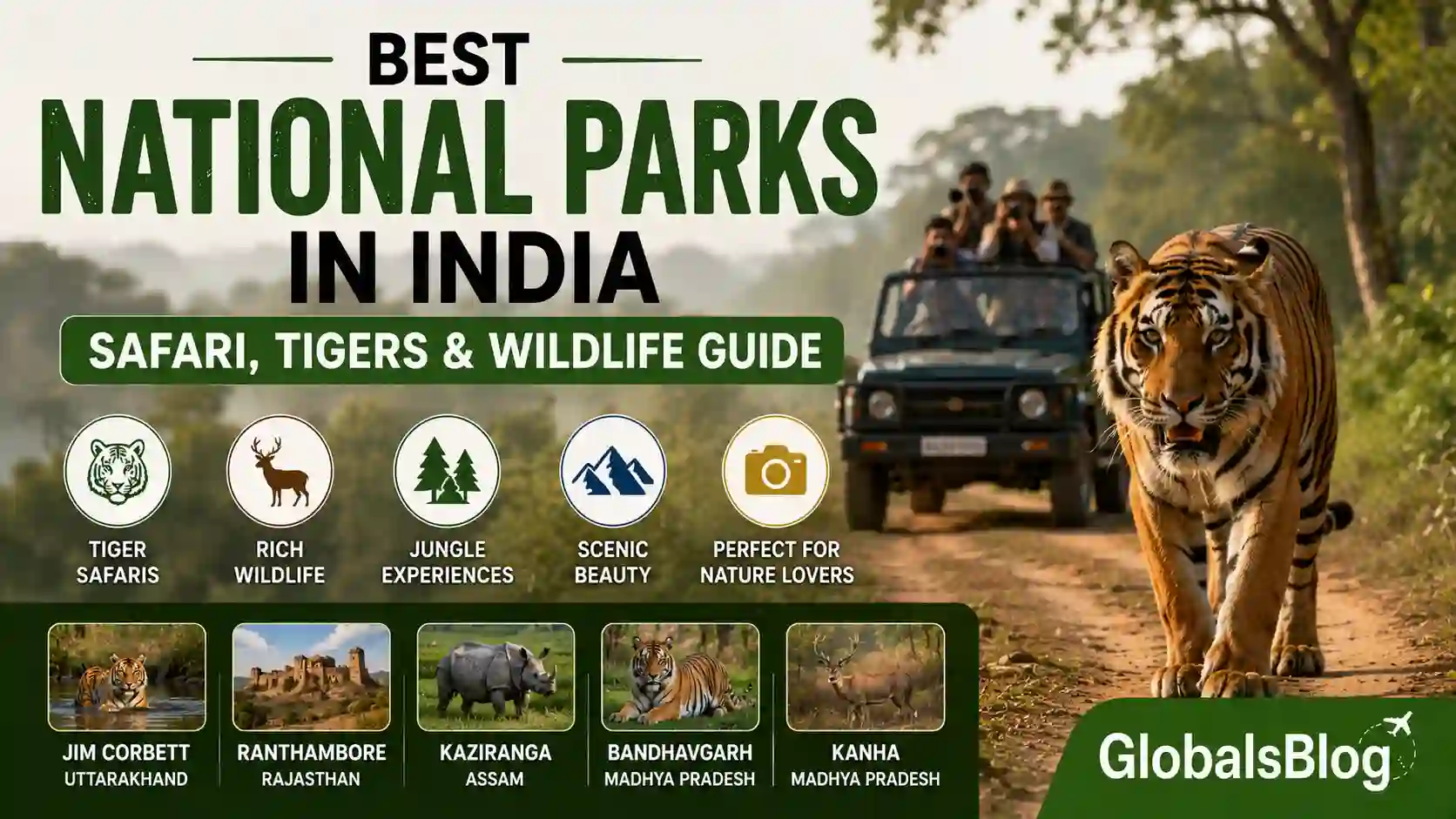
The best national parks in India are Jim Corbett (best for tigers, Uttarakhand), Ranthambore (best for tiger photography, Rajasthan), Kaziranga (best for rhinos, Assam), Bandhavgarh (highest tiger density, Madhya Pradesh), Kanha (best jungle safari experience), Sundarbans (best for unique mangrove safari, West Bengal), and Nagarhole/Kabini (best for South India wildlife). For first-time tiger safari visitors, Ranthambore and Bandhavgarh give the highest probability of a tiger sighting. For overall wildlife diversity, Kanha and Jim Corbett are the most rewarding.
How to Choose the Right National Park in India
Three questions determine the right park — before you look at any specific name:
What do you most want to see? Tigers are the primary draw for most visitors, but India''s wildlife diversity goes far beyond tigers. One-horned rhinos in Kaziranga, wild elephants in Corbett and Nagarhole, leopards and wild dogs in Pench, flamingos in the Rann of Kutch, snow leopards in Hemis (Ladakh) — each park has a different "flagship species" and choosing by what you want to see, rather than which park has the most famous name, produces a more satisfying safari.
When can you go? Most central Indian national parks (Corbett, Ranthambore, Kanha, Bandhavgarh) close from July to September for monsoon. Kaziranga in Assam closes later in monsoon (June-October). South Indian parks like Nagarhole are open year-round but have seasonal variation. Getting the season right is as important as the park choice.
How far are you willing to travel? For Delhi-NCR and north India-based travellers, Ranthambore, Corbett, and Kanha are the most accessible options. For Mumbai and Pune, Pench and Tadoba are closest. For Bangalore and Chennai, Nagarhole, Bandipur, and Mudumalai are the natural first choice. Travelling 12+ hours to a national park is genuinely worth it for exceptional parks — but knowing your nearest options first helps with trip planning.
Best National Parks in India — Region by Region
Jim Corbett National Park (Uttarakhand) is India''s oldest national park — established 1936 — and the one that launched the Project Tiger conservation programme. The Dhikala zone in particular delivers an experience unlike most other Indian parks: vast open grasslands (chaurs) where elephants, tigers, and leopards move in full view rather than through dense jungle. Best between November and June; the Dhikala zone requires a two-night stay minimum to access by Forest Department rule. Ranthambore (Rajasthan) is India''s most photographed tiger park — the combination of ruined Ranthambore Fort ruins, dry deciduous forest, and relatively habituated tigers who are comfortable in the open makes this the highest probability tiger photography destination in India. October to June is the season, with February to May delivering the highest sighting rates as water sources dry and tigers concentrate around remaining pools. Our North India guide covers both parks in regional context.
The Nilgiri Biosphere Reserve cluster — Nagarhole, Bandipur, Mudumalai, and Wayanad — forms the largest contiguous wildlife habitat in South India, and the four parks essentially form one giant connected ecosystem in the Western Ghats. Nagarhole''s Kabini area is particularly famous for its open water bodies where elephants gather in herds of 50-100 during summer (March-May) — one of Asia''s finest wild elephant spectacles. Leopard density in this zone is among the highest in India, and the park also hosts the endangered Indian wild dog (dhol). Best accessed from Mysore (80 km) or Bangalore (220 km). Bandipur connects directly to Nagarhole and is excellent for tiger, elephant, and gaur sightings in its more open terrain. Note for car-based visitors: Bandipur has a well-enforced night traffic ban (9pm-6am) across the NH-766 highway — plan your journey timing accordingly. Our South India guide covers the full cluster.
Kaziranga National Park (Assam) is India''s single most wildlife-dense national park — a UNESCO World Heritage Site that hosts two-thirds of the world''s one-horned rhinoceros population alongside tigers, wild water buffalo, and swamp deer. Unlike tiger-focused central Indian parks, Kaziranga guarantees impressive wildlife sightings even for casual visitors — rhinos are visible from the main road entering the park. Best season is November to April; the park floods during Assam''s monsoon (June-September). Sundarbans (West Bengal) is the world''s largest mangrove forest and the only place where tigers swim between islands in a tidal river delta — a fundamentally different safari experience from any other Indian park. Boat-based safaris through narrow mangrove channels are the mode here, not jeep-based. Our Northeast India guide covers Kaziranga''s seasonal context.
Central India''s Madhya Pradesh and Maharashtra corridor is India''s "tiger heartland" — the parks here, taken together, host the highest tiger density of any region in the world. Bandhavgarh has India''s highest tiger density per square kilometre and is the best choice for maximising tiger sighting probability on a short visit — a 2-night, 4-safari visit here gives a very high probability of at least one tiger sighting. Kanha is the park that inspired Rudyard Kipling''s Jungle Book and the most traditionally "junglee" safari experience — vast sal forests, open meadows, and the unique barasingha (swamp deer) alongside tigers, leopards, and wild dogs. Pench is the most accessible from Nagpur and an excellent first-time safari park. Tadoba in Maharashtra is often called "the Jewel of Vidarbha" and has experienced an extraordinary tiger population recovery — increasingly the top recommendation for Mumbai and Pune-based safari travellers. Best season for all: October to June, closing July to September for monsoon.
Best National Parks for Tiger Sighting — Ranked
| Park | State | Best Season | Tiger Sighting Probability | Other Notable Wildlife | Verdict |
|---|---|---|---|---|---|
| Bandhavgarh | Madhya Pradesh | Oct–Jun | ★★★★★ Highest | Leopard, sambar, gaur | Best Tiger Sighting |
| Ranthambore | Rajasthan | Oct–Jun | ★★★★★ Excellent | Sloth bear, crocodile | Best Tiger Photography |
| Tadoba | Maharashtra | Mar–Jun peak | ★★★★ Very Good | Gaur, sloth bear, dhol | Best for Mumbai/Pune |
| Kanha | Madhya Pradesh | Oct–Jun | ★★★★ Good | Barasingha, wild dog | Best Overall Experience |
| Jim Corbett | Uttarakhand | Nov–Jun | ★★★ Good (zone-dependent) | Elephant, gharial | Best North India |
| Kaziranga | Assam | Nov–Apr | ★★★ Good (bonus) | Rhino, wild buffalo — guaranteed | Best Overall Wildlife |
| Nagarhole / Kabini | Karnataka | Oct–May | ★★★ Good | Elephant herds, leopard | Best South India |
| Sundarbans | West Bengal | Year-round | ★★ Low (mangrove tigers) | Unique ecosystem, estuarine crocs | Most Unique Experience |
Safari Booking — What You Need to Know
Gypsy permit booking: Indian national park safaris use open 4x4 jeeps called "gypsies" (typically Maruti Gypsy or Mahindra Thar), with a licensed naturalist guide and driver. Safari permits are issued by Forest Departments and can be booked online through respective state forest department websites. In peak season (October-March for most parks), permits sell out 30-45 days ahead. Do not assume walk-in permit availability at any major park in peak season.
Safari zones: Most major parks are divided into core zones (higher permit cost, higher wildlife density, very limited slots) and buffer zones (lower cost, more flexibility). For first-timers, a 2-night, 4-safari booking covering two morning and two evening sessions gives the best balance of cost and sighting probability.
Timing: Morning safaris (6-10am in summer, 6-9am in winter) are consistently better for sightings than evening safaris because animals are most active at dawn. If forced to choose, prioritise morning slots. Use our Trip Cost Calculator to estimate full safari trip costs including resort, permits, guide, and transfers.
Safari Tips for First-Time Visitors
- Book both resort and park permits together 30-45 days ahead in October-March peak season — they fill simultaneously
- Wear muted earthy colours on safari — avoid white, red, or bright patterns that can startle wildlife or make you visible at distance
- Go in groups of 6 or fewer per jeep — larger groups are noisier and less manoeuvrable at sighting locations
- Do not speak loudly or use phones during safari — the naturalist guide''s instructions are the most important asset you have for finding wildlife
- Bandhavgarh for guaranteed tiger sightings, Kaziranga for guaranteed rhino sightings — if you are on a single-visit trip and sighting probability matters most, these two are the right choice
- Our best places in India guide covers national parks alongside other destination types for full trip planning context
Safari Planning Mistakes to Avoid
- Choosing a park based on name recognition alone without checking sighting probability — Jim Corbett is India''s most famous wildlife park but not the highest tiger sighting probability destination. Bandhavgarh is less well-known to casual visitors but delivers meaningfully more consistent tiger sightings per safari on average.
- Visiting major parks in monsoon (July-September) — most central and north Indian parks close entirely, and those that remain open (like Tadoba in some years) have limited access and poor visibility in dense post-monsoon vegetation
- Not booking safari permits in advance for peak season — October-March permits at popular parks sell out completely online; planning a safari trip without pre-booked permits is a significant risk
- Expecting guaranteed tiger sightings on a single safari — tigers are wild animals in large forests. Even at Bandhavgarh, a single safari does not guarantee a sighting. Budget for at least 4 safari sessions (2 nights) to meaningfully improve probability
- Staying too far from the park gate — a 2-hour commute to the park gate per safari wastes precious early morning sighting time. Stay within 15-20 km of your entry gate
⚠️ Permit note: Safari permit booking systems and rules change by state and season. Always verify current availability through official state forest department websites — third-party booking agents often have access to the same permits at a service charge premium, but the official website is always the most reliable source for availability.
Choose by Animal First. Then Park. Then Season.
Bandhavgarh for maximum tiger sighting probability. Ranthambore for tiger photography with heritage backdrop. Kaziranga for the world''s best rhino sighting guaranteed. Kanha for the most complete jungle safari experience. Nagarhole/Kabini for elephant herds in South India. Sundarbans for a completely unique mangrove tiger ecosystem. Know what you want to see, pick the park that delivers it, and book 30-45 days ahead in peak season. India''s wildlife is genuinely world-class — the only mistake is picking the wrong park for the wrong reason at the wrong time of year.
The best national park in India depends on what you want to see. For tiger sightings, Bandhavgarh in Madhya Pradesh has India's highest tiger density and the best sighting probability. For iconic tiger photography, Ranthambore in Rajasthan is unmatched. For overall wildlife diversity, Kaziranga in Assam (rhinos, tigers, elephants) and Kanha in Madhya Pradesh are the most rewarding. For South India, Nagarhole/Kabini in Karnataka is best for elephant herds and leopards. Jim Corbett in Uttarakhand is India's oldest and most famous park, best for elephant and tiger sightings in northern grasslands.
October to June is the best time for jungle safaris in most Indian national parks — particularly the central Indian parks of Kanha, Bandhavgarh, Pench, and Tadoba, and north Indian parks of Corbett and Ranthambore. Most parks close from July to September for monsoon. March to June is peak sighting season as water sources dry and animals concentrate around remaining pools, making wildlife easier to spot. November to February offers comfortable weather. Kaziranga in Assam is best November to April, while South India parks like Nagarhole are open year-round.
Bandhavgarh Tiger Reserve in Madhya Pradesh has India's highest tiger density and the best probability of tiger sightings per safari. Ranthambore Tiger Reserve in Rajasthan is the best for tiger photography due to open terrain and relatively habituated tigers. Jim Corbett is India's first tiger reserve and excellent for tiger sightings in the Dhikala zone. Tadoba in Maharashtra and Kanha in Madhya Pradesh are also top recommendations, each with strong tiger populations and excellent naturalist guide quality.
Safari permits in Indian national parks are booked through respective state forest department websites — Madhya Pradesh Forest Department for Kanha, Bandhavgarh, and Pench; Rajasthan Forest Department for Ranthambore; Uttarakhand Forest Department for Jim Corbett. Permits sell out 30-45 days ahead in peak season (October-March). Most good wildlife resorts near parks will assist with permit booking as part of their package. Always book permits before booking your resort stay, as resort availability without permits makes the trip pointless.
Kaziranga National Park in Assam is the world's best destination for seeing one-horned rhinos — it hosts approximately two-thirds of the world's entire one-horned rhino population and sightings are essentially guaranteed on any visit between November and April. Rhinos at Kaziranga are visible even from the road approaching the park, and the park's open grasslands make sightings dramatically easier than most Indian wildlife parks. Pobitora Wildlife Sanctuary, also in Assam, has an even higher rhino density but is much smaller and less famous.
Reader Experiences