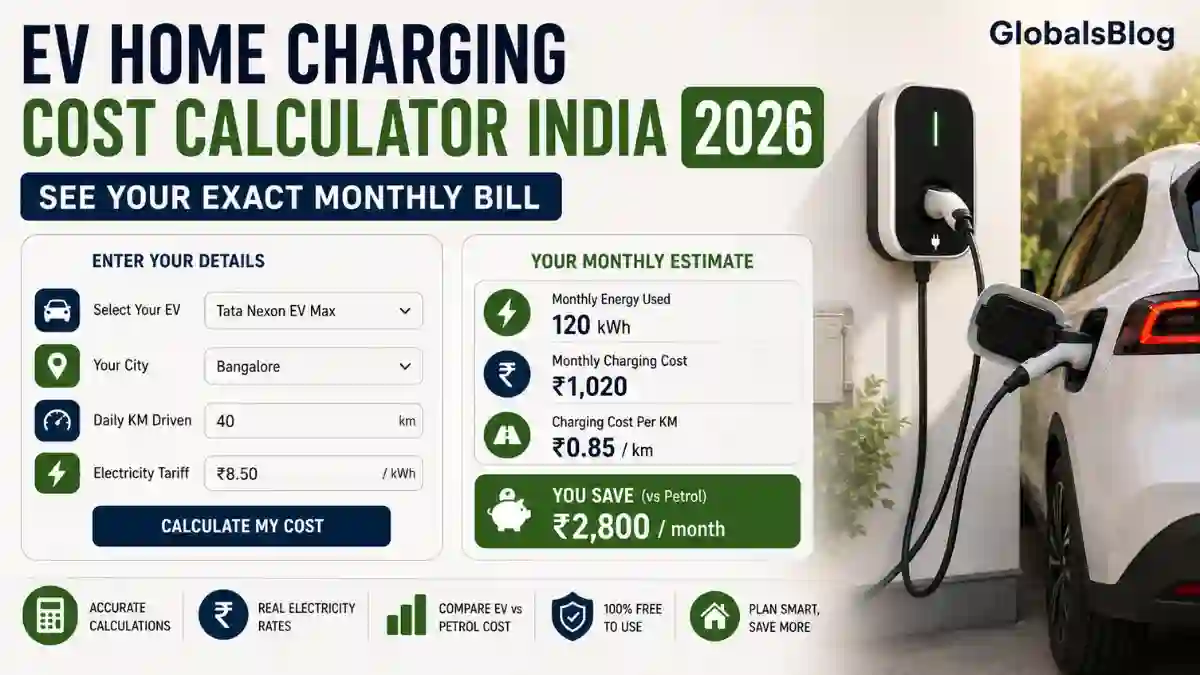
Stop guessing your EV electricity bill. Enter your car, city, and daily kilometres — get your exact monthly home charging cost, cost per km, and how much you save over petrol.
Also Searched As
- How Much Will My Electricity Bill Increase After Buying an EV in India?
- EV vs Petrol Running Cost India 2026 — The Real Numbers Nobody Shares
- My EV Monthly Charging Cost in Delhi / Mumbai / Bengaluru — Exact Calculation
Here is the conversation that happens in every Indian household after buying an EV: someone opens the electricity bill and wonders how much it will change. The answer is not complicated — but it does depend on three things that vary significantly across India: your car battery size, your daily driving distance, and your state electricity tariff. A Tata Nexon EV 45 owner in Delhi pays a very different monthly charging bill than the same car owner in Maharashtra — sometimes ₹500–₹800 different per month.
This guide gives you the formula, a live calculator to crunch your exact numbers, a state-by-state tariff reference, and context on how India's home EV charging electricity cost compares to petrol — so you can make genuinely informed decisions about your EV ownership economics.
Quick Answer
Formula: Monthly Cost = (Daily km ÷ Efficiency km/kWh) × Tariff ₹/kWh × 30
Typical range: ₹800–₹2,200/month for a mid-range EV (40–45kWh) driving 40–60 km/day on home charging across Indian cities.
Cost per km: ₹0.80–₹1.80/km at home — versus ₹8–₹12/km for a petrol car at current fuel prices. Home EV charging is 5–8× cheaper per km than petrol in most Indian scenarios.
Monthly EV Charging Cost Calculator
India-specific tariffs · Real-world efficiency · Petrol comparison
Cost per km — EV vs Petrol Comparison
—
The Formula Behind the Calculator — Explained Simply
The maths behind EV home charging costs in India is straightforward once you break it down. Here are the three inputs that drive everything:
EV Home Charging Cost Formula
Cost per km (₹) = Tariff (₹/kWh) ÷ Efficiency (km/kWh)
Full charge cost (₹) = Battery capacity (kWh) × Tariff (₹/kWh)
Real example — Tata Nexon EV 45 in Bengaluru: Battery = 45 kWh. Real-world efficiency = ~7.8 km/kWh in city. BESCOM tariff = ₹6.00/kWh. Daily driving = 50 km.
Monthly units consumed = (50 ÷ 7.8) × 30 = 192 kWh/month. Monthly cost = 192 × ₹6.00 = ₹1,152/month. Cost per km = ₹6.00 ÷ 7.8 = ₹0.77/km. Compare to a 15 km/L petrol car at ₹105/L: ₹7/km — nearly 9× more expensive per km.
The EV-Specific Meter: India's Most Underused Cost Hack
Delhi, Haryana, Maharashtra, and several other states offer dedicated EV electricity meters with subsidised tariffs — Delhi's EV tariff is ₹4.50/kWh versus the standard domestic slab of ₹5.50–₹7.50/kWh. For a Nexon EV 45 driving 50 km/day in Delhi, this single change saves approximately ₹180–₹380/month — or ₹2,160–₹4,560 per year — with zero change to driving behaviour. Apply through your DISCOM portal.
What Does a Home EV Charging Station Actually Cost in India?
Full breakdown of wallbox hardware prices, DISCOM load upgrade fees, wiring costs, and state subsidies — everything you need before spending a rupee on installation.
Electricity Tariff by State: What You're Really Paying per kWh in 2026
India's electricity pricing is deeply state-dependent — and within each state, it's further split into consumption slabs. Adding an EV can push your household into a higher monthly consumption slab, which changes your effective rate. Here's the reference table for major cities.
| State / City | Domestic Tariff (avg.) | EV-Specific Tariff | EV Meter Available |
|---|---|---|---|
| Delhi | ₹5.00–₹7.50/kWh (slabs) | ₹4.50/kWh | Yes |
| Maharashtra (Mumbai/Pune) | ₹5.19–₹11.85/kWh (slabs) | ₹5.00–₹5.50/kWh | Yes |
| Karnataka (Bengaluru) | ₹5.75–₹7.20/kWh | ₹5.00–₹6.00/kWh | Partial |
| Tamil Nadu (Chennai) | ₹4.50–₹7.00/kWh | ₹4.50–₹6.00/kWh | Partial |
| Gujarat | ₹4.50–₹6.00/kWh | ₹4.50/kWh (duty exempt) | Yes |
| Telangana (Hyderabad) | ₹5.00–₹7.00/kWh | ₹5.50/kWh | Partial |
| Punjab | ₹8.00–₹10.00/kWh | No dedicated rate | No |
| Uttar Pradesh | ₹5.50–₹7.50/kWh | ₹5.50/kWh | Partial |
| Kerala | ₹5.50–₹7.50/kWh | No dedicated rate | No |
The key variable most buyers miss: slab migration. If your household normally consumes 200 units/month and your EV adds 180 units, you jump from ~200 to ~380 units — potentially pushing into a higher tariff bracket for your entire bill, not just the EV portion. The EV-specific meter solves this by metering your car's consumption separately, keeping your home appliances in the lower slab.
How the Home EV Charger Installation Process Works in India
From applying for a dedicated EV meter to the final Form-4 test certificate — a step-by-step walkthrough of the full installation process, including how to avoid the DISCOM slab migration trap.
Real-World EV Efficiency: What Your Car Actually Consumes
ARAI-rated range and real-world driving range are different things — sometimes very different. At 100 km/h with AC on, most EVs consume 15–25% more energy than their rated figure. For the cost calculator to be accurate, you need real-world efficiency numbers, not manufacturer claims.
Popular Indian EVs — Real-World Efficiency Reference
| EV Model | Battery (kWh) | ARAI Range | Real-World (city) | Efficiency (km/kWh) |
|---|---|---|---|---|
| Tata Nexon EV 45 | 45 kWh | 489 km | ~350 km | 7.8 km/kWh |
| Tata Nexon EV 30 | 30 kWh | 275 km | ~220 km | 7.3 km/kWh |
| Tata Punch EV | 26 kWh | ~315 km | ~250 km | ~7.0 km/kWh |
| MG ZS EV | 50.3 kWh | 461 km | ~340 km | 6.8 km/kWh |
| MG Windsor EV | 38–40 kWh | 332 km | ~250 km | 6.7–7.2 km/kWh |
| Hyundai IONIQ 5 | 72.6 kWh | 631 km | ~400 km | ~6.5 km/kWh |
| BYD Atto 3 | 60.5 kWh | 521 km | ~380 km | ~7.0 km/kWh |
| Ather 450X | 3.7 kWh | ~115 km | ~90 km | ~50 km/kWh equiv. |
The Summer Penalty Indian EV Owners Rarely Plan For
In May–June, running a car AC in 42°C heat consumes 1–2 kWh/hour additionally. For a 45 kWh EV driving 50 km/day with AC on continuous, this can reduce effective efficiency by 12–18%, pushing real-world city efficiency from ~7.8 km/kWh to ~6.5 km/kWh. Your summer electricity bill will be noticeably higher than your winter bill even with identical driving patterns. The calculator above uses base efficiency — add 10–15% to your summer estimate.
Before vs After EV: What Your Electricity Bill Actually Does
- "My electricity bill will double"
- "Charging will cost as much as petrol"
- "The smart meter doesn't matter much"
- "I should charge during the day for convenience"
- "Public charging is fine for daily use"
- Bill rises ₹800–₹2,200/month — far less than petrol savings
- EV costs ₹1–₹1.8/km vs petrol's ₹8–₹12/km at home
- EV meter saves ₹2,000–₹5,000/year by preventing slab jump
- Night charging catches stable voltage and lower tariffs
- Public DC charging costs 3× home rates — minimise it
"At ₹6/kWh in Bengaluru, driving a Nexon EV 45 costs ₹0.77/km. A comparable 15 km/L petrol car at ₹105/litre costs ₹7/km. The EV is 9 times cheaper to run per kilometre at home — every single day." — ZevPoint, February 2026
Best Home EV Chargers in India 2026 — Ranked & Tested
The right 7kW wallbox charges your EV in 5–6 hours instead of 14. Here are India's top 5 home EV chargers — with real prices, IP ratings, and which one suits your setup.
5 Ways to Reduce Your Home EV Charging Electricity Bill in India
1. Apply for a Dedicated EV Meter
The single highest-impact action available to most Indian EV owners. States including Delhi, Maharashtra, Gujarat, and Haryana offer separate EV electricity meters with subsidised tariffs. The application is straightforward — typically a form submission through your DISCOM portal plus an on-site inspection. The annual savings range from ₹2,000 in lower-tariff states to ₹5,500+ in Maharashtra's higher slab regions.
2. Schedule Charging Between 1 AM and 5 AM
Indian grid voltage is most stable in the early morning hours — power demand drops, voltage spikes and troughs reduce, and your charger can work at rated efficiency throughout. Some states also offer time-of-use tariff discounts for off-peak consumption. A smart wallbox (Delta AC Mini Plus, Tata Power EZ Charge) handles this scheduling automatically via app.
3. Charge to 80%, Not 100%, for Daily Use
Charging from 20% to 80% rather than 0% to 100% reduces daily energy consumption by approximately 15–20% on most EV battery chemistries. It also extends battery longevity meaningfully — lithium-ion cells degrade fastest at very high and very low states of charge. Reserve 100% charges for the night before a long weekend trip.
4. Use Eco Mode During City Driving
Eco mode typically reduces peak motor output and increases regenerative braking aggressiveness. For urban stop-start driving — the dominant Indian EV use case — this improves city efficiency by 8–15%, directly reducing your monthly kWh consumption without changing your driving distance.
5. Consider a Rooftop Solar Pairing
A 2kW rooftop solar system in a sun-rich Indian city generates 220–280 kWh/month — enough to cover 30–50% of a typical EV's monthly home charging requirement. The Delta AC Mini Plus charger supports solar-priority charging mode that draws from your PV system first. The solar payback period shortens significantly when EV charging load is included in the calculation.
⚡ EV Home Charging Cost — Quick Reference (Featured Snippet)
- Cost per full charge = Battery kWh × Tariff ₹/kWh. Nexon EV 45 at ₹6/kWh = 45 × 6 = ₹270 per full charge.
- Monthly units = (Daily km ÷ km/kWh) × 30. For 50 km/day at 7.8 km/kWh: (50÷7.8)×30 = ~192 units/month.
- EV-specific meter saves ₹1.50–₹3/kWh versus standard domestic tariff in eligible states — worth ₹2,000–₹5,500/year.
- Public DC fast charging costs ₹15–₹25/kWh — 2.5–4× more expensive than home charging. Minimise it for daily use.
- Summer EV efficiency drops 10–18% in India due to AC load — budget higher for May–July months.
- Night charging (1–5 AM) gives the most stable grid voltage and best efficiency, plus off-peak discounts where available.
- Charging to 80% daily instead of 100% reduces monthly bill by ~15% and extends battery longevity.
EV Charging Station Business Cost & Profit in India
Thinking about turning your extra parking into a commercial EV charging point? Here's the full investment, revenue, and payback breakdown for starting an EV charging business in India 2026.
Your Monthly EV Charging Bill: Lower Than You Think, Simpler Than You Fear
The home charging electricity bill for most Indian EV owners lands between ₹800 and ₹2,200 per month — a figure that sounds significant until you compare it to the ₹4,000–₹8,000 per month most equivalent petrol car owners spend on fuel. The savings are real, consistent, and compounding over time as petrol prices continue their long-term upward trajectory.
The variables that matter most are your state's tariff, whether you apply for a dedicated EV meter, and whether you charge at home the majority of the time rather than relying on public fast charging. Get those three things right and your effective per-km cost drops to ₹0.80–₹1.20 — a figure that makes the EV decision straightforward for any buyer doing meaningful annual mileage.
Use the calculator above to get your personal number, then read the full home charging station cost guide to understand what the upfront setup will run. If you haven't installed a dedicated wallbox yet, the installation process guide walks you through every step from DISCOM application to first charge. For hardware choices, the best home EV chargers India 2026 ranking covers every major option. And if you're thinking about commercial opportunity, the EV charging station business guide lays out the investment and return picture in full.
The numbers have always been in your favour. Now you know exactly what they are.
Leave a comment
Share a quick thought about this story.
Thanks for sharing your view. It is ready for review.
Please try again in a moment.