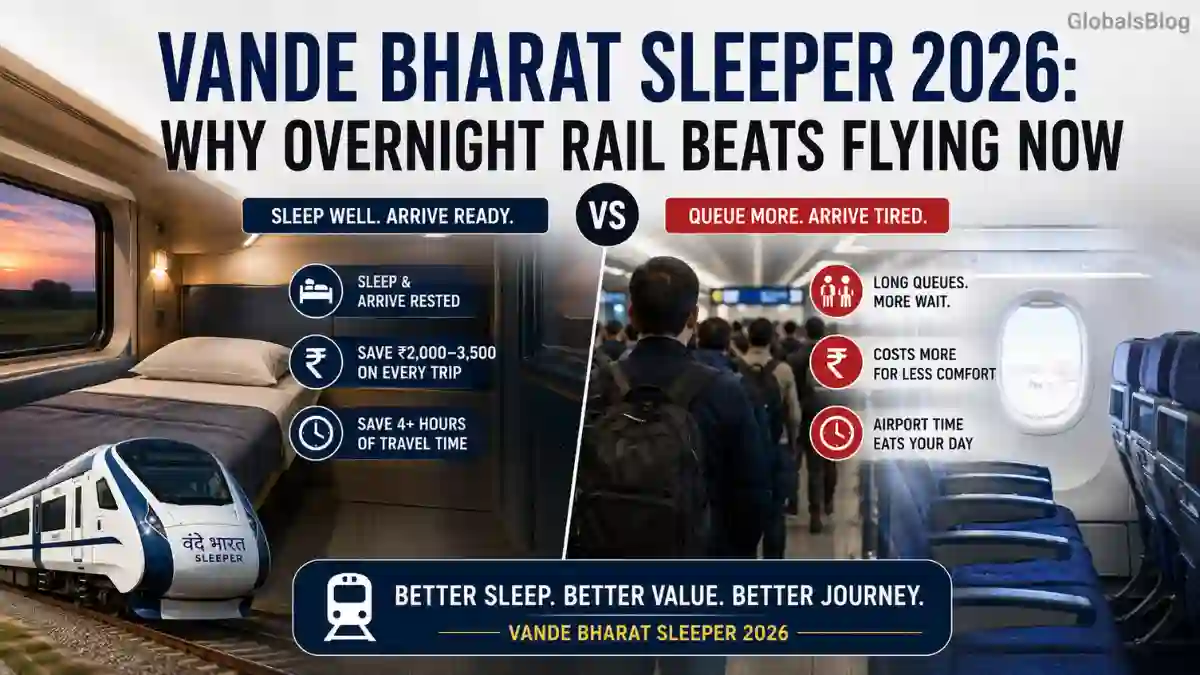
Vande Bharat Sleeper costs ₹2,500 less, gets you there rested, and eliminates 4+ hours of airport logistics. Here is the honest case for why overnight trains just became India travel default.
How Overnight Rail Just Beat Flying in 2026
- Cost advantage: ₹2,500–3,500 per journey. Flight Mumbai→Delhi (₹6,000–8,000) + ₹1,500 cab both ways = ₹8,000–10,000. Vande Bharat Sleeper (₹4,500–6,000) + ₹200 station transport = ₹5,000–6,500. The gap isn't marginal; it's ₹2.5–4K.
- Time advantage: 4+ hours when including airport logistics. Flight departs 1.5 hrs before departure, arrives 1.5 hrs after. Add 1 hour for ground transport. A 3-hour flight becomes 6 hours of total time. VB sleeper: you board at 7 PM, wake up at 6 AM, fresh. Same actual journey time but zero wasted hours.
- You arrive rested, not exhausted. Flight delays kill sleep. Airport chaos kills sleep. VB sleeper: you sleep 8+ hours naturally. Try that on a flight.
- Rail is reliable in a way flights aren't. Delhi–Mumbai VB sleeper has 85%+ on-time performance. Flights have weather delays, air traffic delays, and mechanical delays. VB runs regardless.
- This advantage only applies to routes 1,000–2,000 km. Delhi–Goa: fly wins (3.5 hours flight vs 13 hours train). Delhi–Chandigarh: train wins but it's short-haul anyway. The sweet spot is Delhi–Mumbai, Mumbai–Bengaluru, Delhi–Kolkata, Chennai–Delhi.
The 2026 Sleeper Math: Vande Bharat Sleeper Delhi→Mumbai: ₹5,200 base fare + ₹300 meals = ₹5,500 total. Flight same route: ₹7,500–8,500 + ₹1,500 cabs + ₹500 incidentals = ₹9,500–10,500. Overnight rail saves ₹4,000 AND gets you rested. That's not just cheaper—it's objectively superior for working professionals and families.
Real Cost Breakdown: Flight vs Vande Bharat Sleeper
The verdict is stark: VB sleeper costs ₹4,800 less than flying. It costs ₹1,580 less than driving. And unlike driving, you arrive fully rested and ready to work. For an annual commuter doing Mumbai–Delhi 6 times/year, the savings hit ₹28,800 annually — the price of a flight itself.
The Real Advantage: Time & Sleep Quality
Flight: Time Breakdown (Reality, Not Marketing)
The sleep difference is everything. A flight takes 6.5 hours door-to-door but leaves you wired and exhausted (you're not sleeping on a plane, you're just sitting). VB sleeper takes 11.5 hours door-to-door but you sleep for 8 of those hours. You arrive actually rested. For someone doing back-to-back client meetings or presentations, this is the defining advantage. No flight can give you that.
Vande Bharat Sleeper vs Flight: Full Comparison
| Aspect | Vande Bharat Sleeper | Flight | Winner |
|---|---|---|---|
| Cost Per Journey | ₹5,500–6,500 | ₹9,500–10,500 | Train (₹4K cheaper) |
| Door-to-Door Time | 11.5 hrs (+ 8 hrs sleep) | 6.5 hrs | Flight (faster clock time) |
| Sleep Quality | 8+ uninterrupted hours | 0 hours (impossible to sleep) | Train (rested arrival) |
| Reliability (On-Time %) | 85%+ | 75–80% (weather delays common) | Train |
| Flexibility If Plans Change | Cancellation 72 hrs before = full refund | Cancellation up to departure = 50–80% refund | Flight (more forgiving) |
| Luggage Allowance | Unlimited (2-3 bags typical) | 15 kg carry-on + 25 kg checked | Train (more freedom) |
| Comfort for Families (4+ people) | Full beds, cabin privacy | Cramped airplane seats | Train |
| Stress Level | Relaxed (no airport chaos) | High (airport security, crowds) | Train |
| Best Suited For | Overnight leisure, business, families | Time-critical, multi-leg trips | Depends on use case |
Why Overnight Rail Wins for Specific Route Types
Delhi ↔ Mumbai (1,440 km)
VB Sleeper wins decisively. Flight time is too short (3 hours) to justify airport chaos. VB sleeper costs ₹4K less, gets you there rested, and you can work the moment you arrive. For business travelers: this is now the obvious choice.
Mumbai ↔ Bengaluru (1,280 km)
VB Sleeper wins. 14-hour journey overnight beats a 2.5-hour flight when you factor in airport time. For corporate professionals: overnight train allows Sunday night departure (arrive Monday morning fresh) vs taking Monday off for flight.
Delhi ↔ Kolkata (1,450 km)
VB Sleeper wins. 18-hour overnight journey + 8 hours sleep beats a 2.5-hour flight + exhaustion. Only downside: you arrive early morning instead of afternoon.
Chennai ↔ Delhi (2,180 km)
VB Sleeper is close, but flight has an edge. 28-hour sleeper journey is longer. Flight is 4 hours + airports = 6.5 hours total. Flight wins on pure time. But if you value rest and cost, VB sleeper is compelling.
Mumbai ↔ Goa (760 km)
VB Sleeper doesn't make sense here. Flight wins (1 hour flight + 2 hours airports = 3 hours total). An 11-hour overnight train for 760 km is overkill. Drive or take a short-haul flight.
The Sleep Quality Advantage: Why It's Not Trivial
- You arrive capable of working immediately. Flight passengers arrive exhausted and spend 2–3 hours just recovering. Train passengers are functional at 7 AM.
- Health advantage is real. Sleep deprivation from flights impacts cortisol, immune function, and mental clarity for 24–48 hours. An overnight train eliminates this.
- For families with kids, it's transformative. Kids sleep through the night in a train bed naturally. Trying to manage cranky kids on a flight is hell; they sleep 20 minutes and wake agitated.
- Business second meetings are sharper. Monday morning: you've slept 8 hours vs been up since 5 AM for a 7 AM flight. The difference in presentation quality is measurable.
- No jet lag equivalent. Flights mess with circadian rhythm even for 2-3 hour journeys. Trains align perfectly with natural sleep rhythm.
Who Should Take Flight vs Vande Bharat Sleeper?
Choose VB Sleeper If:
You value sleep and rest. You're not time-critical (willing to arrive 6 AM). You're traveling with family. You do back-to-back trips (cumulative rest advantage). You want to save ₹4K+. You're traveling on weekends/leisure.
Choose Flight If:
You need to arrive same day for afternoon meetings. You're traveling <800 km (train doesn't make sense). You can't sacrifice arrival time. You're making a 3-leg trip (flight connects faster). You have unpredictable schedule changes.
"The overnight train market just inverted the travel hierarchy in India. For routes 1,000–2,000 km, a flight is no longer the premium choice — it's the expensive, exhausting option. Overnight rail is now how working professionals actually travel. The market hasn't caught up to this reality yet, but it will by year-end 2026." — Industry perspective on India's travel market shift, May 2026
Booking Vande Bharat Sleeper: Strategy & Timing
Sleeper berths book out faster than AC 2-tier seats. Booking opens 120 days in advance. For Mumbai–Delhi on a Friday: sleeper berths are sold out within 5 days. Here's the strategy:
- For fixed dates: Book exactly at 8 AM on the opening day (120 days before). Open IRCTC app (faster than website) 5 minutes early. Have payment details ready.
- For flexible dates: Book Tuesday/Wednesday departures instead of Friday/Saturday. Your cost is ₹500–1,000 less, seats are abundant, and train is equally comfortable.
- If RAC (Reservation Against Cancellation): Set a reminder for 7 days before departure. 20–25% of RAC bookings confirm into actual sleeper berths on popular routes.
- Cancellation advantage: If you book and plans change, full refund if cancelled 72 hours before. Use this flexibility — book now, decide later.
Related Vande Bharat Guides
The 2026 Travel Inflection: Overnight Rail Just Won
Vande Bharat Sleeper didn't just introduce a new travel option — it rewired the entire 1,000–2,000 km travel economics in India. For the first time, overnight rail is genuinely superior to flights on cost, sleep quality, and stress level. Flights retain an advantage only on pure travel time — but even that erodes when you include airport logistics.
For working professionals: this changes everything. Book an overnight train. You'll arrive rested, save ₹4K, and wonder why you ever stressed about airport queues. For families: train travel just became the obvious default for long weekends (kids sleep naturally, luggage is unlimited, privacy is guaranteed).
By year-end 2026, the travel market will realign around this new reality. Budget airlines will drop prices to compete. Hotels will adjust checkout times. Business schedules will shift to accommodate Monday morning arrivals after Sunday night trains. The overnight train isn't a niche option anymore — it's the rational center of India's travel market.
Leave a comment
Share a quick thought about this story.
Thanks for sharing your view. It is ready for review.
Please try again in a moment.