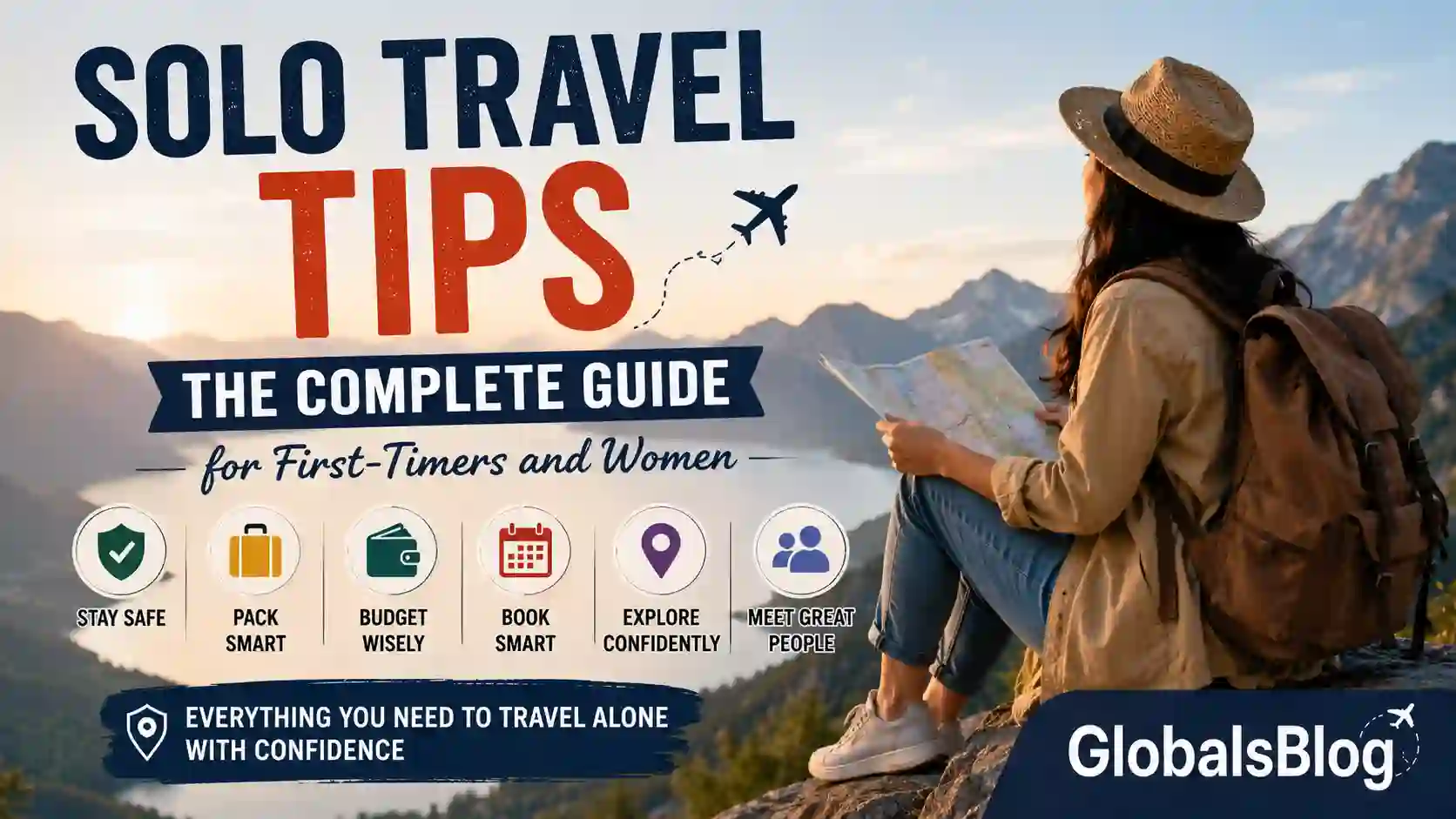
Solo travel is not lonely. It is the most efficient way to learn who you are when nobody else is deciding where you go next.
A reader from Pune had been planning her first solo trip for two years. The destination was decided, the leave approved, the savings set aside — but she kept finding reasons to delay. The safety question, the eating alone question, the what-do-I-do-if-something-goes-wrong question. When she finally went — a week in Coorg, solo — she described it as the most clarifying experience of her adult life. Not because nothing went wrong (her bag was delayed, she got lost on a trail, it rained for two full days) but because she handled every one of those things herself, without anyone else to defer to. Solo travel does not require courage. It requires the first booking. Everything after that teaches you the courage on the way.
The most important solo travel tips are: start with a destination that is genuinely beginner-friendly (not necessarily safe — manageable), book accommodation in social areas not isolated ones, share your itinerary with someone at home, carry offline maps and key contacts, use hostels or guesthouses for built-in social connection, trust your instincts and leave any situation that feels wrong, and give yourself permission to do nothing on some days. For women specifically: research dress norms before arriving, use app-based transport over street hailing where possible, and trust discomfort as information rather than failure.
Before You Go — Planning Your Solo Trip
The best first solo destination is not necessarily the safest or the cheapest — it is the one where the systems are manageable enough that problems do not compound. A beginner-friendly destination has reliable app-based transport (reduces the negotiation burden on arrival), English-language signage or widely spoken English, clear accommodation options across budget ranges, and an established backpacker or solo traveller community that creates natural social opportunities. For Indian solo travellers, excellent beginner-friendly domestic options include Goa (South Goa specifically), Coorg, Rishikesh, Hampi, and Puducherry — each has an established solo traveller culture, good guesthouse infrastructure, and enough English fluency to make navigation straightforward. For first international solo trips: Bali, Thailand (Chiang Mai or Koh Tao), Sri Lanka, and Vietnam are consistently the most manageable entry points for Indian passport holders. See our solo travel places in India guide for a full destination breakdown.
The most common first solo trip mistake is over-planning — filling every day with pre-booked activities and accommodation, leaving no room to follow an interesting recommendation, extend a stay somewhere unexpectedly good, or simply rest when needed. The sweet spot: book the first two nights of accommodation before arriving (so you land with a confirmed address and a bed) and book your return transport. Leave everything in between flexible. Some of the best solo travel experiences come from decisions made the morning of — a hike recommended by someone at breakfast, a detour to a town you had not heard of, an extra day somewhere that surprised you. Over-planned solo trips feel like guided tours without a guide.
Physical documents to carry: passport (with at least 6 months validity), one printed copy of your visa/hotel confirmation, travel insurance card (see below), one emergency cash amount in local currency separate from your main wallet. Digital backup essentials: photograph every document and save to cloud storage before leaving home, download offline maps of your destination (Google Maps allows offline download of entire cities — do this on WiFi before arrival), save the address of your accommodation as a screenshot (not just in a browser tab that requires data), and store emergency contacts including your country''s embassy number offline. Share your full itinerary with someone at home — not just the destination, but accommodation addresses, contact numbers, and a check-in schedule.
Travel insurance is more important for solo travellers than for group travellers — because there is no one else to help cover unexpected costs if something goes wrong. A medical emergency abroad without insurance can cost more than the entire trip. A cancelled flight without insurance means losing everything already paid. Good travel insurance covers: medical emergency and evacuation, trip cancellation and delay, baggage loss or theft, and personal liability. For Indian travellers: Bajaj Allianz, HDFC Ergo, and Tata AIG all offer solid international travel insurance plans starting from ₹500–₹1,500 for a week-long international trip — a fraction of what a single night in a foreign hospital costs uninsured. Always read what the policy excludes (adventure activities often require an add-on) before buying.
On the Ground — Solo Travel Safety Tips
For solo travellers, accommodation location and social atmosphere matter more than room quality. A well-reviewed hostel or guesthouse in a central, walkable area will produce a better solo travel experience than a comfortable hotel in an isolated location, for two reasons: first, you can walk back safely in the evening without depending on transport; second, hostels and social guesthouses have common areas where solo travellers naturally meet each other — the built-in antidote to the loneliness that first-time solo travellers most fear. For women specifically, hostels now routinely offer female-only dormitory and private room options — verified by Hostelworld and Booking.com filters. Look for accommodation with 24-hour front desk for solo trips in unfamiliar destinations.
The transport decisions that matter most for solo traveller safety are the arrival and late-evening journeys — when you are tired, possibly in an unfamiliar area, and most vulnerable to poor decisions. Prefer app-based ride services (Uber, Ola, Grab in Southeast Asia, Bolt in Europe) over street-hailed taxis for all airport arrivals and late-night transport — you have a record of the journey, the driver''s details, and a shared route with someone at home. For daytime exploration, public transport is usually both safer and more interesting than taxis. On overnight trains and buses: keep your bag with you or chained to the luggage rack, store valuables in a small bag used as a pillow, and keep your phone and wallet in a front or inside pocket rather than a backpack external pocket.
Solo travellers — especially first-timers — often override their instinctive discomfort signal out of politeness, social pressure, or fear of seeming paranoid. The rule is simple: if something feels wrong, leave. You do not owe anyone an explanation for removing yourself from a situation, a conversation, or a location that makes you uncomfortable. This applies to people (someone whose interest feels intrusive), places (a neighbourhood that suddenly feels different after dark), and situations (a group activity that has shifted in tone). Trust the instinct first and assess the situation from safety. False alarms are far less costly than ignored warnings. For women: this instinct is particularly well-calibrated and consistently undervalued in solo travel advice that focuses on destination safety statistics rather than real-time situational awareness.
Solo Travel Tips for Women — Specific Advice
Women travelling solo navigate a different risk landscape than men — not a more dangerous one in absolute terms, but one that requires additional situational awareness in specific contexts. These are the practical tips that experienced female solo travellers consistently identify as most valuable:
- Research local dress norms before arrivingNot to conform rigidly, but to make informed choices about when blending in reduces unwanted attention. In temple towns, beach destinations, and conservative rural areas, this one piece of research reduces friction significantly.
- Book arrival accommodation in advance and alwaysArriving in a new place without a confirmed address — especially late at night — puts female solo travellers in the most vulnerable position of the entire trip. The first booking is the one to never skip.
- Use app-based transport preferentially over street hailingParticularly for after-dark journeys. The accountability that comes from a digitally recorded journey with a named driver is meaningfully different from an unregistered street taxi.
- Have a fake phone call readyWalking while appearing to be on a call, or having a contact you can call to say "I''m on my way" in the presence of someone making you uncomfortable, is a widely used and effective de-escalation tool.
- Connect with female solo travel communitiesr/solotravel, Girls Love Travel, and Solo Female Travelers (Facebook group, 1M+ members) have destination-specific safety information, accommodation recommendations, and the practical knowledge of women who have recently visited your specific destination.
- Give yourself permission to say no clearlyIn some cultures, an indirect "maybe later" or polite deflection is read as continued interest. A clear, direct "no thank you, I prefer to be alone" is kinder in the long run than politeness that prolongs unwanted interaction.
Solo Travel Packing — What You Actually Need
| Category | What to Pack | Solo-Specific Reason |
|---|---|---|
| Documents | Passport, insurance card, printed hotel confirmation, emergency cash | No one else has a copy — you are your own backup |
| Technology | Offline maps downloaded, portable charger, universal adapter | Dead phone = no navigation, no emergency contact access |
| Safety | Door stopper alarm, small torch, whistle, basic first aid kit | Door alarm for hostel/guesthouse rooms — inexpensive and effective |
| Luggage | One bag you can carry yourself without help | You cannot leave your bag with a stranger while you manage stairs |
| Money | Split across wallet, bag, and hidden money belt | Losing one does not mean losing everything |
| Health | Basic medication, prescribed drugs with prescriptions, insect repellent | Finding a pharmacy alone in an unfamiliar place is stressful — avoid it |
How to Meet People When Travelling Solo
The loneliness question is the one first-time solo travellers most fear and experienced solo travellers most rarely experience. The reason: solo travellers are far more approachable than people travelling in groups, and the infrastructure of solo travel — hostels, food tours, day trips, walking tours — creates natural meeting points without requiring social effort.
Free walking tours: Available in almost every tourist destination, pay-what-you-want, and consistently the best way to meet other solo travellers in a new city while also learning the place. The group size (typically 10–20 people) is manageable, the shared activity provides easy conversation starters, and post-tour coffee is a natural continuation.
Hostel common rooms: Sit in the common room with a book or your phone and someone will talk to you. This is not a social skill — it is an architectural feature of hostels. The shared table at breakfast is the most reliable daily social opportunity in solo travel.
Day trips and group activities: Snorkelling trips, cooking classes, wine tastings, trekking groups — any shared-activity format creates natural conversation without the pressure of a social setting. Book through your accommodation where possible — they know which operators attract good groups.
Eat at the bar or communal table: Restaurants with bar seating or communal tables are the solo traveller''s dining solution — you can eat comfortably alone while being part of the room, and conversations happen naturally without effort.
Solo Travel Budget Tips
Solo travellers pay the highest per-person cost of any travel format — the single supplement on hotel rooms, eating for one, taxis that could be split. Managing this requires specific strategies:
Stay in hostels for social spaces, not just cost: A private room in a social hostel costs 20–40% less than an equivalent hotel room and comes with a common area, free social connection, and local knowledge from staff and other travellers. The social dividend is free.
Eat where locals eat: Street food, market stalls, and local restaurants without English menus are the most interesting and least expensive dining in almost every destination. Point at what others are eating, or use Google Translate''s camera function on the menu.
Use public transport aggressively: The per-journey cost of taxis compounds quickly over a week of solo travel. Metro, bus, and local train not only cost a fraction of taxis but put you in the actual city rather than passing through it.
Book accommodation slightly off-centre: The exact central neighbourhood is the most expensive to stay in. One or two metro stops away typically halves the accommodation cost while adding only 10–15 minutes to any journey. Our budget travel guide covers destination-specific cost breakdowns.
Solo Travel Tips — The Short List
- Download offline maps before you land — Google Maps allows city-wide offline download on WiFi. This single action prevents the most common solo travel stress moment: arriving somewhere with no data and no idea where you are
- Tell someone at home your itinerary — not just "I''m going to Bali" but your accommodation address, flight details, and a check-in schedule. Takes 5 minutes and provides enormous reassurance on both sides
- Carry a portable charger always — your phone is your map, your translator, your emergency contact, and your booking system. A dead phone is a solo travel emergency
- Eat at the bar — the single best dining solution for solo travellers in sit-down restaurants. You''re part of the room, the conversation is natural, and you never feel conspicuously alone
- Learn five words in the local language — hello, thank you, excuse me, how much, and where is — the attempt alone changes how people respond to you
- Give yourself rest days — solo travel is energising but also consistently more tiring than travelling with others. One day with no agenda, a café, and a book is often the best day of a solo trip
Solo Travel Mistakes to Avoid
- Over-planning every day — the most common first-trip mistake. Pre-booked activities on every day of a solo trip remove the flexibility that makes solo travel distinctively rewarding. Book arrival accommodation and return transport. Leave the rest open.
- Staying in isolated accommodation — a quiet hotel far from the centre sounds appealing in planning but produces anxious evenings, expensive transport, and zero social opportunity. Central and social beats comfortable and isolated for solo travellers.
- Ignoring discomfort signals to be polite — the politeness instinct is not your safety tool. Your instinct is. Leave any situation that feels wrong, without explanation, without delay.
- Not buying travel insurance — the one cost that solo travellers most commonly skip and most regret skipping when they need it. A week of travel insurance costs less than one restaurant dinner abroad.
- Comparing your solo trip to group travel — solo travel produces a different experience than travelling with friends, not a worse one. Missing people at home is normal and expected; it does not mean the solo trip is failing.
💡 The first trip rule: Choose a destination where the systems are manageable, not the destination you most want to go to. Save your most ambitious destination for trip three or four, when you have the solo travel toolkit — offline maps, instinct calibration, accommodation strategy, transport habits — already running automatically. Your first solo trip is for building confidence, not conquering the hardest destination on your list.
Make the Booking. The Confidence Comes on the Way.
Download the offline maps. Tell someone at home your itinerary. Book the first two nights. Get the travel insurance. Trust the instinct. Eat at the bar. Take the rest day. Start with a destination where the systems are manageable and save your most ambitious destination for later. Solo travel is not something you are ready for and then do — it is something you do and then feel ready for. The Pune reader who delayed for two years came back from Coorg and booked her next solo trip before she unpacked. The first booking is always the hardest one.
The best solo travel tips for beginners are: start with a manageable destination (not necessarily the most exciting one), book only the first two nights accommodation and return transport in advance, download offline maps before arriving, share your itinerary with someone at home, stay in social accommodation (hostel or central guesthouse) rather than isolated hotels, use app-based transport for airport arrivals and late evenings, get travel insurance without exception, and trust your instincts to leave any situation that feels wrong. The first booking is the hardest part — everything else teaches you the skills on the way.
Yes — millions of women travel solo safely every year, and solo female travel has grown significantly as an established travel category with dedicated communities, resources, and accommodation options. Women solo travellers benefit from specific practical strategies: researching local dress norms before arriving, booking arrival accommodation in advance always, using app-based transport for after-dark journeys, staying in social accommodation with a 24-hour front desk, connecting with female solo travel communities (Girls Love Travel, Solo Female Travelers on Facebook) for destination-specific advice, and consistently trusting instincts to leave situations that feel wrong. Safety varies significantly by destination — research specific areas rather than entire countries.
The easiest ways to meet people while travelling solo are: free walking tours (available in most cities, pay-what-you-want, consistently attended by other solo travellers), hostel common rooms and breakfast tables (the most reliable daily social opportunity in solo travel), shared-activity day trips like snorkelling, cooking classes, or trekking groups, and eating at bar seating or communal tables in restaurants. Solo travellers are far more approachable than people in groups — you do not need social skills, you need to put yourself in proximity to the right situations. Most experienced solo travellers report loneliness as the least actual problem of solo travel despite being the most anticipated fear.
Solo travel packing essentials are: one bag you can carry completely alone (no one to help with stairs or heavy luggage), offline maps downloaded before departure, a portable charger (your phone is your map, translator, and emergency contact), travel insurance documents accessible offline, emergency cash split between wallet and a hidden location, a door stopper alarm for hostel or guesthouse rooms, basic first aid and any prescription medication with prescriptions, and all documents photographed and saved to cloud storage. The golden rule: pack for what you actually need, not for every possible scenario — overpacking creates physical burden that compounds solo travel challenges.
The best domestic solo travel destinations from India are Coorg, Rishikesh, Hampi, Goa (South Goa), Puducherry, and Spiti Valley for more experienced solo travellers. For first international solo trips from India, the most manageable destinations are Bali (Indonesia), Chiang Mai and Koh Tao (Thailand), Sri Lanka, Vietnam (Hoi An and Hanoi), and Japan — all have excellent solo traveller infrastructure, widely available English, and established communities of independent travellers. Visa-on-arrival and visa-free options for Indian passport holders significantly simplify the planning for most of these destinations.
Reader Experiences