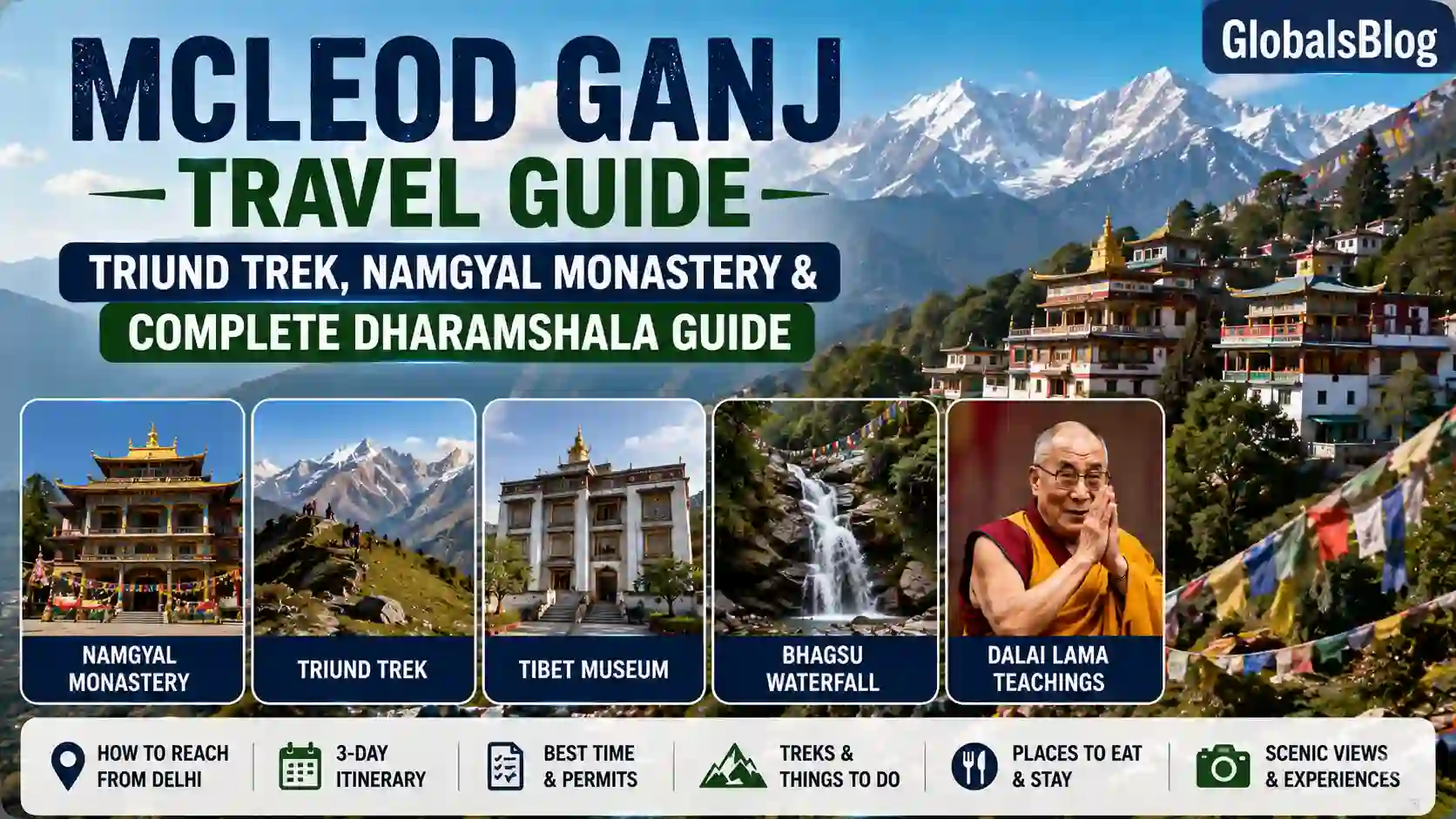
McLeod Ganj is the seat of the Tibetan government-in-exile and the home of the 14th Dalai Lama — a small hill town above Dharamshala in Himachal Pradesh where Tibetan Buddhist monasteries, prayer flags, and momo restaurants occupy the same narrow lanes as Israeli backpacker cafés and trekking outfitters. It is one of the most culturally layered small towns in India.
A reader from Mumbai had spent three days in McLeod Ganj expecting a hill station and found something she had not anticipated — a functioning Tibetan town in exile, complete with the Tibet Museum documenting the 1959 escape from Chinese occupation, the Namgyal Monastery where the Dalai Lama gives public teachings, the Library of Tibetan Works and Archives where monks and scholars study manuscripts that no longer exist in Tibet itself, and the specific sound of the town in the early morning when the monks' chanting from the monastery drifted down the hillside before the first tourist arrived. "I went for the mountains and the momos," she said. "I stayed for three extra days because I started understanding what I was actually looking at." McLeod Ganj rewards exactly this — the visitor who arrives expecting a weekend getaway and discovers a place with a specific historical weight and cultural depth that few Indian hill towns contain. This guide covers both the accessible surface (the café trails, the Triund trek, the mountain views) and the deeper layer beneath it.
McLeod Ganj key facts: Located 5km above Dharamshala, Kangra district, Himachal Pradesh — 480km from Delhi, 240km from Chandigarh, 1,457m altitude. Home of the 14th Dalai Lama and the Tibetan government-in-exile (Central Tibetan Administration). Best time: March–June and September–November. Avoid: July–August (heavy monsoon, Triund trail slippery). Key places: Namgyal Monastery (Dalai Lama's monastery), Tibet Museum, Bhagsu Waterfall, Triund Trek (9km, 2,828m), Library of Tibetan Works and Archives, Dal Lake (McLeod Ganj), St. John in the Wilderness Church. How to reach: Gaggal Airport (Dharamshala, 13km) for flights; Pathankot Railway Station (90km) + bus/taxi; direct overnight bus from Delhi ISBT (12–13 hours, ₹800–1,500).
Best Places to Visit in McLeod Ganj
Namgyal Monastery is the personal monastery of the 14th Dalai Lama and the most important Tibetan Buddhist temple in India outside of Tibet. The monastery complex (Tsuglagkhang Complex) contains three main sections: the Tsuglagkhang (main temple) with statues of Shakyamuni Buddha, Avalokiteshvara, and Guru Padmasambhava; the Kalachakra Temple with its extraordinarily detailed sand mandala and mural cycle depicting the Kalachakra Tantra; and the courtyard where public teachings are held when the Dalai Lama is in residence. The monastery at 6am — when the first morning prayers are conducted and a small group of monks chant in the main temple while butter lamps illuminate the statues — is one of the finest early-morning experiences available in any Indian town. The public teachings by the Dalai Lama (held in the teaching courtyard, announced on the official HHDL website) are open to all visitors of all religions without charge or invitation — they draw thousands of Tibetan pilgrims, Western dharma students, and Indian visitors simultaneously, creating the most cosmopolitan gathering visible at any Indian religious site. Check the Dalai Lama's teaching schedule at hhdl.org before visiting if attending a teaching is a priority.
Triund is the most popular day or overnight trek from McLeod Ganj — a 9km trail from the town up through rhododendron and oak forest to the broad ridge at 2,828m where the Dhauladhar Range unfolds in a wall of snow peaks directly in front of you and the Kangra Valley spreads below to the south. The view from Triund — the Dhauladhar immediately behind (the snow peaks of Mun Peak and Indrahar Pass rising to 4,300–4,700m directly above), the Kangra Valley below, and the distant shimmer of the plains beyond the foothills on clear days — is the finest accessible vista from any town in Himachal Pradesh's lower ranges. The trek is moderately steep but does not require technical skill — suitable for reasonably fit adults without trekking experience. The trail is well-marked and busy (200–400 trekkers on peak days); a guide is not required but a companion is recommended for safety. Day trek option: depart McLeod Ganj by 7am, reach Triund by noon, spend 2 hours at the ridge, descend by 5pm. Overnight option: carry a sleeping bag (or rent at Triund for ₹100–200), camp under the stars on the ridge, watch the Dhauladhar dawn — the mountain wall catches the first light while the valley below is still dark. The overnight option is the strongly recommended choice.
The Tibet Museum is the most important single stop in McLeod Ganj for understanding the cultural and political context of the town — a free museum documenting the history of Tibet's Chinese occupation (1950 onwards), the Dalai Lama's 1959 escape to India across the Himalayas, and the subsequent 60+ years of Tibetan exile community in Dharamshala. The museum contains photographs (many taken in Tibet covertly), documentary evidence of cultural and religious destruction in Tibet, oral testimonies from Tibetan refugees who walked across the Himalayas to India, and a section on the ongoing Tibetan resistance and international human rights advocacy. It is not a neutral museum — it presents the Tibetan perspective explicitly — but the documentary material (photographs of monasteries destroyed, testimonies of escape routes through mountain passes in winter, the demographic data of the exile community) is primary historical evidence that is unavailable anywhere else in a single accessible exhibition. Visiting the Tibet Museum before the Namgyal Monastery significantly changes the experience of the monastery itself — the context of exile, preservation, and cultural continuity that the monastery represents becomes visible rather than assumed.
Bhagsu Nag is the ancient Shiva temple 2km from McLeod Ganj town — predating the Tibetan settlement by centuries and representing the original Hindu character of the Dharamshala hills before the 1959 Tibetan arrival transformed McLeod Ganj. The temple is built around a natural spring (the "Bhagsu Nag" or serpent spring) and is an active pilgrimage site for Hindu devotees from the Kangra Valley. Above the temple, a 30-minute walk on a rocky trail leads to the Bhagsu Waterfall — a 20m cascade that is at its most spectacular during and immediately after monsoon (July–September) when the water volume is highest. The Bhagsu area (the village between McLeod Ganj and the temple) has developed a significant café culture — rooftop restaurants with views of the Dhauladhar, live music venues in the evenings, and the specific character of a village that caters to both long-stay international visitors and domestic weekend tourists simultaneously. The walk from McLeod Ganj to Bhagsu temple and up to the waterfall, with a café lunch on a Bhagsu rooftop, is the most natural half-day itinerary from the town centre.
The Library of Tibetan Works and Archives (LTWA) is one of the most significant cultural preservation institutions in Asia — established by the Dalai Lama in 1970 to preserve Tibetan texts, manuscripts, and artefacts that were being systematically destroyed in Tibet under Chinese cultural policies. The library holds over 80,000 manuscripts in Tibetan, Sanskrit, and other languages — including texts on Buddhist philosophy, Tibetan medicine (Sowa Rigpa), astronomy, and history that exist nowhere else in the world. The museum section displays thangka paintings (Buddhist scroll paintings), ritual objects, and historical photographs of pre-1950 Tibet. The LTWA also runs courses in Tibetan language and Buddhist philosophy (from 1 week to several months) that attract long-stay visitors from around the world. For visitors who want to understand the intellectual and cultural weight of what McLeod Ganj represents as a centre of Tibetan preservation: the LTWA visit, combined with the Tibet Museum, forms the most complete orientation available.
Dal Lake (not to be confused with the famous Dal Lake in Srinagar) is a small natural lake 2km north of McLeod Ganj, surrounded by deodar cedar forest and with a Shiva temple on its bank. It is considerably smaller and quieter than most visitors expect — more of a large mountain pond than a lake — but the cedar forest walk around its perimeter (20 minutes, flat) is one of the most pleasant short walks near McLeod Ganj. Naddi Village, 3km above McLeod Ganj on the Dhauladhar hillside, offers the most open views of the Dhauladhar Range from McLeod's immediate vicinity — the ridgeline visible from Naddi's terraced cafés and guesthouses shows a broader section of the snow peaks than the town centre's building-obstructed views allow. Naddi is also the base for local paragliding (tandem flights available; the serious paragliding in the area is at Bir Billing, 60km from McLeod Ganj — Asia's paragliding capital and the site of the Paragliding World Cup). For McLeod Ganj visitors who want to escape the town centre's weekend crowds: Dal Lake forest walk in the morning and Naddi sunset in the evening is the optimal day structure.
St. John in the Wilderness is the Anglican church built in 1852 during the British period — a neo-Gothic stone church set in a dense deodar cedar forest on the road between McLeod Ganj and lower Dharamshala. The church is architecturally striking (Belgian stained glass windows, stone construction, Gothic arches in the Himalayan forest) and the forest setting — mature deodar cedars whose canopy shades the churchyard — produces an atmosphere unlike any other religious building in the region. The churchyard contains the grave of Lord Elgin, Viceroy of India from 1862–63, who died in Dharamshala and is buried here. St. John's represents the British colonial layer of Dharamshala's history — the town was a British cantonment and hill station before becoming the Tibetan exile capital. The 3km walk from McLeod Ganj through the forest to St. John's (passing through a transition from the Tibetan commercial character of McLeod to the deodar forest that the British period created) is one of the best short walks in the area.
McLeod Ganj Food — The Tibetan Café Culture
McLeod Ganj has one of India's most distinctive food cultures outside of its major cities — a combination of Tibetan cuisine (momos, thukpa, tingmo, tsampa) and the Israeli-influenced café scene that developed from the large Israeli traveller presence (similar to Kasol). The most India-relevant food experiences:
| Food | What It Is | Where to Find It | Price |
|---|---|---|---|
| Momos | Tibetan steamed/fried dumplings — pork, chicken, veg, cheese fillings | Every restaurant and street stall in McLeod | ₹60–120 for plate of 8–10 |
| Thukpa | Tibetan noodle soup — rich broth, hand-pulled noodles, meat or vegetables | Tibetan Kitchen, Lungta Restaurant, Nick's Italian Kitchen | ₹120–200 |
| Tingmo | Steamed Tibetan bread — soft, fluffy, served with dal or curry | Traditional Tibetan restaurants in McLeod market | ₹40–80 |
| Butter tea (Po Cha) | Tibetan salted butter tea — an acquired taste, energising at altitude | Namgyal Monastery canteen, traditional Tibetan tea houses | ₹30–60 |
| Israeli food | Shakshuka, hummus, falafel, Israeli breakfast — the backpacker café staple | McLlo Restaurant, Peace Café, Illiterati Books & Coffee | ₹200–400/dish |
| South Indian filter coffee | Filter coffee in the Tibetan hill town — because India | Several South Indian dhabas in lower McLeod | ₹30–50 |
McLeod Ganj Itinerary — 3 Days
Day 1 (Arrive, Orient, Understand): Arrive McLeod Ganj (by bus from Delhi overnight — arrive 6–7am). Check in. 8am: Namgyal Monastery early morning — monks' prayers, butter lamps, the Tsuglagkhang. 10am: Tibet Museum (1.5 hours — context for everything else you will see). 12pm: Lunch at Tibetan Kitchen (thukpa, momos). Afternoon: McLeod Ganj market walk, Jogiwara Road, Illiterati Books & Coffee (secondhand books, excellent coffee). Evening: Bhagsu road sunset view.
Day 2 (Triund Trek): Depart McLeod by 7am. Shared taxi to Galu Devi (₹100–150, 15 min). Forest permit ₹100. Trek to Triund (3–4 hours). Afternoon on the ridge — Dhauladhar panorama, tea shop lunch (Maggi and omelette at 2,828m). Overnight camping or descent by 4pm (day trek option). If overnight: Dhauladhar dawn is the finest single experience in this guide.
Day 3 (Bhagsu + LTWA + Departure): Morning: Walk to Bhagsu Nag temple and waterfall (2km, 1.5 hours). Bhagsu rooftop café lunch. Afternoon: LTWA (Library of Tibetan Works and Archives, 2km below McLeod, 1.5 hours). Evening: St. John in the Wilderness walk (3km, cedar forest, colonial church). Night bus to Delhi or Chandigarh.
How to Reach McLeod Ganj
| Mode | From | Duration | Cost | Notes |
|---|---|---|---|---|
| Overnight bus (recommended) | Delhi ISBT Kashmere Gate | 12–13 hours | ₹800–1,500 | HRTC Volvo and private operators. Departs 7–9pm, arrives McLeod 6–8am. Book on redBus or HRTC website |
| Flight + taxi | Delhi to Gaggal (Dharamshala Airport) | 1 hr flight + 30 min taxi | ₹3,000–7,000 flight + ₹400–600 taxi | Seasonal IndiGo/Air India flights to Gaggal (DHM). Check availability — limited schedule |
| Train + bus/taxi | Delhi to Pathankot | 6–8 hrs train + 2.5 hrs bus/taxi | ₹300–1,200 train + ₹400–600 taxi | Pathankot is closest major railhead — HRTC buses or shared taxis from Pathankot to McLeod Ganj |
| Road from Chandigarh | Chandigarh | 4.5–5 hours (230km) | Fuel or ₹1,800–2,500 cab | Via Kiratpur–Mandi or via Una–Hamirpur. Scenic but long stretch |
The overnight bus from Delhi is the most popular option — HRTC Volvo and private operators run daily services from Delhi ISBT Kashmere Gate departing between 7pm and 9pm, arriving at McLeod Ganj bus stand by 6–8am. Book on HRTC's official site, redBus, or MakeMyTrip. For visitors from Chandigarh or Punjab: the 4.5-hour road trip is straightforward. McLeod Ganj is 5km above Dharamshala proper — all buses arrive at either McLeod Ganj bus stand (some services) or lower Dharamshala bus stand (most services, from where a shared taxi to McLeod costs ₹20–30 per person).
✓ McLeod Ganj Travel Tips
- Visit the Tibet Museum before the Namgyal Monastery — the sequence matters: Most McLeod Ganj visitors go directly to Namgyal Monastery on arrival. The Tibet Museum, visited first (1.5 hours), provides the historical context — the 1959 occupation, the Dalai Lama's escape, the 60+ years of preservation in exile — that transforms the monastery from a beautiful religious building into a functioning act of cultural survival. After the Tibet Museum, the Namgyal Monastery produces a completely different response
- Check the Dalai Lama's teaching schedule before booking your trip: The Dalai Lama's public teachings at Namgyal Monastery are open to all visitors of all backgrounds at no charge — they are among the most extraordinary public events accessible to any traveller in India. The schedule is published 2–4 weeks in advance at hhdl.org. If a teaching is scheduled during your potential travel window: plan around it. The combination of the teaching, the monastery, and the context of McLeod Ganj on a teaching day is unlike anything else in India
- September–November is the best season: March–June is pleasant but the Triund trail can be crowded and dusty. July–August is monsoon — the Triund trail becomes slippery and occasionally dangerous. September–November brings post-monsoon clarity (the Dhauladhar is most dramatically visible when the monsoon clears), moderate temperatures, and reduced crowds. October is the finest single month — crisp air, maximum mountain visibility, and the town has returned to its regular rhythm after the peak tourist season
- Stay in McLeod Ganj proper, not Dharamshala town below: Dharamshala is the lower town — the administrative and transport hub. McLeod Ganj is the Tibetan cultural town 5km above. Most of what makes McLeod Ganj worth visiting is in the upper town; staying in lower Dharamshala means uphill taxi rides every morning. The guesthouses along Jogiwara Road and Bhagsu Road in McLeod Ganj centre are the correct bases — typically ₹600–2,000/night depending on standard and season
- See our Shimla guide for Himachal's developed hill station alternative and our Kasol guide for Parvati Valley backpacker comparison
✗ McLeod Ganj Mistakes to Avoid
- Treating McLeod Ganj purely as a café-and-momos weekend getaway: McLeod Ganj has a specific historical and cultural weight that most Indian weekend travellers miss — the Tibetan government-in-exile functions from this town, the preservation of a culture systematically destroyed in its homeland is happening in real time in the library, monastery, and community here. This does not mean every visitor must engage with it deeply, but visitors who skip the Tibet Museum and LTWA entirely in favour of café-hopping leave without understanding what they are actually looking at. One morning at the Tibet Museum costs nothing except time
- Attempting Triund in July or August without checking trail conditions: The Triund trail in heavy monsoon (mid-July to mid-August) is slippery clay and exposed rock — several incidents of falls occur every year during peak monsoon. The trail is passable with care but is not at its best. Check current trail conditions with your guesthouse before departing. September onwards the trail is clear, dry, and at its best. The Dhauladhar views from Triund in clear October weather are dramatically better than in monsoon cloud
- Visiting in early January expecting snow without checking road conditions: McLeod Ganj in December–January can be cold (0–5°C days) with occasional snowfall that makes roads icy. The Triund trail is snow-covered and potentially dangerous without proper footwear. Some guesthouses and cafés close for the season. The town is quiet (which some visitors prefer) but the infrastructure is reduced. If visiting in winter: carry warm layers, verify road access from Pathankot, and confirm your guesthouse is open before departing
- Not carrying sufficient cash: McLeod Ganj has ATMs (State Bank of India, Punjab National Bank near the main square) but they run out of cash during peak season weekends and festivals. Most small restaurants, street stalls, and guesthouses accept cash only. The Triund tea shops and camping sites are cash-only. Withdraw sufficient cash in lower Dharamshala or in Delhi before ascending to McLeod Ganj
⚠️ Disclaimer: McLeod Ganj road conditions, Triund trail access, and bus schedules change seasonally. The Triund trail may be closed by the forest department during high fire risk periods (March–May) or heavy snowfall (December–February). Dalai Lama teaching schedules change — verify at hhdl.org before travel. All prices listed are indicative as of August 2026. Bus bookings should be confirmed through HRTC or redBus closer to travel date as schedules change.
Tibet Museum First. Namgyal at 6am. Triund Overnight. Bhagsu Rooftop Lunch. LTWA for the Manuscripts. McLeod Ganj Is Not a Hill Station. It Is a Culture in Exile Making Itself Permanent.
The Mumbai reader who stayed three extra days understood something that most weekend visitors miss: McLeod Ganj is not a hill station with Tibetan food. It is the functioning seat of a government in exile, a cultural preservation operation of global significance, and a monastery town where the specific quality of the early morning — monks chanting in the Tsuglagkhang, butter lamps lit at dawn, the Dhauladhar visible above the rooflines — is the thing that makes people return. The café culture, the momos, the Triund trek, the Israeli breakfast places — these are the accessible surface of a town with a much deeper reason for existing. Both layers are worth engaging with. The Tibet Museum and the LTWA cost nothing but an hour each. The early morning at Namgyal costs an alarm set for 5:30am. Everything that makes McLeod Ganj worth three days instead of one is available at zero cost, in the places that require the most minimal effort: the monastery at dawn, the museum that explains it, and the ridge above the town where the Dhauladhar makes its scale known.
McLeod Ganj is famous for being the seat of the Tibetan government-in-exile (Central Tibetan Administration) and the residence of the 14th Dalai Lama — it has been the centre of the Tibetan exile community since 1960 when the Dalai Lama established his administration in Dharamshala after fleeing Tibet in 1959. Key attractions: Namgyal Monastery (the Dalai Lama's personal monastery, open to all visitors, public teachings when in residence); Tibet Museum (documenting the 1959 Chinese occupation and Tibetan exile history, free entry); Triund Trek (9km, 2,828m, Dhauladhar Range panorama, overnight camping); Bhagsu Nag Temple and Waterfall (2km from McLeod, ancient Shiva temple); Library of Tibetan Works and Archives (80,000+ manuscripts, largest Tibetan collection outside Tibet); Dal Lake and Naddi Village (day excursions); St. John in the Wilderness (1852 Gothic church in deodar forest). McLeod Ganj is also known for its Tibetan food culture (momos, thukpa, butter tea), Israeli café scene, and as a base for Himachal Pradesh trekking. Located 480km from Delhi, 5km above Dharamshala town, at 1,457m altitude.
How to reach McLeod Ganj from Delhi: Overnight bus (most popular) — HRTC Volvo or private bus from Delhi ISBT Kashmere Gate, 12–13 hours, ₹800–1,500, departs 7–9pm, arrives McLeod Ganj 6–8am. Book on HRTC website, redBus, or MakeMyTrip 1–2 weeks ahead for weekends. By flight — Delhi IGI to Gaggal Airport (Dharamshala, DHM, 13km from McLeod): 1 hour flight (₹3,000–7,000, IndiGo/Air India seasonal), then taxi 30 minutes (₹400–600). Limited schedule — verify availability. By train — Delhi to Pathankot by train (6–8 hours, ₹300–1,200 depending on class); Pathankot to McLeod Ganj by HRTC bus (2.5–3 hours, ₹200–350) or taxi (2 hours, ₹1,500–2,000). From Chandigarh — road (230km, 4.5–5 hours by car or bus). McLeod Ganj bus stand receives buses from Delhi, Chandigarh, and Pathankot. Some buses stop at lower Dharamshala bus stand — shared taxi to McLeod Ganj ₹20–30 per person or auto ₹100–150.
Triund trek details: Distance — 9km one way from McLeod Ganj town (or 6km from Galu Devi Temple, 15 min shared taxi from McLeod, ₹100–150 per person). Altitude — 2,828m at Triund ridge. Altitude gain — 1,371m from McLeod Ganj, 980m from Galu Devi. Duration — 3–4 hours ascent from Galu Devi (moderately fit adult); 2.5–3 hours descent. Difficulty — moderate. No technical skill required. Trail is well-marked and popular. Guide — not required in season (March–November) during daylight hours. Trail is busy enough that solitude is rarely an issue. Overnight option — camping at Triund ridge: tents available for hire ₹200–400, tea shops provide meals (basic). Day trek — depart Galu Devi by 8am, reach Triund by noon, return by 5pm. Permit — forest permit ₹100 per person, available at Galu Devi checkpoint. Best season: September–November (clearest views), March–May (spring, rhododendrons). Avoid: peak monsoon July–August (slippery trail, reduced visibility). Essentials: water (2L minimum), snack food, sunscreen, light jacket (wind at ridge level even in summer).
Best time to visit McLeod Ganj: September–November (recommended) — post-monsoon clarity, Dhauladhar Range most visible, Triund trail dry and clear, temperatures 10–20°C days. October is the finest single month. March–May — spring, rhododendrons on Triund trail, comfortable temperatures, pre-monsoon crowds building in May. Avoid June–August — monsoon. Triund trail is slippery and potentially dangerous in heavy monsoon (especially July–August). Town is still functioning but views are cloud-covered and the outdoor experience is significantly reduced. December–February — cold winter. McLeod Ganj remains open (unlike high-altitude Ladakh which closes) but temperatures drop to 0–5°C and Triund trail is snow-covered. Some guesthouses and cafés close. The town is quiet — some visitors prefer the winter atmosphere. For first-time visitors: October–November is the unambiguous recommendation. For Dalai Lama teaching priority: check hhdl.org for teaching dates (scheduled across multiple months) and plan accordingly — teachings can occur in any season.
Minimum 3 nights (4 days) for McLeod Ganj to cover the essential experiences without rushing. 3-night plan: Day 1 (arrive morning from overnight bus) — Namgyal Monastery early, Tibet Museum, McLeod Ganj market. Day 2 — Triund Trek (day trek or overnight camping). Day 3 — Bhagsu Nag Temple and Waterfall morning, LTWA afternoon, St. John's evening walk. Day 4 — departure. 4-night plan: adds Dal Lake and Naddi Village, Bir Billing paragliding (day trip, 60km), or leisure café time. 2 nights: covers Namgyal, Tibet Museum, and either Triund or Bhagsu — adequate for a first introduction but rushed for Triund overnight. 5–7 nights: for visitors attending Dalai Lama teachings, studying at LTWA courses, or using McLeod as a base for longer Dhauladhar treks (Indrahar Pass, 5-day trek). For Delhi weekend travellers: 3 nights (Fri night bus, Mon morning bus back) is the correct minimum. The 12-hour bus each way makes a 2-night trip feel rushed — 3 nights is the efficient minimum for genuine engagement with the town.
The Dalai Lama gives public teachings at Namgyal Monastery (Tsuglagkhang Complex) in McLeod Ganj that are open to all visitors of all backgrounds at no charge. These are not private audiences — they are formal Buddhist teachings delivered to hundreds or thousands of attendees simultaneously in the monastery courtyard. To attend: check the official teaching schedule at hhdl.org (updated when teachings are confirmed, typically 2–4 weeks in advance). Registration: foreign visitors typically register at the Branch Security Office near the monastery (bring passport). Indian nationals may attend without formal registration for many teachings. The Dalai Lama travels extensively and is not always in residence in McLeod Ganj — he conducts teachings across India and internationally. If attending a teaching is your primary reason for visiting: check hhdl.org first to confirm he is in residence and teaching during your planned travel dates. When not giving formal teachings, the Dalai Lama is occasionally visible at the monastery during his morning practice — but personal meetings or casual encounters are not possible. The monastery is worth visiting regardless of whether the Dalai Lama is in residence.
Leave a comment
Share a quick thought about this story.
Thanks for sharing your view. It is ready for review.
Please try again in a moment.