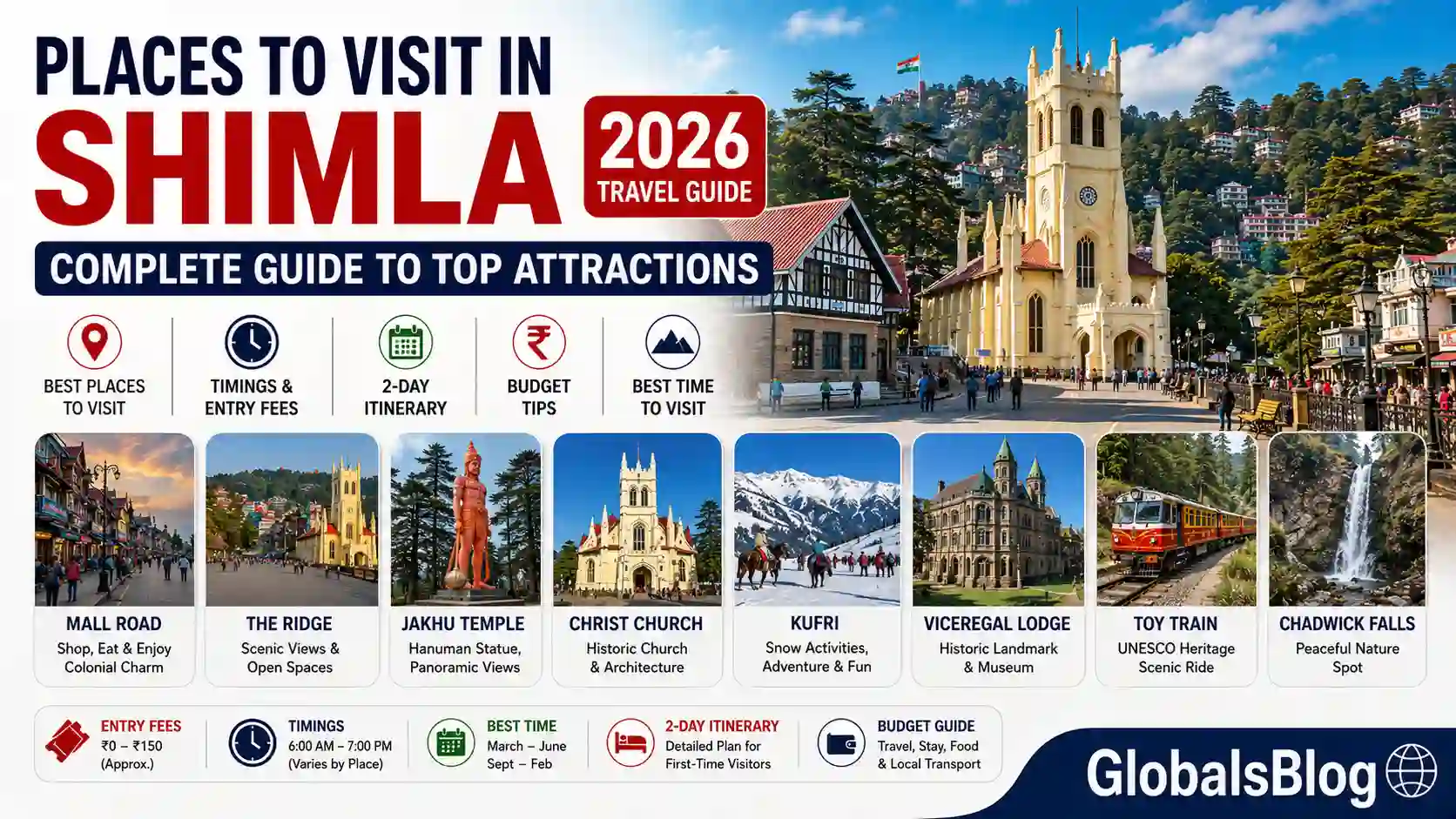
Shimla sits at 2,276 metres in the Shivalik hills of Himachal Pradesh — the former summer capital of British India, a UNESCO World Heritage toy train terminus, and north India's most iconic hill station. Mall Road's colonial promenade. Jakhu Temple's panoramic view from 2,455 metres. Kufri's winter snow. The Viceregal Lodge's Victorian grandeur. The Kalka–Shimla Toy Train's 5-hour journey through 102 tunnels. This is Shimla — and this guide covers every attraction, entry fee, timing, and travel tip for 2026.
Shimla is a must-visit destination in 2026 because it offers the perfect mix of pleasant weather, scenic views, and easy travel experiences — suiting families, couples, solo travellers, and anyone seeking a relaxed hill getaway. From Mall Road shopping and sunset views at The Ridge to snowfall in Kufri and peaceful spots like Summer Hill, Shimla fits every travel style. The "Queen of Hills" served as the summer capital of British India from 1864 to 1947 — every summer, the entire colonial government relocated from Calcutta (later Delhi) to Shimla to escape the plains heat, leaving behind a legacy of Victorian architecture, colonial bungalows, and planned promenades that define the town today. The best places to visit in Shimla include The Ridge, Mall Road, Jakhoo Temple, Christ Church, Kufri, Mashobra, Chadwick Falls, Indian Institute of Advanced Study, Naldehra, Annandale, and Lakkar Bazaar. This guide covers every major attraction with current 2026 entry fees, timings, the optimal 2- and 3-day itinerary, budget, and practical transport details — including the iconic Kalka–Shimla Toy Train that should anchor every Shimla visit.
Top places in Shimla 2026: Mall Road + The Ridge (car-free colonial promenade, Christ Church, Scandal Point, no entry fee), Jakhoo Temple (2,455m, Hanuman, ropeway ₹400 return or trek 2.5 km, city's best panoramic view), Kufri (15 km, snow December–March, Mahasu Peak pony rides, Eco Park), Viceregal Lodge/IIAS (5 km, 1888 Tudor-Elizabethan architecture, ₹50 entry), Chadwick Falls (7 km, 67m waterfall, seasonal, ₹30 entry). Toy Train: Kalka → Shimla UNESCO heritage train (5–6 hrs, ₹200–1,200). Best time: March–June (10–20°C, all attractions open) or December–February (snow, skiing at Kufri). How to reach: Delhi Kalka Shatabdi + Toy Train — see our Delhi to Chandigarh guide for the Chandigarh → Shimla connection (90 km onward). Budget: 2 days from ₹8,000–12,000 per person including travel, stay, and sightseeing.
1. The Ridge and Mall Road — The Heart of Shimla
The Ridge is the heart of Shimla — a spacious, open promenade offering panoramic views of snow-capped peaks. It is a scenic spot and a cultural hub, often hosting festivals and events. One can see colonial landmarks like Christ Church and the Gaiety Theatre from here. The Ridge is dotted with benches, horse rides, and local vendors, making it an ideal place to relax and people-watch. Lined with shops, cafés, and historic buildings, Mall Road is Shimla's main commercial street — perfect for strolls, souvenir shopping, or just soaking in the city's vibrant vibe. Vehicles aren't allowed here, which adds to the relaxing experience. The street lights up in the evenings, and musicians often play, making it feel like a festive local gathering.
| Attraction | Location | Entry Fee | Best Time | Highlights |
|---|---|---|---|---|
| The Ridge | Upper Shimla, above Mall Road | Free | Sunrise or sunset (5:30–7 PM golden hour) | Panoramic Himalayan views, Christ Church backdrop, open promenade, festival venue |
| Mall Road | Running below The Ridge | Free | Evenings 5–9 PM (most vibrant) | Colonial-era buildings, shops, cafés, Indian Coffee House (century-old), street musicians |
| Scandal Point | Junction of Mall Road and The Ridge | Free | Anytime | Historic meeting point, equestrian statue of Lala Lajpat Rai, panoramic valley views |
| Gaiety Heritage Cultural Complex | Mall Road | ₹20–50 (for events) | Check event calendar | 1887 Victorian theatre, hosts cultural performances, Himachal Pradesh's oldest theatre |
| Lakkar Bazaar | End of Mall Road | Free | Morning 10 AM–1 PM (freshest stocks) | Himachali wooden handicrafts, toys, walking sticks — best souvenir shopping in Shimla |
To reach Mall Road and The Ridge, one can use the HP Tourism elevator that links the lowest point of Shimla (Cart Road) to the highest point (the Mall) — a significant help given Shimla's steep terrain. Alternatively, walk up the steps from Cart Road. Key practical note: Shimla is a pedestrian hill town — most walking is unavoidable. Comfortable shoes are the single most important packing item for Shimla. The Ridge to Mall Road to Scandal Point is a 10–15 minute pleasant stroll on flat promenade. From Cart Road (bus drop) to Mall Road is a steep 15–20 minute walk up steps — the elevator (₹20) is recommended if carrying luggage or visiting with elderly family members.
2. Jakhoo Temple — Shimla's Sacred Summit
Jakhoo Temple is an ancient temple dedicated to the Hindu deity Hanuman, located at the highest peak in Shimla at 2,455 metres. The Jakhoo Ropeway is an aerial lift connecting Shimla's Ridge area with Jakhoo Hill — Swiss-imported cabins, covering the distance in approximately 5 minutes, operating at 8,054 feet above sea level with jaw-dropping valley views. The temple is steeped in Ramayana mythology — Hanuman is said to have rested at this spot while searching for the Sanjeevani herb to heal Lakshmana. The hilltop is dominated by a 33-metre Hanuman statue visible from across the Shimla valley.
| Detail | Information |
|---|---|
| Location | Jakhoo Hill, 2.5 km from Mall Road (by road ~5 km) |
| Altitude | 2,455 metres — highest point in Shimla |
| Ropeway fare | ₹400 return (adult). ₹300 (child). Ropeway timing: 8 AM – 8 PM |
| Trek option | 2.5 km on foot from The Ridge — steep uphill, 45–60 mins, free |
| Temple entry | Free. Open 6 AM – 12 PM and 3 PM – 9 PM |
| Monkeys | Significant monkey population — keep bags closed, avoid visible food. Don't wear sunglasses or hats (monkeys snatch) |
| Best time to visit | 6:30 AM – 8 AM (pre-crowd, peaceful, best light) or ropeway evening for valley views |
The early morning Jakhu Temple trek (6:30 AM departure) finishes before the monkey rush — complete the hike early to enjoy peaceful surroundings and panoramic city views. The ropeway experience is one of Shimla's highlights even for non-temple visitors — the 5-minute Swiss cable car ride above the cedar forest with Himalayan peaks visible in every direction is outstanding. The 33-metre Hanuman statue at the summit (one of India's largest) is visible on clear days from Shimla's Mall Road 2 km away. During the annual Dussehra festival (October), Jakhoo Temple hosts one of Himachal's most colourful processions — crowds surge to thousands and advance planning is essential.
3. Christ Church — Shimla's Colonial Landmark
Christ Church sits at the eastern end of Mall Road and is impossible to miss. The yellow neo-Gothic structure is the second-oldest church in North India and looks especially striking against a clear blue sky. Built in 1857 during British colonial rule, it is open daily for visitors with no entry fee required. The stained glass windows inside are quietly stunning — most tourists photograph the exterior and leave without exploring the interior, which is a significant miss. Best photographed in early morning or golden hour light.
| Detail | Information |
|---|---|
| Built | 1857 — British colonial era, neo-Gothic architecture |
| Distinction | Second-oldest church in North India |
| Entry fee | Free — open to all visitors (church services on Sunday mornings) |
| Timings | 8 AM – 6 PM (closed during Sunday service 10–11:30 AM) |
| Must-see inside | Five stained glass windows depicting Faith, Hope, Charity, Fortitude, and Patience — Victorian-era craftsmanship |
| Photography | Exterior permitted anytime. Interior — check with priest on duty |
| Best time | Early morning (8–10 AM) for soft light and minimal crowds, or golden hour 5–6 PM for orange-lit façade photography |
4. Kufri — Snow, Views and Family Adventures
Kufri is about 15 km from Shimla and feels like a completely different world. The road climbs steeply through deodar forests, and by the time you reach the top, the views open up in every direction. In winter, Kufri gets real snow. In summer, it's a cool escape from the already cool Shimla weather. The pony rides to Mahasu Peak are the big draw for families. Kufri is one of the best places near Shimla for snowfall — another good option for snow is Narkanda (65 km) if willing to travel farther.
| Activity/Attraction | Season | Price (approx) | Notes |
|---|---|---|---|
| Pony Ride to Mahasu Peak | Year-round | ₹400–700 (negotiable) | 30–45 min ride to summit with panoramic views — confirm price before mounting |
| Kufri Eco Park | Year-round | ₹50 entry + ₹150–400 activities | Yak rides, mini zoo, nature trails — family-friendly |
| Skiing / Snow Activities | December–March | ₹500–2,000 (+ equipment hire) | Basic skiing slopes, snow tubing, snowman making — good for beginners and families |
| Himalayan Nature Park | Year-round | ₹50 (adult) ₹25 (child) | Native Himalayan flora and fauna — snow leopard enclosure, Himalayan black bear |
| Apple orchards | August–October | Free to view | Himachal's famous apple season — orchards visible along Kufri road |
Kufri practical notes: Distance from Mall Road is 15 km by road — 30–45 minutes by private cab (₹600–800 return) or shared taxi (₹60–80 per seat from Rivoli bus stand). Shared taxis are the recommended option as parking at Kufri is extremely limited. The pony ride price is entirely negotiable — the "official" rate displayed is usually ₹700, but ₹400–500 is achievable with polite negotiation. In peak December–January snowfall, the road to Kufri can become slippery — confirm drivability before departing. Afternoon at Kufri after morning in Shimla is the recommended Day 2 itinerary — spend morning at Jakhu Temple and Shimla State Museum, afternoon at Kufri.
5. Viceregal Lodge / Indian Institute of Advanced Study (IIAS)
The Viceregal Lodge — now the Indian Institute of Advanced Study — is one of Shimla's most historically significant buildings. Built in 1888 as the summer residence of the British Viceroy of India, this massive Elizabethan-Tudor palace on Observatory Hill hosted pivotal meetings of the independence era, including the Shimla Conference of 1945 between Viceroy Wavell and Indian National Congress leaders. Every treaty, discussion, and summer governance decision of colonial India was made in this building for nearly 80 years.
| Detail | Information |
|---|---|
| Official name | Indian Institute of Advanced Study (IIAS) — research institution since 1965 |
| Location | Observatory Hill, ~5 km from Mall Road (auto ₹80–120, taxi ₹200–250) |
| Entry fee | ₹50 (Indian adult), ₹25 (child), ₹100 (foreign national) |
| Guided tours | Guided tour available (included in ticket) — 45–60 minutes, covers main hall, library, historical rooms |
| Timings | 9:30 AM – 5 PM. Closed Mondays. Photography: limited inside, permitted in gardens |
| Architecture | Elizabethan-Tudor — grey stone exterior, teak-panelled interiors, billiard room, ballroom, state dining hall |
| Botanical gardens | Surrounding terraced gardens with panoramic valley views — free to explore with entry ticket |
The Viceregal Lodge is Shimla's most underrated attraction — most day-trippers skip it in favour of Mall Road and Kufri but the guided tour through the rooms where British India's most significant political decisions were made is genuinely fascinating. The 1945 Shimla Conference room, the Viceroy's study, and the grand staircase are particular highlights. The terraced botanical gardens surrounding the lodge provide excellent Himalayan views and a quiet contrast to the commercial bustle of Mall Road.
6. Kalka–Shimla Toy Train — UNESCO World Heritage Experience
The Kalka–Shimla Railway is one of India's most iconic travel experiences and should anchor every Shimla visit. Built by the British between 1898 and 1903, the 96 km narrow-gauge railway climbs from Kalka (656 metres) to Shimla (2,076 metres) through 102 tunnels, 864 bridges, and 919 curves — an engineering feat so remarkable it was awarded UNESCO World Heritage status in 2008 as part of the "Mountain Railways of India."
| Train | Departure | Duration | Fare | Notes |
|---|---|---|---|---|
| Shivalik Deluxe Express | Kalka 5:30 AM | 5 hrs 20 min | ₹590 (AC chair) | Best morning train — arrives Shimla 10:50 AM, panoramic valley views in daylight |
| Himalayan Queen | Kalka 6:00 AM | 5 hrs 30 min | ₹590 (AC chair) | Another early morning option — arrive early afternoon |
| Rail Motor Car | Kalka 10:20 AM | 4 hrs 10 min | ₹1,220 (private glass car) | Fastest heritage service — small glass car, panoramic unobstructed views |
| Passenger train | Multiple | 6 hrs | ₹200–250 (second class) | Slowest, cheapest — stops at all 18 stations |
| Shimla → Kalka return | Multiple from Shimla | 5–6 hrs | Same as above | Return through same spectacular mountain scenery — equally worthwhile |
The toy train journey is a destination in itself — the 102 tunnels create a rhythm of dark→light→dark as the train snakes through the Shivalik hills, emerging to increasingly dramatic views as altitude increases. The tunnels were all hand-drilled by Indian workers between 1898–1903 using nothing but hand tools and dynamite. The highest point of the journey (Shimla station at 2,076m) is reached through the final dramatic approach over the Shivalik ridge. Booking: irctc.co.in well in advance for morning departures which sell out quickly in peak season. Alternatively, take the Delhi Shatabdi to Kalka (3.5 hrs from Delhi, ₹700–900) and connect directly to the toy train for the complete Delhi→Kalka→Shimla journey. See our Delhi to Chandigarh guide for the road alternative if the toy train is fully booked.
7. Chadwick Falls, Naldehra, and Beyond Shimla
Chadwick Falls at 67 metres is Shimla's tallest accessible waterfall — a hidden gem that most Mall Road visitors miss entirely. Located 7 km from central Shimla in a dense forest area of Summer Hill, the falls require a 1.5 km forest walk from the road entry point. The falls are at their most powerful during and after monsoon (July–September) — in summer (April–June) the flow is lighter but the forest walk is more pleasant. Entry ₹30. Cab from Mall Road: ₹300–400 return. Best combined with Summer Hill village (a quiet suburb of Shimla known as Gandhi's preferred retreat during the independence movement — Mahatma Gandhi stayed at the local university guesthouse during Shimla Conferences). Chadwick Falls is a good afternoon option on Day 2 after the morning Jakhu Temple visit.
Naldehra, 23 km from Shimla, hosts the oldest golf course in India — established by Viceroy Lord Curzon in 1905, the 9-hole course sits at 2,255 metres surrounded by cedar and oak forest with Himalayan peaks visible beyond the fairways. Even non-golfers find Naldehra exceptional — the Shaly Pathar meadow adjacent to the golf course is one of the most peaceful open-air viewpoints in Himachal Pradesh, with sweeping 180° Himalayan views. The Naldehra fair (June) is one of Himachal's most colourful Himachali folk festivals with traditional dance, music, and horse shows. No entry fee for the meadow. Golf: ₹800–1,200 per round including equipment hire. Cab from Shimla: ₹1,200–1,500 return. Naldehra combined with Kufri in a single day trip is possible but tight — Naldehra for morning views + Kufri for afternoon is the recommended sequence on a 3-day itinerary.
The Himachal State Museum on the Mall Road is Shimla's most culturally substantial indoor experience — housing a comprehensive collection of Himachali miniature paintings, sculptures, folk arts, colonial photographs, weapons, jewelry, and textiles spanning 2,000+ years. The museum's colonial photography collection (British Raj era Shimla — viceroys, garrisons, early Mall Road) is historically fascinating and provides context for every colonial building you'll encounter in Shimla. Entry ₹10 (Indian), ₹100 (foreign). Open Tuesday–Sunday 10 AM – 5 PM. Closed Mondays and gazetted holidays. Photography: permitted in general galleries, restricted in specific sections. The museum is best visited mid-morning (10:30–12:30) after the Jakhu Temple early morning trek — it provides a cool, air-conditioned contrast to the outdoor morning activities.
Shimla 2-Day and 3-Day Itinerary 2026
| Time | Activity | Notes |
|---|---|---|
| Day 1 — Arrive + Mall Road + Jakhoo + Ridge | ||
| Arrive noon | Check in, rest if overnight journey | Take the HP Tourism elevator from Cart Road to Mall Road (₹20) if carrying luggage |
| 2 PM | Mall Road walk + Lakkar Bazaar shopping | Souvenir shopping — wooden items, Himachali shawls, walking sticks |
| 4 PM | The Ridge + Christ Church | Evening light on Christ Church façade is the best time for photos (golden hour ~5:30–6:30 PM) |
| 6 PM | Scandal Point + Indian Coffee House | Colonial café since 1936, ₹100–200 for snacks and coffee |
| Evening | Dinner on Mall Road | Multiple cuisine options ₹300–800 per person |
| Day 2 — Jakhu Temple + Museum + Kufri | ||
| 6:30 AM | Jakhu Temple trek (early, pre-monkey) | 2.5 km uphill, 45–60 mins, best views and fewest people at this hour |
| 9:30 AM | Himachal State Museum | ₹10 entry, 10 AM open — arrive at opening for empty galleries |
| 11:30 AM | Viceregal Lodge | ₹50 entry + guided tour (45 mins) — book cab from museum ₹200 |
| 2 PM | Kufri (half day) | Private cab ₹600–800 return (15 km, 30 min). Pony ride + Eco Park + views |
| Evening | Return to Mall Road | Shimla's evening buzz peaks 6–9 PM |
| Day 3 (Extended) — Naldehra + Chadwick Falls or Toy Train Return | ||
| 8 AM | Naldehra | Cab ₹1,200–1,500 return. Shaly Pathar meadow + golf course views |
| 1 PM | Chadwick Falls + Summer Hill | 7 km, ₹30 entry, forest walk 1.5 km — afternoon after Naldehra |
| Evening/Next day | Kalka–Shimla Toy Train return | Book well in advance — early departures sell out in peak season |
Shimla Travel Budget — Per Person 2026
| Category | Budget | Mid-range | Premium |
|---|---|---|---|
| Accommodation per night | ₹700–1,500 (guesthouse/hostel) | ₹2,500–6,000 (hotel) | ₹12,000–40,000 (heritage hotel/resort) |
| Food per day | ₹300–500 (dhabas/bakeries) | ₹700–1,500 (restaurants) | ₹2,000+ (hotel dining) |
| Local transport per day | ₹200–400 (shared taxi) | ₹600–1,200 (private cab) | ₹2,000–3,000 (dedicated cab) |
| Sightseeing (2 days) | ₹500–800 (mostly free sites) | ₹1,000–1,500 (ropeway + Kufri + entries) | ₹3,000+ (guided tours, golf) |
| Toy Train (Kalka→Shimla) | ₹200 (second class) | ₹590 (AC chair) | ₹1,220 (Rail Motor Car) |
| Total 2 days (ex-Delhi transport) | ₹4,000–6,000 | ₹10,000–18,000 | ₹35,000+ |
Best Time to Visit Shimla 2026
| Season | Months | Temperature | What to Expect | Crowds |
|---|---|---|---|---|
| Spring / Summer | March–June | 10–22°C day, 5–10°C night | All attractions open, pleasant walking, rhododendrons blooming — best overall | High (peak) — book 2–3 weeks ahead |
| Monsoon | July–September | 15–20°C, heavy rain | Green, misty Shimla — fog and rain daily, landslide risk on mountain roads, Chadwick Falls at peak flow | Lower — budget accommodation available |
| Autumn | October–November | 5–15°C day, 0–5°C night | Clear skies, apple harvest, Dussehra festival (October), excellent visibility — best photography season | Medium — excellent shoulder option |
| Winter | December–February | -5 to 5°C day, -10°C night | Snow in Shimla town (December–January), skiing at Kufri, Christmas/New Year is peak crowded | Very high (Dec 24 – Jan 2 peak) |
The best time to explore Shimla is from March to June for pleasant weather and September to November for clear views and fewer crowds. Summer rates in Shimla are noticeably higher than offseason — budget roughly 30–50% more than the rates you might find in November–February for equivalent properties.
How to Reach Shimla
| Mode | From | Route | Duration | Cost |
|---|---|---|---|---|
| Toy Train + Shatabdi | Delhi | Delhi → Kalka (Shatabdi, 3.5 hrs) → Kalka → Shimla (Toy Train, 5–6 hrs) | 9–10 hrs total | ₹900–1,800 total |
| Bus | Delhi | HRTC overnight bus Delhi → Shimla direct | 10–12 hrs | ₹600–1,200 |
| Bus | Chandigarh | HRTC from Sector 43 ISBT → Shimla (90 km) | 2.5–3 hrs | ₹280–350 |
| Self-drive | Delhi | NH44 → NH5 via Chandigarh → Solan → Shimla (~380 km) | 7–8 hrs | Fuel ₹1,800–2,500 + toll |
| Flight | Delhi/Mumbai | Jubbarhatti Airport (22 km from Shimla) — very small, seasonal, frequent cancellations | 1 hr + 45 min cab | ₹3,000–8,000 (unreliable) |
The recommended route from Delhi: Take the Kalka Mail or Shatabdi to Kalka, then connect directly to the Toy Train for the most memorable Shimla arrival. From Chandigarh, the 90 km road to Shimla (NH5) is one of Himachal's most scenic drives — entirely feasible as a 2.5-hour connection after a Delhi → Chandigarh bus or train. See our Delhi to Chandigarh guide for complete fare and timing details for that leg.
Shimla Travel Tips 2026 — What Most Guides Miss
- Book accommodation near Mall Road — not "near Shimla": Shimla is a vertical hill town — being "in Shimla" can mean Cart Road (bottom, accessible by vehicle) or Mall Road (top, pedestrian only, 15–20 min steep walk from parking). Hotels near Mall Road are worth paying a premium for — you'll walk less and have immediate access to the best evening atmosphere. Hotels at Cart Road or lower Shimla require climbing steps every time you want to visit the Ridge or Christ Church
- Skipping Naldehra and Kufri and staying only on Mall Road for two days misses most of what makes Shimla worthwhile: Even one day trip — Naldehra, or Kufri and Narkanda combined — transforms the trip significantly. Mall Road is essential but it is the introduction to Shimla, not its full story.
- Monkey protocol at Jakhu is essential knowledge: The Jakhu hill and temple area has a very large and bold Rhesus macaque population. Keep all bags zipped. Do not carry visible food. Remove sunglasses before the trek (monkeys snatch). Do not make eye contact or smile (shows teeth = threat signal). If a monkey approaches, stand still and do not run. Temple staff will assist if a monkey is particularly aggressive. This is not alarmist — the Jakhu monkeys are Shimla's most consistent tourist challenge and forewarned visitors handle it fine
- Summer (May–June) weekend crowds at Kufri are extreme: Kufri on a Saturday or Sunday in May is essentially gridlocked — the single-lane road to Kufri backs up for 2–3 km from Shimla. Visit Kufri on a weekday morning (8–10 AM) for a dramatically better experience. Friday and Monday are often acceptable alternatives if weekday is impossible. Avoid Sunday afternoons entirely — it is the worst single time to visit any Shimla attraction
- Carry cash for all Shimla activities: Mall Road shops have good UPI acceptance. Kufri pony rides, Jakhu ropeway, Himachal Museum entry, and Viceregal Lodge tickets all typically require cash. Carry ₹2,000–3,000 cash per person per day. ATMs on Mall Road: SBI, HDFC, PNB
- Sunscreen for Shimla — more important than most visitors expect: Shimla at 2,276m (and Kufri at 2,600m, Jakhu at 2,455m) exposes visitors to significantly higher UV intensity than Delhi. The pleasant temperature (15–20°C) masks sun intensity — severe sunburn can occur in 45–60 minutes at these altitudes without SPF. See our Plum SPF 50 PA++++ guide for the best mountain sunscreen
Mall Road at Sunset. Jakhu at Dawn. Kufri in Winter Snow. Viceregal Lodge for History. Toy Train for the Journey Itself. Shimla Earns Its Title — Queen of Hills.
From Mall Road shopping and sunset views at The Ridge to snowfall in Kufri and peaceful spots like Summer Hill, Shimla fits every travel style — families, couples, solo travellers, and anyone seeking a relaxed hill getaway. The 1857 Christ Church at golden hour, the Jakhu Temple ropeway above the cedar forest, the Kalka–Shimla Toy Train through 102 tunnels — Shimla delivers experiences that feel irreplaceable rather than merely pleasant. Come in summer for the walking weather, October for the clarity, December for the snow. Stay near Mall Road, arrive at Jakhu before 7:30 AM, skip Kufri on Sunday afternoons, take the Toy Train at least one direction, and pack sunscreen. Shimla rewards well-prepared visitors with memories that remain long after the hill fog has cleared.
Top places to visit in Shimla 2026: The Ridge and Mall Road (car-free colonial promenade, panoramic views, free), Christ Church (1857, second-oldest church in North India, neo-Gothic, free), Jakhoo Temple (2,455m, Hanuman, ropeway ₹400 return or 2.5 km trek, best panoramic view in Shimla), Kufri (15 km, snow December–March, pony rides to Mahasu Peak ₹400–700, Eco Park ₹50), Indian Institute of Advanced Study/Viceregal Lodge (1888 Tudor-Elizabethan, ₹50 entry, guided tours), Himachal State Museum (Mall Road area, ₹10 entry, Himachali art and colonial photographs), Chadwick Falls (7 km, 67m waterfall, ₹30 entry, seasonal), Naldehra (23 km, India's oldest golf course, mountain meadows), Lakkar Bazaar (wooden handicrafts, Himachali souvenirs), Kalka–Shimla Toy Train (UNESCO Heritage, 5–6 hrs, ₹200–1,220). Best time: March–June or October–November.
Best time to visit Shimla (2026): March to June — pleasant 10–22°C, all attractions open, rhododendrons blooming, most popular season (book accommodation 2–3 weeks ahead, prices 30–50% higher than offseason). October to November — clear skies, apple harvest, excellent Himalayan views, fewer crowds than summer, cooler 5–15°C (good photographic conditions). December to February — snow in Shimla town (especially December–January), skiing at Kufri, Christmas/New Year extremely crowded and expensive. July to September — monsoon, heavy daily rainfall, Chadwick Falls at peak flow, some landslide risk on mountain roads, fewer tourists and lower prices. Most travellers prefer March–June for the best weather + open attractions combination. Avoid Shimla on long weekends (Republic Day, Holi, Diwali) when it gets extremely crowded — accommodation books up weeks ahead.
Yes, 2 days are sufficient to cover Shimla's main attractions comfortably. The standard 2-day itinerary: Day 1 — Mall Road, The Ridge, Christ Church, Scandal Point, Lakkar Bazaar shopping, evening on Mall Road. Day 2 — Early morning Jakhoo Temple trek (6:30 AM, best views, fewer monkeys), Himachal State Museum (10 AM), Viceregal Lodge, afternoon at Kufri. Optional Day 3 extension: Naldehra (23 km, India's oldest golf course) + Chadwick Falls (7 km, 67m waterfall). The Kalka–Shimla Toy Train journey (5–6 hours) is a destination experience in itself and best used as the arrival or departure transport rather than a day trip. 3 days is ideal for a relaxed visit covering all major attractions without rushing. 4 days allows day trips to Narkanda (65 km, more snow) and Chail (45 km, palace hotel and forest).
Jakhoo Temple ropeway price (2026): ₹400 return (adult), ₹300 (child). Ropeway timing: 8 AM to 8 PM daily. The ropeway covers the distance from the Ridge area to Jakhoo Hill (2,455m) in approximately 5 minutes in Swiss-imported cable cars — at 8,054 feet above sea level with panoramic views of the Shimla valley, Himalayan peaks, and dense cedar forests below. The alternative is the 2.5 km uphill trek from The Ridge (45–60 minutes, free, moderately steep). The early morning trek (6:30 AM start) is recommended to avoid crowds and the most aggressive monkey activity, which intensifies after 9 AM when tourist numbers increase. The ropeway is the more comfortable option for families, elderly visitors, and those who want the views without the physical effort. Temple entry itself is free — the ropeway is the only cost.
Getting from Delhi to Shimla (2026 options): Best route — Delhi Shatabdi to Kalka (3.5 hours, ₹700–900 AC chair from New Delhi station) + Kalka–Shimla UNESCO Toy Train (5–6 hours, ₹200–1,220 depending on class) — total 9–10 hours, the most memorable combination. Bus — HRTC overnight direct bus Delhi → Shimla (~10–12 hours, ₹600–1,200, book at hrtchp.com). Via Chandigarh — Delhi to Chandigarh by bus (HRTC ₹570, 4–5 hours) then HRTC bus Chandigarh Sector 43 ISBT → Shimla (90 km, 2.5–3 hours, ₹280–350) — good if combining Chandigarh sightseeing. Self-drive — Delhi → NH44 → NH5 via Chandigarh → Solan → Shimla, ~380 km, 7–8 hours. Flight to Jubbarhatti Airport (22 km, extremely small, frequent weather cancellations — not recommended as primary mode). Total distance Delhi to Shimla: approximately 380 km by road.
Kufri from Shimla: Distance 15 km by road (30–45 min drive). There is no single entry fee for Kufri as it is a hill area, not an enclosed park — individual attractions charge separately: Kufri Eco Park ₹50 (adult), Himalayan Nature Park ₹50 (adult) ₹25 (child). Activity costs: pony ride to Mahasu Peak ₹400–700 (negotiate before mounting), snow activities in winter ₹500–2,000. Transport from Shimla: private cab ₹600–800 return (recommended as parking at Kufri is very limited), or shared taxi from Rivoli Bus Stand ₹60–80 per seat. Best time to visit Kufri: December–March for snow activities; year-round for views and nature park. Avoid Sunday afternoons in peak season (May, June, long weekends) — the single-lane road to Kufri backs up severely. Weekday mornings are significantly better. Snow in Kufri: December to February/March. Kufri typically receives more snow than Shimla town due to higher altitude (~2,600m vs 2,276m).
Reader Experiences