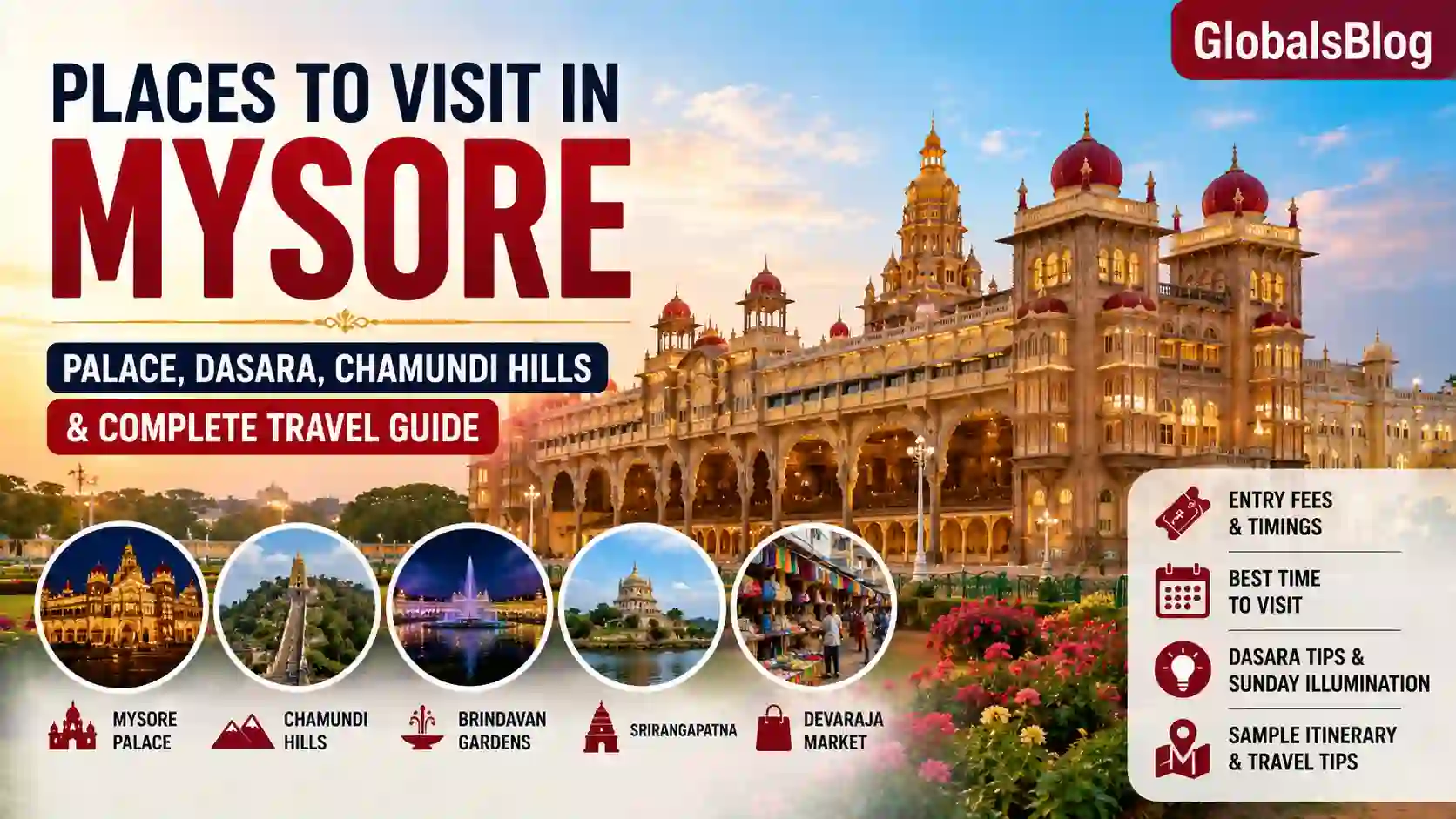
Mysore Palace is illuminated by nearly 100,000 light bulbs every Sunday evening and on festival days. The Mysore Dasara procession — 10 days, an elephant carrying a golden howdah, and the entire city in celebration — is Karnataka's most spectacular annual event. And the city's food, silk, incense, and sandalwood industries have been running for centuries.
A reader from Bengaluru described Mysore as "the city I kept meaning to visit for eight years and finally did in three hours on a day trip — which is why I don't actually know Mysore." She had seen the palace exterior, eaten at a restaurant on Sayyaji Rao Road, and driven back. A second visit — staying overnight, attending the Sunday evening palace illumination, visiting the Chamundi Hills at dawn, spending a morning in the Devaraja Market, taking the morning train to Srirangapatna, and eating at Hotel RRR for the complete Mysore thali — produced a city she described as "completely different from the tourist-palace version I had skimmed the first time." This guide covers what Mysore actually offers, at the pace it deserves.
Best places to visit in Mysore: Mysore Palace (open daily, entry ₹70 Indians — illuminated Sunday evenings and holidays with 97,000 bulbs), Chamundi Hills (Sri Chamundeshwari Temple, 1,001 steps, panoramic city view), Brindavan Gardens (6km from Mysore, musical fountain evening show, ₹100), Mysuru Zoo (one of India's best zoos, ₹100 Indians), Jaganmohan Palace Art Gallery (₹50, India's second-oldest museum), Srirangapatna (15km, Tipu Sultan's island capital), Devaraja Market (flower market, incense, sandalwood, spices). Best time: October–March and especially October for Dasara. How to reach: 2.5 hours from Bengaluru by road, 3 hours by Shatabdi Express train.
Best Places to Visit in Mysore
Mysore Palace — officially Amba Vilas Palace — is the most visited monument in India after the Taj Mahal, and the claim is easily justified by the building. The current palace was built between 1897 and 1912 by the Maharaja of Mysore after the previous wooden palace burned down — designed by British architect Henry Irwin in the Indo-Saracenic style, blending Hindu, Islamic, Rajput, and Gothic elements in a cream-coloured granite exterior with rose marble domes. The interior is the extraordinary part: the Diwan-i-Am (Public Hall) with its cast-iron pillars from Glasgow, the Kalyana Mantapa (Wedding Hall) with a stained-glass ceiling of peacocks, the Dasara procession paintings in the corridor (the finest documentary painting of a royal ceremony in south India), and the golden throne (Ratna Simhasana) displayed during Dasara are collectively among the finest royal interiors in India.
The Sunday evening illumination — 97,000 light bulbs switched on simultaneously at 7pm — is the most famous single Mysore experience. The palace lit in warm yellow against the evening sky, reflected in the courtyard pools, draws enormous crowds but is genuinely worth the crowd. If visiting on a Sunday, plan dinner nearby and return by 6:45pm for the best viewing position. The palace grounds also contain the Jaganmohan Palace, the Residency, and smaller temples within the complex. Allow a minimum of 2 hours for the main palace interior.
Chamundi Hills rises 1,062 metres above sea level, 13km from Mysore's city centre, and carries the Sri Chamundeshwari Temple at its summit — the family deity of the Mysore royal family and one of Karnataka's most important Shakti shrines. The 1,001 stone steps that ascend from the base of the hill are a traditional pilgrimage route — passing the Nandi bull statue (carved from a single boulder at the 800th step, one of the largest Nandis in India at 5 metres tall) on the way up. Most visitors drive to the top and walk the last section; devoted pilgrims climb the full 1,001 steps, particularly on Ashtami days when the hill is crowded with devotees.
The view from Chamundi Hills summit is the finest aerial view of Mysore available — the city spread below in the early morning light with the palace visible at the centre and the surrounding farmland extending toward the horizon. Dawn is the recommended time: the light is extraordinary, the crowds are minimal, and the temple opens at 7:30am for the first puja of the day. The Chamundi Hills road also passes through the Maharashtra and Karanataka border of the Chamundi Wildlife Sanctuary — langurs and peacocks are regularly seen on the road.
Brindavan Gardens is one of India's most famous botanical gardens — a terraced garden at the base of the Krishnarajasagara Dam on the Kaveri River, 19km from Mysore. The garden was designed in the 1930s in the style of Italian terrace gardens, with fountains, flower beds, topiary, and illuminated pathways that run down to the reservoir edge. The Krishnarajasagara Dam (KRS Dam) beside the gardens is one of India's significant early 20th-century irrigation projects — built between 1909 and 1932, the dam created a massive reservoir that enabled Karnataka's Cauvery basin agricultural transformation. The garden's evening musical fountain show (Carnatic classical music synchronized with coloured fountain jets) is the primary reason most visitors come — a genuinely pleasant 30-minute spectacle that works best when arriving at the garden at 4pm, exploring the terraces in the golden hour light, and staying for the 7pm show before returning to Mysore.
Mysuru Zoo — established in 1892 and covering 157 acres adjacent to the palace — is consistently rated one of the best-maintained zoos in India. The zoo originated as the private collection of the Mysore royal family and was opened to the public in 1902. The collection includes white tigers (among the finest specimens in India), African elephants (one of the few Indian zoos with this species), gorillas, hippopotamus, Nile crocodiles, flamingos, and the full spectrum of Indian wildlife including Royal Bengal tigers, Indian elephants, sloth bears, and gharials. The enclosures are spacious by Indian zoo standards and the landscaping maintains the original garden character of the royal collection. Visit on a weekday morning when crowds are manageable and animals are active in the cooler temperature. Children and families find the Mysore Zoo a complete half-day experience independent of the palace. The zoo is located adjacent to the palace complex — both can be covered in the same morning.
Srirangapatna is a small island town on the Cauvery River, 15km from Mysore, that served as the capital of Tipu Sultan's Mysore Kingdom until his defeat and death in 1799. The island fortress — besieged and conquered by British forces under Arthur Wellesley (later Duke of Wellington) in the Fourth Anglo-Mysore War — is one of the most historically significant sites in South India. Tipu Sultan's summer palace (Daria Daulat Bagh, meaning "Wealth of the Sea") is the finest surviving palace of his reign — a wooden palace with exquisite teak columns and murals depicting the Battle of Pollilur (Tipu's 1780 victory over the British) on the western corridor. The Gumbaz is Tipu Sultan's mausoleum alongside his father Hyder Ali — a simple, dignified domed structure in a garden of cypress trees. The Ranganathaswamy Temple (dedicated to Vishnu as Ranganatha) is one of the most important Vaishnavite shrines in Karnataka and predates Tipu's kingdom by centuries. The entire Srirangapatna complex can be covered in a comfortable half-day and makes the most natural day-trip extension from Mysore.
Devaraja Market is Mysore's main municipal market — a covered market dating to the 19th century that sells everything from fresh jasmine flowers to sandalwood oil, from silk sarees to spices, from vegetables to the famous Mysore incense. The flower section is the most visually spectacular — rows of marigold garlands, jasmine strings, and rose petals piled in vivid orange, yellow, and white, tended by women flower sellers who have occupied the same stalls for generations. The sandalwood and incense section is where Mysore's most famous products are concentrated — the Karnataka Soaps and Detergents Limited (KSDL) government sandalwood soap and incense stalls sell authentic Mysore sandalwood at official prices, avoiding the tourist markup of shops near the palace. The morning visit (7–9am) catches the flower sellers at their most active before the day's temple demand depletes the stocks. The market is the most genuinely local experience available in Mysore.
The Jaganmohan Palace was the royal family's residence before the current palace was built, and now serves as an art gallery housing one of India's most significant collections of South Indian classical painting. The collection's highlights: original paintings by Raja Ravi Varma (the 19th-century artist who created the modern visual vocabulary of Hindu mythology, producing the oil paintings of goddesses that defined how India visualised its deities), the Mysore school of miniature painting (a distinct tradition that evolved under Wadiyar patronage with its characteristic gold embossed detailing), traditional Carnatic musical instruments of the royal court, and ornate carved ivory and sandalwood artifacts. The palace building itself — built in 1861 — is an elegant example of late Wadiyar-period architecture. Significantly less crowded than the main Mysore Palace, the Jaganmohan Gallery is an absorbing 1.5-hour visit for those interested in South Indian art history. Entry is included in some combined Mysore Palace tickets — confirm at the main palace counter.
Karanji Lake Nature Park is a 90-acre urban wetland adjacent to the Mysuru Zoo, developed as a bird sanctuary around an existing irrigation lake. The lake hosts over 150 bird species including winter migratory visitors — painted storks, spot-billed pelicans, open-bill storks, purple moorhens, and various heron species are regularly visible. A butterfly park within the enclosure has over 40 butterfly species. The lake walk circuit (approximately 2km around the perimeter) takes 45–60 minutes and is pleasant in the morning. Combined with the zoo (adjacent entry), Karanji Lake makes a complete 3-hour morning at the palace complex end of Mysore, within walking distance of the palace gates.
Mysore Tourist Places — Quick Reference
| Place | Distance | Entry | Best Time | Don't Miss |
|---|---|---|---|---|
| Mysore Palace | City centre | ₹70 (Indians) | Morning + Sunday 7pm illumination | Diwan-i-Am, Kalyana Mantapa, Dasara paintings |
| Chamundi Hills | 13km | Temple free | Dawn 6am | 1,001 steps, Nandi bull, city view |
| Brindavan Gardens | 19km | ₹100–150 | 4pm + 7pm show | Musical fountain evening show |
| Mysuru Zoo | City centre | ₹100 | Morning weekday | White tigers, African elephants |
| Srirangapatna | 15km | ₹25 + free | Morning | Daria Daulat Bagh, Gumbaz, Ranganathaswamy |
| Devaraja Market | City centre | Free | 7am–9am or 4–6pm | Flower sellers, sandalwood, incense |
| Jaganmohan Gallery | City centre | ₹50 | Morning | Raja Ravi Varma originals, Mysore miniatures |
| Karanji Lake | City centre | ₹30 | 8:30–10:30am | Painted storks, migratory birds, butterfly park |
Mysore Dasara — Karnataka's Most Spectacular Festival
Mysore Dasara (Navarathri) is the most famous festival in Karnataka and one of the grandest in India — a 10-day celebration (typically in October) culminating in the Vijayadasami procession on the final day. The procession features the golden idol of Goddess Chamundeshwari carried on a decorated elephant with a golden howdah (sedan) through the illuminated city streets, accompanied by tableaux, musicians, and the armed forces. The procession route (from the palace to the Bannimantap grounds) attracts over a million spectators and is broadcast nationally.
During Dasara: Mysore Palace is illuminated every evening for the 10-day period; the palace grounds host cultural performances, exhibitions, and food festivals; Chamundi Hills sees continuous pilgrimage; and the city's hotels book out months in advance. If Dasara timing aligns with your Mysore visit, it is the most rewarding time to be in the city. If it does not, the palace illumination every Sunday evening is available year-round as a substitute for the Dasara spectacle.
Mysore Itinerary — 1 Day and 2 Days
1-Day Mysore Itinerary (recommended sequence):
6:00am: Devaraja Market flower section (30 minutes — freshest flowers, minimal crowds). 7:00am: Drive to Chamundi Hills for dawn view and temple (1 hour). 9:00am: Return, breakfast at Hotel Mylari (famous Mysore masala dosa). 10:00am: Mysore Palace — full interior visit (2 hours). 12:30pm: Zoo (adjacent to palace) — if travelling with family (2 hours). 12:30pm: Jaganmohan Art Gallery — if art-focused (1.5 hours). 2:00pm: Lunch at Hotel RRR (complete Mysore thali, ₹80–100). 3:30pm: Srirangapatna (15km) — Daria Daulat Bagh and Gumbaz (2 hours). 6:00pm: Return to Mysore. 7:00pm: Palace illumination (Sunday only). 7:30pm: Dinner on Sayyaji Rao Road.
2-Day Mysore Itinerary:
Day 1: Full Mysore city circuit as above. Day 2: Early morning — Karanji Lake birding (8:30–10:30am). 11am: Brindavan Gardens + KRS Dam (19km, 1 hour drive). 1pm: Lunch near garden. 2pm: Return to Mysore via Srirangapatna (alternate route). 4pm: Shopping — Mysore silk (Government Silk Factory showroom, Mananthody Road — only place for genuine GI-tagged Mysore silk at fixed prices), sandalwood soap (KSDL government store). 7pm: Musical fountain at Brindavan (alternate: palace illumination if Sunday). Return to Bengaluru or extend.
How to Reach Mysore
| Mode | From | Duration | Cost | Notes |
|---|---|---|---|---|
| Train | Bengaluru (KSR) | 2.5–3 hrs | ₹80–250 | Shatabdi Express — most comfortable, book ahead |
| Road / Bus | Bengaluru | 2.5–3 hrs | ₹150–300 (KSRTC AC) | KSRTC AC Volvo from Majestic Bus Stand — frequent |
| Self-drive | Bengaluru | 2.5 hrs | Fuel ₹600–700 | NH275 — 4-lane expressway most of the way, easy drive |
| Cab | Bengaluru | 2.5 hrs | ₹2,500–3,500 one way | Convenient for families, drop-off at palace directly |
| Bus | Chennai | 7–8 hrs | ₹400–800 | Overnight buses available, KSRTC and private |
| Train | Chennai | 7–8 hrs | ₹200–600 | Chennai–Mysore Express via Salem |
The Bengaluru–Mysore Shatabdi Express is the most convenient public transport option — departs KSR Bengaluru at 11am, arrives Mysore by 1:30pm (approximately), giving an afternoon for the palace and zoo before returning on the evening Shatabdi. The NH275 expressway makes self-driving comfortable — the road is mostly 4-lane and the drive through the Cauvery basin rice fields and sugarcane country is pleasant. The 150km distance makes Mysore accessible as a day trip from Bengaluru but it is significantly better as an overnight stay, particularly if the Sunday palace illumination or Brindavan Gardens evening show is part of the plan.
✓ Mysore Travel Tips
- Sunday evening palace illumination is the defining Mysore experience: Plan any Mysore visit around arriving by Saturday evening or Sunday morning to ensure you are in the city for the 7pm Sunday illumination. The palace lit by 97,000 bulbs is a completely different experience from the daytime visit — arrive by 6:30pm for a good position in the palace grounds. Dasara evenings (10 days in October) offer the same illumination nightly
- Buy Mysore silk and sandalwood only from government sources: Mysore silk (GI-tagged, made at the Government Silk Weaving Factory on Mananthody Road) and Mysore sandalwood soap (KSDL, available at government stores and the factory shop near Cauvery Handicrafts Emporium) are genuine. Private shops near the palace sell "Mysore silk" that is often polyester-silk blends at genuine silk prices. Government fixed-price stores are the only reliable source
- The Government Silk Factory tour is free and excellent: The Mysore Government Silk Weaving Factory (10am–4pm, closed Sundays) offers free tours of the entire handloom silk weaving process — from thread to finished saree — in a working factory that has operated since 1912. The factory store sells genuine Mysore silk at government fixed prices (₹2,500–1,00,000+ depending on zari content). The tour takes 30–45 minutes and is the most educationally substantive experience in Mysore after the palace
- Hotel RRR for the complete Mysore thali experience: Hotel RRR on T Narasipura Road serves the most authentic and generous Mysore-style South Indian thali in the city — unlimited rice, three curries, rasam, sambar, payasam, and papad for ₹80–100 served on a banana leaf. This is the meal that defines Mysore food culture and the price-to-quality ratio is extraordinary by any standard. Queue outside at 1pm on weekdays
- Dasara hotel booking — 3–4 months in advance: If visiting during Dasara (October), Mysore hotels within 10km of the palace are booked out 3–4 months ahead. Even budget guesthouses charge 3–4x normal rates. Book accommodation and the train/bus from Bengaluru as soon as Dasara dates are announced (typically confirmed by August of the same year)
- See our Munnar guide for a comparable South India heritage destination, and our Kerala complete guide for extending a Mysore trip southward
✗ Mysore Mistakes to Avoid
- Coming for a day trip and skipping Sunday illumination: Mysore as a 4-hour palace visit is a fraction of what the city offers. If Sunday timing is possible, the palace illumination alone justifies the overnight stay over a same-day return to Bengaluru
- Buying silk and sandalwood products from palace-area shops: The shops on Sayyaji Rao Road and near the palace gates selling "genuine Mysore silk" and sandalwood products are rarely selling the authentic GI-tagged product at a fair price. The Government Silk Factory store and KSDL government store remove both the authenticity uncertainty and the price negotiation stress
- Skipping Srirangapatna because it is "just a fort": Srirangapatna is one of the most historically consequential sites in South India — the location where the 1799 Siege of Seringapatam effectively ended Tipu Sultan's resistance to British colonial expansion. The Daria Daulat Bagh paintings (the western wall murals depicting the Battle of Pollilur) are extraordinary documentary art. 15km is not a meaningful distance on the Mysore road
- Missing the Chamundi Hills dawn: Chamundi Hills at 9am with tour groups on the steps is a different experience from Chamundi Hills at 6am with early pilgrims, mist in the valley below, and the 1,001 steps in the pre-sunrise quiet. The auto ride from the city takes 30 minutes and the early departure is the only significant effort required
⚠️ Disclaimer: Mysore Palace entry fees, illumination schedule, and Dasara festival dates change annually. Entry fees listed are as of August 2026. The palace illumination operates on Sundays and state holidays — verify the current schedule at the palace ticket counter or through the Karnataka Tourism website before planning around the illumination. Dasara dates vary by the Hindu calendar year — confirm each year's dates through Karnataka Tourism.
Palace in the Morning. Chamundi Hills at Dawn. Srirangapatna by Afternoon. Devaraja Market at Dusk. Sunday Illumination at 7pm. Mysore Deserves Two Days — Not Four Hours.
Mysore is the most underestimated major destination in South India — a city that most Bengalureans treat as a day trip and most non-Karnataka visitors skip entirely in favour of the more marketed Kerala or Rajasthan itineraries. What they miss: a royal palace that hosts 6 million visitors annually for a reason, a market where sandalwood incense has been made for centuries, a silk weaving tradition with a government factory open to free tours, a fort city 15 kilometres away where one of India's most significant colonial-era battles was fought, and an annual festival that turns the entire city into a spectacle for 10 days. Two days covers it comfortably. One day, timed correctly around a Sunday evening, is the minimum for understanding what makes Mysore worth the 2.5-hour drive from Bengaluru.
Best places to visit in Mysore: Mysore Palace / Amba Vilas Palace (₹70 Indians, 10am–5:30pm — most visited monument after Taj Mahal, illuminated with 97,000 bulbs Sunday 7pm), Chamundi Hills (13km, Sri Chamundeshwari Temple, 1,001 steps, panoramic city view — best at dawn), Brindavan Gardens (19km, ₹100, evening musical fountain show 7pm), Mysuru Zoo (₹100, 157 acres, white tigers and African elephants, one of India's best zoos), Srirangapatna (15km, Tipu Sultan's fort capital, Daria Daulat Bagh palace paintings, Gumbaz mausoleum), Devaraja Market (free, best morning — flowers, sandalwood, incense, Mysore silk), Jaganmohan Palace Art Gallery (₹50, Raja Ravi Varma originals, Mysore miniatures), and Karanji Lake Nature Park (₹30, 150+ bird species, adjacent to zoo).
Mysore Palace entry fee (2026): ₹70 for Indian adults, ₹200 for foreign nationals, children under 10 free. Camera fee ₹50 (still), ₹150 (video). Timings: 10:00 AM to 5:30 PM daily. The palace is illuminated with 97,000 bulbs every Sunday from 7:00 PM to 7:45 PM and on all state and national holidays — this is free to view from the palace grounds (no extra entry fee). During Mysore Dasara (10 days in October), the palace is illuminated every evening. Dress code: shorts and sleeveless tops are not permitted inside the palace — women should carry a dupatta or shawl. Audio guides are available at the entrance. A guided tour (₹400 for groups of up to 4) is recommended for first-time visitors as the palace's 400 years of construction phases require context.
How to reach Mysore from Bengaluru: By train (recommended) — Shatabdi Express from KSR Bengaluru City station, approximately 2.5–3 hours, ₹250–350 chair car. Multiple Mysore Express trains also available throughout the day. Book on IRCTC at least a week ahead on weekends. By road — KSRTC AC Volvo bus from Majestic (Kempegowda) Bus Stand, approximately 2.5–3 hours, ₹150–300, very frequent departures every 15–30 minutes. Self-drive — NH275 expressway, 150km, 2.5 hours in normal traffic, toll approximately ₹150. Cab from Bengaluru — ₹2,500–3,500 one-way, convenient for families visiting multiple places in Mysore. The train is most comfortable; the KSRTC Volvo is most frequent. For a day trip targeting the Sunday illumination, take the afternoon train/bus from Bengaluru (arriving Mysore by 4pm), see the illumination at 7pm, and return on the 9pm bus or next morning train.
Mysore Dasara (Navarathri) is a 10-day festival celebrated in October each year (exact dates depend on the Hindu calendar — typically September–October). The festival culminates on Vijayadasami with the famous procession: the golden idol of Goddess Chamundeshwari on an elaborately decorated elephant with a golden howdah, preceded by tableaux, armed forces, and folk performers, through the illuminated city streets from the palace to Bannimantap. During the 10 days: Mysore Palace is illuminated every evening (free entry to grounds), cultural performances are held in the palace grounds, Chamundi Hills sees continuous pilgrimage, and the city's markets run special programmes. To attend: book Mysore hotels 3–4 months in advance (they fill up and prices triple for Dasara period). Book Bengaluru–Mysore trains as soon as the dates are announced (typically August). The Vijayadasami procession route is viewable from Sayyaji Rao Road and Bangalore–Nilgiri Road — arrive by 3pm to claim a viewing spot for the 5pm procession. Karnataka Tourism organises grandstand viewing packages — check their website.
Mysore is famous for Mysore Palace (second most visited monument in India after the Taj Mahal, illuminated with 97,000 bulbs), Mysore Dasara (Karnataka's most spectacular festival — 10-day celebration with the famous elephant procession), Mysore silk (GI-tagged handloom silk produced at the Government Silk Weaving Factory since 1912), Mysore sandalwood and incense (Karnataka Soaps and Detergents Limited, the world's finest sandalwood soap), Mysore pak (a ghee-rich sweet that originated in the royal kitchen of the Mysore Maharaja), Mysore masala dosa (the original recipe from Hotel Mylari, different from the Bengaluru version), the Chamundeshwari Temple on Chamundi Hills, Brindavan Gardens with its musical fountain, and Srirangapatna (Tipu Sultan's island capital, 15km away). Mysore is also known as the "City of Palaces" — there are over a dozen heritage palaces in and around the city.
Two days is the recommended minimum for Mysore to cover its major attractions comfortably. Day 1: Chamundi Hills at dawn, Mysore Palace morning visit, Mysuru Zoo or Jaganmohan Gallery afternoon, Srirangapatna afternoon, Sunday illumination (if applicable). Day 2: Devaraja Market morning, Government Silk Factory tour, Brindavan Gardens afternoon with evening musical fountain. One day is possible as a Bengaluru day trip covering the palace, zoo, and market — but misses the Sunday illumination (the most important experience) unless timed specifically around it. Three days adds Coorg (120km, coffee country) or Wayanad (Kerala, 90km) as a natural extension. Dasara timing (October) justifies a 3-night stay to fully experience the festival programme.
Reader Experiences
The Sunday illumination — I had read about it many times and assumed it would be overhyped. It is not. Standing in the palace grounds at 7pm when the lights switch on simultaneously is genuinely one of the most beautiful man-made visual experiences in India. 97,000 bulbs all coming on at once, the palace going from dark to blazing yellow in a single second, the crowd involuntarily making a collective sound of surprise. We stayed for 45 minutes. The photographs do not capture the scale of it. Worth planning your entire Mysore visit around the Sunday timing.
Government Silk Factory tour — the guide's recommendation is accurate and I almost skipped it because it is not on any tourist map. A 40-minute free tour through a working handloom factory where women at jacquard looms produce a single saree over 15–30 days, the gold zari thread visible under the loom, the shed mechanism creating the silk pattern row by row. Then the store where authentic silk starts at ₹2,500 — I bought a ₹4,500 saree for my mother with complete confidence in its authenticity. The "Mysore silk" at palace-area shops for ₹8,000 that the auto driver was pushing us toward would not have been the same product.
Hotel RRR at 1pm on a weekday — the guide's recommendation is justified. Sat down, banana leaf appeared, 7 dishes arrived over 15 minutes in an unlimited sequence: rice, sambar, rasam, kootu, payasam, papad, pickle, and finishing with buttermilk. Total cost ₹90 per person. The rasam specifically is different from any rasam I have had in Bengaluru — more tamarind, more peppercorn, lighter body. This is apparently the specific Mysore food tradition that Bengaluru's restaurants have moved away from. Spent another ₹30 on coffee afterward, still thinking about the rasam three weeks later.
Daria Daulat Bagh at Srirangapatna — the western wall painting of the Battle of Pollilur is the most remarkable thing I saw in Mysore and almost nobody talks about it. An enormous mural covering the entire western wall of the palace, painted by Tipu Sultan's court artists to document his 1780 victory over the British — British soldiers being taken prisoner, elephants and cavalry, the Mysore flag, all in the Mughal-influenced painting style of the late 18th century. Looking at a 245-year-old painting of South Indians defeating a British military force on a wall commissioned by the person who won the battle is an extraordinary document. ₹25 entry.
Mysore Dasara — attended for the first time this October after planning 4 months ahead. Hotel booked in March. The Vijayadasami procession: arrived at Sayyaji Rao Road at 2:30pm for the 5pm procession start. The elephant carrying the golden idol passed within 10 metres of where we were standing — the howdah reflecting the evening sun, the mahout in ceremonial dress, 500 years of a tradition in front of us with the entire city watching. Nothing in my travel experience in India has come close to this. If Dasara is the reason someone travels to Mysore, it is a completely sufficient reason.