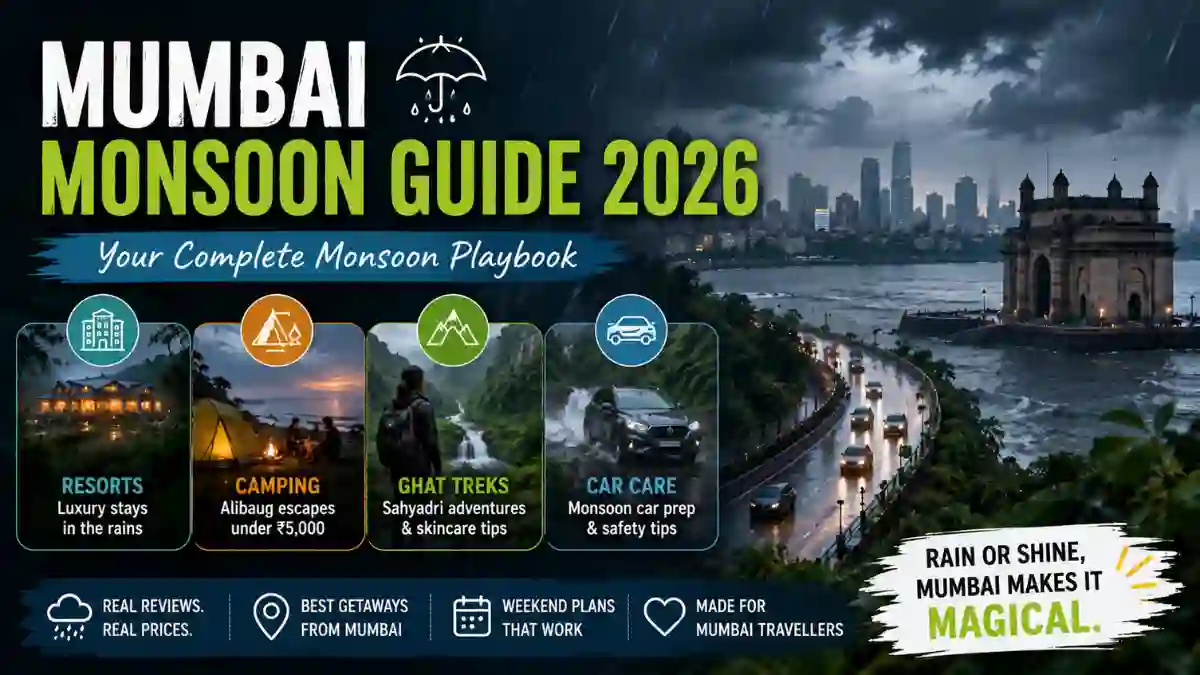
Four types of escapes. Four complete guides. One page to figure out which one is yours — and exactly how to pull it off this rainy season.
🔥 Also trending
- The Only Mumbai Monsoon Planning Page You Need to Bookmark Before June 2026
- I Planned Four Different Monsoon Trips from Mumbai — Here is the Master Guide That Covers All of Them
- No Single Blog Tells You: The Complete Monsoon Escape Ecosystem from Mumbai
Every June, millions of people from Mumbai look at the same grey sky and make the same decision: stay in the city and see flooded roads and cancelled plans, or finally use the monsoon the way the Western Ghats were designed to be used. The second option is better. But most people do not know where to start so they cancelled the plan but here i am giving you full information below that cover all things for you.
This is the Mumbai monsoon guide for 2026 that works as a master guide for everyone not for only mumbai peoples from anywhere in india. Whether you want a luxury resort with valley views, a ₹5,000 camping trip to Alibaug, a ghat road trip in a monsoon-prepped car, or a Sahyadri trek with your skin intact at the end — every answer here, with direct links to the complete deep-dive guide for each.
This page is your monsoon planning starting point. Read the overview, find your escape type, and follow the link to the full guide. By the time you are done, you will have a plan, a budget, and a departure date.
🗺️ Quick Answer: Which Mumbai Monsoon Escape Is Right for You?
Find Your Monsoon Escape Type
Mumbai sends a hundred different kinds of travellers into the Sahyadris and the Konkan coast every weekend. The best monsoon trip is the one matched to your pace, your group, and your budget — not the one with the most Instagram traction. Pick your type below.
Escape #1 — Best Monsoon Resorts Near Mumbai 2026
Where to Stay When You Want the Ghats to Come to You
Handpicked resorts from Lonavala to Kashid — with real monsoon-specific value
The monsoon resort market around Mumbai has matured significantly in 2026. The best properties aren't just beautiful — they're designed for the rainy season: covered infinity pools with fog-valley views, guided waterfall walks, bonfire evenings, and Malvani tasting menus. These aren't summer resorts tolerating the rain. They're at their best in July.
The six destinations that consistently deliver: Lonavala (85 km, misty valley views), Mahabaleshwar (260 km, strawberry farms and Lingmala Falls at peak), Igatpuri (130 km, lake wellness, Atmantan's new lakefront villas), Matheran (83 km, car-free, toy train in the rain), Alibaug (95 km, coastal luxury), and Kashid (143 km, secluded beach resorts from ₹9,000/night).
The contrarian insight: monsoon is the landscape's peak season, not its off-season. Waterfalls that don't exist in April become 100-foot cascades. Valleys glow emerald. Book mid-week in early July for the best combination of price, availability, and dramatic weather.
Escape #2 — Alibaug Camping Trip Under ₹5,000
Three Days, One Beach, ₹5,000 — The Complete Budget Roadmap
Real numbers, real campsite picks, and a day-by-day plan that actually holds
Alibaug is 95 km from Mumbai — and in monsoon, it transforms. The coconut groves go deep green, the beaches empty out, and budget campsites along Nagaon and Kihim offer tent stays with meals for ₹500–₹700 per person per night. The full three-day trip, including the Gateway of India ferry and all meals, comes in between ₹3,600 and ₹4,700 per person in a group of four.
The framework that makes this work: Book directly with campsite operators via WhatsApp (20–30% cheaper than OTA pricing), take the ferry over driving (cheaper, faster, and the sea view in monsoon is spectacular), and eat two streets inland from the beach where prices drop 40–60%. Kolaba Fort, Murud Janjira, and Kihim Beach are all free or nearly free experiences that form the trip's core.
Escape #3 — Prep Your Car Before Any Monsoon Road Trip
7 Car Maintenance Checks That Separate Safe Ghat Drives from Dangerous Ones
The pre-monsoon checklist every Mumbai driver needs before hitting the Konkan or the ghats
Here's the thing most monsoon travel content skips: the car you're driving to Lonavala, Alibaug, or Bhandardara needs to be specifically prepared for monsoon conditions. Worn tyres aquaplane. Brake fluid absorbs moisture and causes fade on ghat descents. A 3-year-old battery fails in the combined electrical load of wipers, headlights, and AC running simultaneously in a downpour.
The seven checks that matter most — in order of safety impact: tyre tread and pressure, brake pads and fluid flush, wiper blade replacement, all-lights inspection, door seals and undercarriage rust-proofing, air filter and engine bay check for hydrolock prevention, and battery load test. The full pre-monsoon service costs ₹3,000–₹8,000 depending on what needs replacing — and it prevents breakdowns that cost 10–20 times more.
The most underknown risk: hydrolock. If your car stalls crossing a flooded road, do not attempt to restart it. Cranking a hydrolocked engine bends connecting rods and destroys the engine completely. The full guide explains which roads to avoid and how to assess flood depth safely.
Escape #4 — Waterproof Skincare for Western Ghat Treks
5 Skincare Essentials That Actually Survive 90% Sahyadri Humidity
Your regular SPF lasts 20 minutes on a ghat trail. Here's what genuinely works
The Western Ghats in monsoon are one of India's most spectacular trekking environments — and one of the most hostile to regular skincare. At 85–95% ambient humidity, standard sunscreens wash off in sweat within 20 minutes. UV radiation still penetrates monsoon cloud cover at up to 80% intensity. And sustained heat, wind, and friction cause skin barrier breakdown that shows up as post-trek breakouts, sensitivity, and sun damage that compounds over multiple Sahyadri seasons.
The five products that handle all of this without adding meaningful weight to your pack: mineral SPF 50+ water-resistant sunscreen (the non-negotiable anchor), micellar water for camp cleansing without a water source, a lightweight gel moisturiser that hydrates without occluding in heat, an antifungal barrier balm for friction zones and lips, and pure 99% aloe vera gel — the one multitasker that earns its weight four times over on any trail.
When to Plan Each Type of Escape — 2026 Monsoon Calendar
Not all monsoon experiences peak at the same time. Timing your escape correctly makes a 40% difference in what you see, how crowded it is, and what it costs.
Monsoon Escape Budget Comparison — Find Your Bracket
Every bracket has a great monsoon trip waiting. Knowing yours before you start planning eliminates 80% of the research friction.
- Alibaug camping, tent with meals
- Ferry transport, shared costs
- Local dhaba food, inland pricing
- Free forts, beaches, trails
- Group of 4 works best
- Igatpuri or Matheran stay
- Monsoon-prepped car, shared fuel
- Mix of local and resort dining
- Trek + sightseeing activities
- 2–4 person groups ideal
- Mahabaleshwar, Kashid luxury resort
- Full board + spa included
- Private valley or beach views
- Guided waterfall walks, bonfire
- Couples and small groups
"Mumbai in monsoon is not the problem. Mumbai in monsoon without a plan is the problem. The Sahyadris and the Konkan coast are waiting literally two to three hours away — all it takes is the right information and a departure date." — Arjun Iyer, travel writer & Western Ghat trek guide, based in Mumbai
⚡ Universal Monsoon Travel Tips — Regardless of Which Escape You Choose
- Book with flexible cancellation — monsoon plans change fast due to landslides, road closures, and weather alerts
- Always check Maharashtra road conditions via MahaHighway portal before any drive into the ghats — some roads close during heavy rainfall
- Mid-week travel (Tuesday to Thursday) saves 20–35% on resorts, campsites, and ferry fares compared to weekends
- Pack a waterproof dry bag for your phone and documents — standard backpacks soak through faster than you'd expect in Sahyadri rain
- Travel insurance with trip interruption coverage is worth it for monsoon — several 2025 trips saw 2–3 day extensions due to landslide road closures
- Carry cash — power outages are common at remote resorts and campsites, and card machines go down in the rain
- The best monsoon weekends book out in 48 hours — set a reminder to finalise plans by the first week of June at the latest
❌ Monsoon Planning Mistakes That Ruin Great Trips
- Waiting until July to start planning: Good campsites and mid-range resorts are fully booked by the last week of June. The research window is May — not June
- Choosing a destination based on Instagram, not conditions: Many viral resort shots are from October or December. The actual monsoon experience looks different — confirm with recent visitor reviews from July of the previous year
- Skipping car maintenance because "it's a short drive": Brake fade on a 20-km ghat descent is just as dangerous as on a 200-km road trip. Distance doesn't reduce the risk — wet roads and worn brakes do
- Ignoring UV protection on overcast trek days: 80% of UV radiation penetrates monsoon cloud cover. The absence of sun glare is not the absence of UV damage. Sunscreen is non-optional on Sahyadri trails in July
- Underestimating return journey time: Sunday evening return traffic from Lonavala, Alibaug, and Mahabaleshwar adds 2–3 hours to normal drive times. Plan your return for Monday morning or Saturday evening if flexibility allows
The Sahyadris Are Calling. You Now Have Every Answer.
The perfect Mumbai monsoon escape in 2026 doesn't require weeks of research scattered across a dozen tabs. It requires knowing your type — comfort seeker, budget adventurer, road tripper, or ghat trekker — and following the right guide all the way to a departure date.
Every escape type has a complete, honest, numbers-included guide linked from this page. Pick your bracket, set your date, and get out of the city. The Western Ghats are at their absolute best right now — and they're only two to three hours away.