Reading time: 5 min | Category: India Travel & Train Journeys | Updated: May 2026
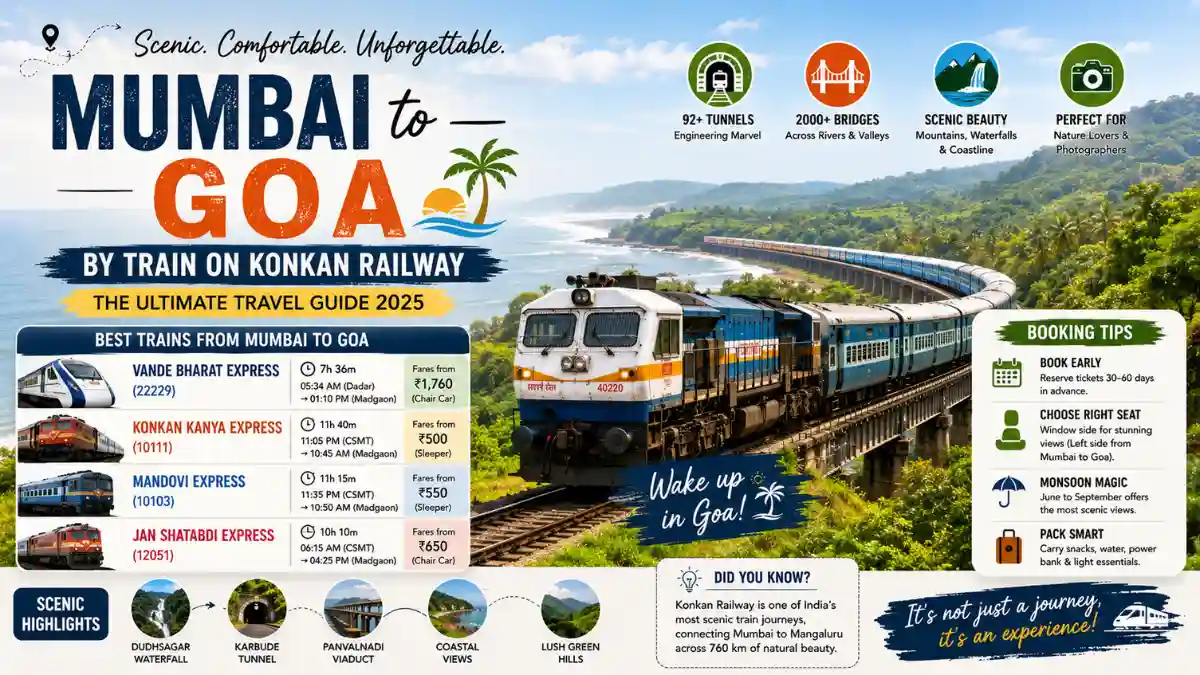
There is a reason seasoned travellers choose the train over a one-hour flight when heading from Mumbai to Goa — and it has nothing to do with saving money. The Mumbai to Goa train on the Konkan Railway is one of the most breathtaking rail journeys in Asia: 92 tunnels, over 2,000 bridges, cascading waterfalls, coconut-fringed coastline, and river valleys that will have you reaching for your camera before you've even had your morning chai. In this guide, you'll get everything you need to plan your Konkan Railway journey in 2026 — the best trains, current fares, which seat to book, scenic highlights, and insider booking tips that actually work.
Why the Mumbai to Goa Train on Konkan Railway Is Worth Every Minute
The Konkan Railway is an engineering marvel unlike anything else in India. Completed in 1998 after a decade of carving track through the Western Ghats and coastal Maharashtra, it connects Mumbai to Mangaluru across some of the subcontinent's most dramatic terrain. The Mumbai–Goa stretch alone covers roughly 580–600 km and passes through Maharashtra's lush Konkan belt before easing into Goa's laterite landscape. Think of it as a moving window seat into a part of India most tourists never see.
The Engineering That Makes It Special
The numbers alone are staggering. The route includes over 91 tunnels — among them the Karbude Tunnel, one of India's longest at 6.5 km — and more than 2,000 bridges, including the soaring Panvalnadi Viaduct. During the monsoon season (June to September), waterfalls pour off hillsides directly beside the tracks and tunnels emerge into curtains of mist. It's the kind of scenery you'd pay a premium for in Switzerland; here, a sleeper class ticket starts at around ₹500.
Best Trains from Mumbai to Goa by Konkan Railway in 2026
Around 8 trains run daily on this route, with dozens more operating weekly. Here are the four most popular and reliable options depending on your travel style and budget.
Vande Bharat Express (22229) — Fastest Option
The Vande Bharat Express is the fastest train on the Konkan Railway, covering Mumbai Dadar to Madgaon in approximately 7 hours 36 minutes. It departs Dadar at 05:34 AM and reaches Madgaon by 01:10 PM, making it ideal if you want to arrive in Goa with a full afternoon ahead of you. The train features airline-style reclining seats, large windows, power outlets, and onboard catering. It's a daytime train, meaning you get the scenic Konkan stretch in full daylight — a major advantage. Book this one well in advance, especially for weekends and peak season.
Konkan Kanya Express (10111) — Best Budget Overnight Train
For most budget travellers, the Konkan Kanya Express is the smartest choice on this route. It departs CSMT Mumbai at 11:05 PM daily and arrives at Madgaon by 10:45 AM — you sleep through the journey and wake up in Goa, effectively saving a night's hotel cost. Sleeper class fares start at around ₹500; 3AC at ₹1,300; 2AC at ₹1,800. It's comfortable, daily, and beloved by Mumbaikars heading home to the coast for long weekends.
Tejas Express (22119) — Premium Daytime Experience
The Tejas Express departs CSMT at 05:50 AM and reaches Karmali (convenient for North and Central Goa) by around 2:00 PM — a journey of roughly 8 hours. It offers modern amenities including onboard meals, a dedicated staff, and a notably punctual track record. AC Chair Car fares range from ₹1,500 to ₹2,000. If Karmali station works for your Goa destination, this train is an excellent daytime alternative to the Vande Bharat.
Jan Shatabdi Express (12051) — Best for Budget Daytime Travel
Departing CSMT at 05:10 AM and arriving at Madgaon around 14:30, the Jan Shatabdi is the cheapest daytime option on the route at just ₹310 for a chair car seat. It runs every day of the week and even features a Vistadome coach — with panoramic glass roof and wide windows — on select days. If your budget is tight but you want the scenery, this is your train.
Scenic Highlights: What to Watch for on the Konkan Railway Journey
Not every kilometre of the Mumbai to Goa train route is equally breathtaking, so here's where to keep your eyes — and your phone — ready.
The Scenic Stretch Breakdown
The journey starts flat and urban through Mumbai and Panvel. Things begin greening up after Roha, and by the time you reach the Roha-to-Chiplun stretch, tunnels begin and the Western Ghats start putting on a show. The Chiplun-to-Ratnagiri section is peak Konkan Railway: river bridges, mountain tunnels, coastal flashes, and small fishing settlements tucked between hills. From Ratnagiri to Madgaon, the terrain softens into coconut groves and the classic Konkan village scene — laterite houses, church spires, and swaying palms as Goa approaches.
Which Side of the Train to Sit On
Book a window seat on the right side of the train when travelling from Mumbai to Goa for the best Arabian Sea and river views, particularly during the Ratnagiri–Kudal stretch on daytime trains. The left side offers more mountain and tunnel views. Honestly, with 92 tunnels and 2,000+ bridges, neither side disappoints — but the right side edges ahead for coastal moments.
IRCTC Ticket Booking Tips: How to Actually Get Confirmed Seats
Trains to Goa — especially the Konkan Kanya and Vande Bharat — sell out fast. Peak periods including Christmas week (December 20 to January 5), Diwali, long weekends, and school holidays in May see waitlists running into the hundreds within hours of the booking window opening.
Book 120 Days in Advance
IRCTC opens bookings 120 days before departure for regular quota. Set a calendar reminder and log in at 8:00 AM sharp on that date — popular trains in 2AC and 3AC fill up within the first hour. If you miss the regular quota, Tatkal bookings open at 10:00 AM (AC classes) and 11:00 AM (Sleeper) one day before departure, at a premium surcharge of roughly 30%.
Pro Booking Hacks That Work
Check trains originating from Mumbai rather than trains passing through — they carry more seats in the general quota. If the direct Mumbai–Goa train is waitlisted, try a split booking: Mumbai to Ratnagiri on one train, then Ratnagiri to Madgaon on another. It's more effort, but it gets you confirmed seats on busy dates. Also check the Ladies Quota, Tourist Quota, and Emergency Quota — these release close to the journey date and often have availability when everything else shows waitlisted.
Quick Konkan Railway Travel Tips Checklist
Save this before you travel:
- Best season: November to February for clear skies; June to September for dramatic monsoon scenery
- Fastest train: Vande Bharat Express (~7 hrs 36 min, departs Dadar 05:34 AM)
- Best budget overnight train: Konkan Kanya Express (departs CSMT 11:05 PM, from ₹500 Sleeper)
- Best seat: Window seat, right side of train (facing direction of travel) for sea views
- Station for North Goa: Deboard at Thivim (Mapusa Road)
- Station for South Goa: Deboard at Madgaon (Margao Junction)
- Book via: IRCTC official website or app — 120 days before departure
- Carry: Valid photo ID (Aadhaar, PAN, Passport, or Driving Licence) — mandatory for ticket checking
- Food: Platform snacks at Ratnagiri station are legendary — don't sleep through this stop on overnight trains
- Monsoon tip: Carry rain gear; delays of 30–60 minutes are common during heavy rainfall season
Your Mumbai to Goa Train Journey Starts the Moment You Board
Most people treat the Mumbai to Goa train journey as transit — something to endure before the holiday begins. The Konkan Railway makes that impossible. By the time you're an hour past Panvel and the tunnels start and the rivers appear below and the green hills close in on both sides, you'll understand why regulars on this route say the journey is the destination.
Book your seats 120 days out. Choose your train based on your budget and preferred arrival time. Grab a window seat on the right side. And when the train emerges from the Karbude Tunnel into a valley of afternoon light somewhere in coastal Maharashtra — put your phone down, just for a moment, and take it in. You'll be back for more.
The best journeys don't begin when you arrive. They begin the moment the train leaves the platform.
Leave a comment
Share a quick thought about this story.
Thanks for sharing your view. It is ready for review.
Please try again in a moment.