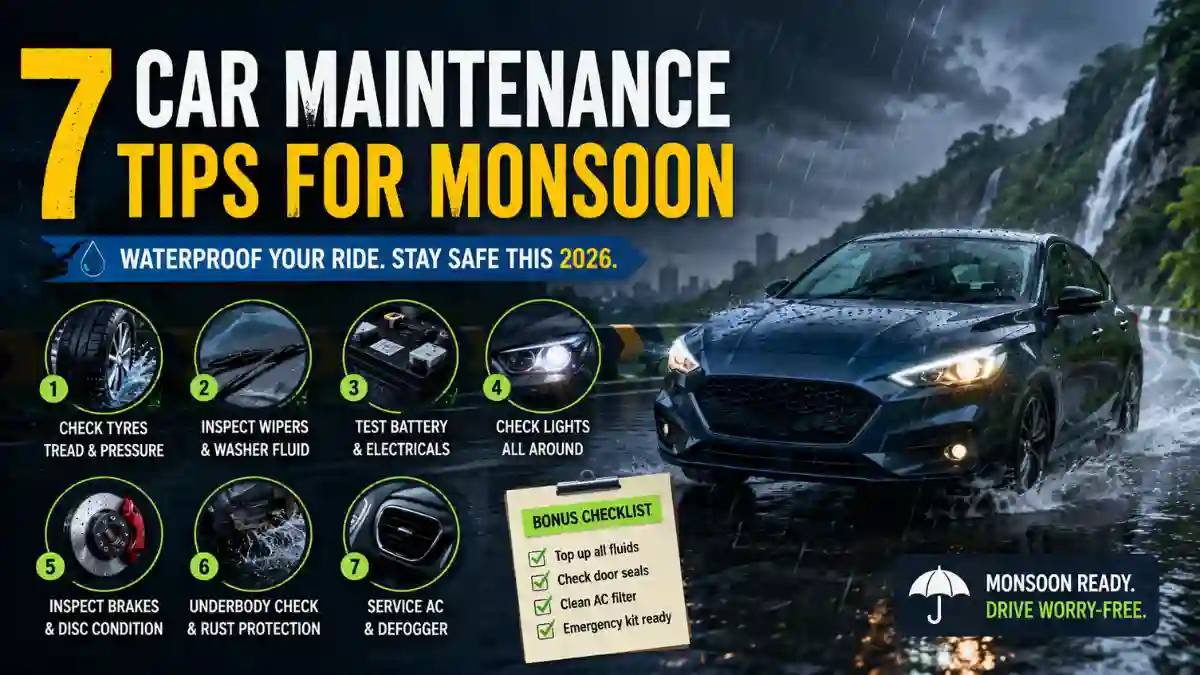
The rains don't damage cars — neglect does. Here's the pre-monsoon checklist that every Indian driver needs before June hits.
🔥 Also trending
- I Skipped Pre-Monsoon Car Service Two Years Running — Here is What It Cost Me
- What Changed in 2026: The New Monsoon Threats your car Mechanic Won not Warn You About
- Most Drivers Ignore Tip #4 Until Their Brakes Fail on a Ghat Road
Every June, thousands of Indian car owners learn the same expensive lesson: monsoon damage is not covered under standard insurance if a mechanic can prove the car was not maintained. A flooded engine due to a cracked air filter seal. Brake fade on a slippery ghat because pads were worn thin. A blown fuse from a short because the door seal had been leaking for months.
These are not freak accidents. They are entirely predictable — and preventable. The car maintenance tips for monsoon in this guide are ordered by the damage they prevent, not alphabetically. The ones at the top are the ones that will actually save you money and possibly your life on a wet expressway this July.
If you are planning a weekend drive to Lonavala, a Konkan coastal road trip, or just navigating Mumbai's flooded arteries every morning, this 2026 pre-monsoon checklist covers everything your service station brochure glosses over.
🔧 Quick Answer: The 7 Car Maintenance Tips for Monsoon 2026
- Tyre tread and pressure check — Your first line of defence on wet tarmac
- Brake inspection and fluid flush — Pads, discs, and fluid all degrade faster in humidity
- Wiper blade replacement — Old wipers are as dangerous as no wipers at 80 km/h
- All lights check + waterproofing — Visibility drops 60% in heavy rain; your lights must compensate
- Door seals and undercarriage rust-proofing — The slow damage nobody notices until it's too late
- Air filter and engine bay inspection — Hydrolock prevention is the most under-discussed monsoon risk
- Battery and electrical system check — Humidity corrodes terminals; monsoon is peak breakdown season
The 7 Essential Monsoon Car Maintenance Tips — In Detail
Tyre Tread Depth and Pressure Check
Your braking distance doubles on wet roads with worn tyres
The minimum tyre tread depth in India is 1.6mm — but on wet roads, you want at least 3mm for meaningful grip. Below 2mm, the tyre cannot channel water away from the contact patch fast enough, and you hydroplane. This is not a gradual sliding sensation. It is instant loss of steering control.
Test tread depth with a 1-rupee coin: insert it into the tread groove. If you can see the entire '1' numeral, your tyres are legally worn and dangerously thin for monsoon driving. Replace before June — tyre shops see a 40% price spike in late June as demand surges.
Also check tyre pressure with a cold gauge. Monsoon temperatures in Maharashtra fluctuate more than summer, which affects inflation. Under-inflated tyres increase aquaplaning risk and reduce fuel efficiency by up to 8%.
2026 update: Several popular OEM tyres fitted on Maruti, Hyundai, and Tata models from 2021–22 are now hitting their natural wear life. If your car is 3–4 years old and you've never replaced tyres, check depth immediately.
Brake Inspection and Brake Fluid Flush
Brake fluid absorbs moisture — and moisture kills braking performance
Brake fluid is hygroscopic — it literally absorbs water from the atmosphere. By the time monsoon season begins, most cars that haven't had a fluid change in 18+ months have brake fluid with moisture content high enough to lower its boiling point by 30–40°C. On a ghat descent in the rain with repeated braking, this causes brake fade — the terrifying sensation where the brake pedal goes soft and the car slows less and less with each application.
Ask your mechanic specifically about brake pad thickness. Front pads on city-driven cars in India typically need replacement every 30,000–40,000 km, but stop-and-go Mumbai or Pune traffic degrades them faster. Discs should show no deep grooves or scoring. Monsoon compounds this: wet brake dust accelerates corrosion on disc surfaces.
If your car pulls to one side when braking or you feel vibration through the pedal, do not wait for monsoon to arrive. This indicates a seized caliper or warped disc — a serious safety issue on slippery roads.
Wiper Blade Replacement
A streaky wiper at 80 km/h in a downpour is effectively no wiper at all
Wiper blades are the most under-replaced safety component on Indian cars. Most drivers replace them reactively — after they've already failed in the middle of a highway rainstorm. The rubber on standard wiper blades degrades from UV exposure year-round, even when not in use. By the time June arrives, blades that look fine when dry will streak, judder, and skip the moment it rains.
The test is simple: pour a cup of water on your windshield and run the wipers. If you see any streaks, skips, or smeared patches rather than a clean wipe, replace them now. Beam-style frameless wipers perform significantly better than traditional frame wipers in heavy Indian monsoon rain — they cost ₹400–₹800 per blade but the visibility difference is substantial.
Also replace your rear wiper if your vehicle has one. Reversing in a Mumbai lane with a failed rear wiper is a surprisingly common cause of minor monsoon accidents.
Cost: ₹400–₹800 per blade (beam type) | ₹200–₹400 (standard) Risk if ignored: Near-zero visibility in heavy rain at speedFull Lights Check and Headlight Waterproofing
Monsoon visibility drops 60% — your lights must compensate
Check every light on your car: headlights (low and high beam), taillights, brake lights, indicators, hazard lights, and fog lamps if fitted. In rain, rear-end collisions spike by over 35% precisely because brake lights are dim, moisture has seeped into housings, or a bulb has simply blown without the driver noticing.
For cars older than 3–4 years, inspect headlight lenses for internal fogging or yellowing. Oxidised headlight plastic reduces light output by up to 70% — meaning your headlights look fine from outside but are projecting a fraction of the light they should. Polishing kits cost ₹200–₹400 and genuinely restore clarity. Sealing gaps in the housing with automotive silicone prevents moisture re-entry.
The Fog Lamp Question
Fog lamps are designed for low-visibility conditions but are consistently misused in India. Use front fog lamps when visibility is genuinely less than 50 metres. Never use rear fog lamps (where fitted) in normal rain — they blind the driver behind you and mask your brake lights.
Cost: ₹50–₹200 per bulb replacement | ₹200–₹400 for headlight polishing Risk if ignored: Rear-end collisions, invisible vehicle to following trafficDoor Seals, Floor Mats, and Undercarriage Rust-Proofing
The slow damage that compounds every monsoon until your car rots from underneath
Run your finger along every door seal, window seal, and boot seal on your car. If the rubber is cracked, compressed flat, or has any visible gaps, water will enter the cabin during heavy rain. This is how carpets stay damp for weeks, how floor electronics corrode, and how that persistent musty smell develops that no amount of air freshener fixes.
Door seal replacement is inexpensive and straightforward — a full set for most sedans and hatchbacks costs ₹800–₹2,000. Do it yourself with peel-and-stick automotive weatherstrip tape for minor gaps, or have a workshop do a full replacement. The investment pays back immediately.
Undercarriage rust-proofing is the genuinely overlooked item on this list. Coastal Maharashtra — Alibaug, Kashid, Murud — has salt-heavy air that accelerates rust exponentially. If you drive to the coast regularly, an annual underbody anti-rust treatment (₹1,500–₹3,000) will extend your car's structural life by years. Some workshops now offer monsoon packages combining underbody coating with door seal inspection.
Cost: ₹800–₹2,000 door seals | ₹1,500–₹3,000 undercoating Risk if ignored: Interior flooding, electrical shorts, structural rustAir Filter and Engine Bay Inspection for Hydrolock Prevention
The single most expensive monsoon mistake most drivers have never heard of
Hydrolock — when water enters the engine's intake and the pistons try to compress it — destroys engines completely. Unlike most mechanical failures, hydrolock is not repairable. A hydrolocked engine typically means a full replacement or a car written off. And it happens more often than you'd think, especially to cars that attempt to cross flooded roads where the water level reaches the front bumper.
The air intake snorkel position on your car determines its wading depth. Most standard hatchbacks and sedans can safely cross water up to 15–20cm deep, at walking pace. SUVs vary widely — check your owner's manual for the specific wading depth. Never attempt to cross water you cannot gauge the depth of. That "only looks 30cm deep" road has drowned more engines than any mechanical failure.
Before monsoon: replace the air filter (a clogged filter reduces performance and in heavy rain can pull moisture through faster), and inspect the engine bay for any gaps in the intake path where water could enter.
If your engine stalls mid-crossing, do not restart it. Attempting to crank a hydrolocked engine bends connecting rods. Switch off ignition, push the car to dry ground, and call assistance.
Battery and Electrical System Check
Humidity corrodes battery terminals silently — until your car won't start in a rainstorm
Batteries older than 2.5–3 years should be load-tested before monsoon. A battery that starts your car fine on a dry April morning may fail in the increased electrical load of a monsoon drive: wipers running at full speed, headlights on, AC at maximum, and heated rear windscreen all draw significant current simultaneously. A weakened battery simply can't handle it.
Check battery terminals for white or blue-green corrosion deposits. This is lead sulphate or copper oxidation — both increase resistance and reduce charging efficiency. Clean with a mixture of baking soda and water, dry thoroughly, and apply petroleum jelly to the terminals before reconnecting. It costs nothing and prevents a surprisingly common breakdown cause.
Also inspect the fuse box (usually under the bonnet and under the dashboard) for any signs of moisture or corrosion. A corroded fuse box in a flooded cabin is how monsoon electrical gremlins — intermittent windows, phantom warning lights, misbehaving central locking — begin their long, expensive career in your car.
Cost: Free (terminal cleaning) | ₹3,500–₹7,000 for battery replacement Risk if ignored: Breakdown in rain, electrical shorts, failed accessoriesThe P.R.E.P. Framework: How to Think About Monsoon Car Readiness
Use this before booking your pre-monsoon service appointment to know exactly what to ask for.
Pre-Monsoon Car Checklist — Print and Take to Your Mechanic
Complete Pre-Monsoon Service Checklist 2026
7 items · Est. total ₹3,000–₹8,000"We see a 40% jump in workshop visits every July — almost all of it preventable. The top three issues are always the same: worn tyres, dead batteries, and water in the cabin from failed door seals. It's the same three every single year." — Rajesh Pawar, Senior Automotive Technician, Pune (15 years in workshop service)
⚡ Quick Tips: Driving Your Car Safely in Monsoon 2026
- Keep a 3-second following distance in rain — double your normal gap. Wet tarmac needs twice the braking distance
- Never use cruise control in rain or on wet roads — you need full throttle control to manage aquaplaning
- If you aquaplane, do not brake hard — ease off the accelerator, hold the steering straight, and let the tyres regain contact naturally
- On ghat roads, use engine braking (downshift to 2nd or 3rd gear) to control speed, not just the brakes — repeated heavy braking causes fade
- Turn on headlights whenever wipers are running — Maharashtra traffic rules now mandate this, and it genuinely improves your visibility to others
- After driving through a flooded section, pump your brakes gently at low speed to dry the pads before you need them at full force
- Keep an emergency kit in the boot: jumper cables, a torch, a basic toolkit, a reflective triangle, and a rope for towing
❌ Monsoon Car Mistakes Most Drivers Make Every Year
- Treating the dealer service as the pre-monsoon check: Standard dealer services don't include wading depth assessment, undercoating, or seal inspection unless specifically requested — you have to ask for these items
- Crossing flooded roads at speed: "Fast means I get through before water enters" is exactly wrong. Higher speed creates a bow wave that pushes water into the engine intake. Slow is survival
- Using summer tyre pressures in monsoon: Many drivers inflate to maximum rated pressure thinking it improves handling. On wet roads, slightly lower pressure (within spec) increases contact patch and grip
- Ignoring the handbrake in flooded parking: Parking brake pads can seize when wet if left applied for hours. In flood-risk areas, leave the car in gear rather than using the handbrake for extended periods
- Not checking insurance for monsoon-specific clauses: Some comprehensive policies exclude engine damage due to flooding if the car entered a visibly flooded road — check your policy before the season starts, not after a claim is denied
-
Best Monsoon Resorts Near Mumbai 2026
Planning a monsoon drive to a hill resort? Read this before you book — and before you hit the ghats
-
Best Budget Road Trips from Mumbai in 2026
Once your car is monsoon-ready, here are the routes worth driving this season
-
Mumbai Monsoon Weekend Getaways 2026
Where to head when you've done the car prep and just want to escape the city
-
Mumbai–Goa Konkan Train Travel Guide
Skip the drive entirely on the most scenic rail route in Maharashtra
-
Sahyadri Wellness Trends 2026
The hill station wellness stays worth driving your freshly-serviced car to this monsoon
Your Car Is Ready. Now Go Enjoy the Monsoon.
The best thing about working through this car maintenance checklist for monsoon is what comes after: you actually enjoy the drives. No nervous glances at puddles. No pumping brakes on a wet descent wondering if they will hold. No fogged-up windows from a leaking door seal you never got around to fixing.
Spend ₹3,000–₹5,000 now on preventive maintenance. Save ₹50,000+ in avoidable repairs — and quite possibly, your life on a slippery coastal highway. The ghats are stunning in the rain. Go see them prepared.
Explore Monsoon Road Trips from Mumbai →
Leave a comment
Share a quick thought about this story.
Thanks for sharing your view. It is ready for review.
Please try again in a moment.