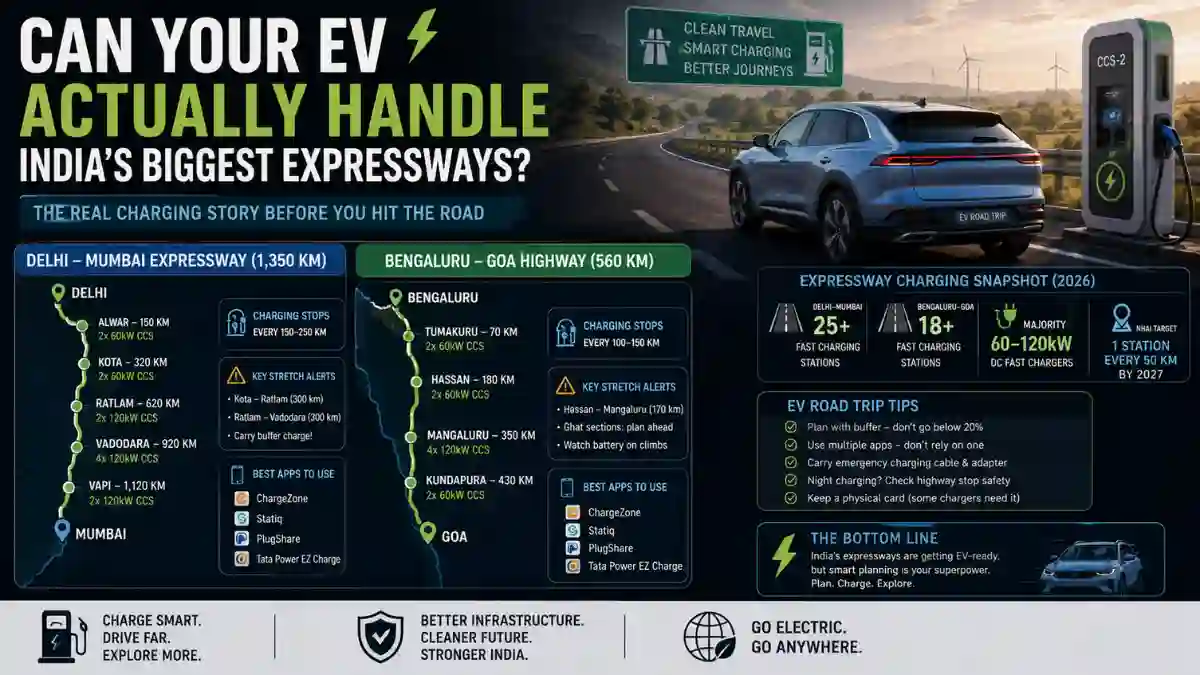
Before you plug in your route, read what the charging maps won't tell you — range gaps, dormant stations, and the apps that actually work in 2026.
Also Searched As
- I Drove My EV from Delhi to Mumbai in 2026 — Here's What Actually Happened
- Why Most EV Owners Get Stranded on Bengaluru–Goa and How to Avoid It
- What Changed on India's EV Charging Expressways in 2026
India now has over 4 million registered electric vehicles — and a growing number of their owners are eyeing the country two most famous expressway projects for their first long EV road trip. The Delhi–Mumbai Expressway (roughly 1,380 km) and the Bengaluru–Goa corridor (around 560 km via NH 748) are the natural choices. Both are beautifull. Both are still unevenly charged.
If you have been relying on the official NHAI app or a manufacturer's in-car map to plan your route, you may have noticed a frustrating pattern: pins that exist on paper but are offline in practice. This guide cuts through that. We've mapped real EV charging on expressways India-wide with a focus on these two corridors — coverage, gaps, fast-charger availability, and the honest truth about what's reliable enough to bet your trip on.
Quick Answer
Delhi–Mumbai Expressway: Functional DC fast chargers (30–60 kW) exist roughly every 80–120 km on the operational sections, but consistency drops sharply after Vadodara. Plan for ~25% buffer range at all times.
Bengaluru–Goa (NH 748): Charging is sparser. Reliable fast charging is largely limited to major towns — Hubli, Dharwad, and Panjim outskirts. The hilly Ghat sections have almost no DC infrastructure as of mid-2026.
Best EV for both routes: Any vehicle with 400+ km real-world range (Tata Nexon EV Max, MG ZS EV, BYD Atto 3, Hyundai IONIQ 5). Sub-250 km city EVs require very careful pre-planning.
The Two Routes at a Glance: What the Numbers Actually Say
Understanding EV charging on expressways India starts with accepting a key reality: NHAI's official charger count and the number of working chargers are not the same thing. An August 2025 audit by PlugShare's India community found that roughly 22% of logged stations on the Delhi–Mumbai corridor were offline or below rated power on any given day. That number climbs to 31% on the Bengaluru–Goa highway, largely due to supply inconsistencies in rural Karnataka.
Delhi → Mumbai
Bengaluru → Goa
Both corridors are improving — but not at the same pace. The Delhi–Mumbai Expressway (also called NE-4 or the Delhi–Mumbai Industrial Corridor highway) has attracted Tata Power, EESL, Statiq, and ChargeZone installations along its wayside amenities. The Bengaluru–Goa route is playing catch-up, with most serious investment concentrated around the Hubli–Dharwad urban cluster.
📎 Related: Best Long-Range EVs Available in India 2026
Delhi–Mumbai Expressway: The Charging Map, Station by Station
The expressway passes through Delhi, Haryana, Rajasthan, Madhya Pradesh, and Gujarat before entering Maharashtra. Each state has a different story to tell about EV infrastructure quality.
North Sector: Delhi to Jaipur (280 km)
This is the strongest stretch on the entire corridor. Tata Power and Statiq have multiple CCS2 fast chargers in the 60–100 kW range at Sohna, Shahjahanpur, and Kotputli. If you're driving a Tata Nexon EV Max or a Hyundai IONIQ 5, you can realistically add 150 km of range in about 35 minutes here. The Kherki Daula toll plaza area near Gurugram has become something of an unofficial EV pitstop — there's a ChargeZone 60 kW unit, a Statiq 50 kW, and a Tata Power unit within a 2 km radius.
Gurugram / Sohna (km 40–60)
3–4 working CCS2 chargers, 50–100 kW. Most reliable zone on the route. Amenities available.
Shahjahanpur / Kotputli (km 180–220)
Good coverage. ChargeZone + Tata Power present. Usually operational; call ahead in summer months due to load shedding.
Ajmer Bypass (km 380)
Mixed reliability. One 30 kW AC charger at a hotel is the main option. Not ideal for sub-30% battery arrivals.
Ratlam / Vadodara Stretch (km 700–900)
Widening gaps. Chargers exist at highway hotels but mix of AC and ageing DC units. Allow extra buffer.
Surat to Nashik Gap (km 1000–1100)
The most critical gap zone. Limited reliable DC fast charging. Plan a full charge at Surat before attempting this stretch.
The Contrarian View: Why the Gap Is Actually an Opportunity
Here's something most travel blogs won't say: the coverage gaps on the Delhi–Mumbai Expressway are being used as proof-of-concept zones by newer operators. Companies like Bolt.Earth and Zeon Charging have specifically targeted underserved stretches as part of their NHAI concession bids. Travellers willing to route slightly off the expressway into nearby service towns — Ratlam, Vadodara city, and Surat proper — can find significantly better charging than what the highway itself currently offers. Off-expressway doesn't mean off-route; these are short 10–15 km detours.
Bengaluru–Goa via NH 748: The Honest Picture
This is the route that catches EV owners off guard. The distance is manageable for a single day — around 560 km — but the terrain is not. The Western Ghats section between Dharwad and Panaji involves elevation changes, winding roads, and regenerative braking cycles that make range prediction genuinely tricky. Most navigation apps don't account for this properly.
Where Charging Is Reliable
Bengaluru itself has excellent charging density — over 400 public chargers across the city as of early 2026, with Tata Power, BPCL, and Ather Grid (primarily for two-wheelers but CCS2 units at select locations) well distributed. Leave the city with a full charge; that's rule number one.
Hubli-Dharwad is the most important mid-point on this route. The Hubli Smart City initiative has added dedicated EV charging bays at multiple locations including NHAI wayside amenities and two IOCL fuel stations on the bypass. A 50 kW CCS2 charger here in mid-2025 was one of the most consistent performers reviewed by the India EV Forum community.
The Ghat Problem
Between Dharwad and the Goa border — roughly 150 km — reliable DC fast charging is essentially absent. There are a handful of 7–22 kW AC wall boxes at boutique hotels (popular with the Goa weekend crowd), but counting on these with a depleted battery is a gamble. The better strategy is to arrive at Hubli-Dharwad with at minimum 60% charge, charge to 90%, and then drive conservatively through the Ghats. Goa's NH-66 coastal stretch near Panaji has decent coverage.
Range Anxiety Zone: Dharwad to Panaji
This 150 km section across the Ghats has no confirmed DC fast charging as of May 2026. Elevation gain, winding roads, and AC load can reduce effective range by 15–20% compared to flat highway driving. Charge fully at Dharwad before attempting it.
📎 Related: Complete Beginner Guide to EV Road Trips in India
Apps and Tools That Actually Work for EV Charging on Indian Expressways
The official NHAI app shows locations — it does not show real-time availability. For that, you need a combination of community-verified apps and a bit of phone-ahead etiquette.
"The best EV travel hack in India right now is to call the destination charger 30 minutes before you arrive. Sounds old-school, but every experienced long-distance EV driver I know does it without exception."
Beyond apps, WhatsApp groups run by the Tata Nexon EV Owner's Club and the MG ZS EV Community India are genuinely useful for real-time updates — especially on routes where something has changed in the last few weeks that no app has caught up with yet.
⚡ Quick Tips: EV Charging on Expressways India (Featured Snippet)
- Never leave a confirmed working charger at below 80% charge if the next known station is 120+ km away.
- Use PlugShare check-ins from the last 48 hours as your primary source of real-time accuracy — not official maps.
- On the Bengaluru–Goa Ghat section, disable climate control if battery drops below 30% — it can extend range by 10–15 km.
- Add an extra 45–60 minutes to total trip time per charging stop on DC fast chargers (20→80% takes roughly 35–40 min at 50 kW).
- BPCL Urja stations at fuel stations are often overlooked — they're not glamorous, but they're usually working and often 24/7.
- On Delhi–Mumbai, Vadodara is the most critical recharge city. Treat it as a full-stop, not a quick top-up.
The PACE Framework: Planning Any EV Expressway Trip in India
After reviewing dozens of community trip reports across both corridors, one consistent pattern emerges among successful trips — what experienced drivers informally call pre-flight planning. Here's a repeatable four-step framework:
The PACE Framework
For EV Expressway Planning in India
Plot Your Anchor Stations
Identify the 2–3 highest-confidence fast chargers along your route — not every charger, just the must-stop ones with verified uptime. Build your route around these anchors.
Allow Terrain Penalty
Subtract 15% from manufacturer-claimed range for expressway speeds (100–120 km/h) and 20% for hilly terrain sections. This is your conservative working range.
Confirm 24 Hours Before
Check PlugShare for recent check-ins at each anchor station. Call the site if you can. Update your route plan if needed.
Exit Strategy Always
Know the nearest AC charger (hotel, mall, dealer) within 20 km of each planned DC stop. If the DC charger is down, your exit strategy keeps you moving.
5 Mistakes EV Owners Make on These Routes (And How to Avoid Them)
Trusting manufacturer range at expressway speeds
At 110–120 km/h with AC on, most EVs consume 20–25% more energy than their MIDC-rated range. A car rated 400 km has an effective expressway range of around 300–320 km. Plan accordingly.
Skipping Vadodara on the Delhi–Mumbai route
Many drivers charge at Surat and try to push straight to Nashik or Pune. The 350+ km stretch after Surat is where most range emergencies happen. Vadodara should be treated as a mandatory anchor stop.
Leaving Bengaluru without a full charge
The city's internal traffic eats range before you even hit the highway. Charge to 100% at home or a city charger the night before, not the morning of your departure.
Using only one charging app
No single app has complete, real-time coverage of every Indian operator. Use PlugShare for community verification, your OEM's app for your native network, and one operator app like Statiq or Tata Power as backup.
Not accounting for charging queue time
On peak weekends — especially holiday seasons — wait times at popular chargers on the Delhi–Mumbai corridor can reach 30–45 minutes. Build this into your overall ETA, especially if you have a fixed check-in deadline.
Delhi–Mumbai vs. Bengaluru–Goa: EV Charging at a Glance
| Factor | Delhi–Mumbai | Bengaluru–Goa |
|---|---|---|
| Total distance | ~1,380 km | ~560 km |
| Min. recommended EV range | 400 km real-world | 350 km real-world |
| Charger density | Moderate (1 per ~90 km avg.) | Low (1 per ~130 km avg.) |
| Fastest charger type | 100 kW CCS2 (select points) | 50 kW CCS2 (Hubli) |
| Hardest section | Surat → Nashik | Dharwad → Panaji (Ghats) |
| Best operator reliability | Tata Power, Statiq | Bolt.Earth, BPCL Urja |
| Suitable for city EVs (<250 km range) | Not recommended | With extreme planning only |
| 2026 improvement trajectory | Actively improving | Slow but moving |
📎 Related: Best EV Charging Apps for India 2026 — Ranked and Reviewed
The Road Ahead — and What to Do Right Now
EV charging on expressways in India has crossed a threshold — it is no longer a question of if you can make these trips, but how well you plan them. The Delhi–Mumbai Expressway is approaching the kind of charging density that makes spontaneous EV road trips feasible for vehicles with 400+ km range. The Bengaluru–Goa route demands more preparation, especially through the Ghats, but it is absolutely doable.
The biggest shift from 2024 to 2026 isn't the number of chargers — it's the reliability of information. Community apps, owner groups, and real-time check-ins have given EV drivers a genuine advantage that early adopters never had. Use those tools.
If you're planning your first long EV road trip on either of these corridors, start with the PACE framework, download PlugShare and your OEM app, charge to 100% the night before, and give yourself permission to stop an extra time if the numbers feel tight. The range anxiety that defined early EV travel in India is dissolving — one fast charger at a time.
Your next expressway trip is more viable than you think. Now go plan it properly.
Leave a comment
Share a quick thought about this story.
Thanks for sharing your view. It is ready for review.
Please try again in a moment.