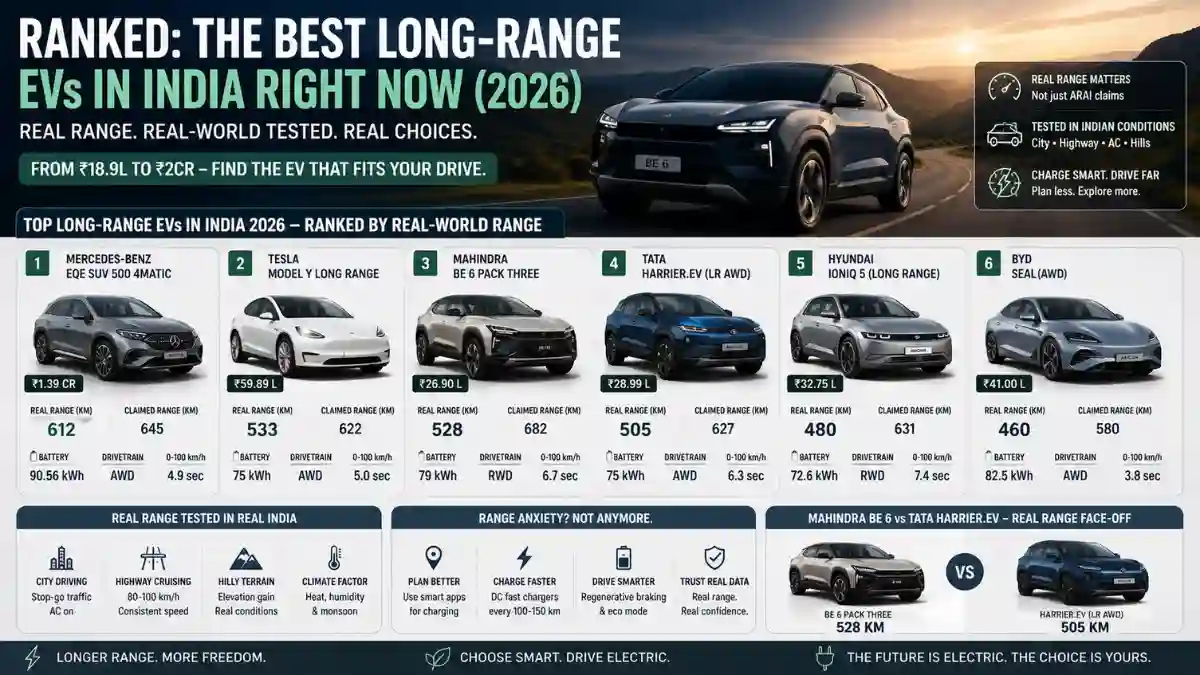
Claimed range is marketing. Real world km is what matters on NH44 or the Pune–Mumbai Expressway. Here is every car that truely cover above 500 km — ranked, priced, and assessed honestly.
- "I Drove the Mahindra BE6 and Tata Harrier EV Back-to-Back — Here's What the Spec Sheet Won't Tell You"
- "What Changed in 2026: Tesla Arrived, Mahindra Redefined Value, and the EV Range War Got Real"
- "Why the Most Expensive EV in This List Isn't the Best One for Most Indian Buyers"
For years, "long range" in the Indian EV market meant clearing 300 km on a good day with the AC off and a tailwind. That era is over. In 2026, India's best long-range EVs are genuinely competitive with global benchmarks — offering 500 to 857 km of certified range across a price band that runs from ₹18.9 lakh to well over ₹2 crore. The market has never been more compelling, more confusing, or more consequential to get right.
But there's a critical distinction that most buyer guides gloss over: certified range and real-world range are not the same number. MIDC and ARAI test cycles are conducted at moderate speeds, minimal AC use, and optimal temperatures. On Indian roads — with summer heat, highway speeds of 100–120 km/h, full AC, and loaded passengers — real-world figures typically land 20–35% below the claimed ceiling. This guide uses both figures where available, so you can plan your charging stops honestly.
Best value under ₹25L: Mahindra BE6 (79 kWh) at ₹18.90L — up to 683 km claimed, ~480 km real-world highway. Best all-rounder ₹25–50L: Tata Harrier EV 75 kWh at ₹21.49L or BYD Seal at ₹41L. Best premium pick: Tesla Model Y Long Range at ₹67.89L — 661 km WLTP, global Supercharger network. Absolute range king: Mercedes-Benz EQS at ₹2.05Cr — 857 km MIDC. For most Indian buyers doing 200–400 km weekend routes, the Mahindra BE6 or XEV 9e 79 kWh represents the sharpest real-world range-per-rupee on the market in 2026.
How India's Long-Range EV Market Stands in 2026
Three forces have reshaped this market in the last 18 months. First, leading 2026 models now range from 500 to 800 km, making interstate travel across India practical — something that was genuinely aspirational even two years ago. Second, Mahindra's INGLO platform EVs arrived and immediately redefined what Indian-priced vehicles could achieve in terms of technology and range. Third, Tesla's India entry, while expensive relative to US pricing, has introduced a benchmark for software integration and charging reliability that other brands are now competing against.
"In our real-world testing, we managed 477 km on the highway with the Mahindra XEV 9S 79kWh — which suits a 'pure highway' pattern well. The Mahindra XEV 9S 79kWh is the safer bet for highway-first use and maximum range." — Autocar India, 2026 real-world range test
The Mahindra BE6 starts at ₹18.90 lakh and offers a driving range of up to 682 km depending on how you spec it. The 79 kWh Pack 2 variant is the one to target for range-focused buyers. The BE6 is powered by an electric motor on the rear axle generating 282 bhp and 380 Nm of peak torque, with a top speed electronically limited to 202 km/h. It sits on Mahindra's purpose-built INGLO platform — the technical foundation that makes its performance-to-price ratio genuinely hard to argue against. The coupe-SUV styling is polarising, but the powertrain credentials are not.
The Harrier EV offers a certified range of up to 627 km with the 75 kWh battery. In AWD configuration it delivers up to 622 km (MIDC cycle). Real-world owner data suggests city range of 450+ km and highway range approaching 500 km for the 75 kWh RWD version. Its standout trait is ride quality — thanks to Tata's Ultra Glide Suspension with Frequency Dependent Dampers, it balances plushness and composure excellently. The Harrier EV nails the fundamentals — ride refinement and all-weather real-world usability — in a way that feels more mature than its newer rivals.
The Mahindra XEV 9e starts at ₹21.90 lakh with a range of 542 km to 656 km depending on variant. On the highway, you can easily expect around 480 km of real-world range with the 79 kWh battery version. Performance is plenty, steering is light, suspension is good, and seats are comfortable — making it ideal for long-distance travel. Autocar India's highway range test confirmed 477 km in real-world conditions, making this one of the most honestly performing long-range EVs in the Indian market. Larger than the BE6 with more rear passenger space — the practical choice within the Mahindra INGLO family.
The BYD Seal provides up to 650 km range (NEDC) and is powered by an 82.5 kWh battery. Its everyday usability appeals to buyers seeking performance and luxury in one package. The Blade LFP (Lithium Iron Phosphate) battery chemistry is a meaningful differentiator: more thermally stable than NMC batteries, significantly longer cycle life, and considerably lower long-term degradation in India's heat — particularly relevant for buyers in Rajasthan, Gujarat, or south India. BYD's charging network in India is expanding rapidly, though it still doesn't match Tata's footprint. The Seal is a sedan, not an SUV — a real-world limitation for buyers used to ground clearance on Indian roads.
The Sealion 7 AWD Performance hits hard with a 0 to 100 km/h time of 4.5 seconds — the quickest in its comparison bracket. Both the Sealion 7 and Model Y arrive with a strong set of features: panoramic glass roof, dual-zone climate control, ventilated powered front seats, 360-degree cameras, ADAS, and connected car technology as standard. The Sealion 7 adds a conventional instrument cluster — a genuine advantage over Tesla's all-touchscreen approach for buyers who prefer not to glance sideways to read speed. Real-world range is more conservative than the Seal due to its larger, heavier body, but the SUV format makes it dramatically more versatile for Indian road conditions.
The Tesla Model Y Long Range RWD is offered with an 84.2 kWh battery pack with a claimed range of 661 km (WLTP). The cabin is anchored by a 15.4-inch touchscreen that handles nearly all functions. Safety features include 9 airbags, blind spot monitoring, lane-keep assist, and Sentry mode. WLTP cycle figures are more conservative than ARAI or MIDC — making this one of the more honest range claims in the list. The real differentiator in India isn't the range number: it's the Supercharger network, over-the-air updates, and software integration that no Indian or Korean competitor has yet matched. Tesla imports fully built cars, and steep duties make it much costlier than in the US or China — putting it in luxury territory where some buyers feel it doesn't offer equivalent value compared to locally built options.
The Kia EV6 is a heavy hitter in the premium space, offering a solid 708 km range. It's built on the E-GMP platform, which supports 800V ultra-fast charging — meaning a quick stop of about 18 minutes can get the battery from 10% to 80%. This charging speed is its defining technical advantage: it's the fastest-charging EV in this entire guide, and on long-distance Indian highway runs, the ability to add 250+ km of range in under 20 minutes is transformatively practical. The EV6 also brings the strongest ADAS suite in the premium non-luxury segment, with a lane-tracking and cruise system that genuinely reduces driver fatigue on long highway stretches.
The Mercedes-Benz EQS stands as the benchmark for long range in the Indian market, featuring a massive 107.8 kWh battery pack which translates to a MIDC range of 857 km. Engineers designed the vehicle with a strict focus on aerodynamics — it has a record-breaking drag coefficient. The EQS combines ultra-luxury interiors, silent performance and cutting-edge technology, making it ideal for long-distance luxury touring without frequent charging stops. For buyers to whom neither price nor range anxiety is a factor, the EQS is in a category of one. At real-world highway speeds with full AC in Indian conditions, expect 600–650 km — still the longest real-world range of any production EV currently on sale in India.
Claimed vs Real-World Range — The Honest Table
Every certified range figure in India is produced under controlled conditions that do not reflect typical Indian driving. The table below gives you the claimed figure, an estimated real-world highway figure (based on published road tests and owner data), and the typical percentage drop to expect.
| Model | Claimed Range | Real Highway Range | Typical Drop | Price (ex-showroom) |
|---|---|---|---|---|
| Mahindra BE6 (79 kWh) | 683 km (MIDC) | ~480 km | −30% | ₹18.90L |
| Mahindra XEV 9e (79 kWh) | 656 km (MIDC) | ~477 km | −27% | ₹21.90L |
| Tata Harrier EV (75 kWh) | 627 km (MIDC) | ~450–480 km | −25–28% | ₹21.49L |
| BYD Seal (82.5 kWh) | 650 km (NEDC) | ~480–520 km | −20–26% | ₹41.00L |
| BYD Sealion 7 | 567 km (ARAI est.) | ~400–430 km | −24–29% | ₹48.90L |
| Tesla Model Y Long Range | 661 km (WLTP) | ~520–550 km | −17–21% | ₹67.89L |
| Kia EV6 (77.4 kWh) | 708 km (ARAI) | ~530–560 km | −21–25% | ₹65.97L |
| Mercedes-Benz EQS 580 | 857 km (MIDC) | ~600–650 km | −24–30% | ₹2.05Cr |
Note that WLTP (used by Tesla) is inherently more conservative than MIDC or ARAI cycles, which is why the Tesla's real-world drop percentage appears lower. A direct honest comparison would show the certified ranges even closer together than they appear on paper.
The Mistake Most EV Buyers Make on Range
Comparing certified range figures across different testing standards — ARAI, MIDC, WLTP, NEDC — as if they are the same number. They are not. NEDC (used historically by BYD) is the most optimistic, often 25–30% above real-world. ARAI/MIDC are moderately optimistic, typically 20–30% above highway reality. WLTP (Tesla, European brands) is the most conservative and closest to Indian highway conditions. When comparing an 857 km MIDC Mercedes against a 661 km WLTP Tesla, the real-world gap is far smaller than the headline numbers suggest.
The Contrarian Truth About Range in 2026
Here is the insight most EV guides won't say directly: above 450 km of real-world highway range, additional range ceases to be a practical differentiator for most Indian buyers. The longest inter-city highway runs in India — Delhi to Jaipur (280 km), Bengaluru to Chennai (346 km), Mumbai to Pune (150 km) — are comfortably within the range of every car on this list. The real-world question for most buyers isn't "how far can it go?" It's "how fast can it recharge when I stop for tea at a highway dhaba?" — which is why the Kia EV6's 800V charging architecture is arguably its most important specification, not its 708 km ceiling.
Which Long-Range EV Should You Actually Buy?
Quick Tips — Buying a Long-Range EV in India 2026
- Always divide the claimed range by 1.25 to get a conservative real-world highway estimate — this is the most reliable rule of thumb across ARAI-tested vehicles
- Verify which charging standard your car supports before buying — AC Type-2, DC CCS2, and CHAdeMO have different fast-charger availability across Indian highways in 2026
- For buyers outside Mumbai, Delhi, and Bengaluru: prioritise Tata or Mahindra for service network depth — Tesla and Kia's after-sales reach in Tier-2 cities remains limited
- LFP battery EVs (BYD Seal, BYD Sealion 7) can be safely charged to 100% daily without accelerated degradation — NMC battery EVs (most others) benefit from keeping daily charge at 80–90%
- Plan highway charging stops at the 50–60% mark, not when the battery drops below 20% — charging curve on most EVs slows significantly above 80% and below 15%, so mid-range charging is fastest
- The 2026 Union Budget's exemption of capital goods for lithium-ion battery manufacturing is an indirect signal that EV prices — especially in the sub-₹25L segment — may dip further in late 2026
The Range War Is Over. The Real EV Battle Is About Everything Else.
In 2026, India's best long-range EVs have crossed the threshold where range anxiety — for most buyers, on most routes — is no longer a rational concern. The Mahindra BE6 and XEV 9e have redefined what ₹20 lakh buys. The Tesla Model Y has demonstrated what a mature software ecosystem feels like. The Kia EV6 has shown what 800V charging changes about long-distance travel. And the Mercedes EQS has proved that 857 km of certified range is achievable in a production car that also happens to be the finest luxury sedan in the country.
The real differentiators in 2026 are not range numbers — they are charging infrastructure, service network maturity, software quality, and long-term battery health in Indian conditions. Choose the car that wins on these dimensions for your specific use case and location, and the range question will take care of itself.
India's EV transition is no longer hypothetical. It is happening, it is well-priced, and the cars are genuinely excellent. The only question left is which one fits your life.
Leave a comment
Share a quick thought about this story.
Thanks for sharing your view. It is ready for review.
Please try again in a moment.