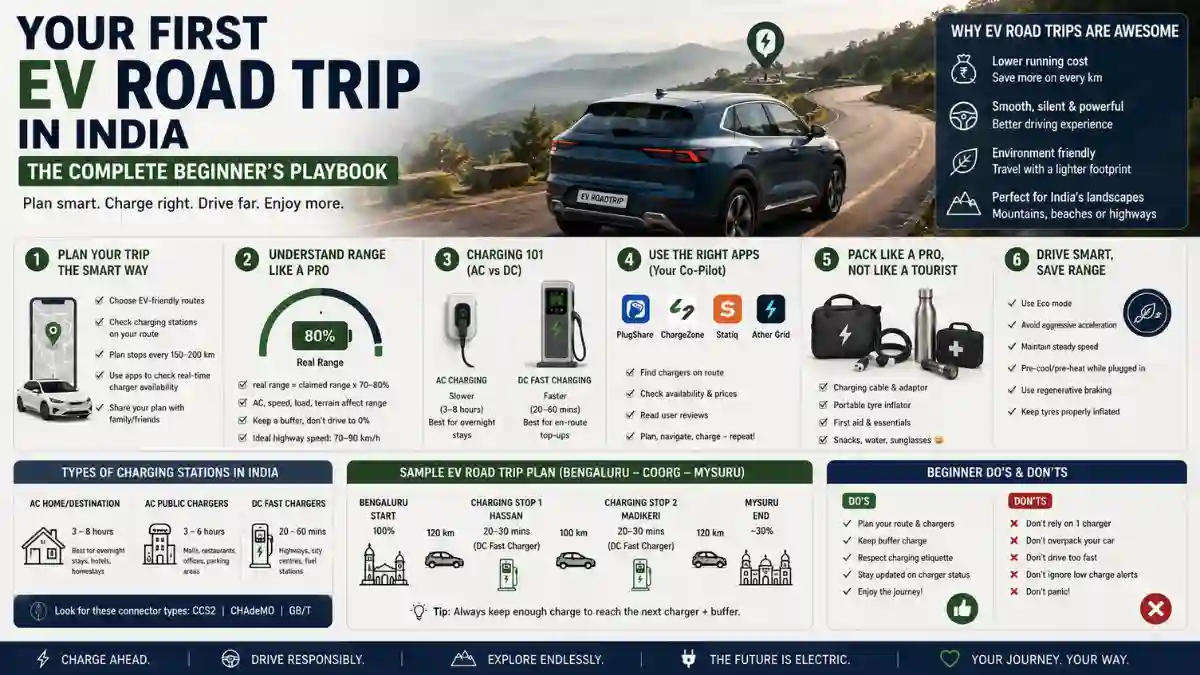
Charging anxiety is the biggest barrier to EV highway travel. Here's the exact playbook that transforms your electric car from a city commuter into a confident long-distance partner.
The Honest Verdict
- Yes, absolutely — but with caveats and planning that petrol cars don't require. A 400 km drive is feasible; a 1,000 km drive requires 2–3 intermediate charging stops.
- You need a DC fast charger, not AC home charging. AC chargers are for overnight top-ups; highway charging is DC fast charging (50 kW+), which adds 300–400 km of range in 30–45 minutes.
- Planning the route around charging points is non-negotiable. Unlike petrol cars where fuel stations are everywhere, you need to know where you're stopping before you leave.
- Your car's real-world range is 65–75% of claimed ARAI numbers. If your EV claims 500 km, plan for 350 km between charges. This buffer is your safety margin.
- The sweet spot for beginner EV road trips: 250–350 km between overnight charges. This gets you from Delhi to Agra, Mumbai to Pune, or Bengaluru to Mysore in a single charge, without stress.
The Five Fundamentals of EV Road Trip Planning
Before you book your highway trip, these five facts need to shape your entire strategy. They're not negotiable; they're the physics and infrastructure reality of EVs in India.
1. Real-World Range Is Your Starting Point — Not ARAI Claims
Every EV comes with an ARAI-certified range. The Tata Nexon EV Plus claims 440 km. The Mahindra BE 6 claims 680 km. But these numbers are measured under ideal lab conditions: 55 km/h constant speed, 23°C, flat terrain, zero AC usage.
Real India road trip conditions are different. You're driving at 80–100 km/h on highways with air conditioning running. Summer heat reduces battery efficiency by 10–15%. Hilly terrain (like the Western Ghats or Himalayas) can cut range by 20–30%. Traffic congestion on city outskirts burns extra charge.
The rule: multiply ARAI range by 0.65 to 0.75 to get your actual highway range. So a 500 km ARAI car becomes a 325–375 km real-world highway range. Plan your charges around this figure, not the marketing number.
2. DC Fast Charging, Not AC, Is What Makes Road Trips Possible
Home charging uses an AC charger (3.3 kW to 7.2 kW) — perfect for overnight top-ups but useless on the highway. Highway charging requires DC fast chargers (50 kW to 175 kW) that charge significantly faster by bypassing your car's onboard converter.
On DC fast charging, expect to add 200–400 km of range in 30–45 minutes. The speed depends on the charger's power (50 kW vs 175 kW) and your car's max charging rate. Most DC chargers stop at 80% charge — pushing beyond that adds disproportionate time and damages the battery. So your charging pattern on a road trip is: charge to 80%, drive 200–300 km, charge to 80% again.
3. Route Planning Is Non-Negotiable
You cannot spontaneously decide mid-drive to take a detour like you would with a petrol car. Before leaving, you must: identify your charging network, locate DC fast chargers along your route, note their reliability ratings in real-time apps, and plan your stops at safe, well-lit highway locations.
Use apps like Tata Charging (best for national highways), ChargeZone, or ZoomCar's EV charging maps. Filter for DC fast chargers only. Screenshot or bookmark the route, including charger locations and contact numbers.
4. Battery Degradation Is Real — But Not Fast Enough to Worry About
Repeated DC fast charging on long road trips does marginally accelerate battery degradation. The industry standard is that EV batteries retain ~80% capacity after 8–10 years or 1.6–2 lakh km — covered by warranty. A single road trip won't noticeably impact this. But for reference: a driver doing weekly 500 km road trips will see measurable battery decline after 3–4 years. For annual or semi-annual trips? Negligible impact.
5. The Time Cost Is Higher Than Petrol — But Predictable
A 400 km trip in a petrol car: 5–6 hours drive, 5 minutes fuel stop = 5.5–6 hours total. The same trip in an EV: 5–6 hours drive, 40 minutes DC charge stop (at 80%) = 5.8–6.5 hours total. The EV adds roughly 30–45 minutes. It's noticeable but manageable. For 800 km, the EV needs two 40–45 minute charging stops, adding 1.5 hours to a petrol car's time — but you arrive less fatigued because you've had two structured breaks.
The Three Charging Networks That Cover India's Highways (And Which to Use When)
| Network | Coverage | DC Fast Chargers | Reliability Rating | Best For |
|---|---|---|---|---|
| Tata Charging | Excellent nationwide | ~2,800+ stations | Highly reliable | Primary network for all routes. Owned by Tata Motors — best support infrastructure. |
| Shell Recharge | Strong metro corridors | ~1,200+ stations | Good | Secondary network. Better coverage on Delhi–UP–Rajasthan routes and coastal highways. |
| ChargeZone | Growing, regional | ~500+ stations | Improving | Regional backup. Stronger in South India (Bengaluru–Chennai). Skip on first trips. |
| Hotel/Mall Chargers | Spotty | Variable (mostly AC) | Unreliable | Never your primary plan. Use as a bonus if discovered. Most are AC only or unmaintained DC. |
Beginner strategy: For your first 2–3 road trips, plan exclusively around Tata Charging stations. Once you're comfortable identifying alternative chargers and understanding app reliability ratings, layer in Shell Recharge as a backup network.
📎 Related: Tata Charging vs Shell Recharge — Which Network Is Fastest on Indian Highways
Sample Road Trip Routes for Beginners (With Realistic Charge Plans)
These routes are designed for learners on moderate-range EVs (claimed 450–550 km range). If you're driving a Mahindra BE 6 (680 km range), some charging stops become optional.
Beginner-friendly. Charge at home in Delhi, drive straight to Jaipur (280 km real-world range is comfortable). Charge in Jaipur overnight on AC home charging or hotel charger. No highway DC charging needed. Perfect first trip.
First DC charging experience. Drive from Delhi to Agra (210 km, well within range). Use Tata Charging app to find the DC charger at Agra (typically near NH44 or in the city). Charge to 80% (30–40 min), explore Taj Mahal, return to Delhi. Total trip time: 7–8 hours including sightseeing.
Shortest beginner route. Easily done on a single charge even in the best-case scenario (real range 300+ km). If your EV's range is borderline, charge once in Pune to get comfortable with charger apps. This route builds confidence for the Mumbai–Goa highway (750 km, requires 2 DC stops).
For understanding hill-terrain range loss. Bengaluru to Mysore (145 km) is safe on a single charge despite hills. In Mysore, charge to 80% (35–45 min on DC). Then Mysore to Coorg (120 km uphill) tests your hill-efficiency knowledge. Plan return with a Mysore DC charge again. Teaches the 20–30% range penalty in hilly terrain.
The Pre-Trip Checklist: Everything You Need Before You Leave
✓ 48 Hours Before Your Trip
- Book DC charging stops on the Tata Charging app — some popular highway chargers get occupied during peak travel seasons (holidays, weekends).
- Check real-time charger status in your route's app — mark if any usual chargers are under maintenance.
- Verify your car's actual range under recent driving conditions (not ARAI numbers). Take a test highway drive if possible.
- Download offline maps of your entire route in case connectivity drops on the highway.
- Full battery health check: have your car's management system display remaining health percentage (often 98–100% on new cars).
- Confirm your insurance covers road trips (most do, but check).
- Book accommodation with charging options if overnight stops are needed (even basic AC chargers help).
✓ Morning of Departure
- Start with a fully charged battery (100% from home AC charger if possible, or DC charge the night before).
- Set your car's navigation to your first charging stop, not your final destination — this keeps you focused on intermediate goals.
- Enable real-time efficiency data on your infotainment if available (shows km/kWh consumption).
- Screenshot or sync all charger locations and phone numbers to your phone.
- Test your car's app connectivity (Tata Charging integration, Tesla app, or whatever your car uses).
- Confirm you have sufficient data / WiFi for the trip (charger apps use surprisingly little data, but connectivity drops happen).
✓ During the Charging Stop
- Plug in and start charging immediately — don't sit around hoping it starts automatically.
- Use the charger's app or card to initiate the session (app is better; cards sometimes malfunction).
- Check the charging screen every 10 minutes for the first 15 minutes — if the charge rate drops unexpectedly, the charger may be faulty.
- Take breaks: eat, walk, use washrooms. Charging to 80% takes 30–45 minutes anyway.
- Do NOT charge beyond 80% in summer heat — it stresses the battery and takes disproportionately longer (80–100% takes almost as long as 0–80%).
- Screenshot the charging receipt / session details in case there's a billing dispute later.
The Mistakes That Turn Road Trips into Stressful Ordeals
- Planning based on ARAI range without a buffer. "My EV claims 500 km, so I can drive 500 km then charge." Wrong. You'll arrive at the charger with 30–50 km of range remaining and extreme stress. Always assume 70% of ARAI as actual range.
- Charging beyond 80%. You think "I have time, let me charge to 95%." That last 15% takes 30+ minutes on DC charging because the car throttles the power to protect the battery. Not worth it. Charge to 80% and go.
- Not downloading offline maps. Charger apps and navigation rely on cellular connectivity. On highways, 4G drops happen. Offline maps let you navigate to the charger even if signal is lost.
- Relying on hotel chargers as primary charging points. Hotels have AC chargers (slow) or unmaintained DC chargers (unreliable). Never use them as your main plan. Use highway DC chargers instead.
- Not booking DC chargers in advance. Peak season weekends can see chargers fully booked 2–3 hours into the day. Always pre-book using the app if the option exists.
- Driving at night without knowing charger operating hours. Some highway chargers close at 10 PM or have spotty staff. Check hours before planning a late-evening arrival.
- Underestimating hill terrain impact. Hilly drives like the Western Ghats or Himalayan foothills cut range by 20–30%. Plan accordingly.
📎 Related: EV Road Trip Failures in India 2025–2026 — Real Stories and How to Avoid Them
Cost Comparison: EV Road Trips vs Petrol Road Trips
Everyone assumes EVs are cheaper to operate — and they are, but the gap narrows on road trips where you're paying highway charger markups.
| Metric | EV (400 km trip) | Petrol SUV (400 km) | Savings |
|---|---|---|---|
| Fuel/Charge Cost | ₹600–900 (DC) | ₹2,400–2,800 | ₹1,500–2,200 |
| Charging/Fuel Time | 40–45 min | 8–10 min | EV slower |
| Maintenance (per 10,000 km) | ₹500–1,000 (tyre wear only) | ₹3,000–5,000 (service) | ₹2,000–4,000 |
| Total 400 km Trip Cost | ~₹700–950 | ~₹2,400–2,800 | ₹1,450–2,100 |
The EV wins on cost by ~60–75%. You pay more for charging than home electricity, but still far less than petrol. The trade-off: you spend 30–45 extra minutes charging per 400 km. For most Indian road trippers (who aren't commuting daily and do this once a year), that trade-off is easily worth it.
The Psychological Shift: Moving From "Can I Make It?" to "When Should I Charge?"
The biggest mental difference in EV road trips is the mindset shift. With petrol cars, you think: "Will I have enough fuel to reach my destination?" With EVs in 2026 India, the question is: "Where are the charging points, and when should I stop?"
This requires pre-planning, but it's liberating in a different way. You're building in structured breaks — better for driver fatigue. You're not anxiously watching the fuel gauge; you're watching your charge percentage in a predictable decline. And after 2–3 trips, this becomes automatic.
"The first EV road trip is intimidating. The second is annoying. The third is normal. By the fifth, you can't imagine going back to petrol car road trips — the anxiety disappears." — Perspective from Indian EV owner communities, 2025 survey data
Making Your First Trips Stress-Free
- Start with a 250 km round-trip route. Close enough to home to turn back if needed, far enough to experience a full charging session.
- Go during off-peak season (weekdays, not holiday weekends). Lower traffic, less charger congestion, and lower stress all around.
- Bring an extra power bank and phone charger. Not for the car — for yourself. You'll be sitting at chargers for 40+ minutes; entertainment and connectivity matter.
- Befriend the Tata Charging app. Spend 15 minutes exploring it before your trip. Knowing how to filter for DC chargers, reserve a spot (if available), and read charger ratings eliminates 80% of the anxiety.
- Join EV owner communities. Facebook groups and Discord servers of Indian EV owners share real-time charger status, failure reports, and route tips. This is more useful than any official guide.
EV Road Trips in India Are No Longer a Test — They're an Option
In 2022, taking an EV on a road trip was a demonstration of early-adopter faith and mechanical luck. In 2026, it's just a different way to travel — with clear trade-offs that most people find acceptable after their first trip.
The bottom line: Start with a 250 km route. Plan your charging stops using Tata Charging. Charge to 80%, not 100%. Drive to your next charger. Repeat. Within three trips, this becomes second nature, and you'll wonder why you were ever nervous.
India's roads are some of the most beautiful in the world. An EV doesn't diminish that journey — it just asks you to pause strategically along the way. After a decade of driving EVs in silence past India's sunsets, most drivers find that's not a compromise at all.
Leave a comment
Share a quick thought about this story.
Thanks for sharing your view. It is ready for review.
Please try again in a moment.