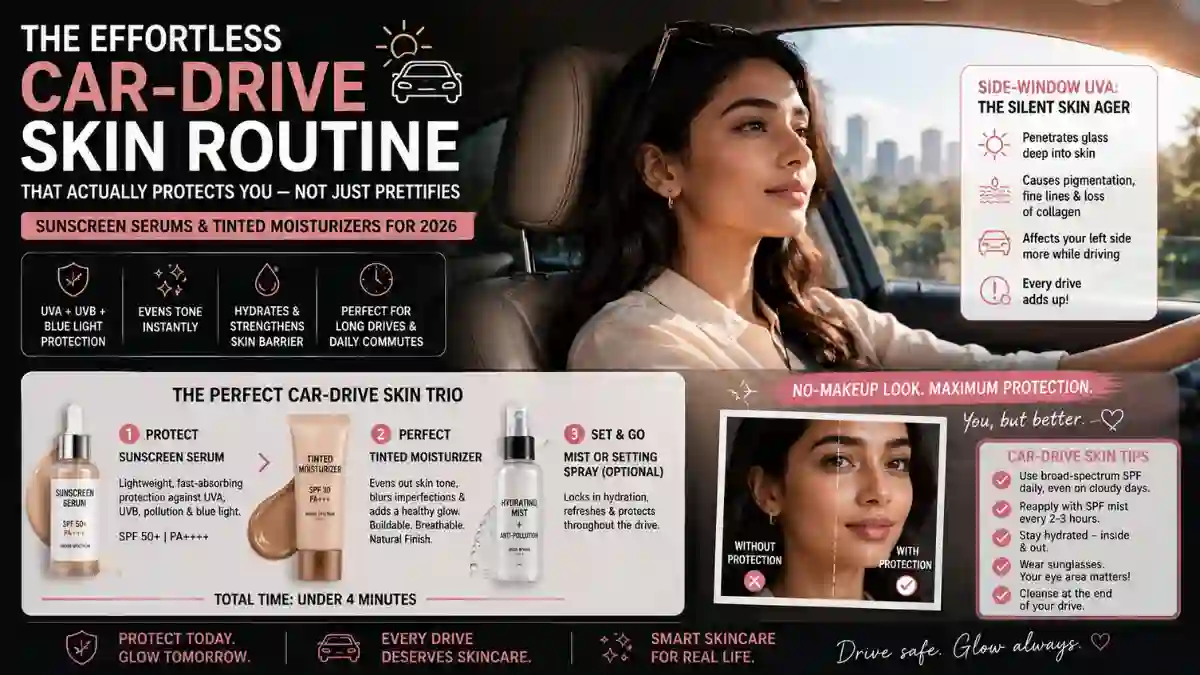
Your side window lets in more UVA than you think. Here how to build a 4-minute routine that makes you look luminously put-together — while actually guarding your skin on every kilometre.
What the Best Skin Strategy for Long Car Drives?
- Sunscreen serum first — a lightweight, non-greasy SPF 50 PA++++ fluid that absorbs like skincare, not sunblock. This is your actual UV defence layer.
- Tinted moisturizer second — choose a formula with built-in SPF that matches your undertone for a secondary filter, even skin tone, and a glowy finish that won't shift in AC air.
- PA++++ matters more than SPF number for in-car protection — PA measures UVA defence (the glass-penetrating wavelength); most Indian skin damage on drives is UVA-driven, not UVB.
- Reapplication at the 3-hour mark — on drives over 3 hours, a tinted SPF cushion or SPF mist restores protection without disturbing your base.
- Your car cabin environment — AC dehydration, recirculated air, dashboard heat reflection — affects how products perform. This is a different use case from a beach or outdoor routine.
Why Your Car Is One of the Most Underrated Sun-Damage Environments
Most people instinctively reach for SPF before going to the beach or stepping out for a walk. Very few think to apply it before settling in for a three-hour highway drive. But the dermatological reality is clear and consistently documented: asymmetric photoageing — more pronounced fine lines, pigmentation, and skin laxity on the left side of the face for drivers — is direct, measurable evidence of long-term in-car UVA accumulation.
Standard automotive glass is excellent at blocking UVB, the burning wavelength. But UVA — the longer, deeper-penetrating wavelength responsible for collagen degradation and melanin dysregulation — passes through most side glass with minimal attenuation. On a long drive, the sun angle tracks across your side window for hours at a near-constant oblique angle that maximises dermal penetration.
The Climate Factor for Indian Drives
For Indian road trippers, the exposure calculus is even less forgiving. The subcontinent sits in one of the world highest UV index zones — peak UVI routinely reaches 10–12 on highway stretches through Rajasthan, Maharashtra, and Tamil Nadu between March and September. The UV Index in Delhi summer hours regularly exceeds the threshold at which skin damage accumulates in under 15 minutes of unprotected exposure outdoors. Inside the car, you're protected from wind and direct UVB. But UVA through that side window? Completely uninterrupted.
UVA through glass is only one part of the in-car skin threat. PM2.5, VOC off-gassing, and AC dehydration compound the damage. Here how next-generation cabin technology — and your own skincare routine — work together as a complete protection system.
"The car is the forgotten photoageing environment. Most patients don't connect their left-cheek pigmentation to a decade of daily commuting — but once you show them the data on glass UVA transmission, the connection is immediate." — Perspective reflected in clinical photoageing literature and dermatological practitioner surveys, 2025
Sunscreen Serums vs Tinted Moisturizers vs Hybrid SPF: What Does What
Before building a routine, it helps to understand exactly what role each product category plays — because layering them correctly is what makes the difference between feeling like you're wearing a protective mask and looking naturally luminous all day.
- UVA exposure for 4+ hours through side glass
- AC air drops cabin humidity below 30%, dehydrating skin
- Dashboard heat reflection adds infrared radiation load
- Existing makeup slides, oxidises, looks patchy by noon
- PM2.5 in recirculated air accelerates oxidative stress
- SPF 50 PA++++ serum as a first-layer UV filter
- Tinted moisturizer locks in hydration, evens tone
- A hyaluronic acid base prep fights AC dehydration
- Complexion stays fresh, no oxidisation or cakiness
- Antioxidant actives (niacinamide, vitamin C) neutralise PM2.5 free radicals
Sunscreen Serums: The Invisible Protection Layer
A sunscreen serum is a hybrid between an active treatment and a UV filter — typically water-light, fast-absorbing, and formulated with additional actives like niacinamide, hyaluronic acid, or antioxidants alongside SPF 50 PA++++. For Indian skin on long drives, this is the non-negotiable first step. It delivers meaningful UV protection without the white cast of traditional mineral sunscreens, and without the heavy texture that feels suffocating under AC ventilation.
The key specification to look for: PA++++ rating, not just SPF 50. SPF quantifies UVB protection only. PA++++ — the Japanese and Indian market UVA standard — is what actually guards you through glass. A product with SPF 50 but only PA++ leaves you meaningfully underprotected for in-car exposure.
Tinted Moisturizers: The Tone-Evening Second Layer
The best tinted moisturizers in 2026 have evolved well beyond sheer wash formulas. They now carry their own SPF 30–50, offer five to eight shades specifically developed for South Asian undertones (warm golden, neutral olive, and deep terracotta), and include ingredients — glycerin, squalane, ceramides — that counter the specific dehydrating effect of air-conditioned cabin air. Layered over a sunscreen serum, they function as a second UV filter while delivering a skin-matching, skin-improving complexion finish.
Hybrid SPF Cushions: Your Reapplication Tool
No sunscreen product maintains full efficacy beyond three to four hours of active UV exposure. On a long drive, you need a way to reapply without disturbing your base. A tinted SPF cushion — pressed, compact, and mess-free — is the answer. A light press over your complexion at the midpoint of a long drive restores UV protection and refreshes coverage without the need for a mirror or a makeup bag.
📎 Related: PA Rating vs SPF — Why Indian Skin Buyers Need to Know the Difference
The 4-Minute Pre-Drive Skin Routine That Actually Works
This isn't a 12-step regimen. It a precision sequence calibrated for the specific demands of in-car skin — UV protection, hydration retention under AC, and a finish that stays composed for hours without touch-ups.
A fine-mist hyaluronic acid essence or serum applied to slightly damp skin. This is your moisture reservoir for the drive — it compensates for the 20–30% cabin humidity that AC creates and plumps the skin surface for the products that follow. 3–4 sprays or 2 drops, pressed in gently.
Apply a fingertip-and-a-half amount evenly across face and neck, including the area behind the ears and the décolletage for longer drives. Allow 60 seconds to absorb — do not rush this step. This is your primary and most critical layer.
Two dots on cheeks, one on forehead, one on chin. Blend outward with fingertips in upward strokes. This layer unifies your complexion, provides a secondary UV barrier, and — critically — gives you the natural glow that makes this the actual no-makeup look rather than just bare skin.
A setting mist — ideally one with antioxidants like vitamin C or green tea — locks in the base, adds a final dewy finish, and begins the antioxidant defence against any PM2.5 that makes it past your cabin filter. Hold 20 cm away, eyes closed, two pumps.
The lips are frequently the most sunburned area on long drives — the cupid bow faces the side window at an acute angle on the driver side. A tinted SPF lip balm is functional, not cosmetic. One swipe of concealer under the eyes completes a genuinely polished, makeup-free look.
The Best Sunscreen Serums and Tinted Moisturizers for Indian Skin in 2026
The Indian beauty market has matured significantly. Several homegrown formulations now match or exceed international alternatives for Indian skin tones — and they do so without the white cast, ashy finish, or wrong-undertone shades that plagued earlier options.
The Minimalist SPF 50 PA++++ Fluid
Ultra-light chemical filter. No white cast, no grease. Layers perfectly under tinted moisturizers. The niacinamide inclusion makes it a pigmentation-prevention layer on top of UV protection.
Dot & Key Glow SPF 30 Tinted Cream
5 shades from light golden to deep terracotta. Vitamin C, squalane, and ceramides in the base. Genuinely dewy finish that doesn't oxidise or go flat over 6+ hours in AC.
Foxtale Glow & Protect SPF 50 PA++++
A true hybrid — acts as both the first-layer sunscreen serum and a subtle radiance base. Formulated specifically for warm-undertone Indian skin. Single-step option for truly minimal routines.
Bioré UV Aqua Rich Watery Essence
The Japanese benchmark that established the "sunscreen serum" category. SPF 50+ PA++++. Absorbs in seconds, wears invisibly. Works as a first layer under any tinted product without disrupting the finish.
Pilgrim SPF 50 Tinted Sunscreen
6 shades including dedicated golden-olive and dusky terracotta options — some of the most accurate undertone matching for Indian skin currently available. Hyaluronic acid base for AC-proofing.
Laneige Neo Cushion SPF 50
The best mess-free in-car reapplication option. Buildable coverage, SPF 50, two India-appropriate shades. Fits in a car centre console. The 3-hour reapplication becomes effortless with this in the glove box.
Shade Matching for Indian Skin: A Quick Guide
Total Sun Protection on Long Drives — More Than Just Your Skincare Routine
Your sunscreen serum and tinted moisturizer are doing a significant amount of work. But they're working within a broader environment — and the smartest approach to in-car sun protection treats that environment as part of the solution, not just the background.
UV-blocking window film, HEPA-filtered cabin air that reduces oxidative stress on skin, and active humidity management — the cabin tech layer that works with your topical routine for complete in-car sun and pollution protection.
UV-blocking window film applied to side glass can cut UVA transmission from 74% down to under 5% — making it the single highest-impact upgrade for in-car photoprotection, whether your car has a cabin purification system or not. It costs a fraction of a premium skincare routine and lasts years. If you drive for long hours regularly, it belongs on every side window.
Keeping Your Routine Effective Across a Long Drive
- Reapply at the 3-hour mark — use a tinted SPF cushion or SPF mist, not more tinted moisturizer. Additional moisturizer layers ball up; SPF cushion presses on cleanly.
- Keep a facial mist in the car — spritz over your base every 90 minutes to counter AC-driven transepidermal water loss. It refreshes the look as well as the skin.
- Angle your AC vents away from your face — direct airflow accelerates skin dehydration dramatically and can cause fine lines to look more pronounced within the hour.
- Wear a wide-brim hat for stops — UV exposure outside the car during fuel stops, dhaba breaks, or highway rest areas is unfiltered and intense. Don't let the stops undo the protection.
- Carry a blotting sheet, not more powder — if the warm cabin triggers oiliness, blot rather than build. Extra powder on top of your layered base leads to cakiness, not freshness.
📎 Related: The Best Facial Mists for Long Indian Road Trips — Ranked by Climate Zone
The Mistakes That Undermine Even the Best Drive-Ready Routine
- Using a moisturizer-only tinted product without dedicated SPF underneath. A tinted moisturizer with SPF 20 as your only sun layer is significantly under-protected for a multi-hour drive. Always pair with an SPF 50 PA++++ base serum.
- Applying sunscreen too thinly. SPF ratings are tested at 2mg/cm² of skin — roughly ¼ teaspoon for the face. Most people apply 25–50% of that. Halved application roughly squares the protection loss: SPF 50 applied at half the correct amount performs closer to SPF 10.
- Skipping the neck and décolletage. Both areas are in UVA line of fire during a drive. The neck, in particular, ages significantly faster when unprotected — it a common tell for otherwise well-protected skin.
- Not matching undertone on the tinted moisturizer. A grey or pink-toned "light" shade will look ashy or ruddy on Indian skin within an hour of wear. Undertone is more important than depth for a natural, no-makeup finish.
- Skipping reapplication on drives over 3 hours. Every sunscreen degrades with UV exposure time, sweating, and sebum production. A 6-hour drive with one morning application gives your skin zero protection in the final three hours — exactly when afternoon UV intensity peaks.
The Drive-Ready Routine Is the New Skincare Essential
The no-makeup look on a long drive isn't just an aesthetic choice — it a skin protection strategy. A sunscreen serum layered under a well-matched tinted moisturizer gives you the two things simultaneously: real broad-spectrum UV defence against the glass-penetrating UVA that ages your skin on every kilometre, and a polished, luminous complexion that requires no mirror, no bag, and no fuss.
Indian road trips are some of the most beautiful drives on earth — and the light pouring through that side window should be something you enjoy, not something your skin pays for weeks later. Build the four-minute routine. Find your tinted shade. Reapply at the three-hour mark. The road is long and the skin is worth it.
Leave a comment
Share a quick thought about this story.
Thanks for sharing your view. It is ready for review.
Please try again in a moment.