Road Trip Skincare
Climate-Zone Ranked · 2026
📅 May 2026
⏱ 8 min read
Travel Skincare
Also trending as
- "I Drove Delhi to Leh With 5 Different Facial Mists — Only One Survived the Altitude"
- "Why the Mist That Saved Your Skin in Kerala Will Destroy It in Rajasthan"
- "What Changed in 2026: The New SPF Mist Category and Why Indian Travelers Need It"
There is a particular kind of exhaustion that settles into your skin about six hours into a long Indian road trip. The AC has been running since Jaipur. The sun has been on your left side since noon. You've eaten highway dhaba food twice. You glance in the visor mirror somewhere near Ajmer and your skin looks like it has aged a decade in a day. You reach into the bag for your facial mist — the one that worked brilliantly on your Mumbai–Goa run last monsoon — and spritz it generously across your face. By the time you've capped it, the moisture has already evaporated. Your skin feels tighter than before.
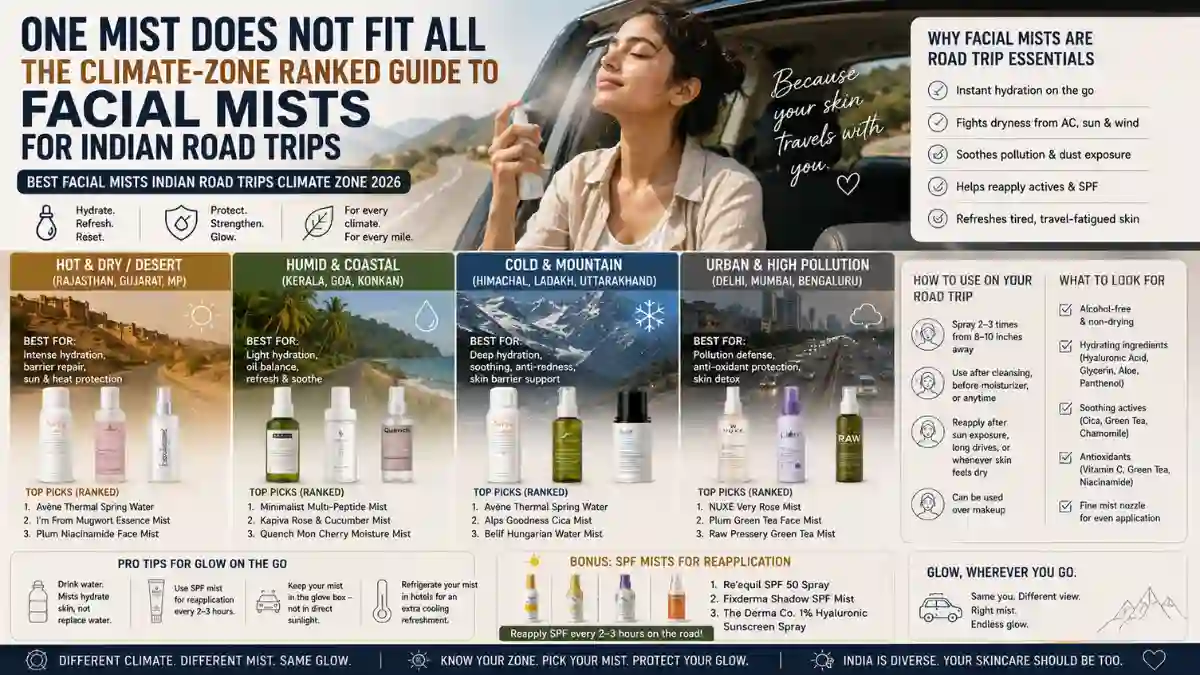
This is not a product failure. It is a climate mismatch — one of the most common and least discussed mistakes in travel skincare. The best facial mists for Indian road trips are not universal. India spans six major climate zones, and what your skin needs at 48°C and 8% humidity on the Thar Desert highway is physiologically opposite to what it needs at 34°C and 90% humidity on a Kerala coastal drive. This ranked guide matches the right mist to the right landscape — so you arrive at every destination with the same skin you left with.
Quick Answer
The ideal facial mist for an Indian road trip changes with the climate zone you're driving through. In dry desert and high-altitude zones (Rajasthan, Ladakh, Spiti), use occlusive-rich mists with glycerin, hyaluronic acid, and ceramides — sealed immediately with moisturiser. In humid coastal zones (Kerala, Goa, coastal Odisha), use lightweight, low-humidity mists based on thermal or rose water with minimal humectants. In semi-arid and Deccan plateau zones, lightweight hydrating mists with antioxidants work best. One universal rule: pure rose water or thermal spring water works adequately in any zone when nothing else is available — but zone-matched formulas outperform by a significant margin.
Why Climate Zone Changes Everything for a Facial Mist
A facial mist is not simply water in a bottle. Its effect on your skin is governed almost entirely by what happens to that moisture once it lands on your face — and that depends on the ambient humidity and temperature of the air around you.
8%
Average humidity, Thar Desert highway in peak summer
92%
Humidity on Kerala backwater coastal drives, monsoon
2×
Faster moisture evaporation rate at high altitude vs sea level
40°C+
Surface temp differential between shaded face and sun-exposed skin on a road trip dashboard
In low-humidity environments — deserts, mountain passes, dry plains — a mist loaded with humectants like hyaluronic acid will draw moisture outward from your dermis as it evaporates, leaving your skin drier than before application. This is the paradox that catches most travellers off guard. In these zones, you need a mist with both humectants and occlusives, applied and sealed with a moisturiser within 30 seconds.
In high-humidity environments — coastal drives, monsoon-season travel — the air already supplies ambient moisture. What your skin actually needs is a light, refreshing mist that cools and resets without adding oiliness or disrupting your sunscreen layer. A heavy glycerin-loaded mist here sits on top of already-saturated skin and creates a sticky, congested feeling that lasts for hours.
"The same ingredient that hydrates your skin in one climate extracts moisture from it in another. Context isn't a preference in skincare — it's chemistry."
— Cosmetic Dermatology, climate-adaptive skincare principles
🌡️ Up to 50°C peak
💧 8–25% humidity
🌬️ Hot, desiccating wind
☀️ Intense UVA + UVB
This is the most demanding environment for facial mist use in India. The combination of extreme heat, near-zero humidity, and constant wind creates relentless transepidermal water loss. A plain thermal or rose water mist applied here evaporates within 45–60 seconds and actively draws moisture from the skin as it goes. You need a formula specifically engineered to deposit and lock.
1
Glycerin + Ceramide Barrier Mist
The desert driver's essential
A mist combining 2–5% glycerin with ceramides (NP, AP, or EOP) and niacinamide deposits humectants and immediately begins building occlusive layer on the skin surface. Must be followed within 20–30 seconds with a thin layer of moisturiser to trap the deposited moisture before the desert air claims it. Brands like Minimalist, Dot & Key, and The Derma Co. offer formats approaching this profile.
Desert ✓
Seal immediately after
Glycerin + Ceramides
2
Hyaluronic Acid Multi-Weight Mist
Deep-pull hydration for dry highway skin
Multi-molecular weight HA (high + low molecular weight in the same formula) works better in desert conditions than single-weight HA because the larger molecules create a surface hydration layer while smaller ones penetrate deeper. Still requires immediate sealing. Apply to slightly damp skin (or after a light thermal mist) for maximum uptake.
Desert ✓
Damp skin application
Multi-weight HA
3
Aloe Vera + Vitamin E Soothing Mist
Anti-inflammatory repair for sun-stressed skin
After extended desert sun exposure, skin becomes inflamed before it visibly burns. Aloe vera's acemannan compound reduces this inflammatory response while Vitamin E provides antioxidant cover against UV-generated free radicals. Suitable for evening reapplication at rest stops when the temperature drops and sealing is less critical.
Desert ✓
Evening use ideal
Post-sun repair
🌡️ 28–38°C
💧 70–92% humidity
🧂 Salt air on coastal routes
☁️ UV remains intense despite cloud cover
Coastal road trips are a beautiful case of skin paradox: the air feels hydrating but the combination of salt, heat, and humidity actually depletes skin differently than dry zones. Salt deposits from sea air draw moisture outward via osmosis. Sweat mixes with sunscreen and creates an occlusive layer that traps heat. You need a mist that refreshes and resets without adding heaviness or congestion.
1
Thermal Spring Water Mist
The coastal classic — lightweight, pH-correct, cooling
Thermal spring water (Avène, La Roche-Posay Serozinc, or equivalent) is buffered to skin's natural pH and contains trace minerals that calm salt-stressed and sweat-congested skin without adding any humectant load. On humid coastal drives, this is the ideal mist because it resets the skin surface, cools the face noticeably, and evaporates cleanly without leaving residue or disrupting sunscreen layers.
Coastal ✓
No sealing needed
SPF compatible
2
Rose Water Mist (Pure, No Alcohol)
Anti-inflammatory and cooling for heat-flushed skin
Pure rose water (not rose-scented toner) is mildly astringent, anti-inflammatory, and reduces the redness and heat-flush that coastal sun produces on skin. The key is confirming zero alcohol content — alcohol-based rose waters devastate an already-dehydrated barrier. Pure Gulab Jal is widely available across India and performs comparably to branded rose water at a fraction of the cost.
Coastal ✓
Alcohol-free only
Anti-redness
3
Green Tea Antioxidant Mist (Low Humectant)
UV-damage defence on long open-road coastal stretches
Coastal drives deliver brutal UVA exposure across wide-open water-reflected terrain. A green tea-based mist supplies EGCG (epigallocatechin gallate) — an antioxidant that neutralises UV-generated free radicals that penetrate past sunscreen. Lightweight enough for humid conditions, this is the choose-it-for-protection rather than choose-it-for-hydration option in the coastal category.
Coastal ✓
UV antioxidant support
EGCG formula
🌡️ 0–25°C (extreme range)
💧 15–30% humidity
☀️ 2× UV radiation vs sea level
🌬️ Cold, desiccating wind
High altitude combines the worst moisture-stripping conditions with the highest UV exposure in India. Wind at mountain passes is constant and cold — even when the sun is intense. At these elevations, any mist that is not immediately sealed with an occlusive moisturiser actively worsens skin condition. The mantra at altitude: if you can't seal it within 20 seconds, don't spritz it.
1
Ceramide Barrier Repair Mist + Immediate Occlusive
The only responsible choice above 3,500m
At altitude, the skin barrier is under constant erosion from UV, wind, and low oxygen. A ceramide-reinforced mist used as a prep layer — applied 20 seconds before a thick occlusive moisturiser — dramatically improves the barrier's ability to hold moisture between reapplications. This is the same principle as the Ayurvedic nasya practice (nasal oiling) but applied topically: small deposits, sealed fast, repeated consistently.
Mountain ✓
Seal within 20 sec
Ceramide NP/AP
2
SPF Setting Mist (Mineral, PA+++ Rated)
Reapplication solution for high-altitude UV exposure
Reapplying cream sunscreen over a full face of protective layers mid-drive is impractical and disruptive. A mineral SPF mist — zinc oxide suspended in a fine spray — allows genuine SPF reapplication every 90 minutes without disturbing base layers. At altitude where UV doubles, this is not optional. The PA rating on SPF mists is often lower than cream equivalents — verify before purchasing and reapply more frequently to compensate.
Mountain ✓
SPF reapplication
PA+++ minimum
3
Thermal Water + Squalane Emulsion Mist
For overnight stops and post-drive repair
Squalane — an extremely stable, lightweight oil — can be suspended in a mist emulsion for use at rest stops and overnight. Unlike most oils, squalane mimics skin's own sebum and penetrates without heaviness. In cold mountain homestay environments where heavy creams are hard to work with cold-stiffened hands, a squalane emulsion mist delivers targeted lipid replenishment with minimal friction.
Mountain ✓
Rest stop / overnight
Squalane emulsion
🌡️ -2°C to 48°C (seasonal extreme)
💧 30–75% (highly seasonal)
💨 Pollution + dust load
🌧️ Monsoon: high humidity June–Sept
The North Indian plains present India's most challenging climate variability — a single highway can experience near-desert conditions in May and humid coastal conditions in August. Plains travelers need a seasonal strategy, not a single product, and a mist with pollution-combating antioxidants year-round given the consistently high particulate matter levels on major highway routes.
1
Niacinamide + Antioxidant Mist (Year-Round)
Pollution defence for highway skin
Niacinamide at 5% in a mist formula addresses the hyperpigmentation triggered by particulate matter and UV simultaneously — making it particularly valuable for darker Indian skin tones on long plains highway routes. The antioxidant layer neutralises pollution-generated free radicals that penetrate even closed car windows on heavily trafficked routes like Delhi–Agra or the Yamuna Expressway.
Plains ✓
Year-round use
Anti-pollution
2
Hyaluronic Acid Mist (October–May)
Dry-season hydration for long north Indian stretches
During the dry season (October through May), north Indian plains drop to desert-range humidity and a humectant mist with immediate sealing is required — following the same protocol as the desert zone. The primary distinction from Rajasthan: lower temperatures mean evaporation is slightly slower, giving you a 40–50 second window to seal rather than 20–30 seconds.
Plains ✓
Oct–May use
Seal within 45 sec
3
Thermal / Rose Water Mist (June–September)
Monsoon-season coolant for plains humidity
During the plains monsoon, humidity spikes to coastal levels and the same lightweight-mist logic as Zone 2 applies. A pure thermal water or alcohol-free rose water mist is all you need — cooling, resetting, and compatible with sunscreen reapplication. Avoid anything with high glycerin content during monsoon on the plains — it congests already-humid skin.
Plains ✓
June–Sept monsoon
Low humectant
🌡️ 25–42°C
💧 35–60% humidity
☀️ High UV, long-angle sun
🌬️ Dry south-west wind pre-monsoon
The Deccan plateau occupies a middle position: not as extreme as the desert or high altitude, not as humid as the coast. This moderate climate zone is actually where a well-formulated general-purpose hydrating mist performs best — the ambient humidity is sufficient to prevent rapid evaporation without being so high that humectants become counterproductive.
1
Vitamin C + Hyaluronic Acid Brightening Mist
The all-rounder that actually works here
Moderate humidity means HA mists work as intended without the paradox-drying effect of desert conditions. Adding stabilised Vitamin C (as ascorbyl glucoside or sodium ascorbyl phosphate — both stable in mist form unlike L-ascorbic acid) delivers antioxidant protection against the Deccan's intense long-angle UV and provides the brightening effect that makes this zone's mist the most skin-improving on the list. NH44 (the Mumbai–Hyderabad–Bangalore artery) is this mist's perfect highway.
Deccan ✓
Brightening
Stable Vit C forms
2
Centella Asiatica Calming Mist
Barrier repair for reactive skin on dusty plateau roads
Centella (Cica) mists have exploded in Indian skincare in 2025–26 for good reason: madecassoside and asiaticoside are clinically validated for accelerating barrier repair and reducing inflammation. The Deccan's dusty interior roads and long sun exposure create cumulative micro-inflammation that a Cica mist measurably addresses over a 4–6 hour drive. Suitable for sensitive and reactive skin types on any zone.
Deccan ✓
Sensitive skin
Barrier repair
The Universal Picks: When You Need One Mist for Everything
Not every road trip allows category-perfect preparation. Here are three formats that perform acceptably across multiple zones — the ones worth packing when you're driving across multiple climate zones in a single trip.
🌹
Pure Alcohol-Free Rose Water
Available everywhere in India, works acceptably in all five zones, costs under ₹200 for 200ml, and has zero harmful ingredients. Not optimal anywhere, but never damaging anywhere either. The emergency backup that belongs in every road trip bag regardless of what else you've packed.
All Zones
🧴
Thermal Spring Water Mist
Avène, La Roche-Posay, or Uriage thermal waters are pH-balanced, contain beneficial trace minerals, and evaporate without residue or disruption of any other skincare layer. Excel in coastal and plains zones; acceptable in moderate Deccan conditions; requires sealing in desert and mountain zones but provides a clean hydration base before the occlusive.
4 of 5 Zones
☀️
SPF 30 PA+++ Setting Mist
The 2026 category entry that changes the road trip skincare calculus: a mist that simultaneously hydrates, refreshes, and reapplies SPF protection. Not yet available in PA++++ formulations in most Indian market brands, but PA+++ mist SPF products from Korean brands (ISNTREE, Beauty of Joseon) are now widely available via Indian e-commerce. The single most practical upgrade for any zone.
SPF Reapplication
| Climate Zone |
Best Mist Type |
Avoid |
Seal Required? |
| 🏜️ Hot Arid Desert |
Glycerin + Ceramide barrier mist |
Plain water or thermal-only mists |
Yes — within 20 sec |
| 🌊 Tropical Coastal |
Thermal spring water or pure rose water |
Heavy glycerin mists |
No |
| 🏔️ High Altitude |
Ceramide mist + SPF setting mist |
Any mist without sealing plan |
Yes — critical |
| 🌾 North Plains |
Niacinamide antioxidant (year-round) + seasonal switch |
High glycerin in monsoon season |
Seasonal (dry months only) |
| 🌄 Deccan Plateau |
Vitamin C + HA brightening mist or Cica mist |
Heavy occlusive formulas |
Light seal recommended |
The Mistake That Makes Every Mist Work Against You
Most Common Road Trip Mist Mistake
Spritzing a humectant-rich mist (anything with glycerin, hyaluronic acid, or aloe vera as primary ingredients) in a low-humidity environment and not sealing it — then wondering why skin feels tighter after application. This is not a product defect. Humectants are hygroscopic: they attract water from wherever water is available. In dry air, the nearest available water source is your own dermis. The seal is not optional — it is what converts a potentially damaging habit into an effective one. In the desert and at altitude: spritz, seal, no exceptions.
Quick Tips — Facial Mist for Indian Road Trips
- Store your mist in the centre console or a front bag — mists kept in the boot reach 55°C+ in Indian summer sun and destabilise active ingredients like Vitamin C and niacinamide within a single day
- Apply mist before sunscreen reapplication (not after) when using a non-SPF mist — it creates a slightly damp surface that helps powder or compact SPF adhere more evenly
- A 30ml travel mist is enough for a full day drive when used correctly (2–3 spritzes per application, 3–4 applications maximum) — don't overspray, which wastes product and creates uneven humidity on the skin surface
- Pure Gulab Jal from any Indian pharmacy or kirana is a reliable emergency mist in all zones — always carry one as a backup regardless of your primary product strategy
- At mountain stops where temperatures drop below 10°C, warm the mist bottle in your hands for 30 seconds before application — cold mist on cold skin in wind causes capillary constriction that can worsen redness and sensitivity
- The SPF mist category in 2026 is genuinely useful but not a replacement for morning sunscreen application — it's a reapplication tool, not a first-application solution
Read the Landscape Before You Read the Label
The best facial mist for an Indian road trip is not the one with the most impressive ingredient list or the highest price point. It is the one that understands where you are driving. India's climate diversity is one of its most extraordinary qualities — and also the reason that a one-size-fits-all skincare approach fails so visibly on long-haul road trips.
Match your mist to your zone. Seal in dry environments. Stay light in humid ones. Carry pure rose water as your fail-safe. Add a PA+++ SPF mist if you're doing mountain passes or open-sky desert routes. These five choices, applied with consistency over a 10-day road trip, will mean the difference between arriving at your destination with improved skin and arriving with the kind of dull, stressed, depleted complexion that takes two weeks to recover from back home.
The road is long and the sun is relentless. Pack accordingly.
Leave a comment
Share a quick thought about this story.
Thanks for sharing your view. It is ready for review.
Please try again in a moment.