- "I Had SPF 50 On Every Day — So Why Was My Hyperpigmentation Getting Worse?"
- "What Changed in 2026: Why Dermatologists Are Now Recommending PA++++ Over High SPF Alone"
- "Most Indians Buy Sunscreen for the Wrong Number — Here's the One That Actually Matters for Your Skin Tone"
Here is a scenario that plays out thousands of times every year across India: a careful, informed buyer picks up a sunscreen with SPF 50, applies it religiously every morning, and watches their pigmentation, melasma, or tan either stay stubbornly unchanged or — confusingly — get worse. They assume the product isn't working. In reality, the product is doing exactly what it says. The problem is that they were solving the wrong half of the equation.
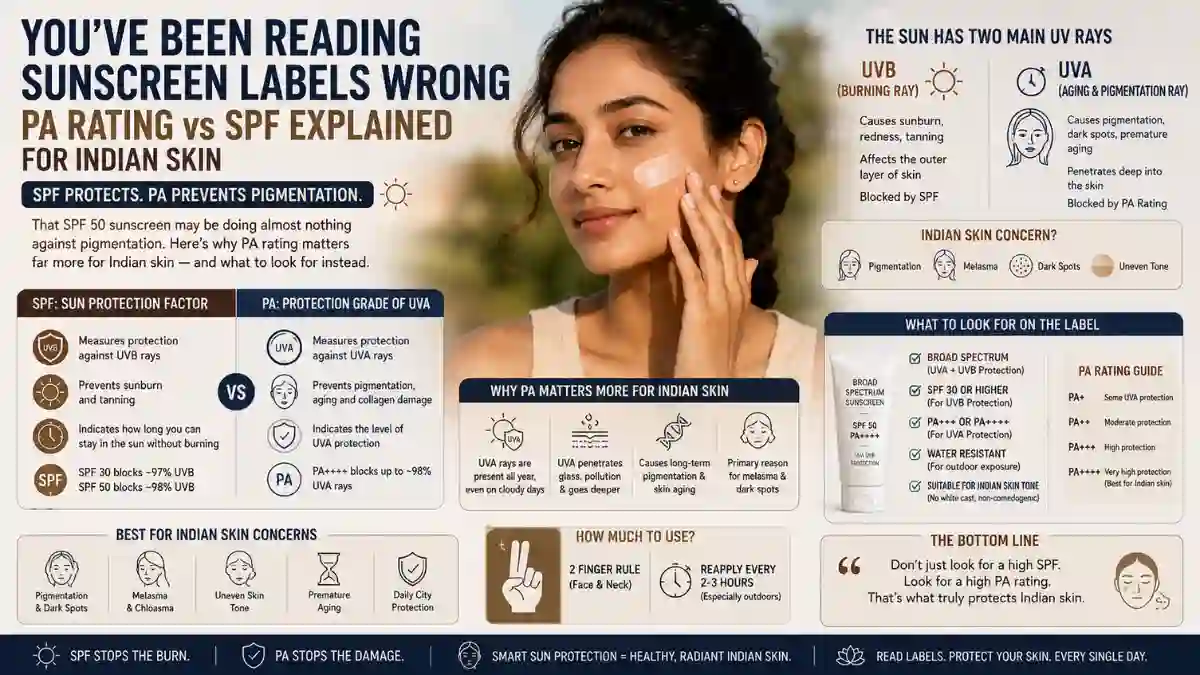
SPF only measures protection against UVB rays. UVA rays — the longer wavelengths that penetrate deeper into skin, triggering melanin production, accelerating ageing, and driving the hyperpigmentation that disproportionately affects darker skin tones — are measured by something most Indian consumers have never been taught to check: the PA rating. For Indian skin, getting this distinction right isn't a technicality. It's the difference between a sunscreen that protects you and one that gives you a false sense of security while UVA works undisturbed beneath the surface.
SPF (Sun Protection Factor) measures protection against UVB rays — the rays that cause sunburn. PA rating (Protection Grade of UVA) measures protection against UVA rays — the rays that cause tanning, pigmentation, melasma, and premature ageing. For Indian and other darker skin tones, UVA is the primary concern because melanin-rich skin is significantly more reactive to UVA-triggered melanin production. The minimum recommended standard for Indian skin is SPF 30–50 combined with PA+++ or PA++++. A high SPF with no PA rating offers dangerously incomplete protection.
UVA vs UVB: The Two Threats Your Sunscreen Has to Handle
The sun emits a spectrum of ultraviolet radiation, but the two wavelengths that reach Earth's surface and affect skin are UVA and UVB. They are not interchangeable. They behave differently, penetrate differently, and cause different types of damage — which is precisely why a single number (SPF) was never sufficient to describe complete sun protection.
95% of all UV radiation reaching Earth
Penetrates deep into the dermis — the skin's living layer. Does not cause immediate sunburn, making it the invisible threat. Stimulates melanocytes to produce excess melanin, directly driving tanning, hyperpigmentation, melasma, and photo-ageing (collagen breakdown).
Present at consistent intensity year-round, through clouds, through glass windows, and throughout all daylight hours — not just peak sun time. UVA is equally intense in December as it is in May.
Measured by: PA rating (Japan/Asia standard) or PPD rating (European standard)
5% of UV radiation — but more energetic per photon
Affects the epidermis — the outer skin layer. Causes sunburn, direct DNA damage to skin cells, and is the primary driver of skin cancer risk. Intensity varies significantly with season, time of day, latitude, and altitude.
Strongest between 10 AM and 4 PM, more intense in summer, significantly stronger at high altitudes like Ladakh and Spiti where the atmosphere is thinner and provides less natural filtration.
Measured by: SPF (Sun Protection Factor)
Why Indian Skin Is Specifically Vulnerable to UVA
Fitzpatrick skin types IV–VI — the range that covers the vast majority of Indian complexions — contain more melanin than lighter skin types, which provides some natural UVB protection (roughly SPF 2–4 equivalent). This is why darker skin tones burn less easily. But melanin also makes darker skin significantly more reactive to UVA-triggered melanin stimulation. The same UVA exposure that causes minimal pigmentation change in a Type I complexion can produce pronounced, persistent hyperpigmentation in a Type IV or V skin tone. This biological reality makes PA rating a non-negotiable consideration for Indian buyers in a way that is categorically more important than it is for buyers with lighter skin.
"In Indian dermatology practice, the majority of photoageing presentations — melasma, post-inflammatory hyperpigmentation, uneven tone — are UVA-driven, not UVB-driven. A sunscreen without adequate UVA protection is clinically incomplete for this population." — Perspective aligned with Indian Journal of Dermatology clinical consensus, 2024
Understanding the PA Rating System: What Those Plus Signs Actually Mean
The PA system was developed in Japan in the 1990s and subsequently adopted across much of Asia as a practical consumer-facing way to communicate UVA protection levels. It is now the most widely used UVA labelling standard in India, South Korea, China, and Southeast Asia. Each plus sign represents a measured level of UVA protection, quantified via PPD (Persistent Pigment Darkening) testing.
How SPF Numbers Map to Actual Protection
| SPF 15 | Blocks ~93% UVB | Allows 1 in 15 UVB photons through. Inadequate for Indian climate; only suitable for brief, incidental sun exposure. |
| SPF 30 | Blocks ~97% UVB | The minimum dermatologist-recommended level for Indian skin. Practically covers daily use under most conditions when reapplied correctly. |
| SPF 50 | Blocks ~98% UVB | Only 1% more protection than SPF 30 — but the psychological margin of comfort makes consistent application more likely. Standard recommendation for Indian outdoor use. |
| SPF 50+ | Blocks 98–99% UVB | Regulatory ceiling in most markets. Recommended for high altitude, water/beach environments, and post-procedure skin. Meaningless without adequate PA rating alongside it. |
The critical insight here is the gap between SPF 30 and SPF 50: just 1% difference in UVB filtration. The marketing industry has successfully convinced consumers that doubling the SPF number doubles the protection — it does not. The real gains in comprehensive sun protection come from increasing UVA coverage (PA rating), not chasing ever-higher SPF numbers.
Reading a Sunscreen Label: The Complete Decoder for Indian Buyers
The average Indian sunscreen label contains multiple claims, abbreviations, and certifications — many of which are meaningful and some of which are marketing noise. Here is what each term actually means and whether it matters.
Searches "highest SPF sunscreen India." Buys SPF 50 product with PA++ or no PA marking. Uses it daily. Wonders why tan and pigmentation aren't improving despite consistent use.
Searches "SPF 50 PA++++ sunscreen India." Prioritises PA rating as the primary filter. Selects broad-spectrum formula. Sees measurable improvement in pigmentation within 8–12 weeks of consistent daily use.
What to Look For: Recommended Formulas by Skin Type and Concern
The ideal SPF + PA combination varies by use case. These are the frameworks Indian dermatologists broadly recommend in 2026, categorised by primary skin concern rather than brand preference.
Common Mistakes Indian Sunscreen Buyers Make
Applying the correct sunscreen incorrectly. A PA++++ SPF 50 sunscreen applied as a thin film — the way most people apply moisturiser — delivers only 20–30% of its labelled SPF value, and proportionally less PA protection. Clinical testing for SPF ratings is conducted at 2mg/cm² — approximately one quarter teaspoon for the face alone. Most users apply one-tenth of this. The right product, applied in the right quantity, is transformatively more effective than a marginal upgrade in SPF or PA rating.
The Contrarian Truth About SPF 100
Several international brands have introduced SPF 100 sunscreens, which are now appearing in Indian premium skincare retail. The clinical reality: SPF 100 blocks approximately 99% of UVB versus SPF 50's 98% — a 1% difference that is functionally irrelevant in real-world use. No sunscreen currently on the market, regardless of SPF, compensates for skipping reapplication. An SPF 30 PA++++ applied every 90 minutes outperforms an SPF 100 PA++ applied once in the morning, every single time. The most powerful upgrade you can make to your sun protection is not buying a higher number — it is applying what you have, in sufficient quantity, consistently throughout the day.
Quick Tips — PA Rating & SPF for Indian Skin
- Always check for both numbers on the label: the SPF (for UVB) and the PA symbol (for UVA). A product without both is incomplete sun protection for Indian skin
- PA++++ is the goal — not the premium option. It is the minimum standard for anyone managing pigmentation, melasma, or uneven skin tone in an Indian climate
- Apply sunscreen as the last step of your morning routine, 15–20 minutes before sun exposure — this allows film-forming ingredients to cure properly on the skin surface
- Reapplication matters more than the SPF number — set a 90-minute reminder for outdoor days and use a compact powder SPF or spray SPF for convenient top-ups
- UVA passes through glass — if you work near a window or drive frequently, indoor sun protection is not optional. Choose a lightweight PA+++ formula that you'll actually wear at your desk
- Vitamin C serum applied under your sunscreen in the morning provides additional UVA-fighting antioxidant activity — a meaningful synergistic layer that PA alone cannot fully replicate
The Label Change That Changes Everything
The difference between a sunscreen that protects Indian skin and one that merely feels like it does comes down to four small plus signs on a label. The entire architecture of how PA rating and SPF work together for Indian skin can be summarised simply: SPF protects against the burn you see; PA protects against the damage you don't — the tanning, the pigmentation, the slow collagen loss that accumulates invisibly every day you step outside without adequate UVA coverage.
You don't need to change how much you spend on sunscreen. You need to change what you look for. Search for PA++++ as a primary requirement, not an afterthought. Pair it with SPF 30 or 50. Apply enough of it — more than feels necessary. Reapply. These four habits, consistently maintained, will do more for Indian skin tone, texture, and long-term health than any brightening serum or treatment can achieve in the presence of unmitigated daily UVA exposure.
The good news: in 2026, PA++++ formulas are available across every price point in the Indian market. The barrier was never cost. It was knowledge — and now you have it.
Leave a comment
Share a quick thought about this story.
Thanks for sharing your view. It is ready for review.
Please try again in a moment.