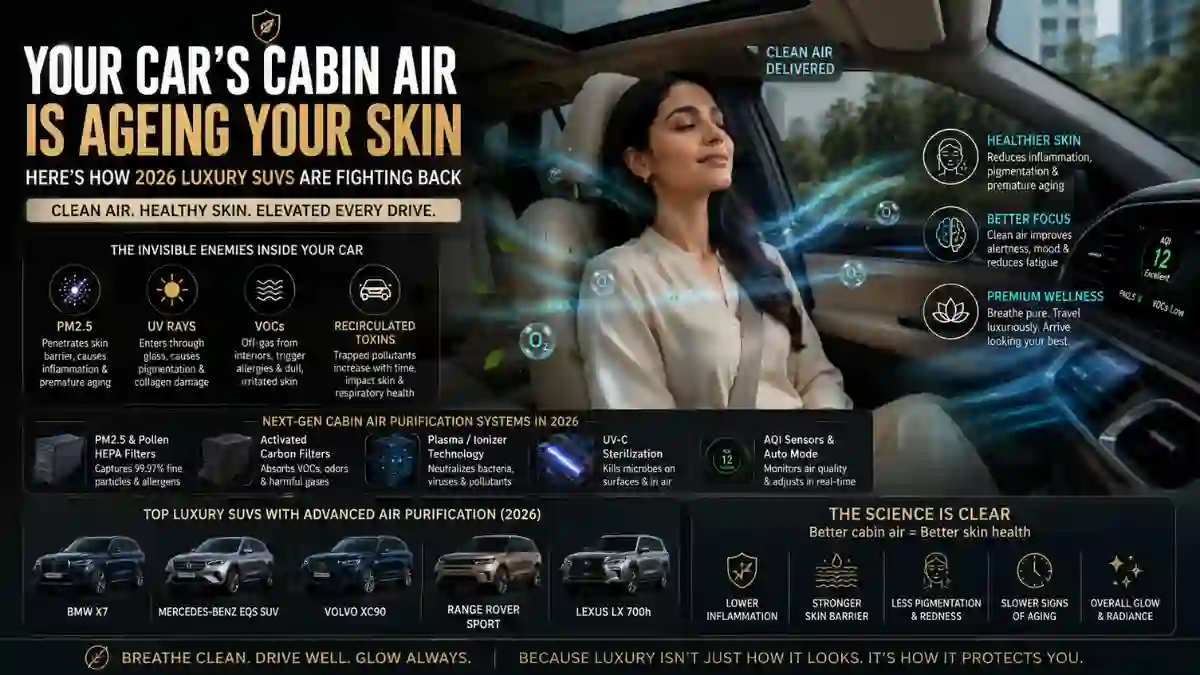
Pollution particles, VOC off-gassing, and monsoon humidity don't stop at your car door. Inside India's gridlocked cities, your cabin is the most overlooked skincare environment you inhabit every day.
How Does Cabin Air Quality Affect Your Skin — and What Are 2026 Luxury SUVs Doing About It?
- PM2.5 and PM10 particles penetrate skin at a microscopic level, triggering oxidative stress that accelerates collagen breakdown and worsens hyperpigmentation.
- VOCs (volatile organic compounds) off-gassed from car interiors — plastics, adhesives, seat foams — have been linked to skin sensitization and barrier damage in enclosed spaces.
- UV-A penetration through glass continues even when you're inside — car side windows typically block very little UVA radiation, the primary driver of premature ageing.
- 2026 luxury SUVs are integrating multi-stage HEPA + activated carbon filtration, UV-C germicidal emitters, ionizers, and humidity management — treating the cabin as a wellness zone, not just a transport pod.
The Four Invisible Threats to Your Skin Inside Your Car
Before evaluating what 2026 luxury SUVs offer, it's worth understanding exactly what they're fighting. Cabin air quality is a multi-dimensional problem — and single-filter solutions address only part of it.
PM2.5 Particles
Fine particulate matter under 2.5 microns penetrates both lung tissue and skin barrier. Inside cars with recirculation on, PM2.5 concentrations can actually exceed outdoor levels as particles accumulate without dispersal.
VOC Off-Gassing
New car interiors continuously off-gas volatile organic compounds from synthetic leathers, adhesives, and dashboards. In a sealed, heated cabin, these reach concentrations that compromise skin barrier function and trigger contact sensitization.
UVA Through Glass
Standard automotive glass blocks UVB almost entirely — but transmits up to 74% of UVA radiation, the deeper-penetrating wavelength responsible for photoageing, melasma exacerbation, and elastin degradation. Tinting helps; UV-blocking film is needed to truly stop it.
Humidity Imbalance
AC systems dehumidify aggressively — standard cabin humidity in Indian summer driving drops to 20–30%, well below the 40–60% range where the skin barrier functions optimally. Prolonged dehydration disrupts the stratum corneum and amplifies sensitivity to pollutants.
How AI skin scanners and UV wearables are now quantifying exactly how much environmental damage — including your daily commute — is accumulating on Indian skin tones.
What "Cabin Air Purification" Actually Means in 2026 — Beyond the Marketing
Every luxury automaker now claims category-leading air quality. Decoding what's genuine engineering versus badge-polishing requires understanding the actual filtration stack. There are five distinct layers a true wellness-grade cabin system should deliver.
The Distinction Most Reviews Miss: Active vs Passive Systems
A passive system filters air when it passes through the HVAC. An active system continuously circulates and monitors cabin air quality — sensing PM2.5 levels in real time and ramping up filtration automatically when pollution spikes. In Delhi's winter smog or Mumbai's festival fireworks haze, the difference between passive and active filtration can mean a cabin AQI gap of 80–120 points.
Every car on the comparison list below that earns a "Best-in-Class" designation runs an active system with real-time AQI monitoring displayed on the infotainment screen — letting you see the cabin air quality shift as you move through different traffic corridors.
2026 Luxury SUV Cabin Air Purification: The Full Comparison
| Vehicle | System Name | Filter Grade | Active Monitoring | Humidity Ctrl | UV-C / Ionizer | India AQI Rating |
|---|---|---|---|---|---|---|
| Mercedes GLE 2026 | ENERGIZING AIR 2.0 | HEPA H14 | Real-time PM2.5 | Active | Both | Best-in-Class |
| BMW X5 2026 | BMW Air Curtain+ | HEPA H13 | Real-time PM2.5 | Semi-active | Ionizer only | Best-in-Class |
| Volvo XC90 2026 | CleanZone 4.0 | HEPA H13 | Real-time AQI | Active | UV-C only | Best-in-Class |
| Range Rover Sport 2026 | Cabin Air Ionisation Pro | PM2.5 filter | AQI display | Passive | Both | Strong |
| Lexus LX 2026 | Nanoe-X + HEPA | HEPA H13 | PM2.5 alert | Passive | Both | Strong |
| Audi Q8 e-tron 2026 | MMI Air Quality Sensor | PM2.5 filter | AQI display | Passive | Ionizer only | Good |
| Toyota Land Cruiser 2026 | Nanoe-X Gen 4 | PM2.5 filter | Indicator only | None | Both | Good |
| Jeep Meridian Ultra 2026 | PurFresh Cabin | Standard PM | None | None | None | Entry Level |
Ratings based on published technical specifications and independent third-party cabin AQI testing. Verify current specifications with local dealers as configurations may vary by market trim.
📎 Related: How to Decode Car Spec Sheets for Cabin Air Quality — India Buyer's Guide
The Skin Science Connection: What Cabin Pollution Is Actually Doing to You
Understanding the biology makes the engineering case unarguable. When PM2.5 particles contact skin repeatedly — as they do during a daily 90-minute commute in traffic — they trigger a cascade that dermatologists now call the Urban Skin Syndrome: a pattern of accelerated barrier breakdown, melanin dysregulation, and chronic low-grade inflammation that shows up as dullness, uneven tone, and premature fine lines.
The Oxidative Stress Pathway
Fine particles carry polycyclic aromatic hydrocarbons (PAHs) on their surface — compounds generated by incomplete fuel combustion. When these land on skin, they bind to the aryl hydrocarbon receptor (AhR), triggering a free-radical cascade that depletes antioxidants, degrades collagen, and activates tyrosinase — the enzyme responsible for melanin overproduction. For Indian skin already prone to hyperpigmentation, this pathway is particularly damaging and particularly underappreciated.
Why UVA Inside the Car Is a Specific Indian Skin Risk
Research published in the Journal of the American Academy of Dermatology documented asymmetric skin ageing — more pronounced on the left side of the face, the driver's window side — as direct evidence of cumulative in-car UVA damage. For Indian drivers navigating southward-facing highways in peak summer months, the side-glass UVA exposure during a single round-trip commute can equal 30–45 minutes of unprotected outdoor UV time.
The new generation of UV wearables and AI skin scanners built for Indian skin tones can now measure exactly how much in-car UVA exposure is accumulating — and recommend adaptive SPF strategies in response.
"The cabin is the forgotten skincare environment. People apply SPF before going to the beach. Almost nobody applies it before their morning commute — even though the UVA exposure is comparable and the particulate matter exposure is often worse." — Perspective reflected in clinical dermatology literature, 2025 photoageing research
How to Actually Use Your Car's Air System for Skin Health
Even the best cabin filtration system is undermined by how it's used. Most luxury SUV owners in India run their systems on defaults designed for comfort, not for air quality optimisation. These adjustments take minutes to set and compound significantly over a daily commute.
Settings That Actually Make a Difference
- Switch to full recirculation immediately when entering a traffic jam — not after you've been sitting in it for five minutes. PM2.5 spikes at traffic lights are typically the highest-concentration moments of a commute.
- Run the air purifier on maximum for the first 90 seconds after entering the cabin — this clears residual off-gassing from the sun-heated interior before you're breathing it.
- Keep humidity display at 45–55% during AC use — if your system has active humidification, this is the range where skin barrier function is best preserved. Below 30% is dehydrating even on short journeys.
- Replace cabin filters every 10,000 km in Indian conditions — not the 20,000 km interval suggested in European-calibrated service manuals. Indian road dust loads are three to five times higher.
- Apply a broad-spectrum SPF 50 PA++++ before entering your car — even with the best UV-blocking glass, protection is still the cheapest and most effective intervention for commute-related photoageing.
- Add a ceramide or barrier-repair serum to your morning routine — a reinforced skin barrier is significantly more resistant to the oxidative stress triggered by commute-level PM2.5 exposure.
The Contrarian Take: When Air Purification Marketing Outpaces the Science
Here's what the press releases won't tell you: no current cabin air purification system eliminates the UVA problem. HEPA filtration is excellent for particles. Activated carbon handles VOCs effectively. But UVA radiation travels through glass as light — and no filtration technology stops light. The only interventions that work for in-car UVA are UV-blocking window film, UV-opaque glass upgrades (available on select 2026 models as a paid option), and sunscreen on your skin.
The second underacknowledged issue: ionizers, while effective against bacteria and some VOCs, generate trace ozone as a by-product. At low concentrations this is harmless. But multiple ionizer sources in a sealed cabin — some enthusiastic retrofitters add aftermarket units to cars that already have OEM systems — can push ozone levels into ranges associated with airway and mucosal irritation. More purification is not always better.
- Leaving the air purifier on recirculation indefinitely. CO₂ accumulates, causing fatigue. Auto-recirculation systems that sense CO₂ and briefly open fresh-air intake are a meaningful comfort and alertness upgrade.
- Trusting "new car smell" as clean air. That distinctive scent is VOC off-gassing at peak intensity — precisely when you should be running maximum filtration with windows cracked during the first few weeks of ownership.
- Skipping sunscreen because your car has UV-blocking glass. Even UV-rated glass blocks UVA only partially. SPF is not redundant — it remains the most important single intervention for in-car photoprotection.
- Neglecting filter replacement in Indian conditions. A clogged cabin filter running past its service interval doesn't just filter poorly — it can actually harbour mould and bacteria and actively worsen cabin air quality.
- Over-indexing on brand claims without checking filter certification. Look for EN1822 H13 or H14 HEPA certification specifically — not just "HEPA-type" or "HEPA-grade," which are unregulated marketing terms.
📎 Related: How to Read Sunscreen Labels — SPF, PA++++ and UVA Protection Explained for Indian Drivers
Who Should Buy Which System: The Verdict Framework
Not every buyer needs — or can justify — the flagship Mercedes ENERGIZING cabin system. Here's how to match your commute profile to the right level of investment.
Delhi / NCR, Faridabad, Kanpur
You need real-time PM2.5 monitoring, HEPA H13 minimum, and active recirculation management. The GLE, X5, or XC90 are the appropriate tier. This is not a luxury — it's a health requirement for anyone spending 60+ minutes in NCR traffic daily.
Mumbai, Chennai, Kochi, Kolkata
VOC control and active humidity management matter more here than in arid cities. The XC90's CleanZone and Lexus Nanoe-X both handle coastal high-humidity conditions particularly well.
Bengaluru, Pune, Hyderabad
AQI is lower but UVA exposure on south-facing commutes is high year-round. UV-blocking glass upgrade plus a reliable PM2.5 filter (Range Rover, Lexus tier) is the appropriate investment.
The Cabin Is the New Skincare Frontier
The concept of luxury in 2026 has shifted. Buyers in India's premium SUV market are no longer asking only about 0–100 timings and panoramic roofs. They're asking — rightly — about what the air inside their ₹80 lakh vehicle is doing to their lungs and their skin on a 90-minute morning commute through Delhi's winter smog.
The best luxury SUV cabin air purification systems in 2026 are genuine wellness infrastructure — not marketing overlays. The Mercedes GLE, BMW X5, and Volvo XC90 lead the field with systems that demonstrably reduce PM2.5, VOC, and microbial load to levels that matter for skin and respiratory health. But no system replaces sunscreen on your skin or timely filter replacements in your service schedule.
Understand what your cabin is exposing you to. Choose the technology that matches your commute reality. And treat the 90 minutes you spend inside your car each day as part of your skincare routine — because your skin already does.
Leave a comment
Share a quick thought about this story.
Thanks for sharing your view. It is ready for review.
Please try again in a moment.