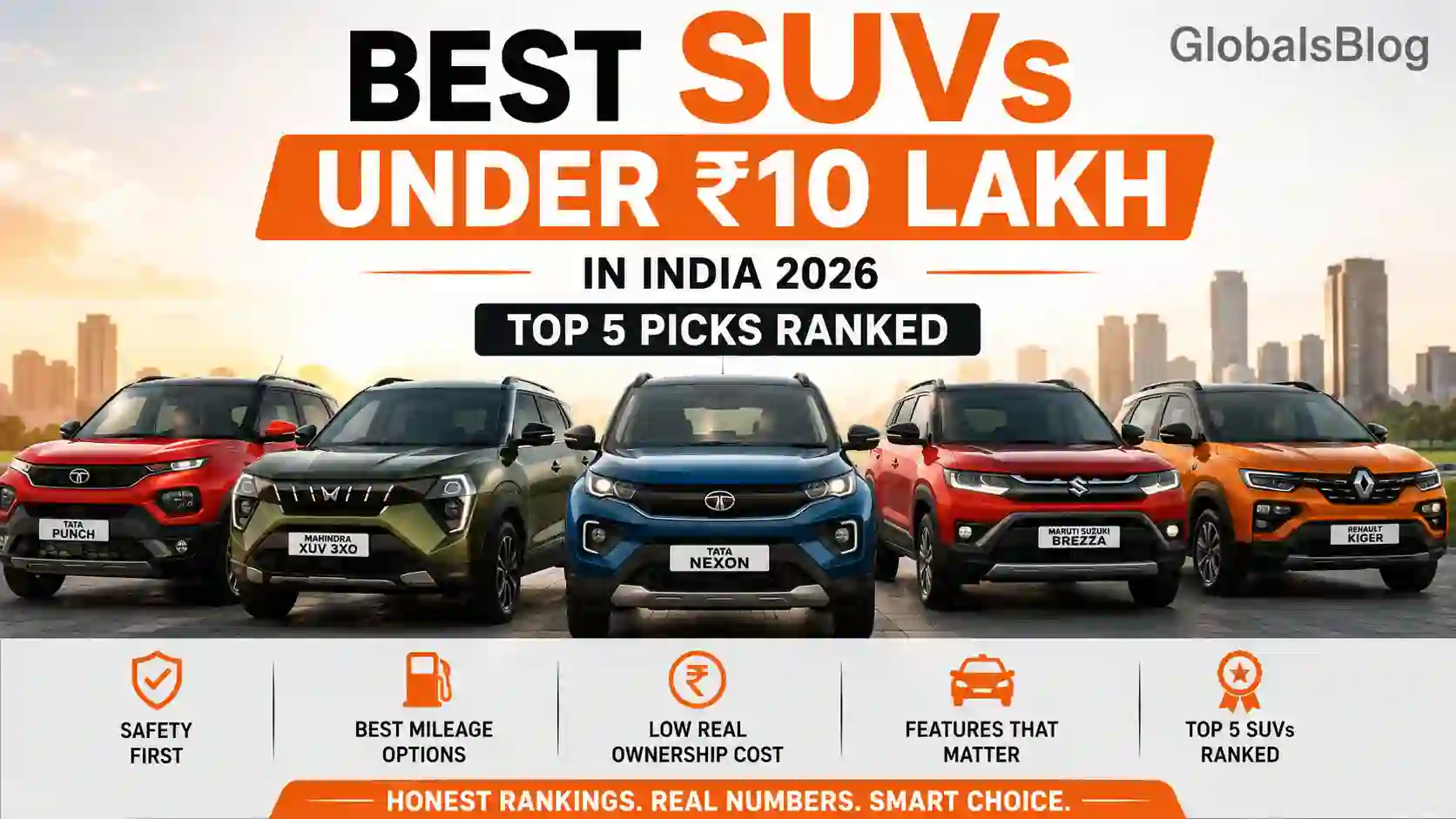
The sub-₹10 lakh SUV segment has never been more competitive — or more confusing. Here is the honest shortlist with real ownership data, not just spec sheet numbers.
The sub-₹10 lakh SUV segment in 2026 is genuinely impressive — you can buy a feature-rich, 6-airbag, touchscreen-equipped compact crossover without touching your budget ceiling. But you can also buy something that looks capable from the outside, handles like a nervous hatchback, and costs you a fortune in repairs and depreciation over three years.
The best SUVs under ₹10 lakh are not just about the sticker price. They are about real-world fuel economy, total ownership cost over 5 years, after-sales support in your city, and cabin quality you will actually live with every day. Before diving into the list — most cars at this price are technically crossovers, not true SUVs. The SUV vs Crossover guide explains that platform distinction clearly if it matters to your purchase decision.
The Maruti Suzuki Brezza (from ₹8.34 lakh) and Tata Nexon (from ₹8.10 lakh) are the two strongest buys under ₹10 lakh in 2026. Brezza wins on resale value and running cost; Nexon wins on safety rating and features. Both are meaningfully ahead of everything else at this price. The Hyundai Exter is the pick for compact city-only buyers.
What You Actually Get Under ₹10 Lakh — Honest Expectations
A sub-₹10 lakh "SUV" in India is almost always a compact crossover — a car-based monocoque platform with raised ground clearance and SUV styling. What you will not get: all-wheel drive, leather seats, or a sunroof in most base trims. What you will get in the best options: 6 airbags, 180mm+ ground clearance, a responsive touchscreen, and fuel efficiency a mid-size SUV cannot match.
This matters because buyers sometimes feel disappointed after buying a budget SUV that does not "feel like an SUV." It drives more like a tall hatchback — because underneath, it largely is. That is not a criticism — it makes these cars excellent urban tools. Just know what you are buying.
The 5 Best SUVs Under ₹10 Lakh — Ranked
1. Maruti Suzuki Brezza — Best Resale and Running Cost
If total cost of ownership matters — and for most Indian buyers it should — the Brezza wins this category outright. Maruti's 4,000+ service centres mean affordable maintenance wherever you live. Resale value after 5 years is typically 10–15% higher than comparable Korean or American brand SUVs at the same starting price.
The 2026 Brezza packs 6 airbags, a 9-inch SmartPlay Pro+ touchscreen, and wireless Android Auto/Apple CarPlay even in mid-range trims. One genuine weakness: interior plastics feel less premium than the Nexon, and the infotainment is less responsive.
2. Tata Nexon — Best Safety and Feature Set
The Nexon holds a 5-star Global NCAP safety rating — the best in its price band. In a country where road safety is a real concern, this matters more than any feature comparison. The 2025 facelift improved cabin quality significantly; interior materials are noticeably better than earlier generations. The diesel variant available under ₹10 lakh offers outstanding highway economy and strong torque. For the full mileage comparison, the Best Mileage SUVs guide has real-world numbers across every variant.
3. Hyundai Exter — Best for City-Only Buyers
The Exter is the smallest car on this list and the one with the strongest value-per-rupee argument for city-only buyers. A panoramic sunroof at under ₹9 lakh is genuinely surprising — no other car at this price delivers this. Not a serious highway tourer, but for daily urban commuting by 2–4 people, it is excellent.
4. Kia Sonet — Best Driving Experience Under ₹10 Lakh
The Sonet's base and mid trims dip under ₹10 lakh and deliver the best interior quality and driving feel in this price band. Weighted steering, composed ride, solid seat support — the Kia DNA comes through even at budget price points. Downside: Kia's service network is thinner than Maruti or Tata, which matters meaningfully in cities smaller than Tier 1.
5. Mahindra XUV 3XO — Best Performance Under ₹10 Lakh
The XUV 3XO punches above its weight on performance and safety — carrying a 5-star Global NCAP rating and a turbocharged petrol engine delivering more punch than any naturally aspirated competitor at this price. If you enjoy the act of driving and value an engaging throttle response, the 3XO stands out. Service costs are slightly higher than Maruti or Tata over time.
Quick Decision Table — Who Should Buy What
| Model | Best For | Start Price | Key Strength |
|---|---|---|---|
| Maruti Brezza | Resale + running cost | ₹8.34L | Service network, efficiency |
| Tata Nexon | Safety + features | ₹8.10L | 5-star NCAP, diesel option |
| Hyundai Exter | City-only buyers | ₹6.13L | Compact size, sunroof value |
| Kia Sonet | Driving experience | ₹7.99L | Interior quality, ride feel |
| Mahindra XUV 3XO | Performance focus | ₹7.99L | Turbo engine, safety rating |
If you are deciding between a compact SUV and a more family-focused body type, the SUV vs MUV pillar guide has a 3-question framework that helps you decide body type before you compare models. If your family needs 6 or 7 seats, the Best MUV Cars in India guide covers dedicated options starting from ₹9 lakh.
✓ Before You Visit the Showroom
- Always check the variant-wise feature list, not just the starting price — base trims sometimes lack all-four disc brakes or ESC, which are safety basics worth paying for.
- Compare the 40,000 km service cost between brands — it varies by ₹3,000–6,000 and adds up significantly over 5 years of ownership.
- If you drive 1,500+ km per month in a CNG city, the Brezza CNG or Nexon CNG brings running costs below ₹2/km — seriously worth evaluating.
- Always sit in the back seat before buying — several cars at this price look like full-size SUVs but have smaller-than-expected rear cabins.
- For families needing more seating than a compact SUV provides, the Best Family Cars in India guide covers every budget from ₹8 lakh to ₹30 lakh.
✗ Mistakes to Avoid
- Buying the base variant without checking the safety feature list. Base trims often lack ESC or have only 2 airbags. Always verify the specific variant before signing.
- Choosing by looks from the outside. Several cars at this price look like full-size SUVs but have rear cabins smaller than some hatchbacks. Sit in the back before deciding.
- Ignoring the service centre map for your city. A Kia or Mahindra service centre may be 40 km from where you live. A Maruti centre is likely 5 km away. This matters when something goes wrong.
- Overlooking CNG if you drive heavily in the city. Petrol vs CNG over 3 years can mean a ₹50,000–80,000 difference for high-mileage city drivers. That is a real number.
Two Cars. One Clear Decision.
For most buyers it comes down to Brezza vs Nexon. Choose Brezza if running cost and resale matter most. Choose Nexon if safety rating and feature content are your priority. Both are excellent. Spend the extra ₹30,000 to get the variant with 6 airbags — at this price point, that upgrade genuinely matters.
Frequently Asked Questions
The Maruti Suzuki Brezza and Tata Nexon are the two strongest choices under ₹10 lakh in 2026. Brezza leads on resale value and service network reach. Nexon leads on safety ratings and feature content. Your choice depends on whether you prioritise long-term ownership costs (Brezza) or safety and technology (Nexon).
Yes, the Tata Nexon diesel base variant starts at approximately ₹9.10 lakh (ex-showroom Delhi), making it available under ₹10 lakh. The diesel engine offers 21.5 kmpl ARAI-rated fuel efficiency — among the best in the compact SUV segment — and strong torque for highway driving.
The Maruti Brezza leads petrol mileage at 19.89 kmpl ARAI. The Hyundai Exter follows at 19.4 kmpl. For diesel, the Tata Nexon at 21.5 kmpl is the highest in this segment. CNG variants of both the Brezza and Nexon offer even better per-kilometre cost for city drivers with CNG infrastructure access.
The Tata Nexon and Mahindra XUV 3XO are the safest sub-₹10 lakh SUVs — both carry 5-star Global NCAP ratings. For a family car, always prioritise a model with a verified crash test rating over one with just a longer feature list. The Nexon's safety suite includes 6 airbags and ESC in mid-range trims.
A used higher-spec SUV can offer excellent value — for ₹8–10 lakh you can find a 2–3-year-old Creta or Seltos with full features. However, you take on unknown maintenance history and no manufacturer warranty. If this is a primary family car, a new base-spec Nexon or Brezza with warranty and full safety features is usually the more reliable choice.
Reader Discussion
Bought a Nexon diesel XE at ₹9.08 lakh last month. 800 km in and the mileage is already touching 22 on the highway. Incredible value at this price.
Can anyone compare Brezza and Sonet for bad roads? I am in Nagpur and some areas are genuinely terrible on the suspension.
The service cost point is so underrated. My XUV 300 was ₹2,000 more per service visit than my previous Brezza. Over 3 years that is a real number.
Exter with the panoramic sunroof under ₹9 lakh is honestly ridiculous value. No regrets for my daily Chennai commute.
Running a Brezza CNG in Delhi — fuel cost is less than half of what my previous Seltos petrol was costing per month. The CNG tip in this guide is genuinely valuable.