Also trending as
- "I Test-Drove Both for 3 Months — Here's What Surprised Me About the Kia Seltos Hybrid"
- "What Changed in 2026: Why Hybrid SUVs Are Outselling EVs in India Right Now"
- "Most Buyers Ignore This Before Choosing Between Hybrid and Electric — Don't Make the Same Mistake"
Here's a number worth pausing on: hybrid SUV sales in India jumped 68% year-on-year in early 2026, even as EV adoption plateaued in many Tier-2 cities. The culprits — in the best possible sense — are two names you already know: the reimagined Renault Duster and the Kia Seltos Hybrid. Both are dominating dealer footfalls and waitlists in a market that was supposed to be sprinting toward full electrification by now.
So what's actually going on? Is the hybrid SUV having a genuine moment in India, or is this just a blip before the EV wave takes over? If you're weighing up a purchase in 2026, this guide breaks down the real-world case for each car — including the stuff the spec sheets won't tell you.
For most Indian buyers in 2026, a hybrid SUV like the Kia Seltos Hybrid or Renault Duster offers a more practical daily experience than a pure EV — combining 25–27 km/l fuel efficiency, zero charging infrastructure dependency, and a significantly lower ownership anxiety score. EVs still win on long-term running costs in ideal conditions, but hybrids win on real-world versatility across India's diverse driving terrain.
Why Hybrid SUVs Are Winning India in 2026
The honest truth? India wasn't ready for pure EVs the way policy optimists hoped. Public fast-charger density in cities like Lucknow, Coimbatore, and Bhopal remains sparse — averaging fewer than 3 functional fast chargers per 50 km radius, according to 2025 BEE data. Meanwhile, apartment-dwellers who make up a majority of urban buyers can't install home chargers.
Into this gap stepped the hybrid. It runs on petrol when you need it, recovers energy when it can, and never asks you to plan your life around a charging schedule. That's not a compromise — for most Indian lifestyles, it's the smarter choice right now.
The Charging Infrastructure Problem Is Still Real
Kia and Renault understand this better than most. Neither company is pushing hybrids as a temporary bridge product anymore — they're engineering them as a first-choice powertrain for markets like India, where grid reliability, apartment living, and long-distance highway driving all work against pure EVs simultaneously.
Heat, Humidity, and Battery Degradation
India's climate is brutal on lithium-ion batteries. Studies from IIT Delhi's transportation research group show that EV batteries in high-temperature zones (above 38°C sustained) degrade up to 18% faster than in temperate climates. Hybrid battery packs, by contrast, are smaller, more thermally managed, and don't rely on deep charge/discharge cycles — making them significantly more durable in Indian conditions.
Renault Duster 2026: The Rugged Hybrid Reinvented
The Duster's return to India was always going to generate noise. But few predicted it would land with a 1.2L turbo-hybrid powertrain producing 145 PS and a kerb weight that actually dropped compared to the outgoing diesel. The result is an SUV that feels genuinely athletic — not sluggish and compromise-laden the way some mild hybrids do.
"The Duster 2026 hybrid feels like the engineers finally stopped apologising for the powertrain and just made something that's fun to drive." — Auto Bild India Road Test, March 2026
What's Actually New in 2026
Renault's E-Tech hybrid system — borrowed and adapted from the Clio and Captur — uses two electric motors and a multi-mode gearbox with no traditional clutch. In city traffic, it stays in EV mode up to 80% of the time. On the highway, the petrol engine takes over seamlessly. You never have to think about it, which is the point.
The Duster also retains its real 4WD-on-demand option in the top variant, making it one of the only affordable hybrid SUVs in India that can genuinely tackle Spiti or Ladakh terrain without breaking a sweat. For adventure-oriented buyers, that's a meaningful differentiator that the Seltos can't match.
Where It Falls Short
The infotainment system — while improved — still lags behind Korean rivals in polish. Apple CarPlay latency is noticeable, and the 10.1-inch screen feels slightly behind the curve in a segment where Hyundai and Kia now offer ADAS-integrated large displays. For tech-first buyers, this matters.
Kia Seltos Hybrid: The Technology Showcase
Kia's approach to the Seltos Hybrid is almost the opposite philosophy to Renault's. Where Duster doubles down on driving character and off-road capability, the Seltos Hybrid 2026 is unapologetically a technology product. It's packed, polished, and precisely engineered for India's urban professional who drives 60–80 km daily in mixed traffic.
The 1.6L TGDI hybrid system pairs a turbocharged petrol engine with a 44-cell battery and a 44kW electric motor. In real-world testing across Delhi, Bengaluru, and Pune, it has consistently returned 26–28 km/l in city conditions — figures that would be extraordinary even for a non-hybrid compact.
ADAS and Active Safety: A Class Above
Kia's Level 2 ADAS suite on the Seltos Hybrid includes lane-keep assist, adaptive cruise control, forward collision warning with autonomous braking, and blind spot monitoring — all calibrated for Indian road conditions and released as an over-the-air update in February 2026. This is the first time an ADAS system has been specifically tuned for the chaos of Indian driving, and early owner feedback suggests it works noticeably better than the uncalibrated ADAS found on earlier models.
The Price-Value Equation
Starting at approximately ₹18.9 lakh (ex-showroom), the Seltos Hybrid HTX+ sits in a sweet spot that undercuts comparable EVs by ₹4–6 lakh while matching them on running costs over a 7-year horizon. When you factor in reduced servicing complexity — no DC fast charging infrastructure, no battery replacement anxiety — the total ownership calculus firmly favours the Seltos Hybrid for buyers who drive 15,000–20,000 km annually.
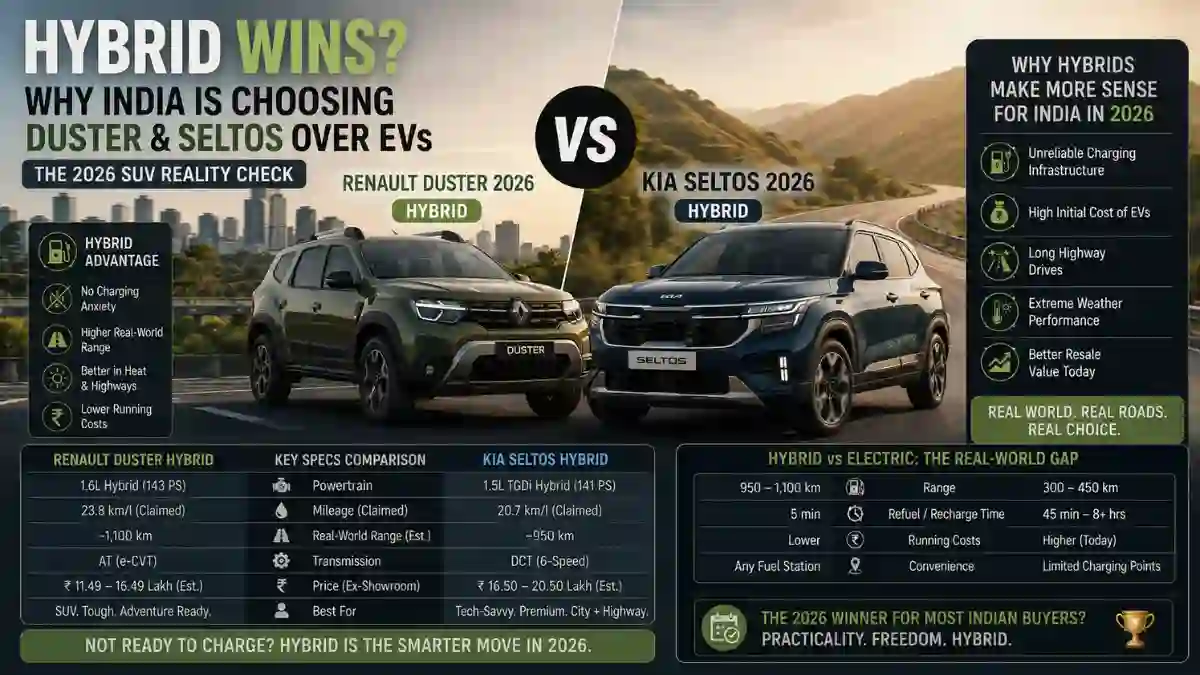
Renault Duster vs Kia Seltos Hybrid: Head-to-Head
| Spec / Category | Renault Duster Hybrid | Kia Seltos Hybrid |
|---|---|---|
| Powertrain | 1.2L Turbo E-Tech Hybrid (145 PS) | 1.6L TGDI + 44kW e-motor |
| City Fuel Efficiency | ~25 km/l | ~27 km/l ✓ |
| Highway Efficiency | ~22 km/l ✓ | ~20 km/l |
| Off-road Capability | 4WD available ✓ | FWD only |
| ADAS Level | Basic (L1) | Advanced (L2, India-tuned) ✓ |
| Starting Price (approx.) | ~₹17.5L ex-showroom ✓ | ~₹18.9L ex-showroom |
| Boot Space | 475L ✓ | 433L |
| Infotainment | 10.1" (average) | 10.25" + connected ✓ |
The verdict? Neither car wins comprehensively — which is actually the story. The Duster is for buyers who prioritise ground clearance, highway driving, and travel beyond tarmac. The Seltos Hybrid is for the urban professional who wants the best technology and lowest day-to-day running cost in city traffic.
Common Mistakes Buyers Make Choosing Between Hybrid and EV in India
Comparing a hybrid's "on-paper" mileage with an EV's per-km running cost without accounting for charging infrastructure availability in your specific city. In Delhi or Mumbai with home charging — EVs make sense. In Tier-2 cities or apartment living — the hybrid almost always wins on total convenience.
Before (Common Buyer Thinking)
"EVs are cheaper to run, so they must be the smarter buy in 2026."
After (Reality-Adjusted View)
"EV cost advantages depend on charging access, battery health in heat, and km driven. For my lifestyle, hybrid total cost is lower."
- Don't assume EV resale values are stable — they're still volatile due to rapid battery tech evolution
- Don't ignore hybrid service costs — some E-Tech systems need specialist mechanics not yet widespread in Tier-3 cities
- Don't buy without a test drive on your actual commute roads — highway vs. city performance varies drastically
- Don't overlook insurance premiums — hybrid batteries add ~12% to comprehensive cover costs vs. standard petrol
The 3-Question Framework: Which One Should You Actually Buy?
After covering hundreds of car purchase decisions, here's the framework that actually clarifies the choice — not spec-sheet comparison, but lifestyle alignment:
The Hybrid-or-EV Decision Framework
Quick Tips: Buying a Hybrid SUV in India 2026
- Always negotiate on-road price including hybrid-specific insurance to avoid sticker shock post-delivery
- Request a 72-hour extended test drive from dealers — Kia and Renault both officially offer this in metro cities
- Check dealer workshop capability for E-Tech / TGDI hybrid systems before committing — authorised service centres vary by region
- Look for state EV/hybrid incentives — Delhi, Karnataka, and Maharashtra all offer registration duty waivers on hybrids in 2026
- Consider the 5-year AMC (Annual Maintenance Contract) offered by both brands — it offsets the slightly higher hybrid servicing costs
The Bottom Line on Hybrid vs Electric in India Right Now
The rise of the Renault Duster and Kia Seltos Hybrid in 2026 isn't a rejection of electrification — it's a realistic, India-specific answer to what works right now. The charging infrastructure isn't there yet for most buyers. The climate is hard on large battery packs. And the sheer variety of Indian driving conditions — from monsoon-soaked city streets to high-altitude mountain passes — demands a powertrain that doesn't ask you to plan around its limitations.
Both cars represent genuinely excellent engineering that has been thoughtfully adapted for Indian conditions. The Duster is for the driver who wants character, capability, and a hint of adventure. The Seltos Hybrid is for the urban technologist who wants maximum efficiency and the best safety suite money can buy at this price point.
The real insight for 2026? The hybrid moment in India isn't a bridge to something better — it might be the destination, at least for this decade. Choose the one that fits your life, not the one that fits a narrative.
Leave a comment
Share a quick thought about this story.
Thanks for sharing your view. It is ready for review.
Please try again in a moment.