- "I Spent 10 Days on India's Most Sacred Spiritual Circuit — Here's What Nobody Warns You About"
- "What Changed in 2026: The New Varanasi and Why Somnath Is Now a Must on Every Pilgrimage List"
- "Most Pilgrims Miss the Best Moment at Somnath — Here's What to Do Instead"
There is a version of India that exists only at dawn — in the blue mist above the Ganges at Assi Ghat, in the sound of a conch shell echoing off a twelfth-century courtyard in Kashi, in the moment the first light strikes the gold shikhara of Somnath and turns the Arabian Sea below it the colour of ripe mango. This is the India the Varanasi–Somnath spiritual circuit reveals, if you know how to move through it.
In 2026, both destinations have evolved significantly — Varanasi with expanded ghat promenades and improved pilgrim infrastructure post-Kashi Vishwanath Corridor Phase 2, and Somnath with new light-and-sound experiences and restored dharmashalas. Yet their essential spiritual weight remains unchanged. This guide gives you the context, the timing, and the practical frameworks to experience both not as a tourist, but as someone genuinely prepared to receive what these places offer.
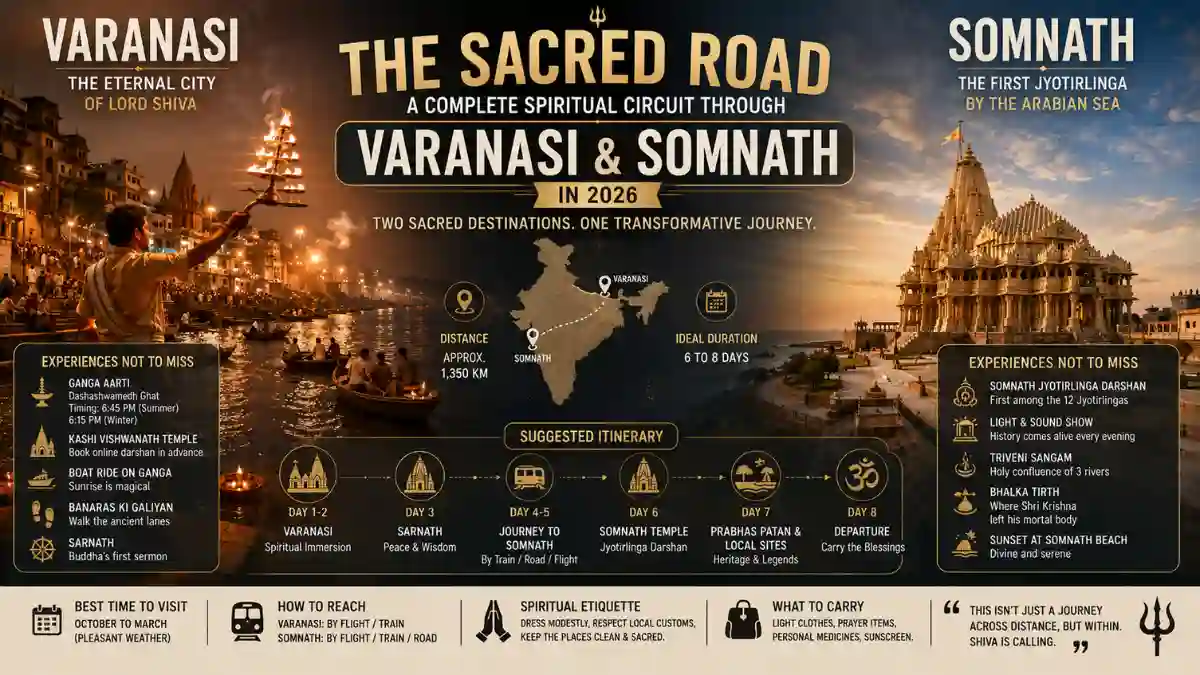
The Varanasi–Somnath spiritual circuit combines the world's oldest living city with one of the twelve sacred Jyotirlingas of Lord Shiva. Ideal duration is 10–12 days: 5–6 in Varanasi (including Sarnath and nearby sites) and 4–5 in Somnath and the Saurashtra coast. Best season is October–March. The circuit is accessible via flight (Varanasi → Rajkot or Diu, then road to Somnath) or a combination of train and road.
Why These Two Destinations Form a Complete Spiritual Circuit
Pairing Varanasi and Somnath isn't arbitrary — it's one of the most spiritually coherent journeys you can make in India. Varanasi (ancient Kashi) represents the Shiva of dissolution: the city where the cycle of life and death is made visible, where cremation pyres burn continuously at Manikarnika Ghat as they have for three thousand years. Somnath represents the Shiva of renewal — the first and most revered of the twelve Jyotirlingas, a temple that was destroyed and rebuilt seven times and continues to stand as an act of collective spiritual will.
Together, they trace a single, complete arc: confronting impermanence in Varanasi, then witnessing indestructibility in Somnath. For pilgrims and seekers alike, this is a journey that works on you long after you've returned home.
"Kashi is not merely a city. It is a field of consciousness — a place where the membrane between the visible and invisible worlds becomes unusually thin." — Described in the Kashi Khanda, Skanda Purana
Varanasi in 2026: What's New and What Endures
The oldest continuously inhabited city on earth operates on its own time. Varanasi doesn't accommodate visitors — it absorbs them. The Kashi Vishwanath Corridor, now fully operational in its expanded Phase 2 form, has created a seamless 5-kilometre pilgrimage pathway from the main temple to the Ganges — an urban transformation that has simultaneously made the sacred site more accessible and restored the visual relationship between the temple's gold spires and the river that defined the city for millennia.
New in 2026: an audio-guided heritage walk on the northern ghats, a digital darshan queue system at Kashi Vishwanath (reducing wait times to 45–90 minutes from peak 4-hour queues), and restored Ahilyabai-era architecture at Harishchandra Ghat visible for the first time in decades after conservation work completed in late 2025.
Essential Experiences in Varanasi
The Contrarian Insight Most Varanasi Guides Miss
Most visitors spend their Varanasi mornings on boats and evenings at the Aarti — which is correct. But the least-visited and most underrated experience is the old city lanes (the galis) at midday. When pilgrims rest and tour groups retreat to hotels, the winding alleys between the ghats and Kashi Vishwanath reveal their true character: small shrines in unexpected recesses, sadhus in genuine meditation rather than performance, sweet shops selling the original Banarasi peda from century-old recipes. This is where the city stops performing and starts simply being.
Somnath in 2026: The Jyotirlinga by the Sea
Standing at the very edge of India where the land meets the Arabian Sea at Prabhas Patan, the Somnath temple occupies a site of such layered history and faith that no amount of reading fully prepares you for the experience of standing before it. The current Chalukya-style structure, consecrated in 1951 under Sardar Patel's initiative and restored again in 2021, is not the ancient original — but it sits on ground saturated with every iteration of what came before.
New in 2026: the revamped Sound and Light Show at the Somnath beach has been extended with a new Act covering the temple's post-independence reconstruction, running nightly in Gujarati, Hindi, and English. A new heritage museum on the eastern complex chronicles all seven historic structures with scale models and recovered artefacts.
Essential Experiences in Somnath
Suggested 10-Day Spiritual Circuit Itinerary
This itinerary is built around spiritual depth rather than maximum sightseeing. It gives you enough time to acclimatise to each city's pace before rushing to the next site.
Varanasi vs Somnath: Understanding the Difference
Pilgrims often ask which of the two is the more powerful spiritual experience. The question misunderstands the circuit's design — they are not competing, they are complementary. But knowing what each offers helps you prepare emotionally and practically.
| Dimension | Varanasi (Kashi) | Somnath |
|---|---|---|
| Primary spiritual energy | Dissolution, liberation, impermanence | Renewal, indestructibility, devotion |
| Landscape character | River city, dense, layered, ancient | Coastal, open, wind-swept, expansive |
| Crowd intensity | Very high, especially Oct–Feb | Moderate, high during Shivaratri |
| Accommodation range | Heritage guesthouses to 5-star hotels | Primarily mid-range; some temple guesthouses |
| Best time to visit | Oct–March (avoid summers) | Oct–Feb (avoid monsoon June–Sept) |
| Duration needed | 5–6 days minimum | 3–4 days including day trips |
| Inter-faith relevance | Very high (Sarnath adds Buddhism) | Moderate (primarily Hindu pilgrimage) |
What to Know Before You Go
Treating the Ganga Aarti as a spectator event to photograph rather than a ceremony to participate in. The most transformative version of this experience involves putting down the phone, standing still in the crowd, and actually receiving the ritual — the sound, the smell of camphor, the collective breath of thousands of people in devotion. The photograph you don't take will stay with you longer than the one you do.
Quick Tips: Planning the Varanasi–Somnath Circuit
- Book Kashi Vishwanath darshan slots online at least 2 weeks in advance during peak season (Oct–Feb) — walk-in queues can exceed 3 hours
- Hire a local knowledgeable guide for your first full day in Varanasi — the difference between understanding and missing the city's layers is enormous
- Carry cash at both destinations — small temples, boat operators, prasad shops, and dharmashalas rarely accept UPI reliably
- Dress conservatively throughout the circuit — cotton salwar or dhoti at temples is expected; synthetic or revealing clothing causes genuine access issues at some sanctums
- Register for Somnath's Abhisheka darshan via the official temple trust website — spots at the 6 AM ceremony are limited to ~200 persons and fill 10–14 days in advance
- The Sound and Light Show at Somnath requires no booking but benefits from arriving 30 minutes early for front beach positions
- Mobile signal in old Varanasi lanes is unreliable — download offline maps and temple information before entering the dense gali network
What to Pack for a Spiritual Circuit
- Lightweight cotton kurtas or sarees for temple visits — purchased locally in Varanasi's Vishwanath Gali for ₹300–600 if needed
- A small brass or copper vessel for Ganga jal (Ganges water) — available at all ghat stalls, deeply meaningful as a return gift
- Sandals that slip on and off easily — you will remove footwear dozens of times daily
- A personal prayer or intention written before departure — both cities respond to conscious purpose more than casual curiosity
- Earplugs for pre-dawn starts — temple bells, conch shells, and morning aartis begin between 4 and 5 AM in both cities
The Circuit That Stays With You
The Varanasi–Somnath spiritual circuit is not a holiday in any conventional sense. You will wake before dawn. You will stand in crowds. You will be confronted with things — a burning ghat, a sea-wall inscription about the infinite distance to the next continent, a Jyotirlinga that has been destroyed and rebuilt seven times and is still standing — that resist easy interpretation. That resistance is the point.
Both cities ask the same question of every visitor, in their different registers of fire and ocean: what do you actually believe is permanent? Varanasi asks it through dissolution. Somnath answers it through endurance. Together, in 2026 as in every year before and after, they constitute one of the most complete spiritual journeys available anywhere on earth.
Go slowly. Return more than once. The circuit gives you more the second time than the first — which is perhaps the most honest thing any travel guide can tell you.
Leave a comment
Share a quick thought about this story.
Thanks for sharing your view. It is ready for review.
Please try again in a moment.