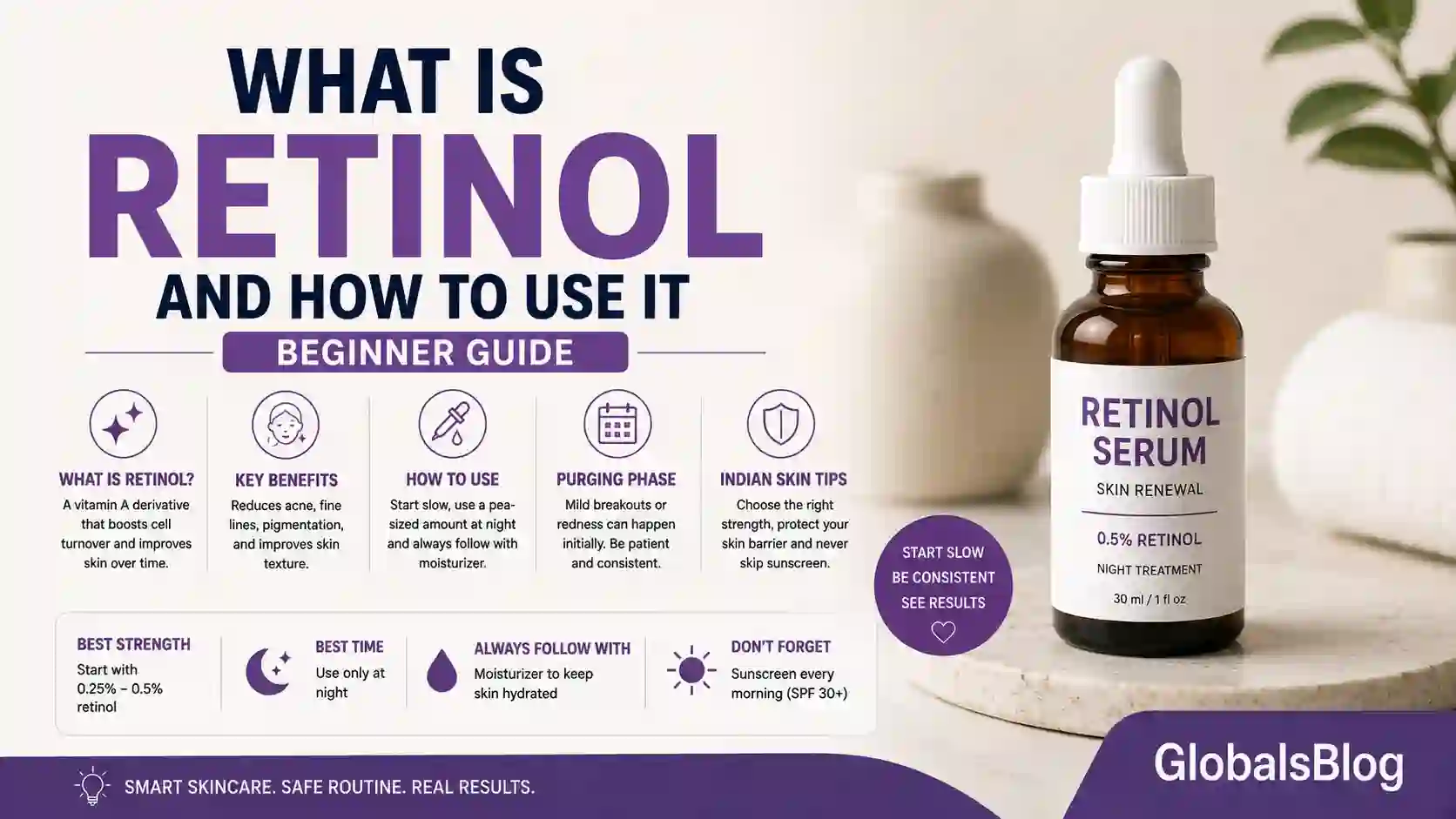
Retinol is the most clinically proven anti-ageing ingredient in skincare. It is also the most misused.
A reader from Hyderabad started retinol at 1% concentration used every night, as enthusiastically recommended by a YouTube skincare influencer. Within two weeks her skin was red, peeling, and more broken out than before she started. She concluded retinol had destroyed her skin and stopped entirely. What had actually happened was a concentration and frequency mistake that is so common it has its own name — retinol overuse. She was not sensitive to retinol. She had simply started too fast at too high a strength. Restarted at 0.025% twice a week. No reaction. Gradual progress. Six months later her skin was the best it had ever been.
Retinol is a Vitamin A derivative that accelerates skin cell turnover, stimulates collagen production, and unclogs pores — making it clinically proven for reducing fine lines, fading dark spots, improving skin texture, and treating acne. For Indian skin, start at 0.025-0.1% concentration used 2-3 times per week at night, build tolerance over 8-12 weeks before increasing concentration, always apply after moisturiser (sandwich method) to reduce irritation, and use SPF 50 PA++++ every morning without exception. Never start retinol at 0.5% or above — this is the single most common mistake Indian beginners make.
What Retinol Actually Is — The Plain Language Version
The retinoid family of ingredients is confusing because it has multiple members with similar names. Here is the clear version: retinoids are a family of Vitamin A derivatives used in skincare. Retinol is the most widely available over-the-counter form. Tretinoin (retinoic acid) is the prescription-strength version approximately 20 times more potent than retinol. Retinaldehyde and bakuchiol are gentler alternatives often marketed as retinol alternatives.
When you apply retinol to skin, it is converted by enzymes in the skin into retinoic acid — the active form that actually produces the skincare benefits. This conversion process is what makes retinol gentler than tretinoin (which delivers retinoic acid directly) but also means it takes longer to show results.
How Retinol Works — Three Core Mechanisms
Cell turnover acceleration: Retinol speeds up the skin's natural cell renewal cycle, replacing older surface cells with fresher ones faster than normal. This produces the smoothing, brightening, and texture-improving effects most visible to users.
Collagen stimulation: Retinol stimulates fibroblasts to produce more collagen, the structural protein that gives skin its firmness. This is the primary mechanism behind retinol's anti-ageing reputation — sustained collagen production results in firmer, plumper skin over months of consistent use.
Pore unclogging: By accelerating cell turnover, retinol prevents dead skin cells from accumulating inside pores — the primary cause of blackheads, whiteheads, and non-inflammatory acne. This makes retinol genuinely dual-purpose for Indian skin dealing with both ageing concerns and acne simultaneously.
Retinol Benefits for Indian Skin — What to Actually Expect
Retinol's cell turnover acceleration gradually replaces pigmented surface cells with unpigmented new ones, fading post-acne marks, UV-induced dark spots, and melasma over consistent use. This is the most immediately relevant benefit for Indian skin, which tends toward hyperpigmentation from acne scarring and year-round UV exposure. Combined with niacinamide and vitamin C, retinol forms part of the most comprehensive anti-pigmentation trio available in over-the-counter skincare.
Retinol is the most clinically studied topical anti-ageing ingredient — decades of peer-reviewed research confirm its ability to reduce the appearance of fine lines and wrinkles through both collagen stimulation and surface cell renewal. For Indian buyers in their late 20s or 30s beginning preventive anti-ageing, retinol started now compounds in benefit over years. The collagen stimulation effect is cumulative — the longer and more consistently retinol is used, the more significant the structural skin improvement becomes.
Retinol's pore-unclogging mechanism makes it a genuine acne treatment — it prevents the dead skin cell accumulation that forms comedones (blackheads and whiteheads) and the subsequent bacterial overgrowth that creates inflammatory acne. Many Indian buyers think of retinol exclusively as an anti-ageing ingredient and do not consider it for acne management, missing its significant efficacy in this area. For adult acne in Indian skin — often triggered by hormonal fluctuations, stress, and humidity — retinol addresses the root mechanical cause rather than just managing symptoms.
The Retinol Purging Phase — What It Is and Why It Happens
This is the most important section for beginners to read carefully before starting retinol — it prevents the most common reason people stop prematurely.
When you start retinol, the accelerated cell turnover it triggers can temporarily push existing congestion and comedones to the skin surface faster than normal. This creates a phase lasting 2-6 weeks where breakouts appear to worsen before improving — called the purging phase. The Hyderabad reader's breakout was partly this purging response, compounded by too-high concentration and too-frequent application.
How to tell purging from a genuine reaction: Purging occurs in areas where you normally break out, consists of comedones and small pustules, and resolves within 6 weeks. A genuine negative reaction occurs in areas where you do not normally break out, may include redness, burning, and larger irritated spots, and does not resolve with continued use. If you experience the second pattern — stop and reassess concentration and frequency.
The way to minimise purging is to start at the lowest effective concentration and the lowest frequency — twice a week maximum — rather than diving straight into nightly high-concentration use.
How to Use Retinol Correctly — The Complete Beginner Routine
| Variable | Beginner (Weeks 1–8) | Intermediate (Weeks 9–20) | Advanced (Week 20+) |
|---|---|---|---|
| Concentration | 0.025–0.1% | 0.1–0.3% | 0.5–1% |
| Frequency | 2× per week | 3–4× per week | Every night |
| Application method | Sandwich method* | On clean skin, then moisturise | On clean skin, then moisturise |
| Morning SPF | SPF 50 PA++++ mandatory | SPF 50 PA++++ mandatory | SPF 50 PA++++ mandatory |
| Avoid combining with | AHAs, BHAs, vitamin C same night | AHAs, BHAs same night | AHAs same night |
*Sandwich method for beginners: Apply moisturiser first, then retinol on top of moisturiser, then another thin layer of moisturiser. The moisturiser layer buffers retinol's penetration rate, significantly reducing irritation while still delivering benefit. This method is particularly recommended for Indian skin types new to retinol and for anyone with sensitive or dry skin.
Retinol Concentrations — Choosing the Right Strength
0.025% — The gentlest entry point. Right for sensitive skin, beginners over 40 whose skin barrier may be thinner, and anyone who has previously reacted to retinol at higher concentrations. Takes longer to show results but almost never causes the purging-plus-irritation experience that drives people away from retinol entirely.
0.1% — The standard beginner strength for most Indian skin types in their 20s and 30s. Delivers visible results within 12-16 weeks with manageable purging if frequency is kept to twice weekly initially. The Minimalist 0.1% Retinol Serum and similar 0.1% products target this start point deliberately.
0.3–0.5% — Intermediate strength once tolerance is established over 8-12 weeks at lower concentration. Meaningfully faster results but higher irritation risk for unprepared skin.
1% and above — The concentration at which the Hyderabad reader started. Appropriate only after months of established tolerance at lower concentrations. Starting here without building up is the single most common retinol mistake in India. Our best retinol serum guide covers Minimalist 0.1% vs 0.3% in depth alongside the top alternatives — including which to start with and when to upgrade.
Retinol Tips for Indian Skin
- Start at 0.025-0.1% twice a week — never at 1% nightly regardless of what any influencer recommends
- Use the sandwich method (moisturiser → retinol → moisturiser) for the first 8 weeks to minimise irritation
- Apply only at night — retinol breaks down in sunlight and increases photosensitivity
- Always use SPF 50 PA++++ the following morning — retinol-treated skin is significantly more UV-sensitive
- Do not use AHAs, BHAs, or vitamin C on the same night as retinol — alternate them on different nights
- Give it 12 weeks before evaluating whether it is working — most people stop during the purging phase before the benefits arrive
Retinol Mistakes Indian Beginners Make
- Starting at 1% concentration used every night — The Hyderabad reader's experience is the direct consequence of following influencer advice without understanding concentration and frequency. Retinol at 1% applied nightly to unprepared skin produces exactly the reaction she described — redness, peeling, and worsened breakouts. Starting at 0.025% twice weekly would have produced zero reaction and visible results within 12 weeks.
- Stopping during the purging phase thinking retinol is damaging skin — the purging phase (weeks 2-6) is normal and temporary, not a sign of skin damage
- Using retinol in the morning — it breaks down in UV and increases photosensitivity significantly; always use at night
- Not using SPF the morning after retinol — retinol-treated skin is measurably more UV-sensitive and unpaired sun exposure can cause more pigmentation than the retinol is fading
- Combining with AHAs or BHAs on the same night — this combination dramatically increases irritation risk and is not necessary for better results
💡 The One Rule That Prevents All Retinol Mistakes: Start low, go slow. 0.025-0.1% twice a week for 8 weeks minimum before considering any increase in concentration or frequency. Every retinol failure story comes from violating this single rule.
Start Low, Go Slow — Everything Else Follows
0.025-0.1% twice a week. Sandwich method for the first 8 weeks. SPF 50 PA++++ every morning. Survive the purging phase. Increase concentration only after 8-12 weeks of tolerance. Retinol is the most proven ingredient in anti-ageing skincare — but only when used correctly. The failure stories are almost all concentration and frequency mistakes, not ingredient failures.
Retinol is a Vitamin A derivative that accelerates skin cell turnover, stimulates collagen production, and unclogs pores. Applied topically, it is converted to retinoic acid in the skin — the active form that produces skincare benefits. Its proven effects include reducing fine lines and wrinkles, fading dark spots and hyperpigmentation, improving skin texture, treating and preventing acne, and gradually firming skin through collagen stimulation. It is the most clinically studied anti-ageing ingredient in over-the-counter skincare.
Start at 0.025-0.1% concentration, used twice a week at night only, using the sandwich method (apply moisturiser first, then retinol, then another thin moisturiser layer) for the first 8 weeks to minimise irritation. Maintain SPF 50 PA++++ every morning without exception. After 8-12 weeks of comfortable use, frequency can be increased to 3-4 times per week before considering a concentration increase. Never start at 1% concentration used nightly — this is the most common retinol mistake in India.
Retinol purging is a temporary worsening of breakouts that occurs in the first 2-6 weeks of use as accelerated cell turnover pushes existing congestion to the skin surface faster than normal. It occurs in areas where you normally break out, consists of comedones and small pustules, and resolves within 6 weeks. It is a normal response, not skin damage. A genuine negative reaction — redness, burning, breakouts in unusual areas — does not resolve with continued use and requires reassessing concentration and frequency.
No — retinol breaks down when exposed to sunlight and significantly increases skin photosensitivity. Always apply retinol at night as the last skincare step before sleep. The following morning, applying SPF 50 PA++++ is mandatory — retinol-treated skin is measurably more UV-sensitive, and sun exposure without protection can cause more pigmentation than the retinol is working to fade.
Retinol and niacinamide can be used together — niacinamide actually helps calm the irritation retinol can cause while adding its own pigmentation and barrier benefits. Vitamin C and retinol work well as a combination but are best used at different times — vitamin C in the morning routine and retinol in the evening — rather than applied together in the same session. Avoid using retinol on the same night as AHAs or BHAs as this combination significantly increases irritation without proportional benefit.
Reader Experiences