- "I Spent 3 Weeks in Spiti — Here's What Happened to My Skin (And How I Fixed It)"
- "Why Your Normal Skincare Fails Above 3,500 Metres — And What Actually Works"
- "Most Ladakh Travellers Pack the Wrong SPF. Here's What Dermatologists Recommend Instead"
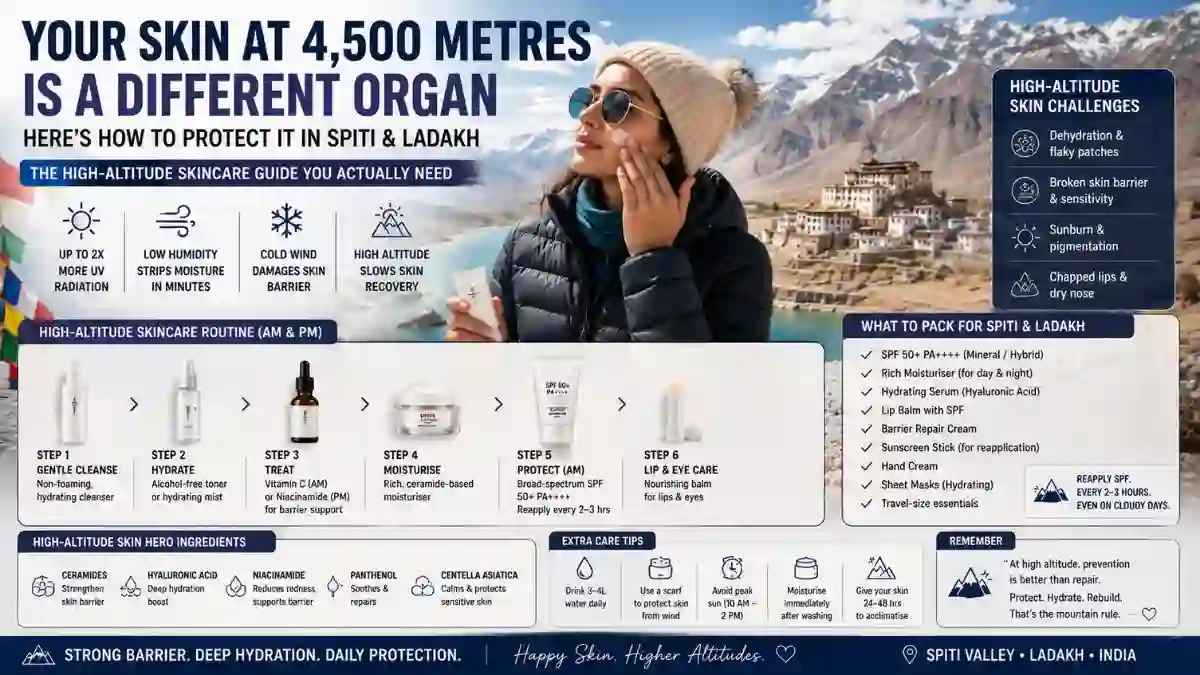
At 4,500 metres above sea level — somewhere between Kaza and Chandratal — UV radiation is approximately twice as intense as it is at sea level. The air holds almost no moisture. Wind strips whatever hydration your skin has left within minutes. And your body, busy managing the effects of altitude on your lungs and circulation, largely forgets to protect your skin barrier. Most travellers to Spiti and Ladakh come prepared for altitude sickness. Almost none come prepared for what the mountains do to their skin.
A high-altitude skincare routine isn't vanity — it's protection. Cracked lips, raw sunburn, wind-scalded cheeks, and barrier-damaged skin that takes weeks to heal back home are among the most common complaints from Ladakh returnees. This guide gives you the science, the products, and the exact routine to prevent all of it — covering everything from base camp prep to Khardung La summit care.
At high altitudes like Spiti and Ladakh, your skin needs three non-negotiable things: SPF 50+ broad-spectrum sunscreen (reapplied every 90 minutes), an occlusive moisturiser rich in ceramides or shea to seal moisture against wind-induced transepidermal water loss, and a deeply hydrating lip balm with SPF. Everything else — serums, actives, exfoliants — should be simplified or temporarily paused. Less is more above 3,500m.
What High Altitude Actually Does to Your Skin
Understanding the enemy is the first step to fighting it intelligently. Three forces converge above 3,000 metres to wreak havoc on your skin — and they work simultaneously.
The UV Problem
Every 1,000 metres of altitude increase raises UV radiation by roughly 10–12%. By the time you're at Pangong Tso (4,350m) or the Spiti valley floor (3,800m), you're receiving UV levels that would be considered extreme even in tropical coastal environments. Snow and water compound this — reflective surfaces bounce UV back up at you from below, meaning even a hat won't fully protect your face.
The Moisture Collapse
Cold mountain air is dry air. But in Ladakh and Spiti, it's also moving air. Wind at altitude creates a continuous convective moisture loss from your skin surface — a process called transepidermal water loss (TEWL) — that no ordinary moisturiser applied once in the morning can adequately counter. Occlusive ingredients like petrolatum, shea butter, and dimethicone are the only way to physically slow this process.
Reduced Oxygen and Skin Repair
Here's the part most travel skincare guides skip entirely: lower oxygen partial pressure at altitude impairs your skin's natural regenerative capacity. Cell turnover slows. Microdamage from UV and wind heals more slowly. This means any barrier disruption you experience on Day 1 may still be visible on Day 7 — which is why prevention matters infinitely more than repair in this environment.
The Essential Product List for Spiti & Ladakh
This isn't a maximalist packing list. These are the six categories you genuinely cannot skip — everything else is optional weight.
"Above 4,000 metres, the mountain is already working hard against your skin's barrier. Your job is simply not to make it worse — strip back your routine to protection-first and your skin will thank you when you're back at sea level." — Dermatology perspective on high-altitude travel skincare
The Exact High-Altitude Skincare Routine to Follow
Keep it minimal. Keep it consistent. The mistake most travellers make is applying their full at-home routine on the road — actives like retinol, AHAs, and vitamin C can sensitise skin that's already under UV stress. In high altitude conditions, these ingredients increase photosensitivity at the worst possible time.
Morning Routine (3–4 Minutes Total)
Night Routine (5 Minutes Total)
Common Skincare Mistakes on Himalayan Trips (And How to Fix Them)
Continuing your AHA, BHA, or retinol routine at high altitude. These active ingredients thin your barrier, increase photosensitivity, and trigger inflammatory responses in skin that is already under environmental stress. Pause all actives at least 3 days before departure and resume 5–7 days after returning to lower altitude.
Pack their full routine. Apply vitamin C in the morning, retinol at night. Wonder why their face feels like parchment by Day 3 and why their cheeks are burning even in the shade.
Pack 4 products. SPF, barrier moisturiser, HA serum, lip balm. Apply consistently. Return home with skin that looks calmer than when they left, because protection-first eliminated all the usual damage.
- Don't use alcohol-based toners or astringents — they strip barrier faster than wind ever could
- Don't skip eye drops — eye irritation from dust and UV is almost universal without them
- Don't assume cloud cover means SPF can wait — UV penetrates cloud cover by up to 80%
- Don't use a new product for the first time at altitude — patch test everything at home before your trip
- Don't rely on SPF in your moisturiser alone — it's rarely enough in UV Zone Extreme conditions above 3,500m
Quick Tips: Skincare Packing for Spiti & Ladakh
Featured Snippet — Packing Tips
- Transfer moisturisers and serums into 30ml silicone travel tubes — cabin pressure changes can pop full-size product lids mid-journey
- Keep your sunscreen in a front pocket or bag accessible from outside your pack — the 90-minute reapplication rule only works if you can reach it while hiking
- Facial mists are worth the weight — a quick spritz before SPF reapplication adds a moisture buffer that helps sunscreen sit more evenly on dry skin
- Pack a small tub of petroleum jelly (Vaseline) as your emergency multipurpose product — lip balm, overnight treatment, cuticle repair, and chafing prevention all in one
- High altitude dehydration is internal as well as external — drinking 3–4 litres of water daily is the skincare step no product can replace
- Use a broad-brimmed hat and UV-protective buff in addition to SPF — at altitude, physical sun blocking is more reliable than chemistry alone
Two Weeks Before Your Trip: Preparing Your Skin for Altitude
The best high-altitude skincare results come from travellers who start 14 days before departure, not after the first sunburn. Think of it like altitude acclimatisation — you're pre-conditioning your skin barrier to handle what's coming.
- Day 14–10: Begin layering ceramide moisturiser morning and night to build up baseline barrier strength
- Day 10–7: Slowly reduce active ingredients — drop retinol frequency, then pause AHAs
- Day 7–3: Introduce your travel SPF at home to confirm no sensitivity or breakouts before you're in remote terrain
- Day 3–0: Stop all actives completely. Simplify to SPF + moisturiser + gentle cleanser — exactly what you'll use on the trip
- Post-trip: Wait 5–7 days back at sea level before reintroducing actives. Your barrier needs time to normalise after altitude stress
Your Skin at 4,500 Metres Deserves the Same Preparation as Your Lungs
A high-altitude skincare routine for Spiti and Ladakh doesn't need to be complicated or expensive. It needs to be consistent, focused on protection over correction, and stripped of everything your skin doesn't need when it's already managing environmental extremes. Four products, two applications a day, and a genuine respect for what UV radiation above the clouds actually means — that's the whole secret.
The mountains will stress your skin. Wind, altitude, UV, and dryness will all work against you simultaneously. But the travellers who come back from Ladakh with genuinely glowing, healthy skin aren't the ones who packed more — they're the ones who packed smarter, applied consistently, and left their actives at home.
Start building your barrier two weeks before you go. Carry your SPF in your hip pocket. Reapply. Drink your water. And give yourself permission to simplify — at altitude, less is always, always more.
Leave a comment
Share a quick thought about this story.
Thanks for sharing your view. It is ready for review.
Please try again in a moment.