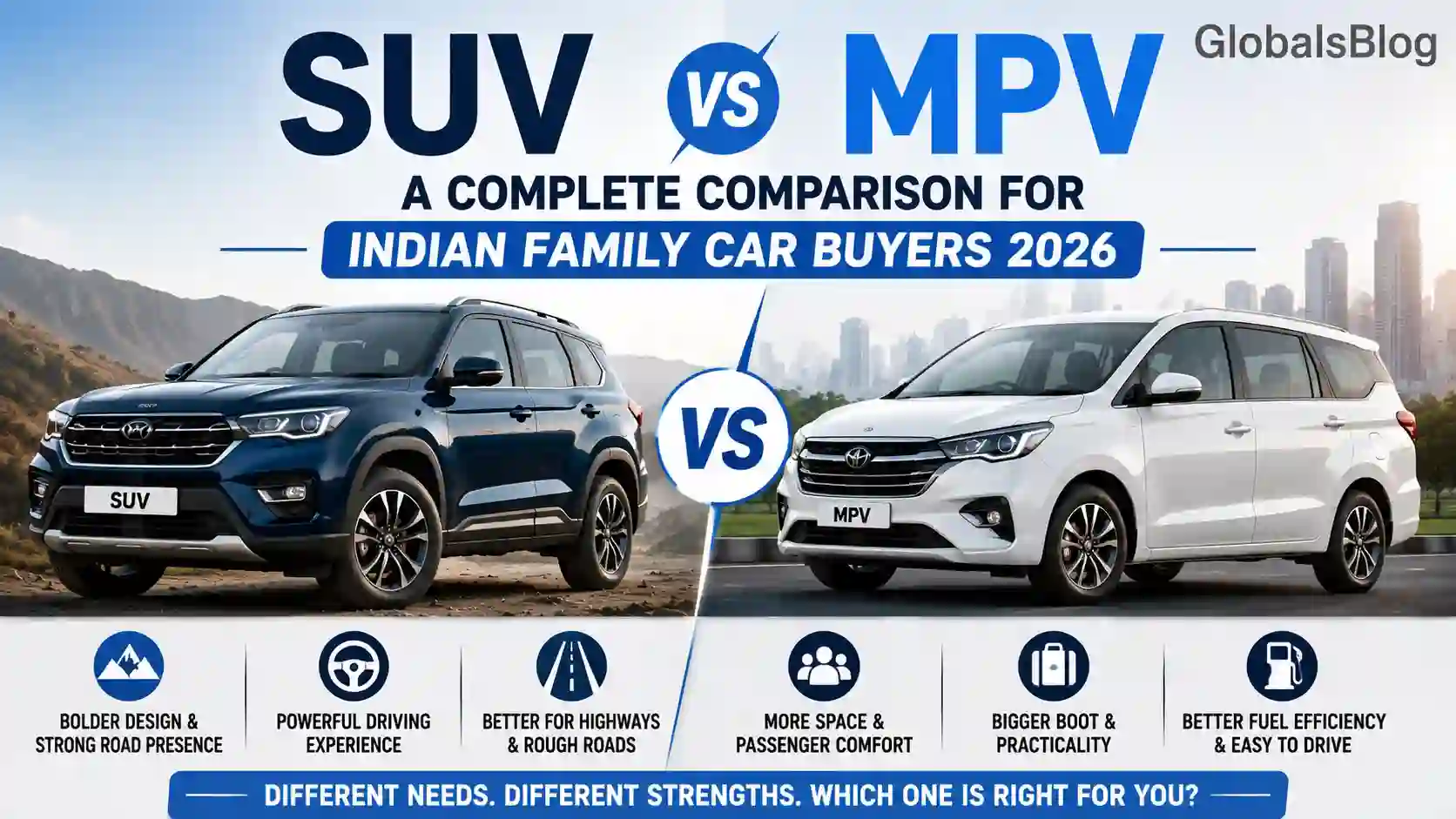
Same price range. Very different lives. Here is the honest comparison that showroom salespeople are not incentivised to give you.
Half the cars people call SUVs in Indian showrooms today are technically MPVs underneath — and quite a few families buying mid-size SUVs would genuinely be better served by an MPV. The SUV vs MPV comparison is one of the most relevant buying decisions for anyone spending ₹12–22 lakh on a family car in India. Get it right and you spend five years loving your choice. Get it wrong and you spend five years wishing the back seat was bigger.
This guide gives you the real, experience-based comparison — not a list of specifications, but a clear picture of how each type actually feels to live with over months and years of Indian driving.
An SUV prioritises driving performance, ground clearance, and road presence — designed primarily around a family of 5. An MPV is engineered to maximise cabin space with flat-floor seating for 6–8 passengers and effortless long-distance family comfort. For joint families or frequent long trips with full occupancy, the MPV wins clearly. For nuclear families who value driving dynamics, the SUV is the better pick.
MPV vs MUV — Are They the Same Thing?
In Indian marketing, MPV and MUV are used interchangeably and for practical buying purposes they mean the same thing. MPV (Multi-Purpose Vehicle) is the global term. MUV (Multi Utility Vehicle) is the Indian variant. Both refer to passenger-volume-first vehicles with flat floors and 6–8 seats. The Maruti Ertiga and Kia Carens are called MPVs. The Toyota Innova Crysta is often called an MUV. You would drive both the same way and use them for the same purpose.
For the full breakdown of the MUV category and which body type genuinely fits your family, the SUV vs MUV pillar guide has a 3-question framework that resolves this decision in under 10 minutes.
How an SUV and MPV Feel Completely Different
The divide between these two types is not just on paper — you feel it within minutes of driving each one and even more clearly after 100 km of highway driving with a full car.
In an SUV, you sit high, the steering is weighted, and there is a sense of road authority. Overtaking on a highway feels natural and confident. When you are alone or with three passengers, an SUV cabin feels spacious and well-appointed.
In an MPV, the driving position is more upright and the steering is lighter. But here is what no specification sheet captures: when you are on a 6-hour Mumbai–Goa run with five adults and luggage, the MPV makes every single passenger comfortable while the SUV has people constantly adjusting and asking when the next stop is.
Where the SUV genuinely wins: driving dynamics
If driving enjoyment matters — weekend ghat drives, quick highway overtakes, confident B-road feel — the SUV is meaningfully better. Most MPVs use comfort-tuned suspension and front-wheel drive setups that smooth out bumps but reduce handling response. A Kia Seltos or Tata Harrier through a hill section is an engaging experience. A Kia Carens is not — and it does not pretend to be.
Where the MPV is unbeatable: long-distance family comfort
For trips over 4 hours with more than 4 passengers, the MPV is in a different class entirely. Captain seats in a 6-seater give every adult personal space and armrests. The flat floor means the middle passenger is not perched on a transmission tunnel. Rear AC vents are positioned for actual coverage. And critically — there is usable boot space left even with all rows occupied. A 7-seater SUV's third row essentially eliminates the boot entirely. For the best current MPV options ranked by real comfort, the Best MUV Cars in India guide covers every major model.
SUV vs MPV — Head to Head on What Matters
- Higher ground clearance — rough roads handled well
- Commanding, sporty driving experience
- Better highway overtaking confidence
- Third row cramped for adults in most models
- Boot disappears with 3rd row deployed
- Stronger urban image and resale in most markets
- Flat floor — genuine equal comfort for all in row 2
- Third row adults actually fit in most models
- Wide doors — easy entry for elderly passengers
- Usable 100–180L boot with all rows occupied
- Rear AC vents properly positioned for coverage
- Comfort suspension — better for 4+ hour trips
| Factor | SUV | MPV |
|---|---|---|
| Platform | Monocoque or ladder-frame | Monocoque (mostly) |
| Seating | 5 standard, 7 available | 6–8 standard |
| Flat Floor | No — tunnel hump | Yes |
| 3rd Row Adults | Uncomfortable in most | Comfortable in most |
| Ground Clearance | 180–220mm | 165–190mm |
| Boot (all rows up) | Very limited | 100–180L usable |
For families still deciding between 5 and 7 seats, the 5-Seater vs 7-Seater Cars guide has an honest framework to decide whether those extra rows actually improve your life or just add cost.
Who Should Buy an MPV Instead of an SUV?
More Indian families than currently do. Here are the profiles where an MPV is clearly the smarter choice:
For a full view of what works best for different family sizes and budgets across both body types, the Best Family Cars in India guide covers everything from ₹8 lakh compact SUVs to ₹30 lakh premium people-movers.
The MPV Stigma — A Contrarian View Worth Stating
"The MPV stigma is purely a marketing perception problem — not a real-world quality problem. Nobody who owns an Innova Crysta thinks they bought a lesser car. They think they bought the right car for their family."— Feedback from Indian family car buyer survey, 2025
There is a persistent idea in Indian car buying culture that SUVs are aspirational and MPVs are practical-but-boring. This idea costs families real money and real comfort every year. The Kia Carens looks as contemporary as any mid-size SUV. The Hyundai Alcazar and Maruti Invicto are genuinely premium inside. Modern MPVs have completely shed the "school van" image — but the perception has not caught up with the product.
The actual aspiration should be choosing the vehicle that makes your real life better — not the one that photographs well in a parking lot.
✓ Tips Before You Decide
- Do the Captain Seat Test: sit in both captain positions of a 6-seater MPV, recline slightly, check armrest height and legroom. That single test tells you more than any brochure page.
- Check boot space with all rows occupied before buying any 7-seater — in many SUVs it is less than one suitcase worth of usable space.
- The Kia Carens diesel 6-seater is one of the best value family configurations in India right now — always compare it before finalising any mid-size SUV.
- For fuel efficiency across both categories, the Best Mileage SUVs guide has real-world numbers — diesel MPV options frequently outperform equivalent diesel SUVs on a per-km basis.
- If you are comparing SUV vs crossover vs MPV body types, the SUV vs Crossover guide explains platform differences that affect long-term durability and off-road capability.
✗ Mistakes to Avoid
- Assuming MPVs are old-fashioned. The Kia Carens, Maruti Invicto, and Hyundai Alcazar have completely redefined what an MPV looks and feels like. This perception is a decade out of date.
- Buying a 7-seat SUV without checking the actual third row. Most mid-size SUV third rows are unusable for adults on long trips — they exist as a numbers game on the spec sheet, not as genuine seats.
- Ignoring rear AC coverage. In a full 7-person car, rear vent position and strength matters enormously. Test it with all rows occupied before buying.
- Paying for off-road capability you will never use. If your roads are urban and highway, a front-wheel-drive MPV handles everything you will encounter and costs less than an AWD SUV.
Stop Buying Perception. Start Buying the Right Car.
If your family is 5 people and you love driving, buy the SUV. If your family is 6 or more, includes elderly passengers, or makes regular long trips with full occupancy — the MPV is the honest, practical, and often better-value choice. The only reason most people do not buy MPVs is perception. Do not let a marketing image cost you five years of back-seat comfort.
Frequently Asked Questions
In India the terms are used interchangeably. MPV is the global term for Multi-Purpose Vehicle; MUV is the Indian marketing variant meaning Multi Utility Vehicle. Both refer to passenger-volume-first vehicles with flat floors and 6–8 seats. Maruti uses MPV for the Ertiga; Toyota uses MUV for the Innova Crysta. You would buy and use both the same way.
The Maruti Suzuki Ertiga is an MPV — built on a monocoque platform, seating 7, and designed around passenger practicality and fuel efficiency rather than driving dynamics or off-road ability. It is India's best-selling MPV and consistently ranks at the top for value, service costs, and long-term reliability.
For a regular family of 6, an MPV is almost always the better choice. A 7-seater SUV has a cramped third row and near-zero boot space when fully occupied. An MPV like the Kia Carens or Innova Crysta gives all 6 passengers genuine comfort and still leaves usable luggage space. The exception is if you strongly prioritise the driver's experience over passenger comfort.
Top MPV picks in India in 2026: Maruti Ertiga (best value under ₹12 lakh), Kia Carens (best features and design, ₹10–19 lakh), Toyota Innova Crysta (best build quality and resale, ₹19–26 lakh), and Maruti Invicto (premium hybrid MPV, ₹24–28 lakh). Each suits a different budget and travel frequency.
MPVs are designed from the ground up with passenger volume as the primary objective — longer wheelbases, upright rooflines, and flat floors that position the third row correctly. SUVs add a third row as an afterthought to increase seat count on a spec sheet. The architecture is not built for it, so the space is compromised from the start.
MPVs are slightly longer than compact SUVs, which can make very tight city parking more challenging. However most modern MPVs have good turning radii and parking sensors as standard. The Ertiga handles city driving well despite its size. If pure urban agility matters more than passenger capacity, a compact SUV is more nimble — but for families who need the space, the mild city trade-off is worth it.
Reader Discussion
We did the same Mumbai to Shirdi route twice — once in a Creta, once in a Carens. Five adults and two kids both times. The Carens was a completely different experience. Nobody complained about leg space even once.
The captain seat test tip is genuinely useful. I sat in the Carens captain seats for 5 full minutes at the showroom, imagined a 4-hour drive, and immediately knew it was the right car. Nobody else told me to do that.
The MPV stigma point is so real. My Innova Crysta gets more respect at highway dhabas than half the mid-size SUVs parked there. Nobody looks at it as a lesser car.
What about the Hyundai Alcazar — is that a good middle ground between SUV and MPV?
The boot space reality check saved me. Tested a Hector Plus with all 7 seats up — space for one bag. Switched to Carens on my shortlist immediately.