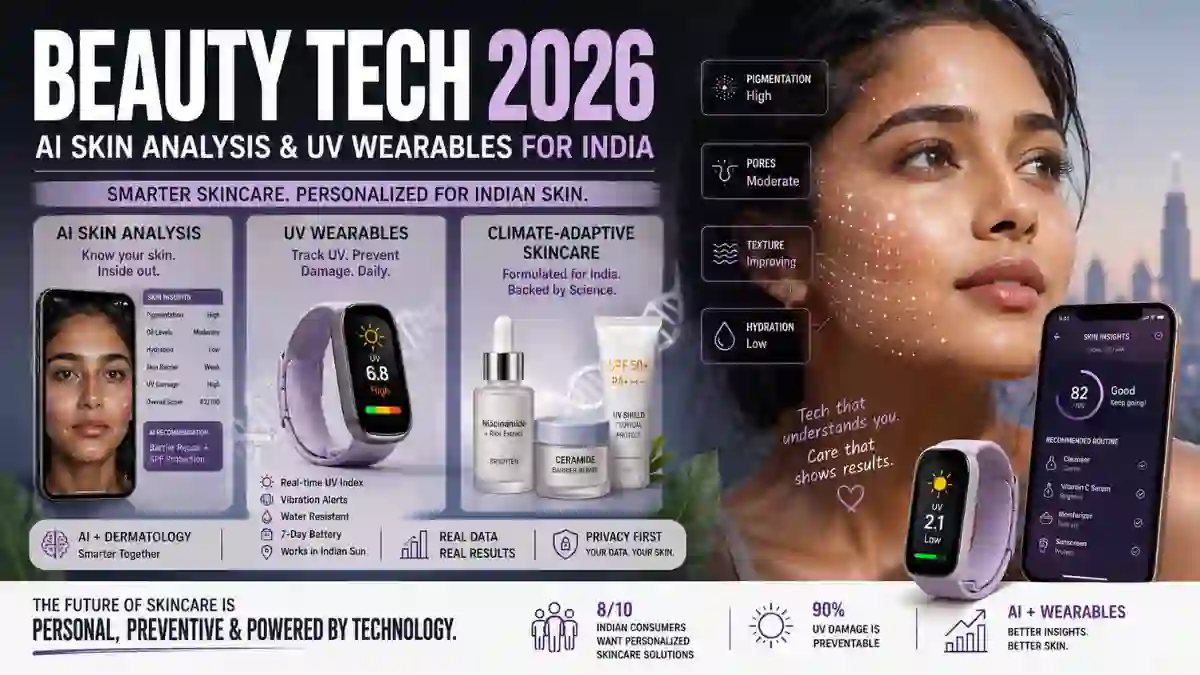
AI skin analysis, wearable UV monitors, and climate-adaptive formulations are reshaping what personalized skincare means for Indian skin tones and tropical climates.
📎 Related: Complete Guide to SPF for Indian Skin Tones — What Actually Works
What Is Beauty Tech in 2026 — and Why Does It Matter for Indian Skin?
- AI skin analysis uses smartphone cameras or dedicated scanners to map hydration, melanin distribution, sebum levels, and early hyperpigmentation — in real time, without a dermatologist visit.
- Wearable UV monitors track your personal UV exposure across the day and adapt SPF and antioxidant recommendations based on your actual environment, not generalized tables.
- Climate-adaptive formulations are products whose active ingredient delivery adjusts based on humidity, temperature, and pollution data pulled from your location.
- Together, these technologies are building the first skincare ecosystem designed around real Indian conditions — not retrofitted from Western dermatology research.
Why Indian Skin Has Always Been Underserved by Global Beauty Science
The global skincare industry has a data problem, and Indian consumers have been paying the price for it. Most foundational dermatology research published between 1970 and 2010 was conducted predominantly on lighter Fitzpatrick Type I–III skin, creating a cascading effect: product formulations, recommended ingredient concentrations, even sunscreen SPF testing protocols were all calibrated for a skin biology that doesn't reflect the majority of the world population.
Indian skin sits primarily in Fitzpatrick Types IV and V — melanin-rich, more resilient to sunburn in some ways but significantly more prone to post-inflammatory hyperpigmentation (PIH), melasma, and uneven tone triggered by hormonal changes and UV exposure. A breakout that fades in two weeks for a Type II skin can leave a dark mark that persists for months on a Type IV or V complexion.
The Six Indian Skin Tone Zones
India skin diversity is not a monolith. A woman in Kashmir has meaningfully different baseline melanin levels and UV exposure patterns than a woman in Kochi. AI skin analysis tools launched in 2025–2026 are beginning to train on regional datasets — accounting not just for tone, but for climate zone, pollution index, and seasonal variation.
Illustrative Fitzpatrick range typical across the Indian subcontinent. AI tools are now training on regional Indian datasets to account for this diversity.
"The biggest failure of global beauty science wasn't malice — it was assumption. The assumption that skin behaves the same way everywhere. It doesn't. And now the data is finally available to prove it." — Perspective reflected in 2025 International Journal of Dermatology, India-specific skincare outcomes research
AI Skin Analysis in 2026: What the Technology Can Actually Do
The phrase "AI skin analysis" has been used loosely for years — applied to everything from basic selfie filters to genuinely sophisticated dermatological tools. In 2026, the gap between these has grown wide enough that distinguishing them matters for any buyer.
Consumer-Grade AI Skin Scanners
Apps like HautAI, Revieve, and India-launched platforms including SkinIQ and Dermavision now use a combination of multispectral imaging (which goes beyond visible light to detect melanin concentration beneath the skin surface) and machine-learning models trained on millions of annotated skin images. A good 2026 consumer scanner can reliably assess: hydration gradient, sebum production zone mapping, UV damage markers, early-stage hyperpigmentation clusters, and skin texture irregularity.
What they still cannot do reliably: diagnose clinical conditions (eczema, rosacea, psoriasis), detect skin cancers, or replace a board-certified dermatologist judgment. The distinction matters. These are optimization tools, not diagnostic tools.
Clinic-Grade AI: Where the Real Shift Is Happening
Dermatology clinics across Mumbai, Delhi, Bengaluru, and Hyderabad are increasingly integrating VISIA Complexion Analysis systems and similar platforms that use UV fluorescence and cross-polarized light imaging. The output is a detailed skin map that tracks changes across consultations with objective precision — not relying on memory or subjective assessment. For conditions like melasma, which require long-term monitoring, this represents a fundamental upgrade in care quality.
📎 Related: Best Dermatology Clinics Using AI Skin Tech in Indian Metro Cities
SkinIQ (India-built)
Smartphone-based multispectral skin analysis trained on 500,000+ South Asian skin images. Available as a standalone app and white-labelled for Indian brands.
L'Oréal UV Sense 2.0
Tiny sensor worn on the thumbnail. Tracks cumulative UV dose, syncs with a smartphone to alert when daily safe exposure is reached. Now calibrated for tropical UV indices.
The Minimalist Climate Range
India own The Minimalist launched humidity-adaptive moisturisers in late 2025. Formulations shift viscosity and humectant delivery based on ambient humidity logged from your phone.
Wearable UV Monitors: The Device Indian Skin Has Needed for Decades
Sunscreen usage in India remains chronically low relative to UV exposure levels. A 2024 survey by the Indian Association of Dermatologists found that fewer than 22% of Indian adults applied SPF 30+ daily — even in high-UV regions like Rajasthan and Tamil Nadu. The reason cited most often? "I didn't think I needed it."
Wearable UV monitors address exactly this perception gap. They don't tell you what the UV index is in your city. They tell you how much UV radiation your specific skin has absorbed today — and they tell you when to reapply, seek shade, or add a supplemental antioxidant serum.
How They Work — Without the Technical Jargon
Most wearable UV sensors use a photodiode or quantum dot sensor that detects UVA and UVB wavelengths independently. The device logs your cumulative exposure, factors in your skin type (you set this once in the companion app), and calculates how close you are to a minimum erythemal dose (MED) — the threshold at which UV damage begins accumulating invisibly even before a tan or burn appears.
In Indian climate contexts, the devices are being further refined to account for monsoon UV scatter — a genuinely underappreciated phenomenon where cloud cover during the June–September period creates a false sense of safety while UVA penetration remains at 80–90% of peak summer levels.
What to Look for Before You Buy
- Confirm the device differentiates between UVA and UVB — UVA is responsible for the bulk of pigmentation damage and requires separate tracking.
- Check whether the companion app allows you to input your Fitzpatrick skin type — Indian skin reacts to UV exposure differently from Type I–II defaults baked into most Western-calibrated devices.
- Look for monsoon mode or cloud-correction algorithms — crucial for reliability during India rainy season.
- Battery life matters more than most reviews say: if the device needs charging daily, real-world usage drops sharply after the first week.
- Integration with skincare apps (for SPF reapplication reminders tied to your actual exposure) is the feature that most changes behaviour — prioritize it.
Climate-Adaptive Skincare Formulations: The Science Behind the Buzzword
Climate-adaptive skincare is the newest and least understood pillar of beauty tech 2026. The concept sounds intuitive — your skin needs in Delhi in January are different from its needs in Chennai in April — but the execution is more sophisticated than seasonal product switching.
The Framework: How Smart Formulations Work
Indian Climate Zones and Why They Matter for Formulation
India is home to at least five distinct macro-climate zones — arid, semi-arid, tropical humid, subtropical highland, and coastal — and any single skincare product optimized for one performs poorly in another. A ceramide-rich barrier cream that works beautifully in dry Delhi winters becomes pore-clogging and comedogenic in Mumbai 85% humidity. A lightweight gel that perfect for Bengaluru year-round mild temperatures provides insufficient occlusion in Jodhpur desert winters.
AI-driven formulation tools are beginning to solve this by moving from "one product for one person" to "one product baseline, dynamically adjusted for your current context." Startups including Minimalist, Dot & Key, and Pilgrim are piloting in this space in India — with mixed but promising early results.
The Contrarian View: What Indian Consumers Should Be Skeptical About
Here the view that beauty tech marketing won't tell you: most AI skincare apps in 2026 are significantly better at product recommendation than at genuine skin diagnosis. The majority of consumer-grade tools are essentially sophisticated matching engines — they take your inputs (skin type, concerns, budget) and use AI to surface products from a partner brand catalogue. The "skin analysis" is often a confidence mechanism, not a clinically validated assessment.
This is not useless. A well-calibrated recommendation engine can meaningfully improve product-fit versus trial-and-error. But it not the same as a tool trained on peer-reviewed dermatology data, tested on diverse Indian skin populations, and validated by clinical outcomes. Before paying a premium for any AI skincare device or subscription, ask specifically: What dataset was this trained on? Was Indian skin included? What is the clinical validation?
- Trusting UV index apps as a proxy for wearable trackers. The city-level UV index doesn't account for your time outdoors, shade patterns, or reflective surfaces — your wearable does.
- Assuming AI-recommended products are dermatologist-approved. Personalization algorithms optimize for engagement and purchase conversion, not clinical outcomes. Verify active ingredients independently.
- Using SPF calibrated only for Fitzpatrick I–III. Some sunscreens show reduced efficacy on higher melanin skin — ask specifically about testing on Indian or South Asian skin types.
- Ignoring UVA in favour of SPF numbers. SPF measures UVB protection only. Look for broad-spectrum products with PA++++ ratings (the UVA standard used in Indian and Japanese markets).
- Overcomplicating the routine based on app recommendations. A 12-step AI-curated routine that you abandon after two weeks beats no consistent routine. Simplicity you sustain wins.
📎 Related: How to Read Sunscreen Labels — SPF, PA, and Broad Spectrum Explained for Indian Buyers
The Future of Skincare Is Personal — and It Finally Built for India
The convergence of AI skin analysis, wearable UV monitoring, and climate-adaptive formulations isn't a distant promise. It a 2026 reality — imperfect, still maturing, but genuinely transformative for Indian consumers who have spent decades working around skincare science that wasn't designed with them in mind.
The most important thing you can do as a buyer? Demand specificity. Ask which skin tones the AI was trained on. Ask whether UV thresholds are calibrated for your city climate. Ask whether the formulation has been tested in Indian humidity. The brands building beauty tech for Indian skin are out there — and the questions you ask are what make the market improve.
Your skin has always been telling you what it needs. In 2026, the technology is finally good enough to listen — and respond in kind.
Leave a comment
Share a quick thought about this story.
Thanks for sharing your view. It is ready for review.
Please try again in a moment.