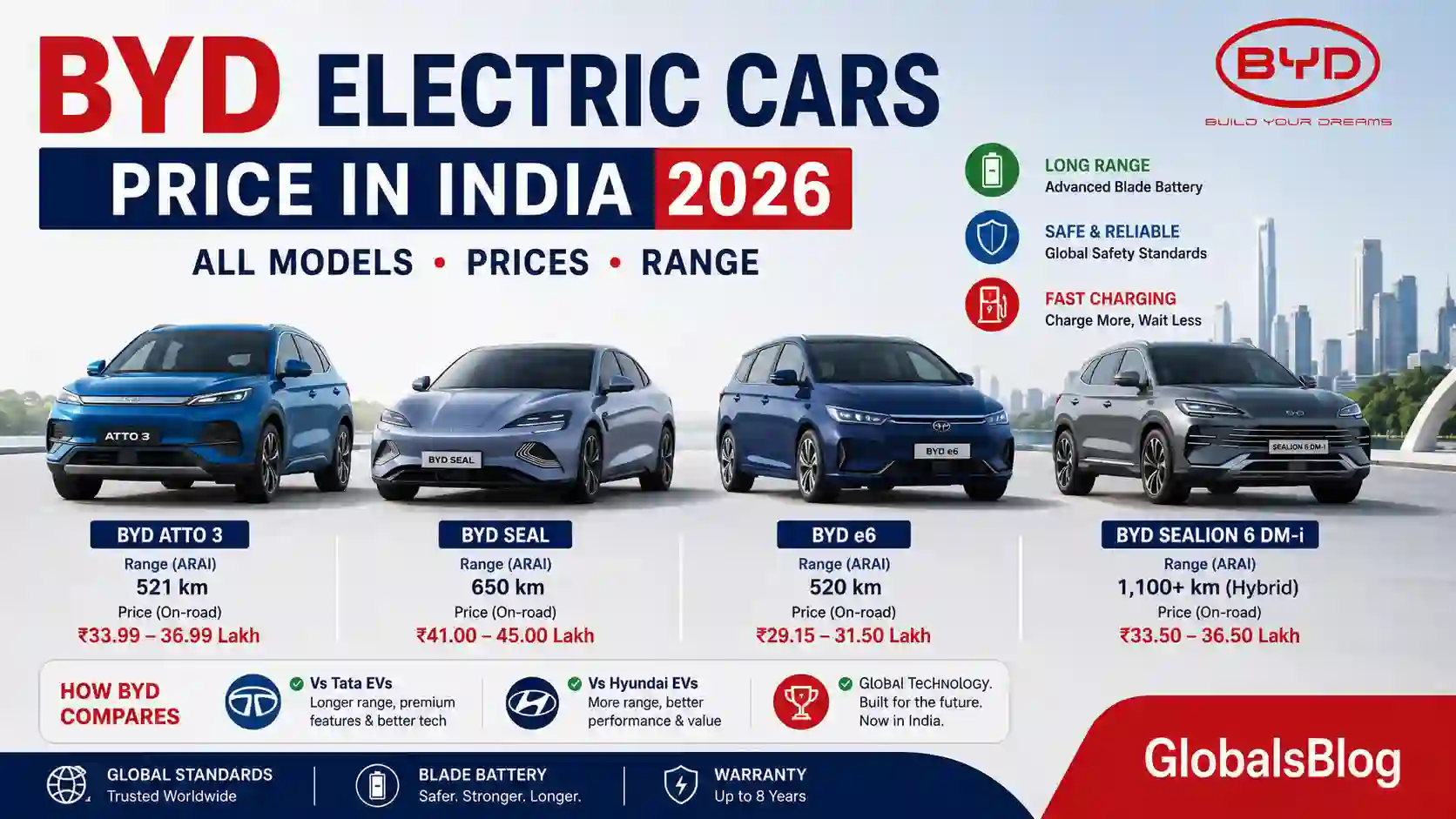
BYD is the world''s largest EV manufacturer. In India, it is building a genuine case as the premium alternative to Tata and Hyundai.
A reader from Bangalore had narrowed his EV choice to Nexon EV Long Range or BYD Atto 3 — a ₹5 lakh price difference he was trying to justify. The answer was not straightforward. Tata wins on service network density, resale track record, and price. BYD wins on battery technology, real-world range performance, and interior quality. Neither is the obvious choice for every buyer — and understanding what BYD actually offers for the premium is what this guide is designed to help with.
BYD's India EV lineup in 2026 includes the Atto 3 at ₹24.99 lakh, the Seal sedan at ₹41 lakh, and the Sealion 6 DM-i plug-in hybrid at ₹29.99 lakh. BYD uses its proprietary Blade Battery technology which offers superior thermal safety and longer cycle life than conventional lithium-ion batteries. BYD EVs occupy the ₹25-45 lakh premium segment — above Tata's lineup but below Hyundai Ioniq 6 and Mercedes EQ pricing. The Atto 3 is the most relevant model for most Indian buyers.
BYD in India — What You Need to Know First
BYD (Build Your Dreams) became the world's largest EV manufacturer by volume in 2024, overtaking Tesla globally. In India, BYD entered the market through a joint venture with Hyderabad-based Megha Engineering and Infrastructures, targeting the premium EV segment above Tata and MG but below full luxury European EVs.
The key BYD differentiator in India is its proprietary Blade Battery — a lithium iron phosphate (LFP) battery pack designed with a unique cell-to-pack arrangement that eliminates conventional battery modules. This delivers better thermal stability (LFP chemistry is inherently safer than NMC), longer cycle life (3,000+ charge cycles versus ~1,000-1,500 for NMC batteries), and meaningfully better performance in Indian heat conditions.
The honest India context: BYD's service network in India remains significantly smaller than Tata's — approximately 25-30 cities versus Tata's 200+ city presence. This is the single most important practical consideration for BYD buyers outside major metros.
BYD Electric Car Price List — India June 2026
The Atto 3 is BYD's most accessible India model and the one generating the most purchase consideration among Indian buyers. The 60.48 kWh Blade Battery delivers 521 km ARAI certified range — meaningfully higher than the Nexon EV Long Range's 502 km and with better real-world efficiency thanks to LFP chemistry's more linear discharge curve. The interior quality is genuinely premium for the price — the rotating infotainment screen, panoramic sunroof, and leather seating are noticeably upmarket compared to Indian competitors at similar pricing. The 80 kW DC fast charging rate (0-80% in approximately 50 minutes) is competitive without being class-leading. The honest premium question is whether the ₹5+ lakh gap over Nexon EV LR is justified by the range, interior, and battery technology — for urban buyers in metros with BYD service access, the answer is increasingly yes.
The BYD Seal is a premium electric sedan targeting the BMW 3 Series and Mercedes C-Class segment with its sleek fastback design and dual-motor AWD performance variant. The 82.56 kWh battery delivers 650 km ARAI range in the rear-wheel-drive variant, and 0-100 kmph in 3.8 seconds in the AWD Performance variant — performance figures that genuinely compete with cars costing twice the price. At ₹41 lakh it is priced as a direct alternative to mid-range luxury ICE sedans for buyers willing to make the full EV commitment. The 150 kW DC fast charging rate is class-leading for this price range in India.
The Sealion 6 DM-i is BYD's plug-in hybrid (PHEV) offering for India — using BYD's fifth-generation DM-i hybrid technology that allows 80+ km of pure electric range alongside a petrol engine for extended range. This is the model for buyers who want meaningful EV daily driving (80 km covers most urban commutes entirely) without full EV commitment and range anxiety on intercity travel. The combined ARAI range of 1,200+ km addresses the primary objection to full EVs in India. At ₹29.99 lakh it sits between the Atto 3 and the mainstream hybrid market, offering a compelling bridge product for the significant segment of Indian buyers not yet ready to go fully electric.
BYD vs Tata vs Hyundai — EV Price Comparison India 2026
| Model | Brand | Price | ARAI Range | Service Network | Verdict |
|---|---|---|---|---|---|
| Nexon EV LR | Tata | ₹19.99L | 502 km | 200+ cities | Best Value Overall |
| BYD Atto 3 | BYD | ₹24.99L | 521 km | 25-30 cities | Best Premium Value |
| Hyundai Ioniq 5 | Hyundai | ₹46.05L | 631 km | 100+ cities | Best Hyundai Pick |
| BYD Seal RWD | BYD | ₹41.00L | 650 km | 25-30 cities | Best Performance Sedan |
| BYD Sealion 6 | BYD | ₹29.99L | 1,200 km total | 25-30 cities | Best PHEV Option |
The ₹5 lakh gap between Nexon EV LR and Atto 3 is the most commonly debated EV comparison in India right now. The Atto 3 wins on battery technology, interior quality, and range. The Nexon EV wins on service network, resale value, and price. The right choice is genuinely situational — metro buyer with BYD service nearby leans Atto 3, non-metro buyer or resale-conscious buyer leans Nexon EV.
BYD Blade Battery — Why It Matters for Indian Buyers
Battery technology is the one area where BYD's advantage over most Indian EV competitors is genuinely significant rather than marginal. The Blade Battery's LFP chemistry provides two specific advantages relevant to Indian conditions:
Thermal stability in Indian heat: LFP batteries are inherently more stable at high temperatures than NMC batteries, reducing the thermal management burden in India's hot climate. This translates to more consistent range performance in summer and lower long-term battery degradation.
Cycle life: LFP chemistry supports 3,000+ full charge cycles before significant capacity loss, compared to approximately 1,000-1,500 cycles for NMC batteries. For Indian buyers planning to keep a car 8-10 years, this is a meaningful long-term ownership benefit — the battery at year 8 will retain significantly more capacity than a comparable NMC-equipped EV.
Our best electric car guide covers how BYD's battery technology compares across the full India EV market in more detail.
Tips for Buying a BYD Electric Car in India
- Check BYD service centre availability in your specific city before committing — the network is strong in metros but limited in tier-2 and tier-3 cities
- BYD offers an 8-year/1,60,000 km battery warranty — verify the exact terms and claim process with the dealer before purchase
- For the Atto 3, the AC charging rate (7 kW) is standard — home charger installation is included in the purchase, verify this with your dealer
- Compare the Atto 3 on-road price carefully against Nexon EV LR — the ₹5 lakh gap narrows somewhat when state subsidies and on-road costs are fully calculated
- Our best electric car guide covers the full competitive landscape before you finalise between BYD and Tata
- BYD resale values in India are still being established — factor this uncertainty into your long-term cost calculation versus Nexon EV's more predictable resale track record
BYD Buying Mistakes to Avoid
- Buying BYD outside major metros without confirming service availability — The service network limitation is the single most important practical consideration. A car that requires a 200 km trip to the nearest service centre for routine maintenance is a genuine ownership burden regardless of how good the product is.
- Choosing BYD over Tata primarily on range — the real-world range difference between Atto 3 and Nexon EV LR in Indian conditions is smaller than the ARAI figures suggest
- Ignoring resale value uncertainty — BYD resale data in India is limited compared to Tata's established track record, and this uncertainty has financial implications for 3-5 year ownership plans
- Not comparing the Sealion 6 DM-i against the Grand Vitara Strong Hybrid — buyers considering the PHEV should evaluate both approaches to partial electrification before deciding
⚠️ Disclaimer: Prices listed are ex-showroom as of June 2026 and subject to change. BYD pricing and model availability have historically shifted with import duty changes — always verify current pricing with an authorised BYD dealer before purchase.
Atto 3 for Metro Premium Buyers. Nexon EV for Everyone Else.
BYD's Blade Battery technology, interior quality, and range genuinely justify the Atto 3's premium over Nexon EV LR for the right buyer — metro-based, service-network-confident, and planning 8+ year ownership where LFP cycle life matters. For buyers outside major metros, or those prioritising resale value and service convenience, Tata's ecosystem advantage remains decisive. Know your situation before choosing between them.
BYD electric cars in India are priced starting at ₹24.99 lakh for the Atto 3 (the most accessible BYD EV), ₹29.99 lakh for the Sealion 6 DM-i plug-in hybrid, and ₹41 lakh for the Seal sedan RWD. All prices are ex-showroom as of June 2026. BYD occupies the ₹25-55 lakh premium EV segment in India, above Tata's lineup and below European luxury EVs.
BYD Atto 3 wins on battery technology (Blade LFP with superior thermal stability and cycle life), ARAI range (521 km vs 502 km), interior quality, and long-term battery durability. Tata Nexon EV wins on price (₹19.99L vs ₹24.99L), service network (200+ cities vs 25-30), and resale value track record. For metro buyers near BYD service centres planning long ownership, Atto 3 is compelling. For buyers outside major metros or prioritising service convenience and resale, Nexon EV remains the stronger practical choice.
BYD Blade Battery is BYD's proprietary lithium iron phosphate (LFP) battery using a cell-to-pack arrangement that eliminates conventional battery modules. This delivers superior thermal stability compared to NMC batteries — important in India's hot climate — and a longer cycle life of 3,000+ full charge cycles versus approximately 1,000-1,500 for typical NMC batteries. The Blade Battery has passed the nail penetration test without fire or explosion — a safety benchmark that most conventional EV batteries cannot match.
BYD has approximately 25-30 service centre cities in India as of mid-2026, concentrated in major metros including Delhi, Mumbai, Bangalore, Hyderabad, Chennai, Pune, and Kolkata. This is significantly smaller than Tata's 200+ city service network. For buyers in cities without BYD service presence, this limited network is a genuine practical disadvantage that should factor significantly into the purchase decision.
The BYD Sealion 6 DM-i is priced at ₹29.99 lakh ex-showroom in India. It is a plug-in hybrid (PHEV) offering 80 km of pure electric range alongside a 1.5L petrol engine for a combined total range of 1,200+ km. This makes it relevant for buyers who want meaningful EV daily driving without full EV commitment, addressing range anxiety on intercity travel that remains the primary objection to pure EVs in India.
Reader Experiences