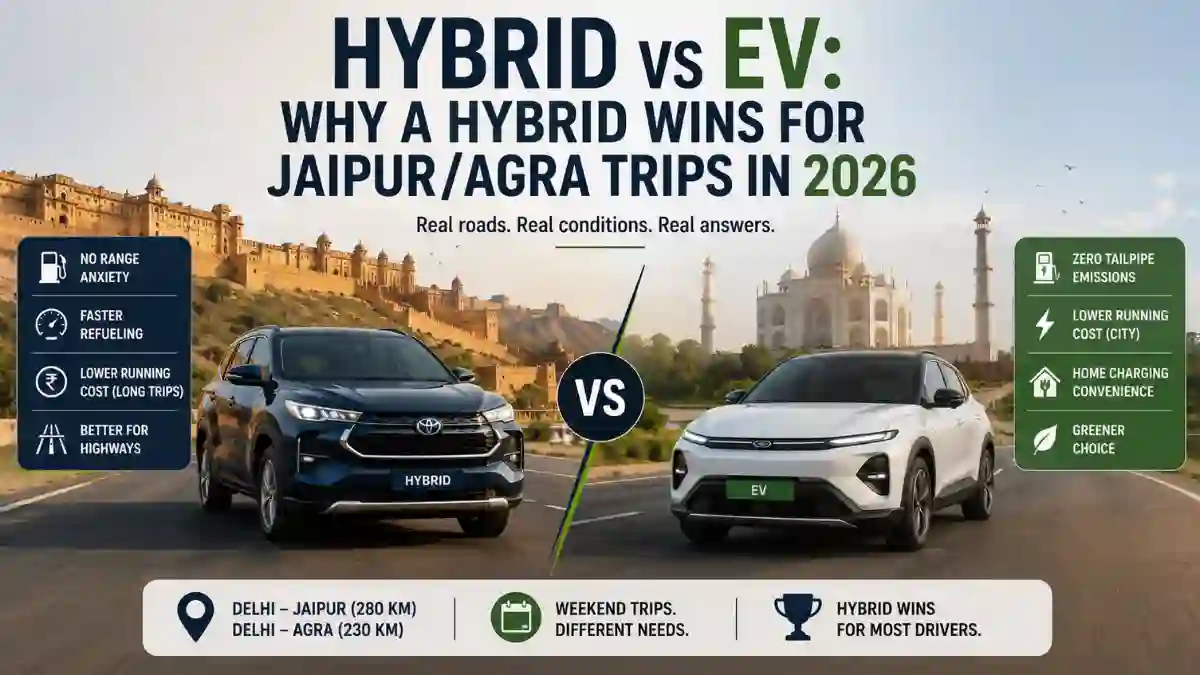
Not every road trip suits an EV. For a quick Delhi–Jaipur–Delhi run, a hybrid delivers more freedom, faster charging, less planning, and genuine peace of mind. Here's the honest comparison.
The Honest Verdict (With Caveats)
- A hybrid wins for trips under 400 km. Zero charging anxiety, 600+ km range per tank, and genuine simplicity. You charge at home overnight (optional), drive whenever you want, refuel anywhere.
- An EV wins for trips over 600 km with multiple charging stops planned in advance. Longer-term cost savings and the environmental win justify the complexity — but only if you're committed to pre-planning routes and charging stops.
- The 250–400 km weekend trip range is hybrid territory. This is where the EV's advantages (lower running cost, environmental impact) are outweighed by the logistical friction (charging time, planning, infrastructure uncertainty).
- An EV makes sense as a primary car only if you have consistent access to DC fast charging. Without it, you're looking at 6–8 hour charging sessions for long trips — that's a dealbreaker for most weekend travelers.
- Many EV owners who take frequent weekend trips are quietly buying hybrids as a second car. That's the real market signal about which vehicle suits which use case.
The Real-World Scenario: Delhi to Jaipur (260 km Round Trip)
Let's stop with abstractions. Let's compare the actual experience of taking a family of four from Delhi to Jaipur for a weekend.
Friday evening: Leave work at 5 PM. Home charging (if you have it) is a bonus — but not required. Tank is full anyway. Hit the highway immediately. No charging app to open, no charger location anxiety. Drive 260 km in 3.5–4 hours. Arrive in Jaipur by 8:30 PM. Explore, eat, sleep. Sunday evening: Drive back 260 km, arrive home by 11 PM. Refuel at a petrol pump if needed (5 minutes) or rely on your full tank. Total trip time: 8 hours drive, zero minutes charging. Total cost: ₹1,200–1,600 in fuel.
Week before trip: Open Tata Charging app. Scout DC fast chargers between Delhi and Jaipur. Note that most highway chargers are clustered around specific towns. Plan a 30–40 minute charging stop (to 80%) partway there. Book the charger if the app allows (it should, but doesn't always). Friday evening: Start with 100% charge (you've been charging at home AC). Leave at 5 PM. Drive 180 km, arrive at charger around 8 PM. Charge to 80% (35–45 minutes). Grab food. Resume drive, reach Jaipur around 11 PM. Sunday evening: Start with 100% charge (charged at your hotel AC overnight — assuming your hotel has a charger, which it may or may not). Drive back, stop to charge again around halfway. Arrive home by midnight. Total trip time: 8 hours drive, 80 minutes charging + logistics. Total cost: ₹800–1,200 in electricity.
The EV is cheaper to run. But it asks you to restructure your trip logistics around charging infrastructure. For a spontaneous weekend escape? The friction is real.
Full Comparison: Hybrid vs EV for Weekend Trips
| Metric | Hybrid (Invicto, Alturas) | EV (BE 6, eVitara) | Winner |
|---|---|---|---|
| Trip Spontaneity | Fully spontaneous | Requires 1-week planning | Hybrid |
| Fuel/Charge Cost (260 km RT) | ₹1,200–1,600 | ₹800–1,200 | EV (₹400 cheaper) |
| Total Trip Time (incl. stops) | 8 hours | 9.5–10 hours | Hybrid |
| Charging/Refuelling Stops | 0–1 (optional) | 1 mandatory | Tie (both require 1 stop) |
| Range Buffer | 600+ km per tank | 350–420 km (70% of ARAI) | Hybrid |
| Charger Reliability Risk | Zero | 1–2% chance of breakdown | Hybrid |
| Mental Planning Load | None | Medium (route, chargers, booking) | Hybrid |
| Environmental Impact | Moderate (burns fuel) | Low (grid electricity) | EV |
| Petrol Station Access Required | Yes, but abundant | No (but chargers less abundant) | Hybrid |
| Best Suited For... | Weekend trips, families, spontaneity | Long trips, planned journeys, city commutes | Depends on use case |
Key insight: The EV wins on cost and environment. The hybrid wins on every other dimension that matters for weekend trips. This isn't a fault of either vehicle — it's a mismatch between the use case and the technology.
When Each Vehicle Actually Wins (The Honest Framework)
The Charging Stop Honesty: What EV Marketing Won't Tell You
EV marketing says: "Fast chargers add 200 km in 30 minutes." True. But that's not the full picture.
The Real Charging Stop Timeline
0:00 — Arrive at charger, open the Tata Charging app, pay, and connect cable. (5 min)
0:05 — Charging begins. You now have 30–45 minutes with nothing to do.
0:35 — Charging reaches 80%. You disconnect to protect the battery and begin degradation caution (the last 20% takes disproportionate time).
0:40 — You've used a bathroom, grabbed a snack, walked around. You're ready to leave.
0:40–0:50 — In reality, you browse the charger area, grab a coffee, maybe take a quick nap in the car. You're not rushing.
Total real-world charging stop: 45–60 minutes.
A petrol stop takes 5 minutes. A charging stop takes 45–60 minutes. That's not a small difference. Over a 600 km trip, an EV adds 1.5–2 hours of stopping time that a hybrid doesn't. For many people, that's the trip difference between a long day and a very long day.
"The charger is fast. The human is slow. And charging to 80% means you're stopping anyway — you're not shaving 45 minutes off a petrol stop; you're adding it." — Perspective from Indian EV owners with 50,000+ km of road trip experience
The Real Cost Calculation (Beyond Fuel)
When you factor in the full cost — not just fuel — the EV's cost advantage shrinks dramatically. For some trip profiles, it disappears entirely.
The Scenarios Where an EV Actually Wins
Scenario 1: Frequent Long Trips (800+ km)
You do quarterly 800 km road trips. Multiple charging stops are built in. Cost savings compound meaningfully: ₹2,000–3,000 saved per trip × 4 times/year = ₹8,000–12,000/year. After 3 years, that's a ₹24,000–36,000 saving.
Scenario 2: Exclusively Highway Driving
You predominantly use your car for long-distance travel (60%+ of annual km). The DC charger ecosystem becomes your normal. Planning overhead drops. Cost advantage is persistent and significant.
Scenario 3: Environmental Priority
If your primary motivator is reducing emissions (not cost), EVs win unambiguously. Charging from a grid with renewable energy means you're driving on solar, wind, and hydro. That matters.
Scenario 4: Spontaneous Weekend Escapes
You make trip decisions on Thursday evening. You want to leave immediately Friday evening. You need no planning app, no charger routing, no pre-booking. Hybrid dominates.
Scenario 5: Rural/Unpredictable Routing
Your trips involve detours to small towns, farmland, or non-standard routes. Charger infrastructure is sparse off the highway. Hybrid's fuel station ubiquity is invaluable.
Scenario 6: Family Trips (4+ people)
Space matters. Most large family SUVs are hybrids (Invicto, Alturas, Fortuner). EV equivalents exist but are pricier. Plus, families need bathroom breaks — charging stops are natural.
The Elephant in the Room: Infrastructure Reliability
What Happens When the Charger Breaks Down?
- In a hybrid: You drive to the next petrol pump (guaranteed to exist within 50 km on any highway). You refuel. You continue. Worst case: you're 30 minutes late.
- In an EV: If your planned charger is broken, non-functional, or occupied beyond your comfort zone, you now have limited range and need to find an alternate charger. This might be 50–100 km away. You call roadside assistance. You lose 2–3 hours. Worst case: you don't reach your destination that day.
Tata Charging has a 98–99% uptime rate on major highways. That's excellent. But 1–2% failure rate on a trip requiring a charger means you're statistically likely to encounter a broken charger within 20–30 road trips. Once.
This single-point-of-failure architecture is why many EV owners keep hybrids as backup vehicles for important trips.
The Verdict: Choose Hybrid for Weekend Trips, EV for Lifestyle
For a Delhi–Jaipur weekend trip, a hybrid is objectively the better vehicle in 2026. It's not close. Zero planning, spontaneous departure, no range anxiety, minimal time cost. The EV is cheaper to operate, but the operational friction outweighs the cost savings for trips under 400 km.
But here's where it gets interesting: if you're taking frequent long trips (800+ km), multiple times a year, and you're willing to plan routes in advance, an EV's economics and environmental impact start to win. The planning overhead becomes normal. The cost savings compound. The technology stops feeling like friction and starts feeling like your normal routine.
The real market insight is this: buy a hybrid if your trips are spontaneous and short. Buy an EV if your trips are planned and long. And if you do both? That's why many EV owners quietly own hybrids too — not because EVs are failures, but because no single powertrain suits all road trip scenarios.
Leave a comment
Share a quick thought about this story.
Thanks for sharing your view. It is ready for review.
Please try again in a moment.