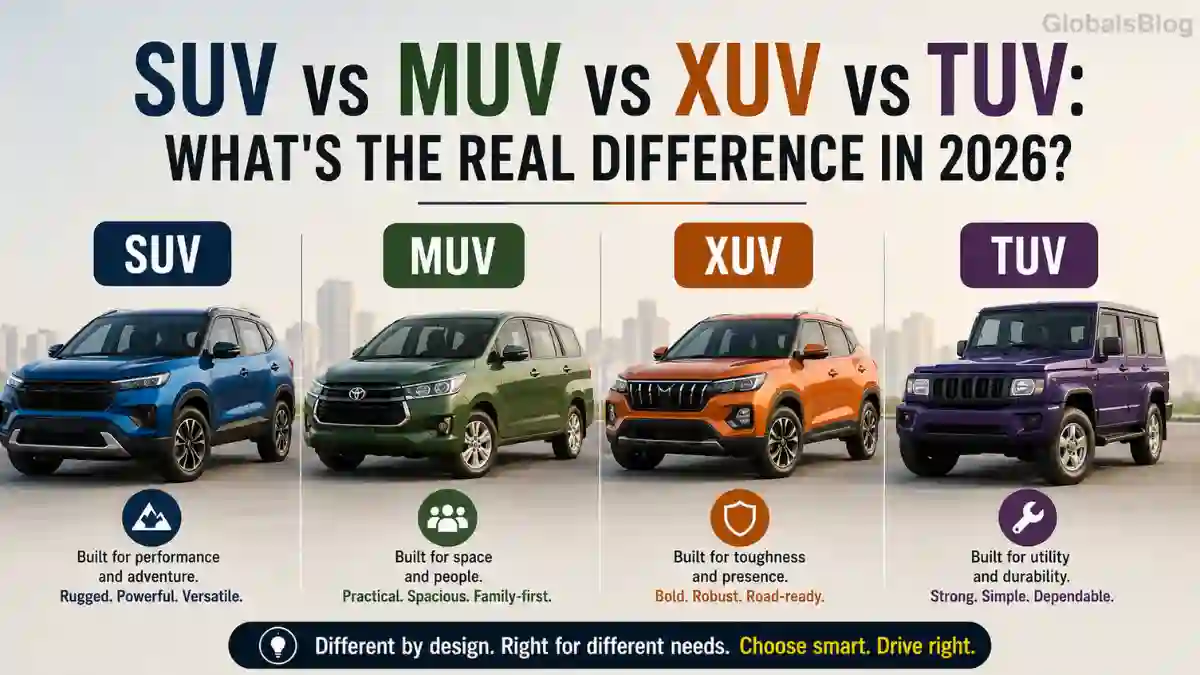
They are not just names. These categories have different tax brackets, seating capacities, and use cases. Here is the exact breakdown so you choose correctly.
What's the Real Difference Between These Categories?
- SUV (Sports Utility Vehicle): High ground clearance, rugged design, all-terrain capability. Can be any length. GST: 12% if 4m+, 5% if under 4m.
- MUV (Multi-Utility Vehicle): Focus on passenger seating and cargo space, not off-road capability. Usually 3-row seating (7–8 passengers). GST: Always 12% regardless of length.
- XUV (Crossover Utility Vehicle): Hybrid of sedan comfort and SUV height. Lower ground clearance than SUVs. Always under 4m to avoid higher GST. GST: 5%.
- TUV (Tough Utility Vehicle): A newer category (post-2020) for tough, angular designs that sit between SUVs and XUVs. Specific design criteria. GST: Can be 5% or 12% depending on length and technical specs.
The Four Categories Explained: What Makes Them Different
Design: Angular, body-on-frame or monocoque with SUV cues
Seating: Usually 5–7 passengers
Examples: Mahindra XUV500, Tata Safari, Maruti Brezza (if classed as SUV)
GST: 5% (if under 4m) or 12% (if 4m+)
Design: Boxy, with 3-row seating as standard
Seating: 7–9 passengers (with third row)
Examples: Maruti Suzuki XL7, Kia Carens, Renault Triber
GST: Always 12% (regardless of length)
Design: Rounded, sedan-like shape with lifted driving position
Seating: Usually 5 passengers (occasionally pseudo-7 with jump seats)
Examples: Maruti Brezza (often classified as XUV), Tata Nexon, Hyundai Venue
GST: Always 5% (sub-4 meters by definition)
Design: Flat-sided, geometric, deliberately tough-looking
Seating: 5–7 passengers depending on model
Examples: Mahindra TUV300, Force Gurkha, Maruti Jimny
GST: 5% (if under 4m) or 12% (if larger)
The Critical Difference: GST & Taxation by Category
Real-world impact: A ₹15 L SUV under 4m saves you ₹1,05,000 in GST vs a 4m+ SUV (5% vs 12%). That's huge. An MUV always pays 12% regardless of size — there's no tax advantage to keeping it under 4m, which is why MUVs tend to be larger and roomier.
Full Specifications Comparison: SUV vs MUV vs XUV vs TUV
| Aspect | SUV | MUV | XUV | TUV |
|---|---|---|---|---|
| Ground Clearance | High (185+ mm) | Moderate (185+ mm) | Moderate-Low (170–180 mm) | High (185+ mm) |
| Length Constraint | None (5% under 4m, 12% above) | Usually 4m+ for space | Always under 4m | Can be under or over 4m |
| Primary Focus | Off-road + on-road capability | Passenger/cargo space | Urban comfort + slight elevation | Tough, purpose-built design |
| Seating Capacity | 5–7 (typically 5) | 7–9 (typically 8 with 3 rows) | 5 (occasionally 7 pseudo) | 5–7 |
| Design Language | Angular, rugged | Boxy, practical | Rounded, sedan-like | Flat-sided, geometric |
| On-Road Comfort | Good (but SUV-tuned suspension) | Excellent (designed for highway) | Excellent (sedan-derived) | Good (SUV-tuned) |
| Off-Road Capability | Excellent (designed for it) | Poor (not intended) | Limited (minimal ground clearance) | Good (designed for rough terrain) |
| GST Rate | 5% (if <4m) or 12% | 12% (always) | 5% (always) | 5% (if <4m) or 12% |
| Example Models | Tata Safari, Mahindra XUV700 | Maruti XL7, Kia Carens | Tata Nexon, Maruti Brezza | Mahindra TUV300, Maruti Jimny |
How To Figure Out What Your Car Actually Is
Which Should You Buy? A Practical Guide
Choose SUV if you want:
Off-road capability, rugged design, higher ground clearance, and don't mind paying more tax if over 4m. Best for: People who take their car on rough terrain, highway adventures, or genuinely need the tough design. Examples: Tata Safari, Mahindra XUV700, MG Hector.
Choose MUV if you want:
Maximum passenger seating (7–9 people), space for cargo, and family highway comfort. You're okay with always paying 12% GST because you're paying for interior room. Examples: Maruti XL7, Kia Carens, Honda Odyssey.
Choose XUV if you want:
A car that looks like an SUV but feels like a sedan. You want the 5% tax advantage, urban comfort, and a slightly elevated driving position without true off-road capability. Examples: Tata Nexon, Maruti Brezza, Hyundai Venue.
Choose TUV if you want:
A purposeful, tough-looking vehicle that's newer and less common. You want design distinctiveness and good off-road capability without fully committing to a traditional SUV. Examples: Mahindra TUV300, Maruti Jimny, Force Gurkha.
"The honest truth: most buyers choose based on looks and space, not tax category. But that 5% vs 12% GST difference adds up. If you're buying a ₹15 L vehicle, understanding the category saves you ₹1 L+ in total cost of ownership over the car's life." — Industry perspective on vehicle category decisions and tax implications
The Bottom Line: Category Matters More Than You Think
SUV, MUV, XUV, and TUV aren't just marketing names — they're official tax categories that affect what you pay. An XUV always saves 7% in GST compared to an MUV, even if they look similar. An SUV under 4m saves money vs the same design over 4m. That's not a coincidence. It's India's vehicle tax system rewarding certain categories and penalizing others.
Before you buy, check your registration certificate to confirm the official category. Then ask yourself: Do I actually need the feature set this category offers, or am I paying extra because of how it's classified?
An XUV gives you urban comfort. An SUV gives you terrain capability. An MUV gives you seating. A TUV gives you design distinctiveness. Choose based on what you actually use — then enjoy the tax savings (or accept the tax cost) that comes with your choice.
Leave a comment
Share a quick thought about this story.
Thanks for sharing your view. It is ready for review.
Please try again in a moment.