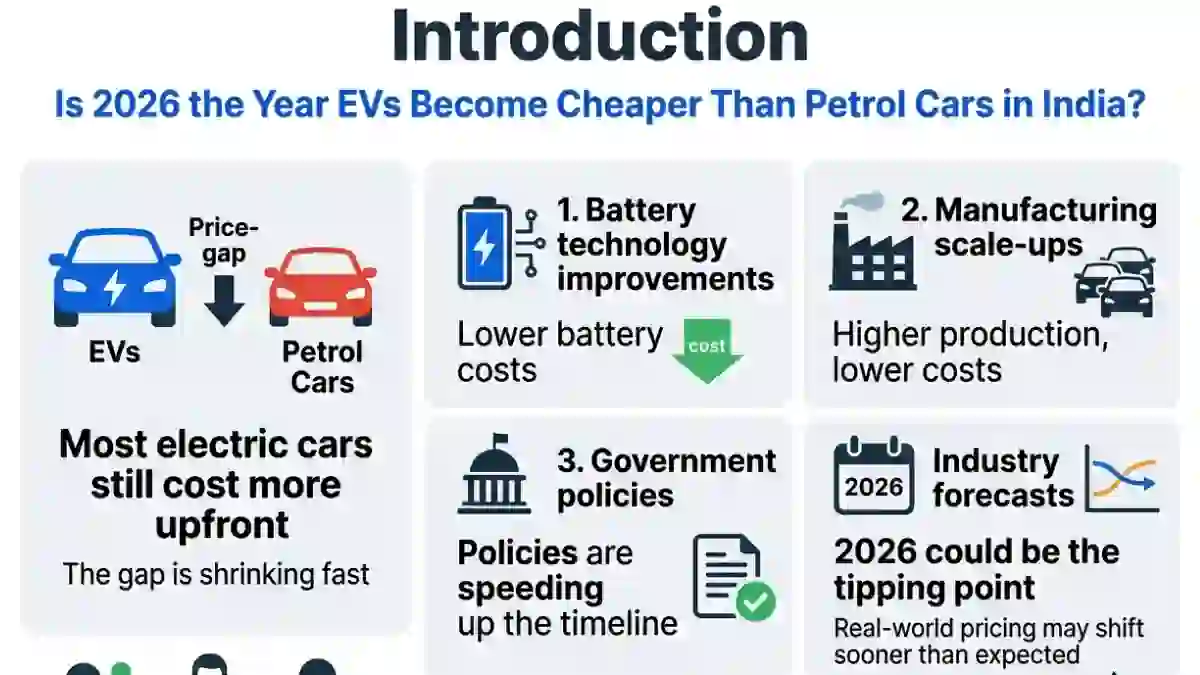
Electric vehicles in India are getting closer to matching petrol car prices every month, and industry experts predict 2026 could be the tipping point. Right now, most electric cars still cost more upfront — but that gap is shrinking fast, driven by battery breakthroughs, local manufacturing, and aggressive government policy.
Section 01Current EV vs Petrol Car Pricing Landscape in India
Price Gaps Between Entry-Level Electric and Petrol Vehicles
The price difference between electric and petrol cars in India remains substantial, though it's narrowing faster than many expected. Entry-level petrol vehicles like the Maruti Suzuki Alto and Hyundai Santro start around ₹3–4 lakh, while the most affordable electric cars such as the Tata Tiago EV and MG Comet begin at approximately ₹8–10 lakh.
This price gap creates a significant barrier for budget-conscious Indian consumers. A typical family looking at their first car faces a ₹5–6 lakh premium for going electric. However, several factors are reshaping this equation. Battery costs, which account for 35–40% of an EV's price, have dropped by nearly 70% since 2015 and continue falling at 10–15% annually.
Local manufacturing is also making a difference. Tata Motors produces EVs domestically, helping reduce costs compared to imported alternatives. New players like Ola Electric and upcoming models from Mahindra are targeting lower price points, with some promising sub-₹6 lakh electric cars by 2025.
Government Subsidies and Their Impact on EV Affordability
The FAME II (Faster Adoption and Manufacturing of Electric Vehicles) scheme provides substantial relief for EV buyers. Under this program, electric cars receive subsidies of up to ₹1.5 lakh, while two-wheelers get ₹15,000–30,000. State governments add their own incentives — Delhi offers ₹1.5 lakh additional subsidy, Maharashtra provides ₹2.5 lakh, and Gujarat gives complete road tax exemption.
These combined subsidies can reduce an EV's effective price by ₹2–4 lakh. For example, a Tata Nexon EV priced at ₹14.5 lakh becomes more affordable at around ₹11–12 lakh after applying central and state benefits.
The Production Linked Incentive (PLI) scheme for automotive manufacturing is boosting local EV production, which should further reduce prices. Companies investing in battery manufacturing and EV assembly in India receive financial incentives, creating a ripple effect that benefits consumers.
Hidden Costs of Petrol Car Ownership Beyond Purchase Price
Petrol car ownership involves numerous ongoing expenses. Fuel costs alone can add ₹80,000–1,20,000 annually for average Indian drivers covering 12,000–15,000 km per year at current petrol prices of ₹100+ per litre.
Maintenance expenses for petrol engines include regular oil changes (₹3,000–5,000 annually), air filter replacements, spark plug changes, and periodic servicing that typically costs ₹8,000–15,000 per year. Electric vehicles eliminate most of these requirements, needing only brake pad replacements and tire rotations.
Depreciation patterns also differ significantly. While EVs currently depreciate faster due to rapidly evolving technology, experts predict this trend will reverse as the market matures and petrol cars become less desirable. Resale values for petrol cars may drop sharply once EVs achieve price parity.
Key Factors Driving EV Cost Reduction by 2026
Battery Technology Improvements and Manufacturing Scale
Battery costs have been the primary barrier preventing EVs from reaching price parity with conventional vehicles. Lithium-ion battery prices have dropped by nearly 90% over the past decade, and this trend shows no signs of slowing down.
Solid-state batteries are moving from laboratories to production lines, offering higher energy density and lower manufacturing costs once scaled. Chinese battery giants like CATL and BYD are already achieving production costs below $60 per kWh, with projections pointing toward $50 per kWh by 2026 — the natural tipping point for EV-over-petrol cost competitiveness.
Global battery production capacity is expected to increase fivefold by 2026, creating massive economies of scale. Tesla's 4680 battery cells demonstrate how innovative manufacturing processes can reduce costs by 50% while improving performance.
Localisation of EV Component Production in India
India's push toward domestic EV manufacturing is gaining serious momentum. The PLI scheme has attracted major investments from Ola Electric, Mahindra, and international players setting up local operations.
Tata Motors already sources 85% of their EV components locally, proving that domestic supply chains can work effectively. By 2026, industry experts predict India will achieve 70–80% localisation across the EV value chain, dramatically reducing import duties and transportation costs that currently inflate EV prices.
Companies like Reliance Industries and Adani Group are investing billions in domestic battery production. Once these plants reach full capacity, Indian EVs will shed the 20–30% cost premium currently associated with imported batteries.
Increased Competition Among EV Manufacturers
The Indian EV market is experiencing an unprecedented influx of players. Traditional automakers like Maruti Suzuki, Hyundai, and Volkswagen are launching affordable EV models to compete with Tesla and domestic startups.
Chinese manufacturers are entering the Indian market aggressively. BYD, MG Motor, and others are bringing cost-effective technologies proven in China's massive EV market. This international competition forces all players to optimise pricing and operational efficiency.
Price wars have already begun in certain segments. The competition between the Tata Nexon EV and Mahindra XUV400 has driven prices down significantly, with both companies offering attractive financing and extended warranties to capture market share.
Infrastructure Development Reducing Operational Costs
The government's plan to install 400,000 charging stations by 2026 will reduce range anxiety and create a competitive charging market. Fast-charging technology improvements mean shorter charging times — companies like ChargePoint and Tata Power are deploying ultra-fast 350kW chargers that can add 200 km of range in just 10 minutes.
Battery swapping networks, particularly successful in the two-wheeler segment, eliminate the upfront battery cost entirely. Companies like Battery Smart and Sun Mobility are expanding rapidly, offering subscription-based battery services that make EVs accessible to price-sensitive consumers.
Government Policies Accelerating EV Adoption Timeline
Enhanced FAME II Scheme Benefits and Extensions
The Indian government has significantly boosted the FAME II scheme, extending it through 2024 with potential further extensions to 2026. The enhanced scheme now offers subsidies up to ₹1.5 lakh for electric two-wheelers and ₹2.5 lakh for four-wheelers, making EVs substantially more affordable.
Recent updates include streamlined subsidy disbursement and expanded manufacturing incentives. The scheme now covers 80% of India's districts, up from the initial 60%. The PLI scheme for automotive components specifically targets EV manufacturing, offering up to 18% incentives on incremental sales.
State-Level Incentives and Tax Exemptions
Individual states have launched aggressive EV adoption programs. Maharashtra offers complete road tax exemption for EVs until 2025, Gujarat provides interest-free loans up to ₹1.5 lakh, and Delhi's EV policy includes a scrapping bonus of ₹7,500 for replacing old petrol vehicles with electric alternatives.
Tamil Nadu has established the most ambitious manufacturing hub with dedicated EV parks in Chennai and Hosur, offering subsidised land allocation and single-window clearance for EV manufacturers — directly reducing production costs that translate to lower consumer prices.
| State | Road Tax Exemption | Registration Fee Waiver | Additional Incentives |
|---|---|---|---|
| Maharashtra | 100% (until 2025) | Yes | ₹10,000 purchase incentive |
| Delhi | 100% | Yes | Scrapping bonus ₹7,500 |
| Karnataka | 100% | Yes | Free charging for 2 years |
| Gujarat | 100% | Yes | Interest-free loans |
Petrol Price Volatility and Carbon Tax Implications
Petrol prices in India have experienced unprecedented volatility, reaching ₹108 per litre in major cities during 2022–23. A government carbon tax framework, expected by 2025, will add approximately ₹2–3 per litre to petrol prices, making the total cost of ownership calculations increasingly favour EVs.
Current fuel price trends suggest petrol could reach ₹120 per litre by 2026. Electric vehicle operating costs average ₹1.2 per kilometre compared to ₹6.5 per kilometre for petrol vehicles at current prices — a gap that will only widen with planned carbon taxation.
"Electric vehicle operating costs average ₹1.2 per km compared to ₹6.5 per km for petrol vehicles — a gap that will only widen as carbon taxes kick in."
Market Predictions and Industry Expert Forecasts
Battery Price Projections for the Next Three Years
Battery technology experts predict lithium-ion battery prices will drop below $100 per kWh by 2026. Bloomberg New Energy Finance forecasts a 40% price decline from current levels, driven by increased lithium extraction in India and improved manufacturing efficiency.
Wood Mackenzie projects battery costs will fall from the current $150–180 per kWh to approximately $80–95 per kWh by 2026 — the breakthrough threshold that makes EVs cost-competitive with ICE engines without subsidies.
- Raw material accessibility: India's recent lithium discoveries in Jammu & Kashmir could reduce import dependency significantly.
- Solid-state battery commercialisation: Expected limited rollout by 2026 with 30% better energy density.
- Scale economies: Global battery production capacity doubling every 18 months.
- India–Australia partnership: Bilateral agreements targeting 50% cost reduction on lithium carbonate imports by 2026.
Manufacturing Capacity Expansion Plans by Major Players
Tata Motors plans to triple its EV production capacity to 300,000 units annually by 2026, with new facilities in Karnataka and Gujarat. The company's dedicated EV platform reduces manufacturing costs by 25% compared to converted ICE platforms.
Mahindra & Mahindra announced a ₹8,000 crore investment to establish three new EV manufacturing hubs, targeting 400,000 units by 2027. Their partnership with Volkswagen for battery technology sharing accelerates production timelines significantly.
| Company | Current Capacity | 2026 Target | Investment |
|---|---|---|---|
| Hyundai Motor India | 50,000 units | 250,000 units | ₹5,200 crore |
| MG Motor | 30,000 units | 150,000 units | ₹3,800 crore |
| Maruti Suzuki | 25,000 units | 200,000 units | ₹6,500 crore |
| BYD (Tamil Nadu) | — | 150,000 units | ₹2,500 crore |
Consumer Demand Trends and Acceptance Rates
Recent surveys by FICCI reveal a 300% increase in EV purchase consideration among Indian consumers since 2022. Urban buyers show 68% acceptance rates for EVs priced within the ₹15–20 lakh range, while rural acceptance stands at 34% with strong growth momentum.
Key demographics show millennials and Gen Z consumers driving adoption, with 78% expressing willingness to switch to EVs by 2026. Range anxiety concerns dropped from 89% in 2021 to 43% in 2024, thanks to expanding charging infrastructure.
Real-World Cost Comparison Analysis for 2026
Total Cost of Ownership Over 5–7 Years
When you crunch the numbers for 2026, EVs start looking very attractive. While a petrol car might still cost ₹8–10 lakh compared to an EV's ₹12–14 lakh upfront, the story changes dramatically over time. Over seven years, that EV owner saves roughly ₹3–4 lakh just on fuel costs. Add in lower maintenance, and the total cost of ownership tips in favour of electric vehicles by year five.
Battery technology improvements mean 2026 EVs will likely retain 80–85% capacity even after seven years, making resale values far more competitive than today's models. Registration and road tax benefits in most Indian states add another ₹50,000–80,000 in savings.
Maintenance and Servicing Expense Differences
Electric vehicles are mechanical marvels in their simplicity. No oil changes, no spark plug replacements, no timing belt issues. Annual maintenance for a typical EV runs about ₹8,000–12,000 compared to ₹15,000–25,000 for petrol cars.
Brake pads last longer thanks to regenerative braking, often doubling their lifespan. Most manufacturers now offer 8–10 year warranties on battery packs, with some guaranteeing 70% capacity retention. Petrol car owners should also budget ₹20,000–40,000 annually for unexpected repairs — a cost EV owners rarely face.
Fuel vs Electricity Cost Projections with Inflation Factors
Petrol prices in India have climbed steadily, and 2026 projections suggest ₹120–130 per litre becomes the new normal. Meanwhile, electricity tariffs for EV charging remain relatively stable, with many states offering special rates for electric vehicle owners.
Running 100 kilometres costs about ₹12–15 with home charging at night-time tariffs, compared to ₹800–1,000 for the same distance in a petrol car. Solar panel adoption among EV owners creates an even more compelling dynamic — those who install home solar essentially drive for free during daylight hours.
| Cost Factor | Petrol Car (2026) | Electric Car (2026) |
|---|---|---|
| 100 km running cost | ₹850–950 | ₹12–18 |
| Annual fuel cost (15,000 km) | ₹1,27,500–1,42,500 | ₹1,800–2,700 |
| 7-year fuel expense | ₹10,61,250–13,38,750 | ₹14,490–21,735 |
The Verdict: Should You Wait for 2026?
The numbers tell a compelling story — EVs are rapidly closing the price gap with petrol cars, and 2026 could be the tipping point Indian consumers have been waiting for. Between falling battery costs, expanding government incentives, and increased local manufacturing, electric vehicles are becoming more affordable every month.
Industry experts consistently point to 2026 as the year when upfront costs will finally favour electric, making the switch a no-brainer for most buyers. If you're considering your next car purchase, keep a close eye on EV developments. The savings potential extends far beyond the sticker price — lower running costs, reduced maintenance, and government benefits could put thousands of rupees back in your pocket annually.
By 2026, you might find yourself choosing between a more expensive petrol car and a cheaper, cleaner electric alternative. The road ahead is electric.
Leave a comment
Share a quick thought about this story.
Thanks for sharing your view. It is ready for review.
Please try again in a moment.