📎 Related: Complete Guide to EV Ownership Costs in India 2026
⚡ Quick Answer: Which EV Should You Buy?
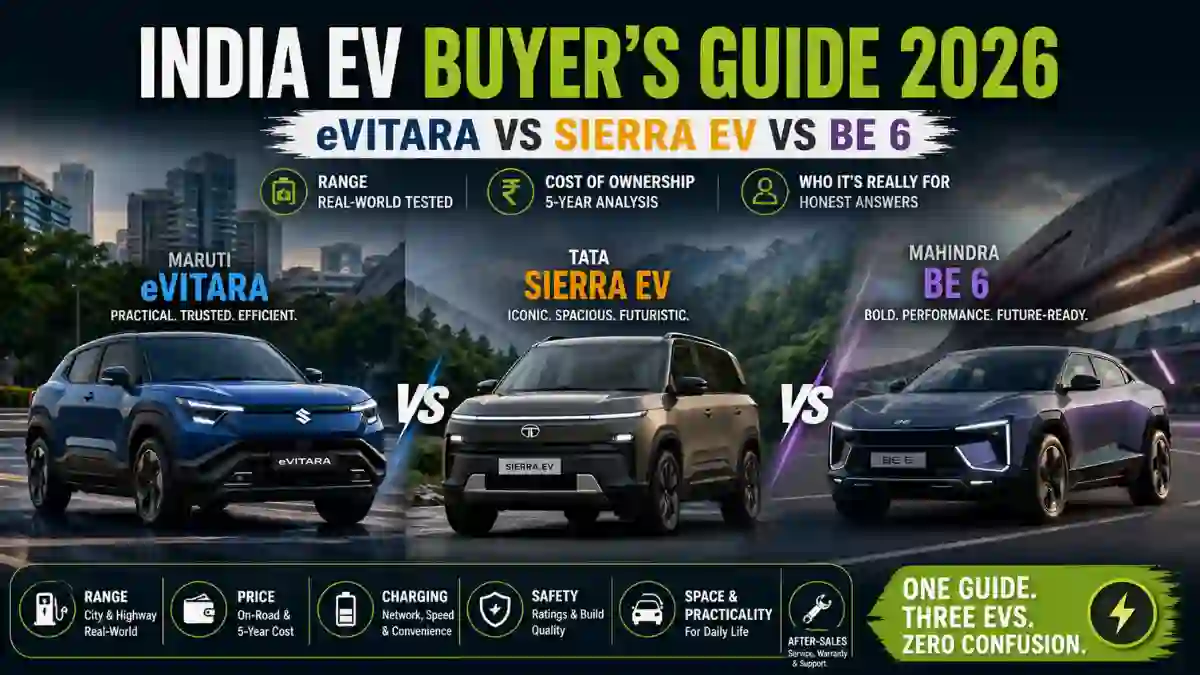
- Maruti eVitara — Best for first-time EV buyers who want Maruti service network and a trusted brand name.
- Tata Sierra EV — Best for nostalgia-meets-practicality buyers who prioritize cabin space, design heritage, and Tata charging ecosystem.
- Mahindra BE 6 — Best for tech-first drivers who want the longest real-world range, premium cabin experience, and don't mind paying more for performance.
What Changed in India EV Market in 2026
A year ago, the EV conversation in India was still dominated by Tata near-monopoly and a few early Mahindra entries. That landscape has shifted dramatically. Maruti Suzuki — the brand that sells one in every three cars in India — has finally entered the electric space with the eVitara, built on a Suzuki-Toyota joint platform. Tata revived the legendary Sierra nameplate as an electric SUV. And Mahindra doubled down on its "Born Electric" lineup with the BE 6, a vehicle that genuinely challenges global standards for its price bracket.
These aren't incremental upgrades. Each car represents a fundamentally different bet on what Indian EV buyers actually want in 2026.
The Platform Question Nobody Is Asking
Here something most comparisons skip: all three cars sit on different architectures, and that matters more than spec sheets suggest. The eVitara shares its platform with the Toyota Urban Cruiser EV — a dual-brand strategy that ensures strong parts availability and cross-brand service compatibility. The Sierra EV rides on Tata gen-2 EV platform (the same family as the Curvv EV). And the BE 6 sits on Mahindra bespoke INGLO platform, engineered specifically for electric vehicles with a skateboard-style battery layout.
Dedicated EV platforms generally deliver better weight distribution, more cabin space, and longer-term software updatability. The BE 6 has an edge here — but it also means fewer legacy service precedents if something goes wrong.
India EV Buyer Guide 2026: Full Spec Comparison
| Feature | Maruti eVitara | Tata Sierra EV | Mahindra BE 6 |
|---|---|---|---|
| Expected Price Range | ₹17–23 L | ₹22–28 L | ₹18.9–26.9 L |
| Battery Options | 49 kWh / 61 kWh | 60 kWh / 69 kWh | 59 kWh / 79 kWh |
| Claimed ARAI Range | ~500 km (61 kWh) | ~480 km (69 kWh) | ~682 km (79 kWh) |
| Real-World Range (est.) | ~370–400 km | ~350–380 km | ~470–510 km |
| Fast Charging (DC) | 50 kW | 100 kW | 175 kW |
| 0–100 km/h (top variant) | ~8.5 sec | ~8.0 sec | ~6.7 sec |
| Segment | Compact SUV | Mid SUV | Mid-Premium SUV |
| Drive Options | FWD / AWD | FWD / AWD | RWD / AWD |
| Service Network | 3,500+ outlets | ~1,500 outlets | ~900 outlets |
| OTA Software Updates | Partial | Yes | Full-stack OTA |
Note: Prices and specs are based on available launch data and may vary by variant and state-level incentives. Always verify with your local dealership.
📎 Related: Best EV Charging Networks in India 2026
Real-World Range vs ARAI Claims: The Truth Indian Buyers Need
Every Indian EV buyer has heard the horror stories — someone bought a car promising 450 km of range and got 280 km on the highway in summer. This is the single most important thing to calibrate before you sign a cheque.
A realistic rule of thumb: expect 65–75% of the ARAI-certified range in Indian driving conditions — particularly in cities like Delhi or Bengaluru with frequent stop-and-go traffic, AC running at full blast, and ambient temperatures above 35°C.
What This Means for Each Car
The Mahindra BE 6 79 kWh pack is the clear winner on real-world range. Even at 68% efficiency (a conservative Indian urban estimate), you're looking at roughly 460–470 km — making it the only car in this trio that genuinely eliminates range anxiety for long intercity runs like Mumbai–Pune or Delhi–Jaipur in a single charge.
The Tata Sierra EV and Maruti eVitara both perform reasonably for urban daily driving. If your daily commute is under 60 km and you have access to home charging, either car will comfortably handle a full week on a single overnight charge.
"Range anxiety in India isn't just about battery size — it about trust. Buyers want to know the car they're buying will perform in Rajasthan in May, not just on a controlled track in October." — Industry analyst perspective, reflected in 2025 SMEV consumer survey data
Total Cost of Ownership: Where the Real Savings Hide
Sticker price is almost irrelevant when evaluating electric vehicles. What matters is what you'll spend over five years. And here, the comparison flips in interesting ways.
The Charging Cost Equation
Charging at home on a standard 7.2 kW AC wallbox costs roughly ₹7–9 per unit in most Indian metros. Filling a 60 kWh battery from near-empty costs approximately ₹420–540. Compare that to a petrol-equivalent SUV consuming ₹2,500–3,000 worth of fuel for the same distance. Over 15,000 km a year, the savings can reach ₹40,000–₹60,000 annually — before factoring in reduced servicing costs.
Service and Maintenance Reality
This is where Maruti flips the script entirely. Despite not having the most impressive specs, the eVitara has access to a 3,500+ service touchpoint network — a number that no EV rival comes close to matching. In Tier 2 and Tier 3 cities, this is not a minor convenience. It can be the difference between a stranded vehicle and a same-day service visit.
Mahindra BE 6 has a strong warranty package and growing service centres, but its INGLO platform is new — which means service technicians are still ramping up training. Early adopters may face longer turnaround times on complex repairs.
⚡ Quick Tips Before You Buy Any of These EVs
- Always test-drive in your actual city traffic, not on a highway stretch near the showroom.
- Ask specifically about DC fast charger compatibility and real charging speeds — not just the port type.
- Check your state EV subsidy: Delhi, Maharashtra, and Gujarat offer significant incentives that can cut effective price by ₹1.5–2.5 L.
- Verify home wiring capacity before buying — a 7.2 kW wallbox needs a dedicated 32A line.
- Ask about battery warranty terms: look for at least 8 years / 1.6 lakh km coverage with capacity retention clauses.
📎 Related: How to Claim EV Subsidies in India — State-by-State Guide
Contrarian Take: The Car Most Reviewers Are Underrating
Every review you'll read this year will crown the Mahindra BE 6 — and for good reason. But here the view that being missed: the Tata Sierra EV may be the most emotionally intelligent product launch of 2026.
Reviving a nameplate that defined Indian automotive aspiration in the 1990s is not nostalgia for its own sake. It a deliberate targeting of a specific buyer: the 40–55-year-old professional who has disposable income, wants an SUV with genuine road presence, cares about cabin quality, and trusts Tata expanding EV infrastructure. The Sierra EV boxy, upright silhouette in a sea of swooping crossovers is a statement. And statements sell, especially in the premium SUV segment.
Meanwhile, the eVitara is quietly building the case that affordability + trust + availability is an unbeatable combination — especially outside the top 8 metros where charging infrastructure is still sparse and service reliability is paramount.
Common Mistakes Indian EV Buyers Make (and How to Avoid Them)
🚫 Mistakes to Avoid
- Buying on ARAI range alone. The claimed figure is measured under ideal conditions — always apply the 65–75% real-world adjustment.
- Ignoring charging infrastructure near your home. An EV without reliable home or workplace charging is an expensive inconvenience.
- Dismissing the service network. Spec-for-spec comparisons miss the reality of after-sales support, especially for buyers outside major cities.
- Overlooking resale value data. EV resale is still maturing in India — check what 2022–2023 EVs are selling for secondhand before committing.
- Not accounting for the charger installation cost. A certified 7.2 kW home charger with installation adds ₹25,000–₹40,000 to your real upfront cost.
Who Should Buy Which Car: The Framework
Rather than giving you a single "winner," here a practical decision framework based on buyer profile — because no single EV is right for every buyer in India diverse market.
For the Practical First-Timer
You want to go electric but you're not a tech enthusiast. You value a brand you trust, service anywhere in India, and a sensible price. You drive mostly in the city with occasional highway runs.
For the Design-Driven Family Buyer
You want a distinctive SUV with genuine cabin room, you're already in Tata charging ecosystem, and the Sierra heritage resonates with you. Weekend highway runs are part of your lifestyle.
For the Tech-Forward Premium Buyer
Range anxiety is your biggest EV concern. You want the best real-world numbers, the fastest charging, the most sophisticated software, and you're willing to pay a premium for all of it.
The Bottom Line
India 2026 EV moment is genuinely exciting — and genuinely complex. This India EV buyer guide exists because the right answer is different depending on where you live, how you drive, and what you value. The Mahindra BE 6 wins on numbers. The Maruti eVitara wins on accessibility. The Tata Sierra EV wins on soul.
Don't buy the car the internet tells you to buy. Test-drive all three, run them in your city, check your state subsidies, and make the decision with your own data. The good news: for the first time in India EV history, any of these three choices is a genuinely good one.
Leave a comment
Share a quick thought about this story.
Thanks for sharing your view. It is ready for review.
Please try again in a moment.