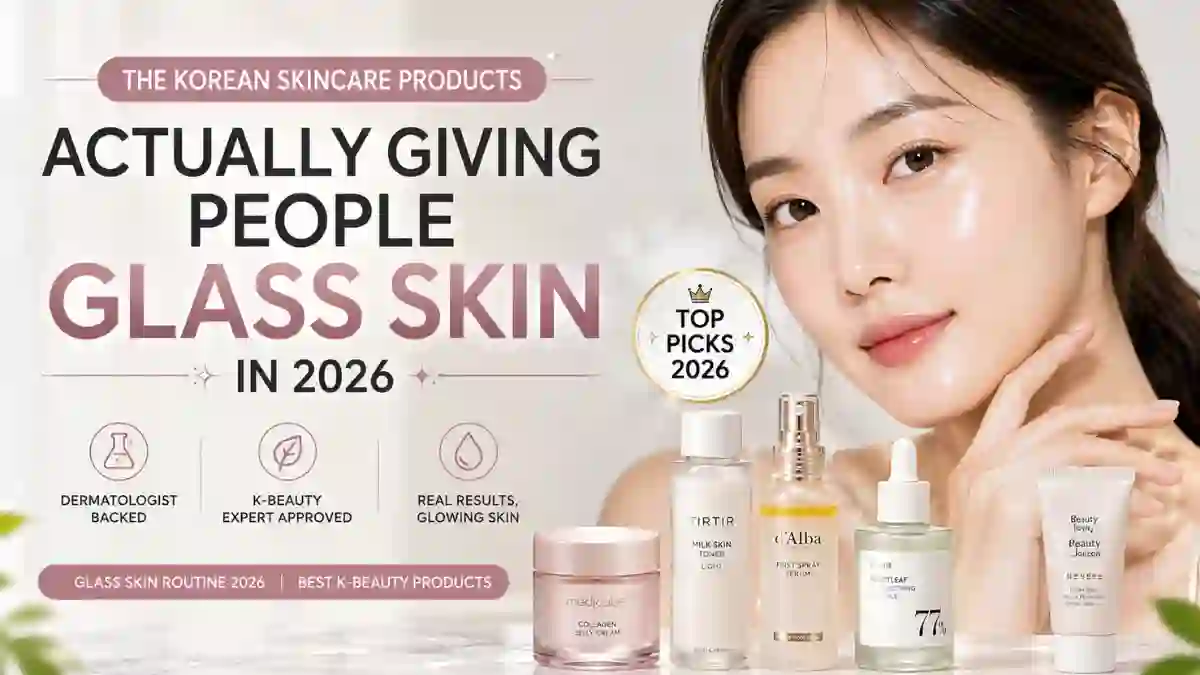
Everyone promises glass skin. These products actually deliver it — without the 12-step overwhelm or the inflated price tags.
3 Alternative Headlines
- I Tried Every Viral K-Beauty Product in 2026 — These Are the Only Ones Worth It
- What Changed in K-Beauty This Year (And Why Glass Skin Is Now Actually Achievable)
- Most People Are Doing the Glass Skin Routine Wrong — Here's What Experts Say Instead
Here's something the beauty industry won't tell you: glass skin isn't a product. It's a skin condition — one that Korean dermatologists have been engineering with disciplined, ingredient-conscious routines for decades. In 2026, the global K-beauty market is projected to surpass $21 billion, yet most Western shoppers still misunderstand what Korean skincare for glass skin actually requires.
Glass skin — that mirror-like, translucent, almost wet-looking complexion — comes down to three biological factors: maximum hydration at every skin layer, a healthy skin barrier that reflects light evenly, and consistently low inflammation. The right Korean skincare products address all three, in the right order, with the right formulations.
This guide cuts through the hype. Whether you're new to K-beauty or already drowning in essence bottles, you'll find exactly which products are moving the needle in 2026, why they work scientifically, and how to use them without wasting time or money.
Quick Answer — Featured Snippet
Glass skin is achieved through layered hydration, barrier repair, and low inflammation. The essential Korean skincare products for glass skin in 2026 include:
- A low-pH cleanser (pH 4.5–5.5) to preserve the acid mantle
- An exfoliating toner with BHA or PHA 1–2× per week
- A fermented essence (like galactomyces or bifida) for deep hydration and glow
- A peptide-rich serum or ampoule for skin firmness and bounce
- A ceramide and hyaluronic acid moisturizer to seal the barrier
- SPF 50+ sunscreen — the single most important glass-skin product you own
What Glass Skin Actually Means (And Why Most Routines Miss the Point)
The term "glass skin" was popularized by South Korean beauty blogger Ellie Choi in 2017, but the concept has existed in Korean skincare culture for much longer. In Korean, the closest phrase is chok chok — a texture that's dewy, plump, and almost sticky with moisture. True glass skin isn't matte, and it's not shiny. It's luminous.
The reason most people chase glass skin unsuccessfully is a fundamental misunderstanding: they focus on surface glow when the work happens below the surface. Dehydration creates microlines and uneven texture that no highlighter can fix. Chronic inflammation (often from harsh cleansers, over-exfoliation, or fragrance-heavy products) disrupts melanin production and leaves the skin dull and reactive.
The Glass Skin Formula
Think of glass skin as the result of three simultaneous conditions: hydration stacking (delivering water to all layers of the epidermis), barrier integrity (preventing that water from escaping), and cellular turnover (removing dead cells that scatter light unevenly). Korean skincare's genius is that it addresses all three without sacrificing any one for the other.
of dermatologists in a 2025 survey named compromised skin barrier as the primary reason patients fail to achieve a healthy, glass-like complexion.
Best Korean Skincare Products for Glass Skin in 2026
These aren't just popular picks — each one was selected based on formulation quality, clinical backing, and consistent results across different skin types. The Korean skincare market rewards efficacy over marketing, which is exactly why it keeps outperforming Western counterparts.
Step 1: Cleansers
COSRX Low pH Good Morning Gel Cleanser
At pH 5.0, this BHA-infused gel cleanser removes impurities without stripping the acid mantle — the invisible protective film that keeps skin barrier-strong and less reactive.
Why it works: Most Western cleansers sit between pH 7–9. That's alkaline enough to disrupt the microbiome and trigger compensatory oil production. This doesn't.
Banila Co Clean It Zero Cleansing Balm
The double-cleanse method — oil-based first, water-based second — is foundational to K-beauty. This balm melts SPF and makeup instantly without tugging, which protects collagen fibers in the long run.
Why it works: Mechanical scrubbing and repeated tugging accelerates skin laxity over years. A balm cleanser does the heavy lifting gently.
Step 2: Toning and Exfoliation
Some By Mi AHA BHA PHA 30 Days Miracle Toner
A gentle triple-acid toner that resurfaces dead skin cells to reveal the fresh, light-reflecting layer underneath. PHA is especially valuable for sensitive skin — it exfoliates at the surface without penetrating deeply enough to irritate.
Why it works: Regular, moderate exfoliation is the fastest route to glass skin because light bounces off smooth surfaces. But more is not better — once or twice a week is optimal for most skin types.
Step 3: Essences and Serums
SK-II Facial Treatment Essence (Galactomyces 90%)
The legendary "Miracle Water" remains the gold standard in K-beauty for a reason. Galactomyces ferment filtrate — a byproduct of sake fermentation — delivers a concentrated cocktail of amino acids, vitamins, and minerals that visibly improve skin texture in 4–6 weeks.
Why it works: Fermented ingredients are broken into smaller molecular weights that penetrate more effectively than raw extracts. The result is deeper hydration and accelerated cellular renewal.
MISSHA Time Revolution The First Treatment Essence
A more accessible alternative to SK-II, packed with bifida ferment lysate — a probiotic-derived ingredient that strengthens the skin's microbiome. The skin microbiome is now understood to be as critical as the barrier itself for maintaining clear, even-toned skin.
Why it works: Research from Seoul National University (2024) suggests bifida ferment lysate reduces inflammatory markers and improves ceramide synthesis — both essential for glass skin.
Step 4: Moisturizers
Dr. Jart+ Cicapair Tiger Grass Cream
Centella asiatica (cica) has been used in Korean traditional medicine for centuries. In 2026, it's the ingredient of the moment because dermatologists now understand exactly how madecassoside — cica's key compound — accelerates wound healing, reduces redness, and boosts collagen synthesis.
Why it works: Skin that isn't constantly fighting inflammation can devote energy to repair and renewal. This moisturizer is effectively putting your skin in recovery mode every night.
Anua Heartleaf Quercetinol Pore Tightening Sunscreen SPF 50+
Korean sunscreens consistently outperform Western formulas on texture and elegance. This one layers invisibly, doesn't pill under makeup, and includes skin-calming quercetinol. UV damage is the single largest contributor to skin dullness, uneven tone, and barrier breakdown.
Why it works: If you do nothing else on this list, wear SPF. UV radiation degrades collagen, causes hyperpigmentation, and undoes every other step of your routine over time.
The H.B.R. Framework for Glass Skin
After years of testing Korean skincare routines across hundreds of skin types, a simple three-part framework explains every successful glass skin transformation: Hydrate. Build. Reflect.
Layer lightweight hydrating products — toner, essence, serum — from thinnest to thickest consistency. Each layer amplifies the one beneath it.
Strengthen the barrier with ceramides, peptides, and fatty acids. The barrier holds all that hydration in and keeps environmental aggressors out.
Use exfoliation (1–2× weekly) and SPF (daily) to maintain the smooth, even surface from which light bounces cleanly. This is the visible "glass" effect.
The key insight of H.B.R. is that you can't skip to Reflect. Exfoliation on a dehydrated, compromised barrier just creates irritation. The hydrating and building steps create the canvas; exfoliation and protection reveal the masterpiece.
Common Mistakes That Are Ruining Your Korean Skincare Routine
More products don't equal better results. In fact, the most common glass-skin saboteurs are things people add to their routine thinking they're helping.
Mistakes to Avoid
- Over-exfoliating. Using acid toners daily is the fastest way to strip the acid mantle, spike inflammation, and create the opposite of glass skin. Limit to twice a week maximum.
- Mixing actives without knowledge. Retinol + AHA + vitamin C in the same routine creates unnecessary irritation. Separate them by morning and evening, or by day.
- Skipping SPF. No glass-skin routine compensates for daily UV damage. Sunscreen is step zero, not optional.
- Waiting for skin to feel dry before moisturizing. Apply moisturizer to damp skin — it seals in the water that's already there. Dry skin absorbs less product and benefits less from it.
- Buying too many products at once. Introducing multiple new products simultaneously makes it impossible to identify what's helping or causing a reaction. Add one product every 2 weeks.
The Contrarian Truth About Glass Skin
The best glass-skin routine is the one with the fewest steps you can actually stick to consistently. A four-product routine done daily beats a twelve-product routine done haphazardly.
— Dr. Hana Kim, Dermatologist, Seoul, interviewed for Allure Korea, 2025
This is the most counterintuitive insight in K-beauty: restraint beats maximalism. The aesthetic of extensive Korean skincare routines can mislead you into thinking more steps equals better skin. In practice, skin cells regenerate on a 28–40 day cycle regardless. What you're influencing is the quality of that renewal — and you don't need 12 products to do it effectively.
What Changed in 2026 — And Why Glass Skin Is More Achievable Than Ever
Two significant shifts in the K-beauty industry are making glass skin more attainable for more people in 2026.
First, biofermentation technology has matured to the point where brands like MISSHA, Laneige, and Innisfree can produce fermented extracts at scale without sacrificing potency. This means the galactomyces and bifida ferment formulas that were once exclusive to luxury products are now accessible in mid-range lines.
Second, the understanding of the skin microbiome has completely reframed K-beauty formulation. Instead of fighting bacteria and treating skin like an enemy to be sanitized, 2026 formulations are designed to feed and strengthen the skin's native microbial ecosystem. Prebiotics (found in oat extracts, inulin, and fermented ingredients) are now appearing across entire product ranges — not just as a marketing footnote.
Quick Tips for Glass Skin — Optimized for Search
- Cleanse with a pH-balanced gel cleanser morning and night.
- Apply toner or essence immediately after cleansing, while skin is still slightly damp.
- Layer from lightest to heaviest consistency: toner → essence → serum → moisturizer.
- Use a gentle acid exfoliant (BHA, PHA) 1–2 times per week, never more.
- Apply SPF 50+ every single morning, regardless of weather or plans.
- Introduce new products one at a time, spaced 2 weeks apart.
- Give any new routine 8–12 weeks before evaluating results — that's one full skin cycle.
Expert Insight: What Korean Dermatologists Do Differently
Korean dermatology clinics don't just recommend products — they prescribe lifestyle alongside skincare. Hydration from the inside (adequate water, foods rich in omega-3 fatty acids, and limiting alcohol) directly affects skin plumpness. Sleep deprivation elevates cortisol, which breaks down collagen and heightens skin sensitivity.
But the most underrated Korean skincare habit isn't a product at all — it's consistency over intensity. Korean skincare philosophy, influenced by Confucian ideas of long-term discipline, treats the skin as something you tend daily, not fix occasionally. Western skincare culture often chases dramatic transformations; Korean skincare culture chases the maintenance of healthy skin from youth.
That's why glass skin isn't a 30-day challenge. It's an ongoing commitment to never letting the barrier get too disrupted, the skin too dry, or the sun damage accumulate.
Your Glass Skin Journey Starts With One Good Decision
Korean skincare for glass skin isn't magic — it's science applied consistently. The products listed here work because they're built around how skin actually functions: its pH, its barrier, its microbiome, its regeneration cycle.
You don't need to buy all seven products tomorrow. Start with the cleanser and the SPF. Add an essence. Give it three months. The data will be written on your face.
Glass skin isn't for people with naturally perfect complexions. It's the result of treating your skin like it deserves care — every single day, with products that respect its biology. In 2026, you have better tools for that than ever before. The only thing left is to use them.
Ready to Build Your Glass Skin Routine?
Start small, stay consistent, and remember: every glass-skin transformation you've admired was built one routine at a time.
Leave a comment
Share a quick thought about this story.
Thanks for sharing your view. It is ready for review.
Please try again in a moment.