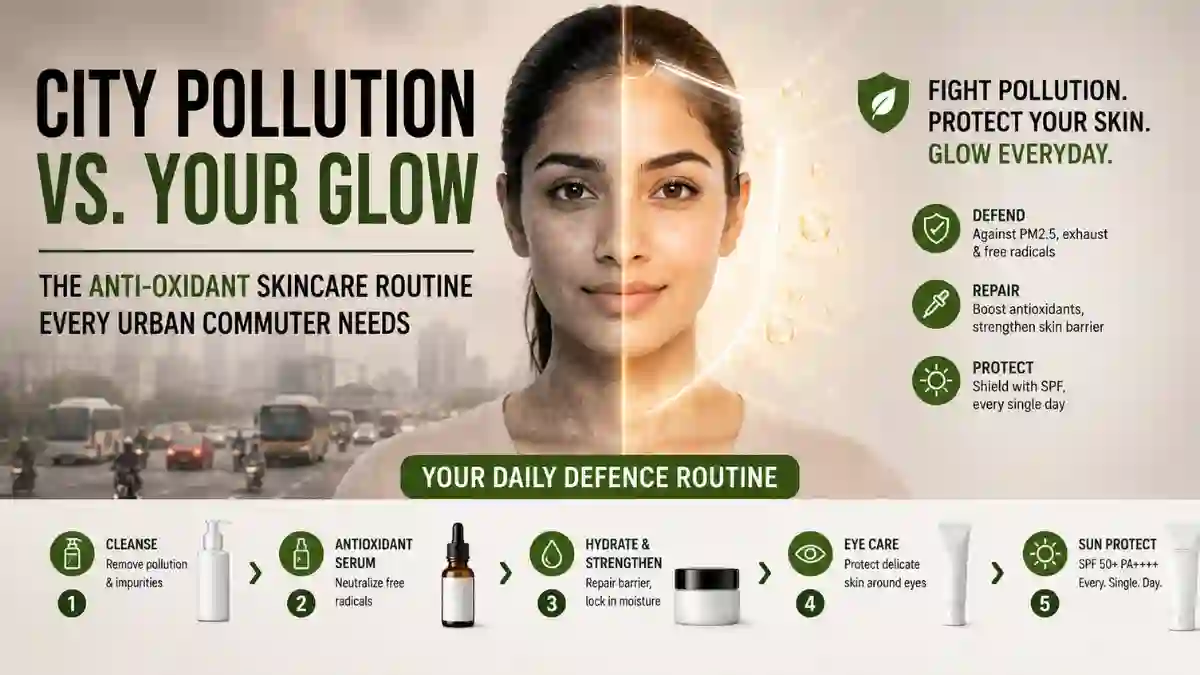
Delhi PM2.5. Mumbai exhaust particulates. Bengaluru's construction dust. Your skin is absorbing all of it — 24 hours a day, 5 days a week. Here is how to fight back.
🔥 Also trending
- My Skin Was Aging Faster in the Office Than on Holiday — City Pollution Was the Reason
- The One Serum Change That Transformed My Metro Commute Skin in 30 Days
- What 2026 Dermatology Research Says About Urban Air and Your Skin Barrier — It's Worse Than We Thought
If you commute in any major Indian city, your skin is working harder than you realise. Not from stress alone — from the air itself. The cocktail of PM2.5 particulates, polycyclic aromatic hydrocarbons from vehicle exhaust, nitrogen dioxide from traffic, and heavy metal particles from brake dust that characterises Indian urban air doesn't stay outside your body. It lands on your skin, lodges in pores, generates free radicals, and initiates a cascade of oxidative damage that, compounded over years, shows up as premature lines, hyperpigmentation, dullness, and a compromised skin barrier that gets sensitised and reactive seemingly out of nowhere.
The research is unambiguous: a 2023 study in the Journal of Investigative Dermatology found that urban residents show measurably higher levels of skin oxidative stress markers than rural controls, with dark spots forming up to 20% faster in high-pollution environments. A separate analysis of Delhi, Mumbai, and Chennai dermatology patients found pollution-related skin concerns now account for over 35% of clinical visits — a number that was near zero in records from a decade earlier.
The antioxidant skincare routine for urban commuters in this guide is built around the specific damage mechanisms that city air causes — not generic "pollution protection" marketing. Seven targeted steps, morning and evening variants, ingredient science explained without jargon, and the specific mistakes that render even expensive routines ineffective against pollution-induced oxidative stress.
How Bad Is Your City's Air — And What It's Doing to Your Skin
Understanding what your skin is up against is the first step to building a routine that actually responds to it. These are approximate annual average AQI figures for India's major metros in 2025–26 — and what each pollution level means for skin health specifically.
Even "moderate" AQI — which most of us would consider acceptable air — generates enough free radical activity on skin to deplete antioxidant reserves within 2–3 hours of exposure without topical antioxidant supplementation. At Delhi's typical AQI of 150–200, this depletion happens in under 90 minutes. The skin is then running on an empty antioxidant tank for the remainder of the day, leaving oxidative damage to accumulate unchecked.
The Pollution–Skin Damage Chain: What's Actually Happening
Four mechanisms — all addressable with the right antioxidant routine.
🧴 Quick Answer: The 7-Step Anti-Oxidant Routine for Urban Commuters
- Double Cleanse (PM only) — Remove pollution particles and SPF before anything else works
- pH-Balanced Gel Cleanser (AM) — Clean without stripping the barrier you're about to protect
- Vitamin C Serum (AM) — The antioxidant anchor that neutralises free radicals before they cascade
- Niacinamide Serum (AM + PM) — Barrier repair, sebum control, pigmentation prevention — does three jobs
- Ferulic Acid + Vitamin E Booster (AM) — Doubles Vitamin C effectiveness; the most underused pollution-protection ingredient
- Barrier-Repair Moisturiser with Ceramides (AM + PM) — Seals active ingredients and rebuilds the pollution-damaged lipid barrier
- Mineral SPF 50+ PA++++ (AM) — Completes the antioxidant shield; without this, steps 1–6 are working at half capacity
The Full Anti-Oxidant Routine — Step by Step
Double Cleanse — The Non-Negotiable First Move
No antioxidant serum penetrates skin that still has a film of PM2.5 and sunscreen sitting on it
Double cleansing exists specifically for urban skin. The first cleanse — an oil cleanser or micellar water — dissolves oil-based debris: SPF filters, sebum, exhaust particulates, and the thin pollution film that settles on skin throughout the day. The second cleanse — a gentle gel or foam — removes water-soluble residue and leaves the skin pH-balanced and genuinely clean.
Skipping to a single cleanser is the most common reason antioxidant routines underperform. A standard gel cleanser on skin coated with day-old SPF, pollution residue, and sebum clears the top layer but leaves a microscopic film that blocks ingredient penetration. Vitamin C serum applied over that film is largely wasted. Double cleansing at night is the single highest-leverage change an urban commuter can make to their routine.
India-specific note: In Mumbai's high humidity, heavy oil cleansers can leave a greasy residue that requires aggressive second-cleansing. A lightweight micellar oil or biphasic micellar water performs the first cleanse step without residue issues in humid conditions.
pH-Balanced Gel Cleanser (Morning)
Your skin doesn't need a deep cleanse in the morning — it needs the right pH to absorb what comes next
Morning cleansing for urban commuters is a contested topic in skincare. Some dermatologists advocate water-only rinses to preserve the overnight barrier repair that happens during sleep. The consensus position for high-pollution environments: a gentle pH-balanced gel cleanser at 5.5–6.0 removes overnight sebum and any remaining residue without stripping the acid mantle that keeps the skin barrier functional.
Avoid anything foaming or fragrant in the morning — these either strip barrier lipids or add unnecessary sensitising variables before a day of pollution exposure. Look for cleansers with short, simple ingredient lists, no SLS or SLES, and a stated pH. In 2026, Indian brands including Minimalist, Foxtale, and Dot & Key have introduced pH-tested, fragrance-free gel cleansers at accessible price points (₹300–₹500) that meet this standard.
Vitamin C Serum (L-Ascorbic Acid or Stable Derivative)
The most evidence-backed topical antioxidant for pollution protection — applied correctly, it changes everything
Vitamin C is the primary weapon in an anti-pollution skincare routine — and it is frequently used incorrectly. The correct form, concentration, and application window determine whether it actually neutralises free radicals or just sits ineffectively on the surface. L-Ascorbic Acid (LAA) at 10–20% concentration is the gold standard — the only form with substantial clinical evidence for both antioxidant protection and collagen synthesis stimulation. At 10%, it's effective and generally tolerated. At 20%, it's maximally effective but can cause initial tingling in sensitive skin.
Vitamin C serums must be applied to clean, dry skin before any other serum or moisturiser — the absorption window is the 30–60 seconds immediately after cleansing when the skin is still slightly warm and the product can penetrate most efficiently. Apply in the morning only: L-Ascorbic Acid is photosensitive and degrades in light, meaning PM application doesn't deliver the same antioxidant loading that AM application does before sun and pollution exposure.
For pollution-driven pigmentation specifically — the AhR-activated dark spots common in Delhi and Kolkata commuters — Vitamin C's inhibition of tyrosinase (the enzyme that triggers melanin production) makes it the single most targeted treatment available without a prescription.
The oxidation test: Fresh Vitamin C serum is clear to slightly yellow. An orange or brown serum has oxidised and provides no antioxidant benefit — it's still applying product to your face but doing nothing protective. Discard and replace. Store in a dark, cool place and replace after 3 months of opening regardless of colour.
Ferulic Acid + Vitamin E Booster
This combination doubles the antioxidant protection of Vitamin C. Most urban commuters have never heard of it.
Ferulic acid is a plant-derived antioxidant that does something no standalone ingredient can: it doubles the photoprotective capacity of Vitamins C and E when combined with them, as demonstrated in a landmark 2005 study by Pinnell et al. that has been replicated multiple times since. It works by stabilising L-Ascorbic Acid's molecular structure, extending its effective lifespan on skin from 2–4 hours to 8–12 hours — meaning your morning Vitamin C application remains protective through an entire commute, workday, and commute back.
For the urban commuter, this synergy is particularly valuable because pollution free radical exposure is continuous rather than intermittent. A Vitamin C serum without ferulic acid depletes in the first few hours of city exposure. A combination serum with ferulic acid + Vitamin E remains active. The practical result: a C + E + Ferulic formulation provides approximately 8x more antioxidant protection than Vitamin C alone.
Many 2026 Vitamin C serums now include ferulic acid in the formulation — look for it listed alongside Vitamin E (tocopherol). If yours doesn't include it, consider layering a separate ferulic acid serum or switching to a combination product. The most referenced formulation globally is SkinCeuticals CE Ferulic — at ₹15,000+ per bottle, it's the clinical gold standard; Indian alternatives from Minimalist and The Derma Co now replicate the core C + E + Ferulic matrix at ₹500–₹800.
Niacinamide Serum (Vitamin B3)
Barrier repair, pore tightening, and pigmentation prevention in one — the urban commuter's most efficient ingredient
Niacinamide (Vitamin B3) is the most useful single ingredient for pollution-damaged urban skin because it addresses three distinct damage pathways simultaneously. First: it repairs the skin barrier by upregulating ceramide production — reversing the barrier disruption caused by chronic pollutant exposure. Second: at 5–10%, it inhibits the transfer of melanosomes from melanocytes to keratinocytes, preventing the AhR-triggered pigmentation that distinguishes pollution-driven dark spots from UV-driven ones. Third: it regulates sebum production, reducing the oily surface film that pollution particles adhere to more readily.
Niacinamide is one of the few skincare ingredients that can be used both morning and evening without photosensitivity concerns. At 5%, it's broadly tolerated. At 10%, it's maximally effective for pigmentation but can occasionally cause mild flushing in very sensitive skin. For the commute-specific concern of skin looking dull and grey by 4 PM, niacinamide's ability to improve overall skin texture and luminosity within 4–6 weeks of consistent use is one of the most reliably observed effects in the skincare literature.
Niacinamide + Vanity Mirror = Confident Pre-Meeting Skin
A consistent niacinamide routine visibly evens skin tone in 4–6 weeks — which is precisely what makes a no-makeup look achievable without heavy foundation. Consistent skin tone is the base that lets you walk into a meeting looking polished with minimal product. Pair this routine with a portable LED vanity mirror and 4 minutes in the car park.
Barrier-Repair Moisturiser with Ceramides + Peptides
The step that makes everything else stick — and rebuilds what pollution breaks down overnight
The moisturiser step in an anti-pollution routine isn't primarily about hydration — it's about occlusion and barrier reconstruction. Pollution damages the lipid matrix of the skin barrier (the combination of ceramides, fatty acids, and cholesterol that holds skin cells together and regulates what gets in and out). Chronic exposure depletes this matrix, leading to the tight, reactive, easily-irritated skin that urban commuters increasingly report after 3–5 years of city living.
A barrier-repair moisturiser contains: ceramides (NP, AP, EOP — look for at least two types) to directly replenish the depleted lipid matrix; peptides to stimulate collagen and elastin production; and humectants (hyaluronic acid, glycerin) to draw water into the skin before the occlusive ceramide layer seals it in. This combination addresses both the immediate damage (dehydration, sensitivity) and the cumulative damage (structural degradation) that pollution causes.
For Indian climate conditions: use a lighter gel-cream format in summer and monsoon months, a richer cream in the dry winter months of November–February. In high-humidity cities like Mumbai and Chennai year-round, a gel-ceramide hybrid prevents the heat-trapping that heavier creams cause in 30°C+ ambient temperatures.
Mineral SPF 50+ PA++++ (with Antioxidant Boosters)
Without SPF, your entire antioxidant routine is fighting at half capacity — UV accelerates every pollution damage pathway
SPF isn't optional in an anti-pollution routine — it's structural. UV radiation and pollution work synergistically on skin: UV degrades the collagen that pollution-generated free radicals have already weakened, and ozone (a common urban pollutant) photoreacts with UV light to create additional oxidative stress. An antioxidant-only routine without sun protection is managing the downstream damage of oxidative stress without blocking one of its primary amplifiers.
The 2026 standard for urban commuters: mineral SPF 50+ with PA++++ (broad-spectrum UVA protection, rated by the Japanese PA system) and ideally a formulation that includes additional antioxidants — many 2026 sunscreens now incorporate niacinamide, Vitamin E, or green tea extract into the base. The mineral formulation (zinc oxide or titanium dioxide) sits on the skin surface and doesn't react with pollutants the way some chemical filters can.
Reapply every 2 hours during outdoor exposure. For commuters who do this once at 8 AM and then sit indoors, a single morning application is sufficient with the antioxidant layers beneath doing the heavy lifting during air-conditioned office hours. For outdoor workers, construction-adjacent environments, or anyone spending extended time outside, reapplication is non-negotiable.
Your Complete AM and PM Routine at a Glance
Translate the seven steps into two practical sequences — each taking under 5 minutes when the products are right.
- Gentle pH gel cleanser — 60 seconds, lukewarm water
- Pat dry — don't rub (friction sensitises pollution-stressed skin)
- Vitamin C serum — 3–4 drops, press into damp skin
- Wait 60 seconds (oxidation window for LAA absorption)
- Niacinamide serum — layer over dry Vitamin C
- Ceramide moisturiser — seal active ingredients in
- Mineral SPF 50+ PA++++ — last step, generous quantity
- First cleanse — oil cleanser or micellar water (remove pollution + SPF)
- Second cleanse — gel cleanser to complete the clean
- Pat dry gently — skin is clean and receptive now
- Niacinamide serum — barrier support overnight
- Optional: retinol or AHA 2–3x/week (alternate nights)
- Ceramide moisturiser — heavier version at night if preferred
- Facial oil (optional) — squalane or rosehip for overnight barrier sealing
Antioxidant Ingredient Comparison — What Each One Does for Urban Skin
| Ingredient | Primary Function | Best Concentration | When to Apply | Pollution-Specific Benefit |
|---|---|---|---|---|
| Vitamin C (LAA) | Free radical neutralisation | 10–20% | AM only | Blocks tyrosinase → prevents pollution pigmentation |
| Ferulic Acid | Vit C / E stabiliser + multiplier | 0.5–1% | AM (with Vit C) | Extends Vit C protection from 2hrs → 8–12hrs |
| Niacinamide | Barrier repair + pigmentation prevention | 5–10% | AM + PM | Blocks AhR-triggered pollution pigmentation |
| Vitamin E (Tocopherol) | Lipid antioxidant, membrane protector | 0.5–1% (with Vit C) | AM (in combo serum) | Protects lipid-rich skin surface from oxidation |
| Resveratrol | Sirtuin activation, anti-inflammatory | 1% | PM preferred | Reduces cytokine inflammation from PM2.5 exposure |
| Green Tea (EGCG) | Polyphenol antioxidant, anti-inflammatory | Variable | AM + PM | PAH-specific antioxidant action from vehicle exhaust |
| Ceramides | Barrier lipid replacement | NP + AP + EOP types | AM + PM (moisturiser) | Directly replaces barrier lipids destroyed by pollutants |
"Urban pollution is now our third major skin ageing factor after UV and intrinsic ageing — and unlike the other two, most people don't even know it's happening to them. The antioxidant routine isn't a luxury add-on. For city commuters, it's genuinely corrective skincare." — Dr. Rashmi Shetty, dermatologist & author, Mumbai (Ra Skin & Aesthetics)
⚡ Quick Tips: Getting the Most From Your Anti-Pollution Routine
- Apply Vitamin C to skin that is damp but not soaking wet — the ideal window is 30–45 seconds after patting dry, when residual warmth assists absorption
- Wait 60–90 seconds between Vitamin C and niacinamide — applying them simultaneously can cause a mild niacin flush; layered with a brief wait, they work without conflict
- Your Vitamin C serum should look water-clear to very pale yellow. If it looks like orange juice, it's oxidised and providing zero antioxidant protection — discard it
- On high AQI days in Delhi or Kolkata (above 200), apply a thin second layer of SPF at noon if spending any time outdoors — pollution amplifies UV damage synergistically above this threshold
- Once a week, use a gentle AHA exfoliant (glycolic or mandelic acid at 5–8%) in the PM to clear the accumulated pollution-particle residue that builds up in pores over 7 days — this is different from daily cleansing and meaningfully improves active ingredient penetration the following day
- Jade rolling or gua sha after the PM moisturiser step can improve lymphatic drainage, which becomes sluggish in skin chronically inflamed by pollution exposure — it takes 90 seconds and measurably reduces morning puffiness over time
- Rinse your pillowcase every 3–4 days — it accumulates pollution residue from your skin overnight and reapplies it in your next sleep cycle, working against everything your routine is trying to do
❌ Anti-Pollution Routine Mistakes That Commuters Make Most Often
- Using an oxidised Vitamin C serum: The most expensive mistake on this list costs nothing to fix — check the colour, discard if orange-brown, and store replacements in the fridge. An oxidised Vitamin C provides no protection and may deposit pro-oxidant by-products on skin
- Skipping the double cleanse because it "takes too long": A PM routine without proper first-cleansing is one of the highest-consequence shortcuts in skincare. Every active ingredient you apply after a single cleanse is working at reduced penetration through a pollution-particle filter
- Applying SPF as the second step: SPF goes last in the AM routine — always. Applying it before serums and moisturiser means the filter is physically diluted and no longer provides rated protection. The sequence is: cleanser → Vitamin C → niacinamide → moisturiser → SPF. Never reversed
- Using the same heavy winter moisturiser year-round in Indian climate: A thick occlusive cream applied in Mumbai summer creates a heat-trapping layer that attracts pollution particles, causes congestion, and makes skin more reactive. Switch to gel-ceramide textures between March and October
- Neglecting the neck and hands: Pollution exposure is not limited to the face. The neck and backs of the hands receive equivalent environmental exposure and show premature ageing first — extend your Vitamin C and SPF application to these areas every morning
- Building a 12-step routine and abandoning it by week two: The seven-step routine above is the complete anti-pollution system. Resist the algorithm-driven impulse to add peptide toners, essence layers, and ampoules on top. Consistency with fewer effective steps beats inconsistency with more
Your City Is Working Against Your Skin.
Your Routine Is the Counterargument.
The antioxidant skincare routine for urban commuters isn't complicated. Seven steps, two sequences, five core ingredients. The science is clear on what works: Vitamin C neutralises free radicals, ferulic acid extends its protection, niacinamide repairs the barrier and prevents pigmentation, ceramides rebuild what pollution destroys, and mineral SPF prevents UV from amplifying all of the above. Used consistently, this routine produces measurable results within 6–8 weeks.
The city isn't going to get cleaner before your skin needs protection. Start this week — ideally tonight, with a double cleanse that removes everything today deposited on your face — and build from there.
Leave a comment
Share a quick thought about this story.
Thanks for sharing your view. It is ready for review.
Please try again in a moment.